
Direct Answer
A payment link, or pay by link, is a shareable web address that opens a hosted checkout page without website code. Merchants send that URL through email, messaging apps, or invoices so buyers pay by card, wallet, or bank rail.
Businesses separate single-use links that expire upon payment from reusable links for repeat buyers. Automated scheduled billing requires dedicated subscription tools. Effective cost depends on domestic versus international card rates, currency conversion, and local bank rails. Security requires Europay, Mastercard, and Visa (EMV) 3-D Secure version 2 (3DS2) checks, locked amounts, and payout reference IDs.
Disclosure: HaiPay publishes this guide and may benefit commercially if readers become merchants. Published rate illustrations explain pricing structure rather than a binding offer. Your signed commercial agreement governs final pricing, corridor availability, and settlement terms.
How Payment Links Work — One-Time, Reusable, Checkout, and Subscription Boundaries
Merchants create a payment request in a dashboard to generate a hosted checkout URL. Buyers pay via email, text message (SMS), WhatsApp, or Instagram and TikTok direct messages (DMs) without code or buyer accounts. Follow our walkthrough on how to create a payment link for parameter locks and channel QA.
Within HaiPay Payment Links, remote collection splits into two link objects across messaging, social commerce, online stores, and invoice workflows. A One-Time Payment Link expires immediately once paid, while a Recurring Payment Link stays active for repeat manual orders.
- Automated Scheduled Subscriptions: Recurring Payment Links wait for buyer clicks and never auto-debit stored cards. Use automated subscription billing for weekly, monthly, or annual cycles, smart retries, and card-updater refreshes.
- Hosted and Embedded Checkout: Graduate to hosted and embedded checkout for multi-item website carts, shipping, tax, and Address Verification Service (AVS) checks. Adyen Pay by Link rules bar links as a shop's sole checkout.
- Itemized Invoicing Workflows: Invoicing is a general billing workflow producing business-to-business (B2B) value-added tax (VAT) documents and Net-30 terms, not a standalone merchant payment product. Issue VAT invoices inside enterprise resource planning (ERP) tools with a purchase order (PO) number and embed a single-use link.
- Merchant Pay by Link vs. Consumer Link.com: Merchant payment links, called pay by link across the UK and Europe, collect remote sales. By contrast, Stripe Link.com is a separate consumer autofill wallet.
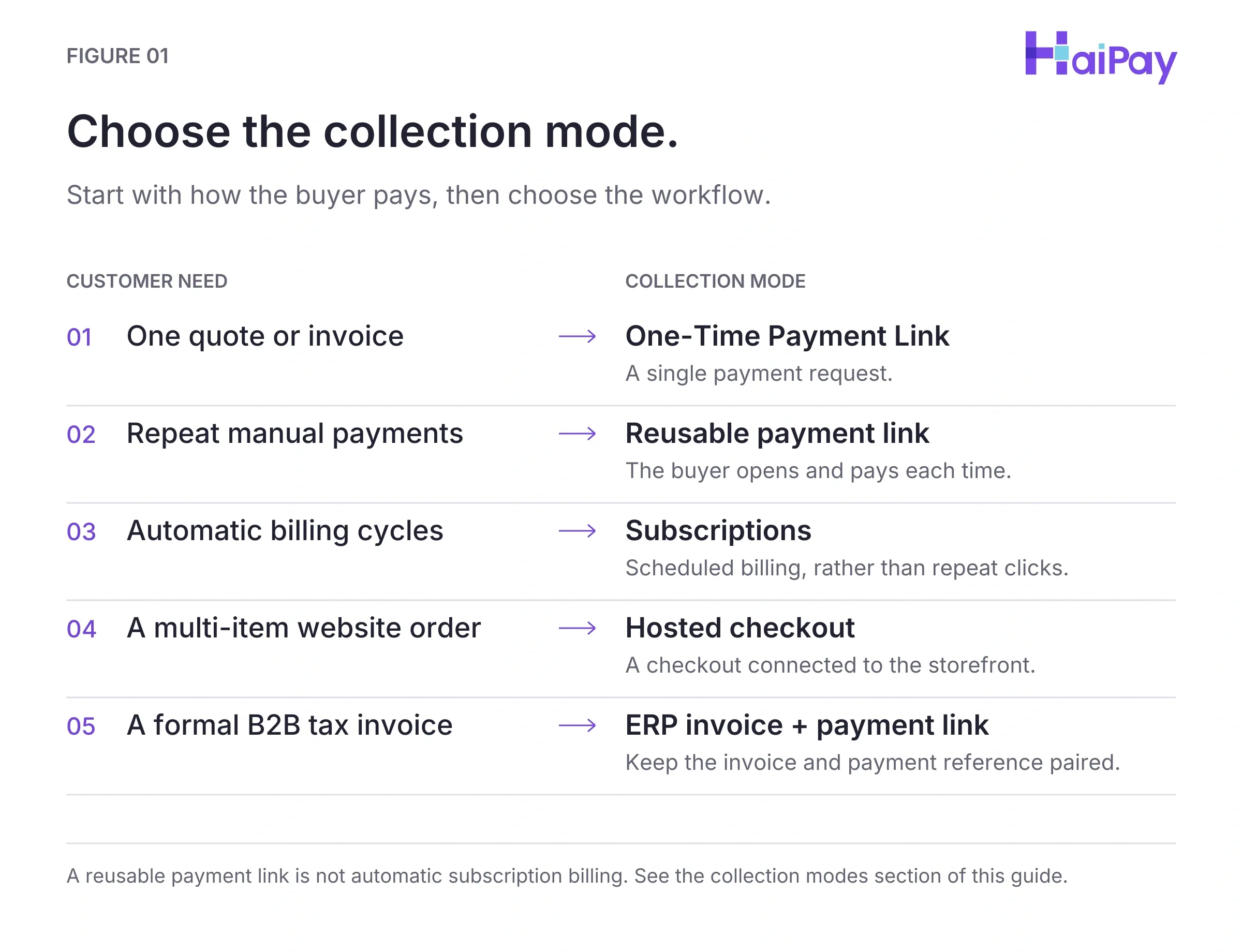
Figure 1: Choose the collection mode. Match the customer need to a one-time link, reusable manual-payment link, subscription, hosted checkout, or ERP invoice with a payment link. A reusable link does not automatically bill the customer. Open full-size diagram
Source: HaiPay Payment Links, Checkout, and Subscription Billing documentation; see the collection-mode discussion above.
Collection Mode | Trigger & Reuse Behavior | Channel & Code Scope | Ideal B2B / Commerce Fit | Wrong Fit / Failure Mode | HaiPay Route |
|---|---|---|---|---|---|
One-Time Payment Link | Single-use URL; becomes invalid immediately once customer completes payment | Email, SMS, WhatsApp, social DMs, embedded invoice URL; no code | Custom quotes, proforma deposits, single remote B2B or DM orders | Reusing as a static storefront Quick Response (QR) code fails after one scan | |
Recurring (Reusable) Payment Link | Stays active so returning buyers pay through the same URL manually | Messaging apps, VIP portals, repeat-order sheets; no code | Returning wholesale buyers reordering fixed packages ad hoc | Exposing open reusable links without velocity controls invites card-testing bots | |
Automated Scheduled Subscription | Merchant-initiated weekly, monthly, or annual cycles with AI retries | Hosted checkout or API mandate with automatic tokenized card updates | SaaS plans, retainers, free trials, and metered recurring contracts | Never substitute an Option 2 link when zero-touch scheduled debits are needed | |
Hosted & Embedded Checkout | Session-based cart checkout rendered on redirect or embedded components | Merchant website or app; multi-item cart, shipping, tax, AVS | Ecommerce catalogs and self-serve checkouts with variable basket items | Over-built for manual chat quotes; Adyen Pay by Link rules bar links as a shop's sole checkout | |
General Itemized Invoicing Workflow | Receivable PDF/ledger document created in ERP or accounting suite | Accounting system with invoice #, PO #, VAT text, Net-30 terms | B2B accounts payable requiring compliant tax invoices plus online pay link | Not a standalone HaiPay product; raw link receipts lack statutory VAT fields | ERP Invoice + One-Time Link |
Source: HaiPay, "Payment Links," "Checkout," and "Subscription Billing" (accessed 2026-11-17); Stripe Docs, "Payment Links" (accessed 2026-11-17); Adyen Docs, "Pay by Link" (accessed 2026-11-17).
Cross-Border Payment Link Fees, Foreign Exchange (FX) Spreads, and Settlement Timing
Headline card percentages understate total cost of ownership (TCO) on international sales. Finance leaders must audit five layers: card rates, FX spreads, refund or dispute fees, wires, and payout timing.
Published US-Entity Card, Local Payment Method, and FX Rate Structure
Providers quote Blended pricing, bundling fees into one rate, or Interchange++ (IC++). IC++ separates issuing-bank interchange fees, card-network scheme fees, and the acquiring bank (acquirer) markup.
For US merchants contracting through HaiPay's US entity, US-issued cards start at 2.5% + US$0.30. Non-US cards start at 4.0% + US$0.30, already including the +1.5% non-US surcharge (never add it twice). Setup and annual fees are US$0 with no monthly minimum. Final rates follow risk review in your written quote, excluding FX, refunds, disputes, wires, and taxes.
Across 40+ local payment method (LPM) markets covering 150+ local wallets, QR code payments, and bank transfers, HaiPay pricing starts from 1.5%. Indonesia's Quick Response Code Indonesian Standard (QRIS) starts from 1.2%, avoiding card cross-border surcharges. On the US card line, FX starts from 0.5% and runs up to 2.5% by pair when conversion occurs. Applicable local routes name Maybank for Malaysian ringgit (MYR) and DBS for Singapore dollars (SGD) to US dollars (USD).
Settlement Windows, Event Fees, and Monthly Benchmarks
Published event fees list US$0.30 per processed refund, US$20 per dispute, and US$15 per USD wire (recipient bears intermediary fees). Standard card settlement is typically T+5 calendar days (five days post-transaction), or T+7 for licensed forex firms. Underwriters may also set a rolling reserve—a temporary percentage holdback released on a schedule—in your quote.
LPMs can settle as fast as T+1 (one day after the transaction, per quote) in eight named markets: Indonesia, Vietnam, Thailand, the Philippines, India, Brazil, Mexico's real-time interbank rail (SPEI), and Bangladesh. In a US$50,000 monthly model (500 US$100 sales, 20% non-US cards, 20% FX), US-entity starting rates total from US$1,600.00 (from 3.20% effective), excluding wires and taxes. That mix costs US$1,850.00 (3.70% effective) at a 2.9% + US$0.30 + 1.5% international + 1% FX baseline.
On a US$1,500 B2B non-US card sale with FX, US-entity starting rates model from US$67.80 before wires, reserves, and taxes. By contrast, a local payment method starting from 1.5% models from US$22.50 (FX and local taxes itemized separately per quote). Review our published gateway pricing schedule, payment gateway fees breakdown, payment settlement timing guide, and merchant account rolling reserve guide.
Provider & Scope | Standard / Domestic Card Link Rate | Non-US Card Differential | Currency Conversion (FX) | Event Fees, Plan Minimums & Settlement |
|---|---|---|---|---|
HaiPay — US-Entity Card Baseline | From 2.5% + US$0.30 (US-issued cards; US entity after risk review; quote required) | From 4.0% + US$0.30 (already includes +1.5% surcharge; do not add twice) | From 0.5% (up to 2.5% by pair when conversion occurs on US card line) | US$0 setup/annual/min; US$0.30 refund; US$20 dispute; US$15 wire; Typically T+5 calendar days (T+7 forex); excludes taxes/reserves |
HaiPay — Local Payment Methods (40+ LPM Markets) | From 1.5% across 40+ LPM markets (Indonesia QRIS from 1.2% across 150+ local methods) | No card scheme cross-border surcharge (subject to quote & corridor review) | FX & local taxes itemized separately; Maybank (MYR) & DBS (SGD) named on applicable routes | Can settle as fast as T+1 in 8 named LPM markets (ID, VN, TH, PH, IN, BR, MX-SPEI, BD); schedule confirmed in quote |
Adyen — Pay by Link (Global USD Display) | $0.13 + Interchange+ + 0.60% (Visa/Mastercard USD display) | Scheme and regional interchange costs vary by card corridor | Quoted per commercial agreement | $0 monthly/setup fee; minimum monthly invoice applies by industry/model; 24h default expiry (70d max, 5 failed attempts) |
PayPal — US Payment Links (Nov 2026 Schedule) | 3.49% + 0.49 USD (PayPal/Venmo/Pay Later) or 2.99% + 0.49 USD (cards/Apple Pay) | +1.50% international commercial transaction fee | 4.00% paying in non-listing currency; 3.00% other conversions | 15.00 USD standard dispute fee (30.00 USD high-volume tier) on PayPal/guest checkouts; 20.00 USD card chargeback fee outside buyer PayPal account or guest checkout |
Square — US Payment Links | 3.3% + 30¢ ($0/mo per location Free) or 2.9% + 30¢ ($49/mo Plus or $149/mo Premium per location) | +1.5% additional fee for cards issued outside the United States | US pricing schedule shown in USD; no separate FX spread % table published | Invoice Automated Clearing House (ACH) bank transfer 1% ($1 min on Free; $1 min, $10 fee cap on Plus/Premium); Free tier avoids monthly subscription |
Stripe — US Standard Payment Links | 2.9% + 30¢ domestic cards (Payment Links included on standard pricing) | +1.5% international card fee | +1% if currency conversion is required | +0.4% ($2.00 cap) post-payment invoice PDF; $10.00/mo custom domain; $15 dispute received + $15 manual counter fee ($15 counter fee returned if won, retained if lost) |
Source: HaiPay, "HaiPay Homepage" (Typically T+5 / T+7 settlement & 150+ local methods), "Payment Links," "Pricing," "Credit Card Processing Fee Calculator" ($50,000 model), "Payment Gateway Fees," and "Cross-Border Payments" (non-binding schedule; competitors ordered alphabetically post-HaiPay without ranking); Stripe Pricing; PayPal US Merchant Fees (Updated Nov 4, 2026); Square US Pricing; Adyen Pricing & Pay by Link Docs (accessed 2026-11-17).
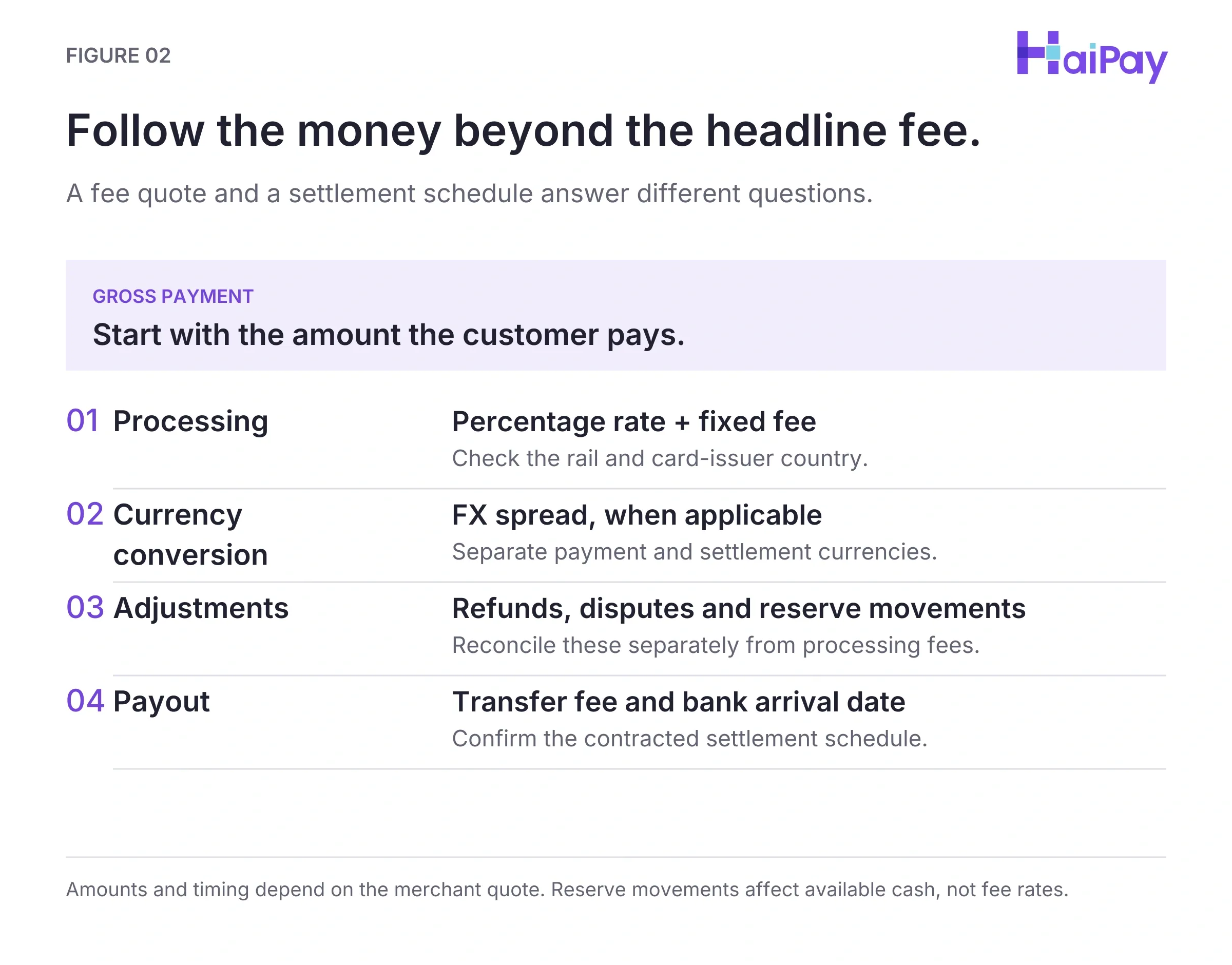
Figure 2: Follow the money beyond the headline fee. Review processing charges, currency conversion, adjustments, and payout terms separately. This is a conceptual breakdown, not a fee quote or a proportional cost comparison. Reserve movements affect available cash rather than fee rates. Open full-size diagram
Source: HaiPay pricing and the fee and settlement discussion above. Actual amounts, currency conversion, reserves, and timing follow the merchant quote.
Audit Your Own Ticket Mix: Compare $50, $1,500, $10,000, and $50,000 cross-border scenarios using our 23-row TCO and Risk Audit Worksheet (CSV), or model custom international shares directly in our credit card processing fee calculator.
Card Rails vs. Local Payment Methods Across US, UK, and EU Corridors
Ticket size decides when a card-only link compresses operating margins. Federal Reserve calendar-year 2024 data (released July 2026) tracked 236.6 billion US noncash payments. Cards held 79% of transaction count yet only 8% of value, while Automated Clearing House (ACH) transfers drove 74% of value at US$104.06 trillion.
US ACH vs. European Single Euro Payments Area (SEPA) Instant and Direct Debit
- US Nacha ACH: Processes 23¼ hours each business day across four daily settlements, closing weekends and federal holidays. Same Day ACH enforces a US$1 million limit rising tenfold to US$10 million on September 17, 2027.
- SEPA Instant Credit Transfer (SCT Inst): Covers 41 European countries per European Central Bank (ECB) data as of 22 May 2025. Clears year-round in nine seconds under European Payments Council (EPC) rules (10 seconds under EU law) with no scheme cap, though payment service providers (PSPs) may set limits.
- SEPA Direct Debit (SDD) & Verification of Payee (VoP): SDD Core grants an eight-week unconditional refund window plus 13 months for unauthorized debits, while SDD B2B removes that eight-week right. EU Regulation 2024/886 Article 5c mandates free VoP matching account names to International Bank Account Numbers (IBANs).
HaiPay supports 160+ transaction currencies across cards and 40+ LPM markets alongside 10+ settlement currencies, defaulting to USD with like-for-like settlement by quote. Settling USD, euros (EUR), British pounds (GBP), or Hong Kong dollars (HKD) in matching currency enables 0% second FX hop routing into 50+ country mass payouts or virtual cards per quote. Explore our cross-border payments guide, multi-currency merchant account guide, SEPA payments guide, and local payment method rails.
Source: Board of Governors of the Federal Reserve System, "2025 FRPS (CY 2024 Topline)" (released 2026-07; accessed 2026-11-17); Nacha, "ABCs of ACH" (accessed 2026-11-17); European Payments Council, "SEPA Instant Credit Transfer" (accessed 2026-11-17); EUR-Lex, "Regulation (EU) 2024/886" (Article 5c free VoP; accessed 2026-11-17); HaiPay, "SEPA Payments Guide" (ECB 2025-05-22 scope; accessed 2026-11-17) and "Cross-Border Payments Guide" (accessed 2026-11-17).
Security Controls — Payment Card Industry Data Security Standard (PCI DSS), 3DS2 Liability, and Anti-Phishing
Outsourced Self-Assessment Questionnaire A (SAQ A) Scope and Vendor Oversight
Hosted card-not-present (CNP) checkouts keep raw card numbers off merchant servers, yet outsourcing capture leaves compliance duties with sellers. Card processing for HaiPay Limited runs on PCI DSS Level 1 certified acquiring infrastructure with tokenized checkout. Merchants still retain applicable SAQ obligations.
SAQ A covers merchants that completely outsource electronic card handling. Under Requirements 12.8.2 and 12.8.4, sellers maintain written provider agreements and review annual Attestation of Compliance (AoC) certificates during Know Your Business (KYB) onboarding. Effective 31 March 2025 alongside PCI DSS v4.0.1, the January 2025 SAQ A revision removed Requirements 6.4.3, 11.6.1, and 12.3.1 while adding a script-attack check.
EMV 3DS2, Revised Payment Services Directive (PSD2) Strong Customer Authentication (SCA), and Visa Disputes
EMV 3DS2 exchanges device, payment-method, and order data between merchant and issuer. On higher-risk payments, issuers may require a one-time passcode or biometric challenge that buyers must pass. Under EU Regulation 2018/389, PSD2 SCA shall be based on two or more independent elements. Article 16 low-value exemptions cap at EUR 30 per payment and EUR 100 cumulative or five consecutive transactions.
Authenticated 3DS2 links never block non-fraud disputes or processing errors. Visa Category 10 (Fraud) and 11 (Authorization) disputes omit a Dispute Response stage, whereas Category 12 and 13 grant 30 calendar days. For digital goods (Visa dispute conditions 10.1, 10.3, and 10.4), Table 11-6 requires a service description and download date. Sellers must supply two or more identity identifiers, like Internet Protocol (IP) address or Device ID. Where lawful surcharging applies, Visa states merchants must notify their acquirer 30 days ahead.
- Phishing & Domain Verification: Inspect the hosted domain and billing descriptor—matching the storefront doing business as (DBA) trade name—before entering credentials. European accounts payable (AP) buyers should verify IBAN names via free VoP on bank links.
- Amount, Currency & Expiry Locks: Bind every link to an exact currency and invoice balance, revoking links once wired. By comparison, Adyen Pay by Link sets a 24-hour default expiry (70-day max), five-attempt lockout, and three-month purge.
- Bot Velocity Defense on Reusable Links: Guard open-amount or preset reusable URLs with rate limits and 3DS2 checks against card-testing bots.
Control Layer | Verified Rule or Requirement | What It Protects | Remaining Merchant Exposure | Required Operator Action |
|---|---|---|---|---|
PCI DSS v4.0.1 SAQ A & Tokenization | Outsourced electronic capture; Jan 2025 SAQ A (effective 31 March 2025) removed 6.4.3/11.6.1/12.3.1 and added script check | Keeps raw cardholder numbers off seller servers and reduces audit scope | Merchants retain Reqs 12.8.2 & 12.8.4 vendor oversight and brand validation duties | Collect current partner AoC during KYB review and monitor compliance annually |
EMV 3DS2 & EU PSD2 SCA | Device telemetry + issuer challenge; EU Reg 2018/389 shall use >=2 elements (EUR 30/EUR 100/5 txn exemptions) | Reduces unauthorized card fraud and supports eligible fraud liability shift | Non-enrolled cards or issuer soft declines outside EU corridors | Enable 3DS2 on card links and monitor international challenge pass rates |
Visa Cat 10–13 & Table 11-6 Evidence | Cat 10/11 omit Dispute Response; Cat 12/13 allow 30 calendar days; Table 11-6 logs required for digital goods | Structures valid dispute-response (representment) packs for Category 12/13 and digital claims | 3DS2 does not shield non-receipt, quality, or processing-error disputes (US$20 dispute fee under US-entity schedule; quote governs) | Persist IP, Device ID, download timestamps, and shipping proof on every link order |
Link Expiry & Amount Lock | One-Time link becomes invalid on payment; cf. Adyen 24h default / 70d max / 5 failed attempts / terms and conditions URL | Blocks amount edits, double payment, and stale FX quote drift | Open-amount reusable links left live after wire settlement create duplicates | Lock invoice amount/currency and cancel superseded links manually |
Anti-Phishing, EU VoP & Card Testing | Buyers check hosted domain; EU Reg 2024/886 Art. 5c mandates free VoP IBAN-name check | Prevents invoice-spoofing transfers and protects processing accounts from bot scraping | Mismatched DBA versus parent legal name causes buyer hesitation and wallet declines | State legal entity name on invoices, pre-notify AP buyers, and throttle open links |
Source: PCI Security Standards Council, "Important Updates Announced for Merchants Validating to SAQ A" (2025-01 / effective 2025-03-31) & "Merchants"; EMVCo, "EMV 3-D Secure"; EUR-Lex, "Regulation (EU) 2018/389" & "Regulation (EU) 2024/886" (Article 5c); Visa Regulation & Compliance; Adyen Docs; HaiPay, "Payment Links," "PCI DSS Glossary," "Chargeback Process," and "SEPA Payments Guide" (accessed 2026-11-17).
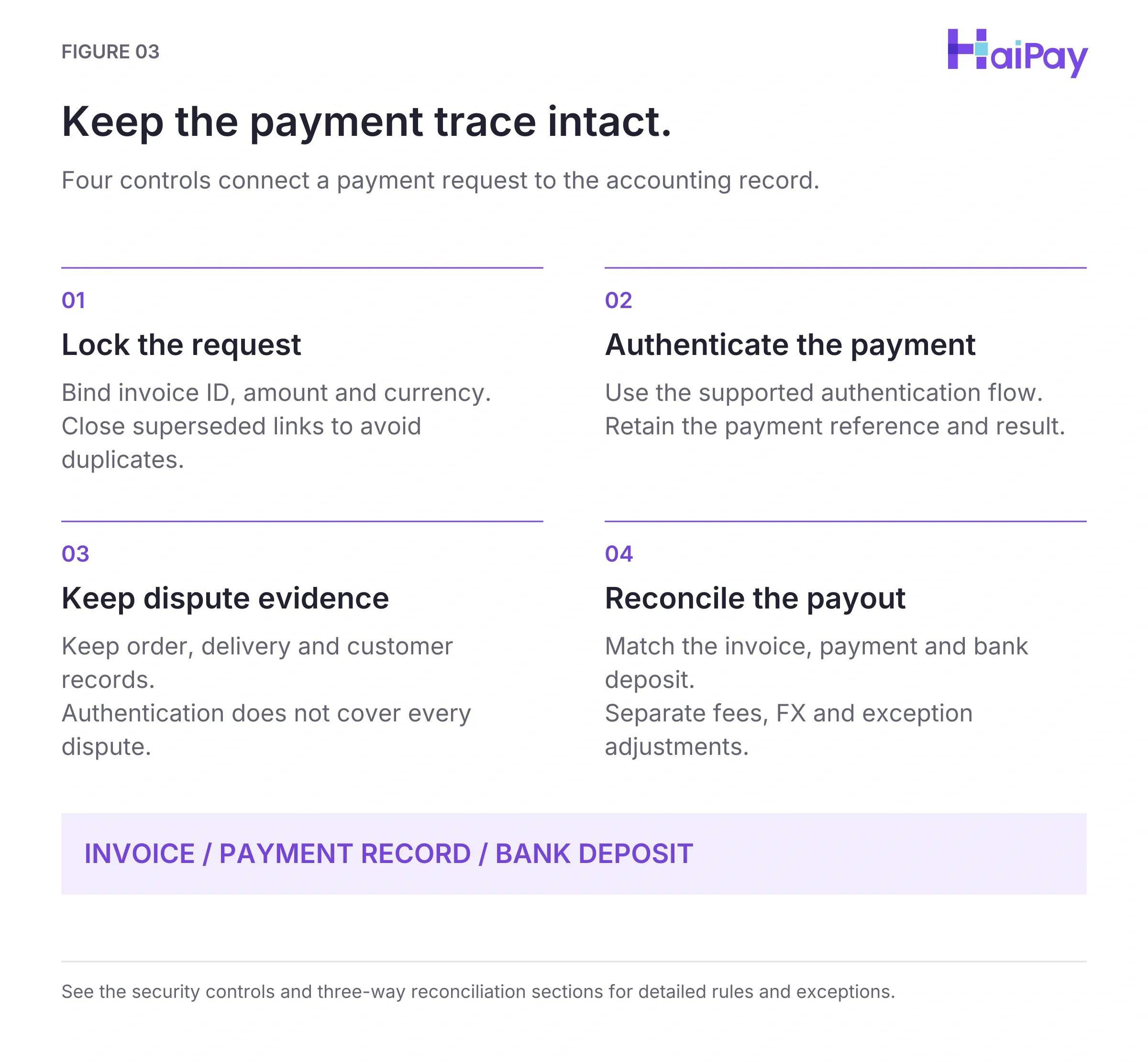
Figure 3: Keep the payment trace intact. Bind the request to the invoice, retain authentication and payment references, preserve dispute evidence, and match the invoice, payment record, and bank deposit. Authentication does not protect against every dispute. Open full-size diagram
Source: The security controls and three-way reconciliation sections of this guide, including HaiPay, PCI SSC, and EMVCo references.
Review detailed controls across our PCI DSS compliance guide, chargeback process and Visa deadlines, 3-D Secure authentication, Address Verification Service (AVS), and 3D Secure implementation guide.
B2B Invoicing Workflows and Three-Way Accounting Reconciliation
Fast collection stalls month-end close when bookkeepers match lump-sum payouts manually against accounts receivable (AR) ledgers in QuickBooks or Xero. Invoicing is a general billing workflow rather than a standalone HaiPay product. Generate VAT invoices in your ERP suite, then attach one unique One-Time Payment Link per invoice.
ERP-issued PDFs preserve PO numbers, Net-30 terms, and regional VAT wording without extra Stripe US 0.4% (US$2.00 cap) post-payment invoice PDF charges. At payout, finance exports Acquirer Reference Number (ARN) traces for card refunds and SEPA endToEndId tracking references across five clearing layers.
Ledger Layer | Required Field / Identifier | Source & Format | Accounting Control Purpose |
|---|---|---|---|
Receivable Binding | invoice_id, order_id, po_number | Unique metadata passed when creating each One-Time link | Enables 1-to-1 clearing against open QuickBooks, Xero, or ERP invoices |
Rail & Auth Trace | payment_id, webhook status, endToEndId, ARN | Dashboard export, International Organization for Standardization (ISO 20022) SEPA trace, or card ARN | Confirms real-time settlement state and lets buyers trace refunded card batches |
FX & Fee Split | txn_currency, settlement_currency, FX spread, fee model | Quoted Blended vs. itemized IC++ statement + FX from 0.5% (up to 2.5% by pair; US card line per quote) | Prevents net-deposit FX haircuts from understating gross top-line revenue |
Settlement Batch | payout_batch_id, value date, wire fee | Typically T+5 calendar days (cards) vs. as fast as T+1 (8 named LPMs); US$15 USD wire (quote governs) | Aligns clearing-account cash expectations with actual bank-feed arrival dates |
Exception Adjustments | US$0.30 refund, US$20 dispute, rolling reserve (US-entity schedule; per quote) | Dedicated exception and reserve clearing sub-accounts per merchant quote | Separates refunds from card-scheme dispute ratios and tracks reserve releases |
Source: HaiPay, "HaiPay Homepage" (Typically T+5), "Payment Links," "Pricing," "Payment Gateway Fees" (8 T+1 LPM markets), "Cross-Border Payments Guide" (FX up to 2.5%), and "SEPA Payments Guide"; Stripe, "Pricing" (0.4% invoice PDF reference) and Stripe Docs, "Payment Links" (accessed 2026-11-17).
Pair this field contract with our payment gateway reconciliation guide, payment acceptance guide, and chargeback glossary.
Onboarding, KYB Review, and Choosing Your Next Integration Step
Cross-border payment links are not unverified self-serve wallets. Merchants submit a KYB application, clear underwriting and pre-launch review, and generate live links once approved.
Services contract with HaiPay Limited (Hong Kong Business Registration Number, HK BRN 78684486; Business Registration Certificate, BRC No. 78684486-000-08-26-9) or applicable affiliates. Regional regulated rails operate via licensed partner institutions. Controls span real-time screening across 20+ watchlists including the US Office of Foreign Assets Control (OFAC), United Nations (UN), and European Union (EU). Data safeguards align with the EU General Data Protection Regulation (GDPR) and Hong Kong's Personal Data (Privacy) Ordinance (PDPO), alongside information security controls aligned with ISO/IEC 27001:2022.
- No-Code Chat & Invoice Collection: Start with no-code payment links backed by global credit card acquiring and 40+ LPM markets.
- Multi-Item Storefronts & Automated Billing: Upgrade to hosted storefront checkout for website carts or pair our recurring payment processing guide with Subscriptions.
- Programmatic Link Workflows: Adopt payment API integration once order volume requires automated link webhooks.
Source: HaiPay Homepage & Pricing Schedule ("HaiPay Limited HK BRN 78684486 · BRC No. 78684486-000-08-26-9"; KYB underwriting and non-binding quote disclosure, accessed 2026-11-17).
Next Step: Share your company name, transaction website, and a test account to request a merchant quote and confirm corridor coverage, settlement timing, and final commercial rates. For internal sign-off, download our 23-row TCO and Risk Audit CSV Worksheet.
Sources
- HaiPay — Payment Links Product & FAQs (One-Time vs. Recurring Link, Channels & Settlement) (accessed 2026-11-17).
- HaiPay — Transparent Pricing Schedule & Non-Binding Commercial Terms (US Entity) (accessed 2026-11-17).
- HaiPay — Platform Overview, KYB Onboarding, Typically T+5 Settlement & Compliance Governance (accessed 2026-11-17).
- HaiPay — Hosted & Embedded Checkout vs. Payment Links (accessed 2026-11-17).
- HaiPay — Automated Subscription Billing & Tokenized Card Updates (accessed 2026-11-17).
- HaiPay — Local Payment Methods Coverage (150+ Wallets, QR & Bank Transfers) (accessed 2026-11-17).
- HaiPay — Credit Card Processing Fee Calculator ($50,000 Monthly Benchmark Model) (accessed 2026-11-17).
- HaiPay — Payment Gateway Fees Guide (8 T+1 LPM Markets, Maybank & DBS Routes) (accessed 2026-11-17).
- HaiPay — Cross-Border Payments Guide (160+ Currencies, 40+ LPM Markets & 0% Second FX) (accessed 2026-11-17).
- HaiPay — SEPA Payments Guide (41-Country ECB Scope, EU 2024/886 VoP & SDD Core vs. B2B) (accessed 2026-11-17).
- HaiPay — Chargeback Process Guide (Visa Category 10–13 Timelines & Table 11-6 Evidence) (accessed 2026-11-17).
- HaiPay — PCI DSS Glossary (Merchant Accountability Under Requirements 12.8.2 & 12.8.4) (accessed 2026-11-17).
- PCI Security Standards Council — Important Updates Announced for Merchants Validating to SAQ A (published Jan 2025; effective 2025-03-31; accessed 2026-11-17).
- PCI Security Standards Council — Merchant Compliance & Payment-Brand Validation (accessed 2026-11-17).
- PCI Security Standards Council — Self-Assessment Questionnaire (SAQ) Document Library (accessed 2026-11-17).
- EMVCo — EMV 3-D Secure (3DS) Protocol Overview & Challenge Authentication (accessed 2026-11-17).
- EUR-Lex — Commission Delegated Regulation (EU) 2018/389 (PSD2 SCA & Article 16 Exemption) (accessed 2026-11-17).
- Visa — Security Compliance & Merchant Transaction Volume Levels (accessed 2026-11-17).
- Visa — US Merchant Surcharge 30-Day Acquirer Notification Rules (accessed 2026-11-17).
- Board of Governors of the Federal Reserve System — 2025 Federal Reserve Payments Study (CY 2024 Topline) (CY 2024 data; released July 2026; accessed 2026-11-17).
- Nacha — ABCs of ACH (Operating Hours, 4x Daily Settlement & Sept 2027 $10M Same Day ACH Limit) (accessed 2026-11-17).
- European Payments Council — SEPA Instant Credit Transfer (SCT Inst Rulebook) (accessed 2026-11-17).
- Stripe — US Standard Pricing Schedule (Cards, Payment Links, Custom Domain & Disputes) (accessed 2026-11-17).
- Stripe Docs — Payment Links Reusability, URL Reconciliation & Invoicing Contrast (accessed 2026-11-17).
- PayPal — US Merchant Fees Schedule (Payment Links, International Commercial & FX Tiers) (updated Nov 4, 2026; accessed 2026-11-17).
- Square — US Processing Pricing Plans & Non-US-Issued Card Fee (accessed 2026-11-17).
- Square — US Payment Links Overview (accessed 2026-11-17).
- Adyen — Global Pricing Display & Minimum Invoice Structure (accessed 2026-11-17).
- Adyen Docs — Pay by Link Overview & Standalone Online-Shop Restriction (accessed 2026-11-17).
- Adyen Docs — Create Payment Links (Expiry Windows, Failed Attempts & 3DS) (accessed 2026-11-17).
- EUR-Lex — Regulation (EU) 2024/886 (Instant Credit Transfers in Euro & Free Verification of Payee Article 5c) (effective 9 October 2025 / 9 July 2027; accessed 2026-11-17).
- Link.com — Consumer Autofill Wallet by Stripe (accessed 2026-11-17).
FAQ
A merchant payment link, called pay by link in Europe and the UK, is a seller-created URL for collecting an order or invoice. Stripe Link (Link.com) is a consumer autofill wallet that stores card details across participating sites rather than a merchant quote link.
For US merchants contracting through HaiPay's US entity, US-issued cards start at 2.5% + US$0.30 and non-US cards start at 4.0% + US$0.30, subject to business and risk review. Setup and annual fees are US$0 with no monthly minimum. Foreign exchange (FX) from 0.5% (up to 2.5% by pair), US$0.30 refunds, US$20 disputes, US$15 wires (recipient pays intermediary fees), and taxes apply separately per your quote. By contrast, Stripe US adds 0.4% (capped at $2.00) on post-payment invoice PDFs above its 2.9% + 30¢ card rate.
No; a reusable Recurring Payment Link stays active so returning buyers can open the URL and submit repeat manual payments. Automatic weekly, monthly, or annual billing cycles, smart retries, and card updates require dedicated subscription billing.
Confirm the sender domain, inspect the hosted checkout URL and corporate billing descriptor, and match the locked amount against your quote. On European bank-rail requests, EU Regulation 2024/886 Article 5c mandates free Verification of Payee (VoP) matching legal account names to International Bank Account Numbers (IBANs).
No; Europay, Mastercard, and Visa (EMV) 3-D Secure version 2 (3DS2) helps shift eligible fraud liability, yet Category 12 processing errors and Category 13 consumer disputes stay merchant risk. Visa Category 10 (Fraud) and 11 (Authorization) disputes omit a Dispute Response stage, while Category 12 and 13 grant 30 calendar days. Published US-entity pricing lists US$20 per dispute, subject to risk review and your signed merchant quote.
Standard card settlement is typically T+5 calendar days (five days post-transaction, or T+7 for licensed forex), with rolling reserve (temporary holdback) terms in your quote. Local payment methods (LPMs) can settle as fast as T+1 (one day after the transaction, per quote) in eight named markets. Those markets are Indonesia, Vietnam, Thailand, the Philippines, India, Brazil, Mexico via SPEI (Mexico's real-time interbank rail), and Bangladesh. Your signed merchant quote confirms the exact settlement schedule.
Issue your tax or value-added tax (VAT) invoice in QuickBooks, Xero, or enterprise resource planning (ERP) tools and attach a One-Time Payment Link with invoice_id and purchase order (po_number) metadata. At payout, match fees, foreign exchange (FX) spreads, US$0.30 refunds, US$20 disputes, and US$15 USD wires per your quote. Recipient banks bear intermediary wire fees. Match settlements using exports, Single Euro Payments Area (SEPA) endToEndId tracking references, or card Acquirer Reference Numbers (ARNs).

Related HaiPay surfaces
Explore the payment stack
Product
HaiPay Payment Links: One-Time & Recurring No-Code Collection
Issue single-use or reusable hosted checkout links across cards, wallets, and 150+ local methods after KYB approval.
Pricing
HaiPay Transparent Pricing & Custom Merchant Quote Schedule
Review US-entity card starting rates, LPM floors, FX spreads, refund/dispute fees, and Blended vs. IC++ models.
Product
HaiPay Hosted & Embedded Storefront Checkout
Graduate multi-item website carts from manual payment links to hosted or embedded storefront checkout.
Product
HaiPay Subscription Billing & Smart Retry Engine
Automate weekly, monthly, or annual billing cycles, trials, and tokenized card updates beyond manual links.
Tool
Credit Card Processing Fee Calculator
Model domestic versus non-US card share and currency conversion impact on your monthly link volume.
Guide
Cross-Border Payments Guide: Multi-Currency Acquiring & Local Rails
Compare 160+ transaction currencies, 40+ LPM markets, 10+ settlement currencies, and eligible 0% second FX payouts per quote.
Guide
Chargeback Process, Visa Category 10–13 Deadlines & Evidence
Navigate Visa dispute timetable asymmetry and Table 11-6 digital-goods compelling evidence rules.
Blog
Payment Gateway Reconciliation & Clearing-Account Guide
Keep QuickBooks, Xero, and ERP clearing accounts clean across fees, FX spreads, refunds, and payout batches.
Terms in this guide
Glossary terms covered
Payment Link (Pay by Link)
A payment link (also called pay by link) is a merchant-generated web address leading buyers directly to a provider-hosted checkout page.

Need help mapping your payment stack?
Talk to HaiPay about acquiring, orchestration, local methods, and payout workflows.
Contact us