


Direct Answer
There is no single best international payment gateway for every business. First exclude providers that cannot support your legal entity, customer markets, required payment methods, or transaction profile. Then compare presentment and settlement currencies, total cost, integration, refunds, disputes, and reconciliation at your actual order values. Choose only a provider that confirms every must-have in writing for your account.
Compare 9 international payment gateway providers by merchant eligibility, payment methods, currencies, settlement, integration, refunds, disputes, and total cost.
No provider is right for every merchant. First, remove any service that cannot onboard your legal entity or business model. Then verify your customers' markets, payment methods, currencies, and transaction sizes. Compare the complete money path: processing, cross-border and foreign exchange charges, settlement, refunds, and disputes. For small, frequent payments, model the fixed fee at your real order values because it can matter more than a modest difference in the percentage rate.
Shortlist by scenario (alphabetical, not a ranking)
- Adyen — larger multi-market merchants that can manage a detailed, method-by-method fee matrix; published fees are indicative, a minimum invoice may apply, and pricing is confirmed with sales.
- Airwallex — businesses that want payment acceptance and multi-currency balances in one account; eligibility is checked per business location and method.
- Braintree — teams already on PayPal that need a developer-oriented integration; methods and multi-currency depend on the banking-partner configuration.
- Checkout.com — scaling merchants that want direct acquiring with configurable pricing; exact processing, FX and settlement economics require a quote.
- ConnectPay — EEA merchants that mainly need Visa, Mastercard and selected EUR bank payments (card acceptance across the EEA; bank-transfer acceptance in four markets); its published schedule lists international Visa and Mastercard at 2.5% + €0.10 per transaction on the entry plan and 3% + €0.25 on the next tier.
- PayPal — merchants prioritising wallet familiarity and a hosted checkout; US PayPal Checkout is 3.49% plus a fixed fee, and tables fragment by country and product.
- Stripe — developer-led businesses that want fast implementation and a large local-method catalogue; the business must be in a supported country and method-level fees vary.
- Tazapay — see its matrix row above; it is positioned for cross-border businesses that want local collection options across buyer markets. Verify the buyer-country method mix and current pricing before relying on catalogue coverage.
- Worldpay — established merchants that need broad enterprise acquiring under negotiated terms; its pricing page is marked indicative and quote-based, and no universal settlement terms are published.
HaiPay is deliberately not in this matrix. Our own scope and published pricing (from 2.5% + US$0.30 for eligible card transactions) are set out in the section Where may HaiPay fit, and where may it not fit? below.
How was this international payment gateway comparison built?
This guide compares nine international payment gateway providers for which sufficient current official documentation was available across the evaluation criteria below. Providers are listed alphabetically; inclusion is not a ranking, endorsement, or claim that these are the only suitable options.
The scope is online payment acceptance for cross-border ecommerce, gaming, content, subscriptions, and digital goods. Merchant-of-record services are outside the comparison because they take on different tax, compliance, and commercial responsibilities.
Cost review includes processing, method fees, international additions, foreign exchange (FX), settlement transfers, refunds, disputes, setup fees, monthly fees, and minimums when disclosed. A blank universal rate is not estimated. It is treated as quote-specific or not publicly disclosed.
Providers are ordered alphabetically. This is not a ranking. “Best fit” describes a likely evaluation scenario, not a performance promise.
Which 9 international payment gateway providers made the comparison?
The first matrix covers eligibility, customer reach, payment methods, and currencies. “Method-specific” means the provider publishes a matrix rather than promising every method to every merchant.
Provider | Merchant eligibility | Customer and method coverage | Card schemes and local methods | Presentment currencies | Settlement currencies |
|---|---|---|---|---|---|
Adyen | Sales review, industry eligibility, and acquiring setup apply | Country, shopper, and method-specific | Global card schemes plus a broad method directory | Listed by payment method | Depends on acquiring region and method; multiple payout currencies can be configured |
Airwallex | Business location, account approval, and method eligibility apply | Shopper location and business location are checked per method | Global cards, wallets, bank methods, and regional methods | 130+ collection currencies, with method limits | Method and account-specific; like-for-like settlement is available for eligible currency paths |
Braintree | Production account and banking-partner approval apply | Business location, customer location, and banking partner affect access | Cards, PayPal, wallets, bank methods, and selected local methods | More than 130 local currencies across 44 countries | Home currency by default; approved multi-currency setups can add settlement currencies |
Checkout.com | Account approval; product availability varies by country | Worldwide processing with domestic coverage disclosed in selected countries | Major card schemes, wallets, and local methods | 150+ processing currencies | Account, method, region, and pricing-schedule specific |
ConnectPay | Card acceptance is available in the European Economic Area; bank-payment acceptance is narrower | Card coverage is broader than its bank-payment service | Visa, Mastercard, and EUR bank-payment initiation | Cards: EUR, GBP, SEK, NOK, DKK, PLN, and USD | Agreed settlement currency; public price page distinguishes SEPA and cross-border settlement |
PayPal | Seller-country, account, product, and method eligibility apply | PayPal wallet, cards, and local methods vary by seller and buyer country | Visa, Mastercard, American Express, Discover, wallet, and listed local methods | Country and method-specific | Account, currency, withdrawal route, and market-specific |
Stripe | Business must be in a supported country or approved network | A supported business can sell to customers internationally; method access remains country-specific | Cards, wallets, bank methods, and a large local-method catalog | Currency support depends on business country and method | Bank account, account country, and payout configuration determine settlement |
Tazapay | Signup, compliance review, and method availability apply | Its support page says up to five payment types may be available in a buyer's country | Cards, bank redirects, local transfers, wallets, wire, vouchers, and mobile money | Published collection table varies by method and country | Published payout-currency table; account and route-specific |
Worldpay | Sales and underwriting approval apply | Global processing and local options are sold through account-specific configurations | Major schemes and a published payment-method directory | The online product page states 135+ currencies | Account, country, method, and agreement-specific |
Source: Official scope and currency documentation from Adyen [1–3], Airwallex [4–6], Braintree [7–8], Checkout.com [9–10], ConnectPay [13–15], PayPal [16–17], Stripe [18–19], Tazapay [22–25], and Worldpay [26–28].
The second matrix focuses on commercial and operating terms. Public prices are examples from the named market or product, not universal offers.
Provider | Public pricing and FX disclosure | Settlement disclosure | Integration | Refunds and disputes | Best fit | Important limitation |
|---|---|---|---|---|---|---|
Adyen | Fixed processing fee plus method fee; no setup or monthly fee; indicative method prices and a possible minimum invoice | Merchant can choose payout timing and eligible currency; route depends on acquiring region and bank location | One integration with APIs, SDKs, and method-specific components | Method-level support and pricing vary | Larger multi-market merchants that can manage a detailed method matrix | Sales onboarding and account-specific configuration make a single headline rate unreliable |
Airwallex | Public docs explain gateway, method, fraud, 3DS, FX, and exception components; exact rates vary by account and region | Settlement into the Airwallex balance is method-specific | APIs and prebuilt payment components | Dispute and exception handling are documented by product | Businesses that want payment acceptance and multi-currency treasury in one operating stack | Business location and method eligibility must be checked line by line |
Braintree | Not publicly disclosed as one current global schedule on the checked pages | No universal schedule disclosed; settlement setup depends on account and banking partner | Drop-in UI, Hosted Fields, client and server SDKs | Refund and dispute tools exist, but availability and fees vary | Teams already using PayPal that need a developer-oriented gateway | Banking-partner configuration controls methods and multi-currency access |
Checkout.com | Tailored flat-rate or interchange++ pricing; FX markup follows the pricing schedule | Speed varies by region, currency, method, and account | Unified Payments API and Flow | API and service terms cover refunds and disputes | Scaling merchants that want direct acquiring plus configurable payment products | Exact processing, FX, and settlement economics require a quote |
ConnectPay | Published card schedule lists 2.5% plus €0.10 per transaction for international Visa or Mastercard on the entry (Tree) plan and 3% plus €0.25 on the Forest plan, with 2.2% FX, €1 refunds, and €20 chargebacks (€25 on Forest) | Public fees distinguish €0.10 SEPA settlement and €30 cross-border settlement; no universal schedule stated | Business APIs and recurring-card support | Published refund and chargeback fees | EEA merchants that mainly need Visa, Mastercard, and selected EUR bank payments | Merchant and method coverage is narrower than broad global suites |
PayPal | US PayPal Checkout is 3.49% plus a fixed fee; many international commercial transactions add 1.50 percentage points | Withdrawal route, currency, account, and market determine access and cost | JavaScript SDKs, REST APIs, and hosted checkout | Method table shows refund support; dispute fees are currency-specific | Merchants prioritizing wallet familiarity and a hosted checkout path | Pricing and capability tables fragment by country, product, buyer, and seller |
Stripe | US examples include 2.9% + 30¢ for card-based Link, plus 1.5% for international transactions and 1% when conversion is required | No single international payout schedule; account country and bank setup apply | Checkout, Elements, APIs, SDKs, and plugins | Full and partial refunds via dashboard or API; original processing fees are not returned | Developer-led businesses that want fast implementation and broad product depth | Business-country availability and method-level fees require local review |
Tazapay | Standard page lists 3.8% + US$0.50 for global cards and 0.8%–2.5% for alternative methods; refunds are US$2 | Weekly by default; customized cycles can be requested | No-code, native, white-label, and plugins | Refund availability is method-specific; dispute tools are included | Cross-border businesses that value published standard rates and local collection options | Verify the exact buyer-country method mix before relying on catalog coverage |
Worldpay | Not publicly disclosed as one universal online rate on the checked pages | Schedule is account and agreement-specific | APIs, SDKs, low-code, and no-code options | Full and partial card refunds are available through the API | Established merchants that need a broad enterprise acquiring footprint | Public pricing and universal settlement terms are not available |
Source: Official pricing, settlement, integration, and post-payment pages [1–2, 5–6, 7–12, 13–17, 20–24, 26–29]. Prices shown above use the page's own market and product scope.
What should you do with this table?
Cross out a provider when a required field is account-specific and sales cannot confirm it in writing. Do not treat a method logo, currency count, or country directory as proof that your entity can enable that capability.
Ask each finalist for a configuration sheet. It should name the approved merchant entity, customer markets, methods, presentment currencies, settlement currencies, settlement schedule, reserves, limits, refund flow, dispute rules, and every applicable fee.
How do presentment, processing, and settlement currencies differ?
Presentment currency is what the shopper sees. Processing currency is the currency sent through the payment route. Settlement currency is what reaches the merchant's balance or bank account.
Those currencies can be the same or different. When they differ, the provider, scheme, bank, or another participant may perform conversion. The FX rate basis, markup, conversion point, and refund treatment then matter.
Use this four-part test for every important currency pair:
- Can the shopper see and pay the exact presentment currency?
- Does the selected payment method process that currency for your merchant entity?
- Can you settle without conversion into a matching balance or bank account?
- If conversion occurs, what base rate, markup, timing, and refund rule apply?
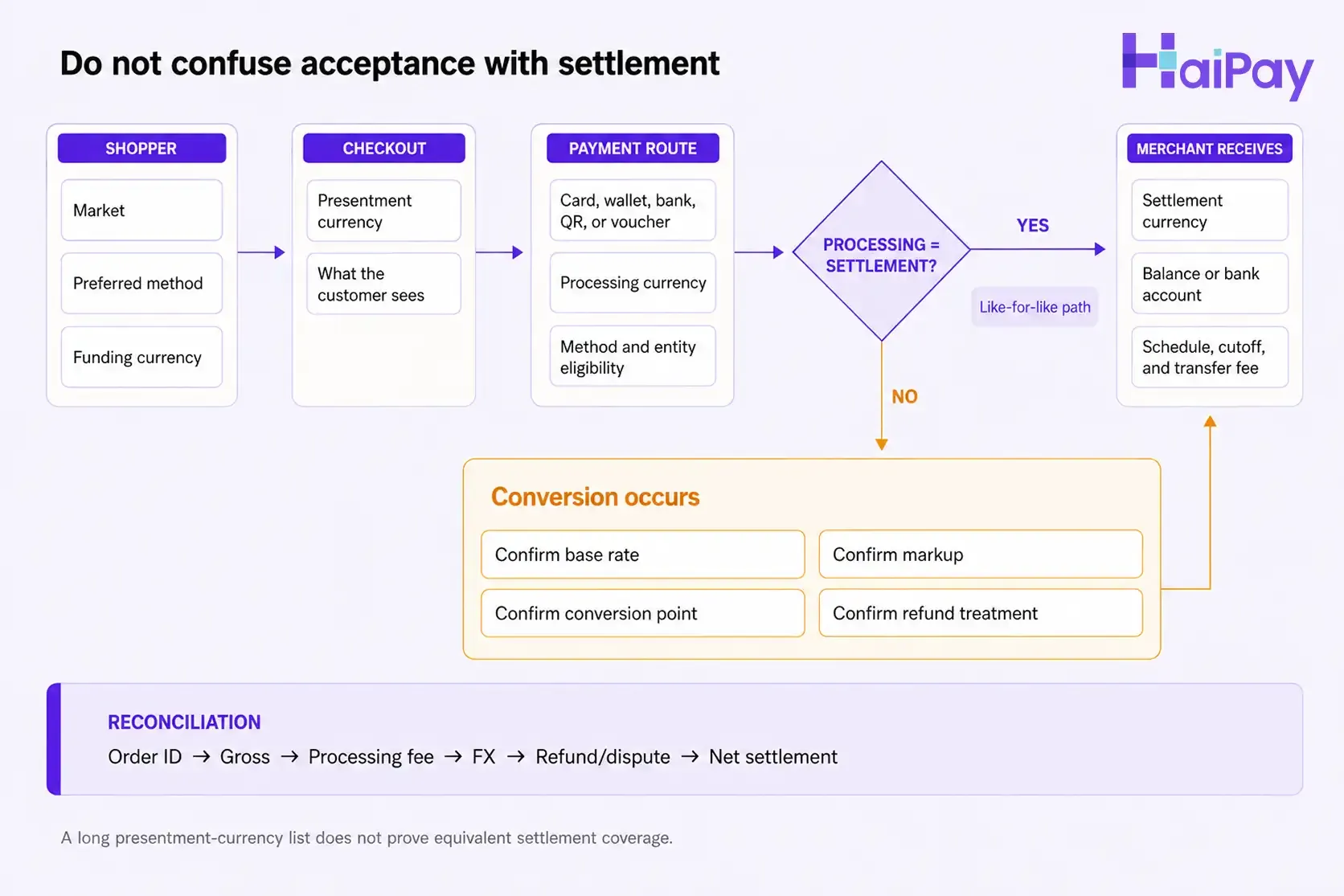
Payment flow from shopper market and presentment currency through payment method and processing currency to conversion and merchant settlement, with a gross-to-net reconciliation rail.
Braintree's documentation is a useful warning. It supports a larger presentment set than the settlement set available to many accounts, and multi-currency settlement needs approval and configuration [7]. Airwallex documents an FX fee when processing and settlement currencies differ, while eligible like-for-like settlement can avoid that fee [6]. Adyen's payout matrix also shows that settlement options depend on acquiring region, method, and bank location [2].
Source: Provider currency and fee documentation [2, 5–7, 11, 19, 23, 27].
How should you evaluate local payment methods?
Start with customer demand, not a provider's total method count. A useful method must be available to your legal entity, visible to the intended customer, supported in the required currency, compatible with your checkout, and operable through refunds and reconciliation.
For each market, build a method card with these fields:
- Customer and merchant eligibility.
- Currency and minimum or maximum amount.
- Redirect, QR, wallet, bank, card, or voucher flow.
- One-time, recurring, and saved-payment support.
- Authorization or confirmation behavior.
- Refund, reversal, dispute, and expiry rules.
- Settlement currency, schedule, holidays, and cutoffs.
- API, webhook, dashboard, and reconciliation fields.
Recurring businesses need an extra check. A method that works for a first purchase may not support merchant-initiated renewals. Digital-goods and gaming businesses should also confirm amount limits, delivery timing, and evidence requirements before automating fulfillment.
Source: Method-level capability tables and implementation guides [3–4, 8, 10, 15, 17, 20, 25, 28].
What compliance, authentication, and risk controls matter?
A gateway can reduce the card data handled by your systems, but outsourcing checkout does not remove every Payment Card Industry Data Security Standard (PCI DSS) obligation. PCI Security Standards Council guidance says eligible ecommerce merchants using SAQ A still retain specified responsibilities, including controls for their ecommerce pages [30]. Confirm your validation path with the acquiring provider or qualified assessor.
For cards, ask how EMV 3-D Secure (3DS) data, challenges, exemptions, and liability outcomes are handled. EMVCo describes frictionless and challenge flows, with transaction and device data exchanged so the issuer can authenticate the shopper [31]. A provider should explain how 3DS interacts with saved cards, subscriptions, soft declines, and regional rules.
Strong customer authentication (SCA) applies to in-scope European electronic payments, with exemptions and transaction treatment defined by applicable rules [32]. Do not assume that turning on 3DS globally is the correct policy. Ask who requests exemptions, who handles an issuer challenge, and what the checkout does when authentication fails.
Risk review should cover more than fraud screening. Confirm merchant category eligibility, prohibited products, reserves, rolling holds, transaction limits, account takeover, card testing, velocity controls, refund abuse, dispute evidence, and manual review. The provider should also explain which controls are configurable and which are managed for you.
Source: PCI Security Standards Council, EMVCo, and European Commission guidance [30–32].
How can you choose a gateway without relying on a generic ranking?
Use the four-pass shortlist below. It is designed to prevent an attractive price from hiding a critical eligibility or money-movement gap.
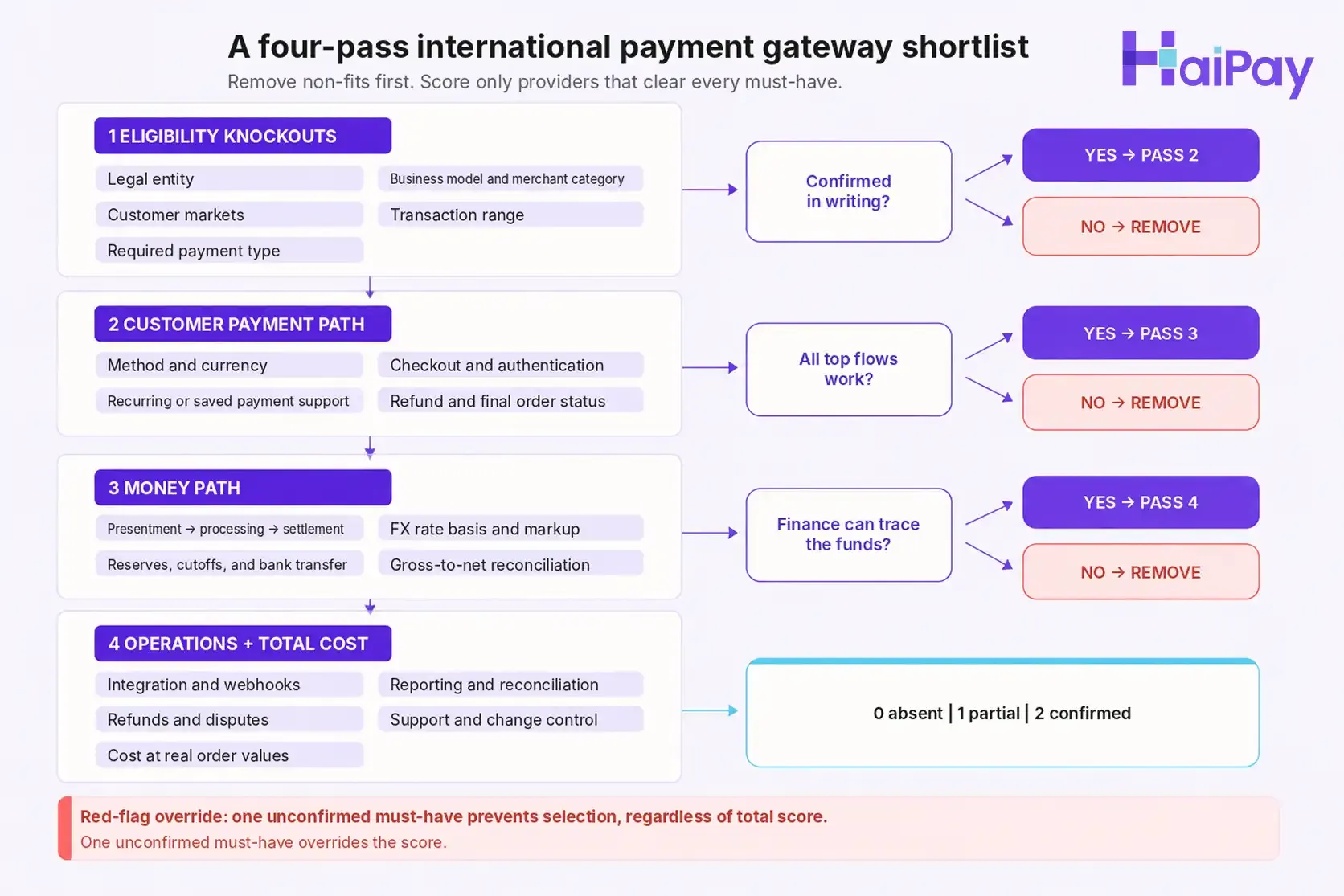
Four-pass international payment gateway selection flow: eligibility knockouts, customer payment-path testing, money-path review, then operations and total-cost scoring with a red-flag override.
Pass 1: Apply eligibility knockouts
Remove a provider if it cannot confirm your legal entity, business model, merchant category, customer markets, transaction range, or required payment type. A sales promise is not enough; request written product and underwriting confirmation.
Pass 2: Test the customer payment path
Choose your five most important customer-market and payment-method combinations. Test eligibility, currency, checkout flow, authentication, recurring support, refund behavior, and final customer status for each combination.
Pass 3: Trace the money path
Map presentment, processing, settlement, conversion, fees, reserves, bank transfer, cutoffs, and holidays. Finance should be able to reconcile gross amount, fee, FX, refund, dispute, and net settlement without a manual mystery step.
Pass 4: Score operations and total cost
Score each provider from 0 to 2 on integration, webhook reliability, reporting, reconciliation, refunds, disputes, support, change control, and total cost at your real order values. Use 0 for absent, 1 for partial or conditional, and 2 for confirmed.
Add a red-flag override: any unconfirmed must-have prevents selection, regardless of score. This keeps a high aggregate score from masking a missing local method, settlement currency, or recurring capability. Once you have a shortlist, use the payment gateway integration guide to turn requirements into a tested launch plan.
For small, frequent payments, run at least three order-value scenarios. On a US$2 payment, a US$0.30 fixed fee equals 15% before the percentage fee. On a US$10 payment, it equals 3%. On a US$100 payment, it equals 0.3%. These are arithmetic illustrations, not provider quotes.
For every fee a gateway can charge — transaction, international-card, FX, dispute and monthly — and six providers' published rates side by side, see the payment gateway fees guide.
Source: Original HaiPay editorial decision framework; provider fields are grounded in the official comparison sources [1–29].
What should change in your gateway review by market?
These notes identify what to verify. They do not state that every compared provider, or the publisher, supports every named method.
Hong Kong
Confirm HKD presentment and settlement, the card schemes your customers use, and any local wallet or bank-transfer flow your checkout requires. Ask how the provider documents refunds and disputes for Hong Kong entities, and whether settlement to a local account avoids an FX conversion step. For a market-level breakdown, see our Hong Kong payment gateway guide.
Philippines
Test GCash, Maya, GrabPay, and QR Ph against your exact ecommerce flow rather than treating “wallets” as one category. QR Ph is an interoperable national QR standard, while individual wallets and merchant products have separate onboarding and online-payment rules [33–35].
For method-by-method eligibility, the GCash and Maya flows, and settlement paths for a Philippine checkout, see the Philippines payment gateway guide.
Thailand
Verify PromptPay and TrueMoney separately because a bank-linked QR flow and a wallet flow can have different eligibility, confirmation, refund, and reconciliation behavior. Bank of Thailand materials identify PromptPay as payment infrastructure, while TrueMoney publishes its own merchant and online-payment products [36–37].
For the PromptPay and TrueMoney flows in detail, plus THB settlement and refund behaviour, see the Thailand payment gateway guide.
Singapore
Include PayNow in the shortlist when Singapore-dollar bank payments matter. Confirm whether the provider supports the required merchant setup, online flow, reconciliation reference, refunds, and settlement path rather than relying on a PayNow logo [38].
For PayNow, SGD settlement paths and the merchant setup each provider requires, see the Singapore payment gateway guide.
India
Treat UPI as its own acceptance flow, not as proof of local-card acquiring. NPCI describes UPI as supporting merchant payments, QR, intent, and two-factor authentication; a provider still must confirm merchant eligibility and the exact integration [39].
For how UPI, PhonePe and Paytm sit in different layers, and how INR checkout, USD routes and bank receipt map to each other, see the India payment gateway guide.
United Arab Emirates
Ask for AED presentment, approved settlement currencies, card routing, wallets, and every FX component in writing. If a bank-transfer flow is mandatory, remove any provider that cannot enable it for your entity; the publisher's current pricing page states that UAE bank transfers are not supported [40]. For a market-level checklist, see our UAE payment gateway guide.
For card and Apple Pay acceptance for UAE-facing merchants, the bank-transfer boundary, and how to ask for the full commercial and settlement model, see the UAE payment gateway guide.
Malaysia
Confirm the merchant entity, MYR presentment and settlement, target methods, recurring support, and refund behavior. Request the method-level configuration because regional availability does not prove that every Malaysian customer flow is enabled.
For Touch 'n Go eWallet, Boost, GrabPay and ShopeePay, DuitNow versus FPX, and the refund lifecycle of each method, see the Malaysia payment gateway guide.
United Kingdom
Map GBP presentment and settlement, card authentication, bank-payment options, recurring transactions, and dispute operations. Ask how the provider documents SCA treatment and how finance reconciles conversion when the customer pays in another currency.
For GBP presentment, settlement and FX, VAT and settlement timing, and SCA treatment for UK-facing checkouts, see the UK payment gateway guide.
Saudi Arabia
Confirm SAR checkout and settlement needs, the card and non-card methods your customers use, merchant eligibility, and Arabic checkout requirements. Obtain the FX basis and any cross-border or settlement-transfer charge in the final quote.
For Mada, STC Bank and Apple Pay routes, SAR settlement and the VAT line in a Saudi quote, see the Saudi Arabia payment gateway guide.
Vietnam
Verify VND presentment, the exact wallet or bank flow, refund availability, order-status timing, and settlement currency. Do not infer online support from a provider's general Southeast Asia coverage.
For MoMo, VietQR and card routes, and how VND and USD presentment, balance and settlement differ, see the Vietnam payment gateway guide.
Taiwan
Confirm TWD presentment, card schemes, any required non-card methods, amount limits, refunds, and settlement route. Ask for a test account that exposes the same methods your production entity will receive.
For ATM and convenience-store payments, the four currency layers and a Taiwan launch checklist, see the Taiwan payment gateway guide.
Source: Official payment-system and wallet pages for the named methods [33–39], plus the current HaiPay pricing page for the UAE limitation [40].
Where may HaiPay fit, and where may it not fit?
Because HaiPay publishes this guide, we want to be transparent about how we present our own service. We have not included HaiPay in the nine-provider matrix or given ourselves a ranking. If you are considering us, we encourage you to ask us to confirm the same requirements in writing that you would ask of any other provider.
HaiPay may be a practical international payment gateway if you want to accept international card payments while also offering local payment methods and multi-currency support. Our current public pricing starts at 2.5% + US$0.30 for eligible card transactions and from 0.8% for local payment methods, priced by market. We also list no setup or monthly fees, a US$0.30 fee for each merchant-initiated refund, a US$15 transfer fee when settling in USD, and a US$1,000 minimum monthly processing volume for IC++ pricing [40]. These are published list figures; the rates, fees and minimums that apply to your account are confirmed in your quote.
Our public pages describe support for 140+ settlement currencies and 150+ local payment methods across key markets [40–41]. These are platform-wide figures, not a promise that every merchant can use every method or settle in every currency. What we can offer your business depends on your contracting entity, customer markets, transaction profile, product configuration, and final quote. Method availability by market is confirmed in your quote. For card payments, acceptance through Visa, Mastercard, JCB, and other major schemes is also subject to approval and availability for your account.
We also want to be clear about the situations where we may not meet your requirements. If you need one settlement timetable to be guaranteed across every market, a payment method that is unavailable to your legal entity, or commercial terms outside your approved quote, HaiPay may not be the right fit. For example, if your UAE payment flow specifically requires bank transfer, we cannot currently support that component [40].
Before you decide, tell us about your legal entity, customer markets, required payment methods and currencies, expected monthly volume and average order value, settlement needs, and operational requirements. We can then confirm in writing what applies to your account, including fees, FX treatment, reserves, refunds, disputes, settlement terms, and implementation scope.
You can also review our current pricing, local payment method coverage, and guide to local versus cross-border acquiring before requesting a tailored quote.
Source: HaiPay public pricing and product pages [40–42]. HaiPay typically settles international card payments in T+5 (calendar days). The tier is counted in calendar days, and funds land on the first working day at or after that count. Your actual timeline is confirmed in your quote. Many providers quote settlement in business days, so confirm each provider’s counting basis and arrival rule before comparing timelines.
Editorial disclosure: HaiPay publishes this guide and was not included in the nine-provider comparison. This comparison is based on desk research of official provider materials; HaiPay did not conduct equivalent live-account or transaction testing across all nine providers. HaiPay has no paid sponsorship, affiliate arrangement, or other commercial relationship with the compared providers that influenced their inclusion or treatment in this guide. This content is for general information only and does not constitute investment, financial, legal, tax, regulatory, compliance, or pricing advice. Confirm eligibility, features, pricing, settlement, and compliance requirements with the relevant provider and your professional advisers.
Sources
All pages were first accessed on August 6, 2026. Volatile provider facts and prices were revalidated against the official pages on August 10, 2026.
- Adyen — Pricing
- Adyen — Supported payout currencies
- Adyen — Payment methods
- Airwallex — Payment methods overview
- Airwallex — Supported currencies
- Airwallex — Payment fees and pricing models
- Braintree — Currencies
- Braintree — Payment method types
- Checkout.com — Pricing
- Checkout.com — Payment methods
- Checkout.com — FX fees
- Checkout.com — Settlement payout timing factors
- ConnectPay — Pricing
- ConnectPay — Support and country availability
- ConnectPay — Providers, payment methods, and currencies
- PayPal US — Merchant and business fees
- PayPal Developer — Payment methods
- Stripe — Global availability
- Stripe — Supported currencies
- Stripe — Local payment method pricing
- Stripe — Refunds
- Tazapay — Pricing
- Tazapay — Supported collection and settlement currencies
- Tazapay — Settlement cycle
- Tazapay — Payment methods
- Worldpay — Online payment processing
- Worldpay — Supported country and currency codes
- Worldpay — Supported payment methods
- Worldpay — Manage payments and refunds
- PCI Security Standards Council — SAQ A ecommerce responsibilities
- EMVCo — EMV 3-D Secure
- European Commission — PSD2 strong customer authentication
- GCash — Merchant product activation
- Bangko Sentral ng Pilipinas — QR Ph
- Grab Philippines — Merchant payment solutions
- Bank of Thailand — Digital payment system and PromptPay
- TrueMoney — Merchant wallet
- Association of Banks in Singapore — PayNow
- National Payments Corporation of India — About UPI
- HaiPay — Pricing
- HaiPay — Local payment methods
- HaiPay — Local acquiring versus cross-border acquiring
FAQ
An international payment gateway connects an online checkout to payment methods and processing routes across markets. Its practical scope depends on merchant eligibility, customer location, method, currency, acquiring route, and settlement setup.
At checkout, the gateway presents eligible payment methods and currencies for the customer's market, then routes the transaction to an acquiring or processing path for authorization. After capture, funds are converted where required and settled to the merchant on the provider's schedule. Each step — method eligibility, currency conversion, and settlement route — depends on the merchant entity and account configuration, which is why two merchants on the same provider can have different capabilities.
No single option fits every merchant. The best shortlist contains only providers that confirm your entity, business model, customer methods, currencies, settlement, integration, and post-payment needs in writing.
Stripe supports businesses in a published list of countries and says supported businesses can sell to customers internationally [18]. Method, currency, pricing, and payout availability still depend on the business country and account configuration.
The main categories are cards, digital wallets, bank payments, and cash or voucher-based methods. The right mix depends on customer behavior, merchant eligibility, currency, recurring needs, refunds, and settlement operations.
No. Acceptance concerns what the customer can pay, while settlement concerns what the merchant receives. A provider can support many presentment currencies but settle a smaller set or convert funds first.
Model the percentage fee, fixed fee, international addition, FX, settlement transfer, refunds, and disputes at your actual order values. A fixed charge has a larger effective impact on a small payment.

Related HaiPay surfaces
Explore the payment stack
Gateway Pricing
Payment Gateway Pricing & Fees
Review processing, local payment method, refund, cross-border, currency conversion, and settlement fees before comparing provider quotes.
Local Payment Methods
Local Payment Methods for Global Growth
Explore local payment method coverage and checkout integration options for businesses expanding across international markets.
Acquiring Decisions
Local Acquiring vs Cross-border Acquiring
Compare local and cross-border acquiring by payment flow, fees, settlement, compliance, and market-expansion fit.
Terms in this guide
Glossary terms covered
Payment Gateway
A payment gateway is technology that passes payment information from a business's checkout to the systems that process the transaction.

Need help mapping your payment stack?
Talk to HaiPay about acquiring, orchestration, local methods, and payout workflows.
Contact us