
Direct Answer
Local acquiring processes payments through an acquirer licensed or connected in the customer’s market, which can improve local payment method access, domestic transaction handling, settlement, and cost efficiency in mature markets. Cross-border acquiring processes payments through an acquirer in another country, making it faster to launch and simpler to manage when testing new markets. Many global merchants start with cross-border acquiring and add local or global acquiring as volume grows.
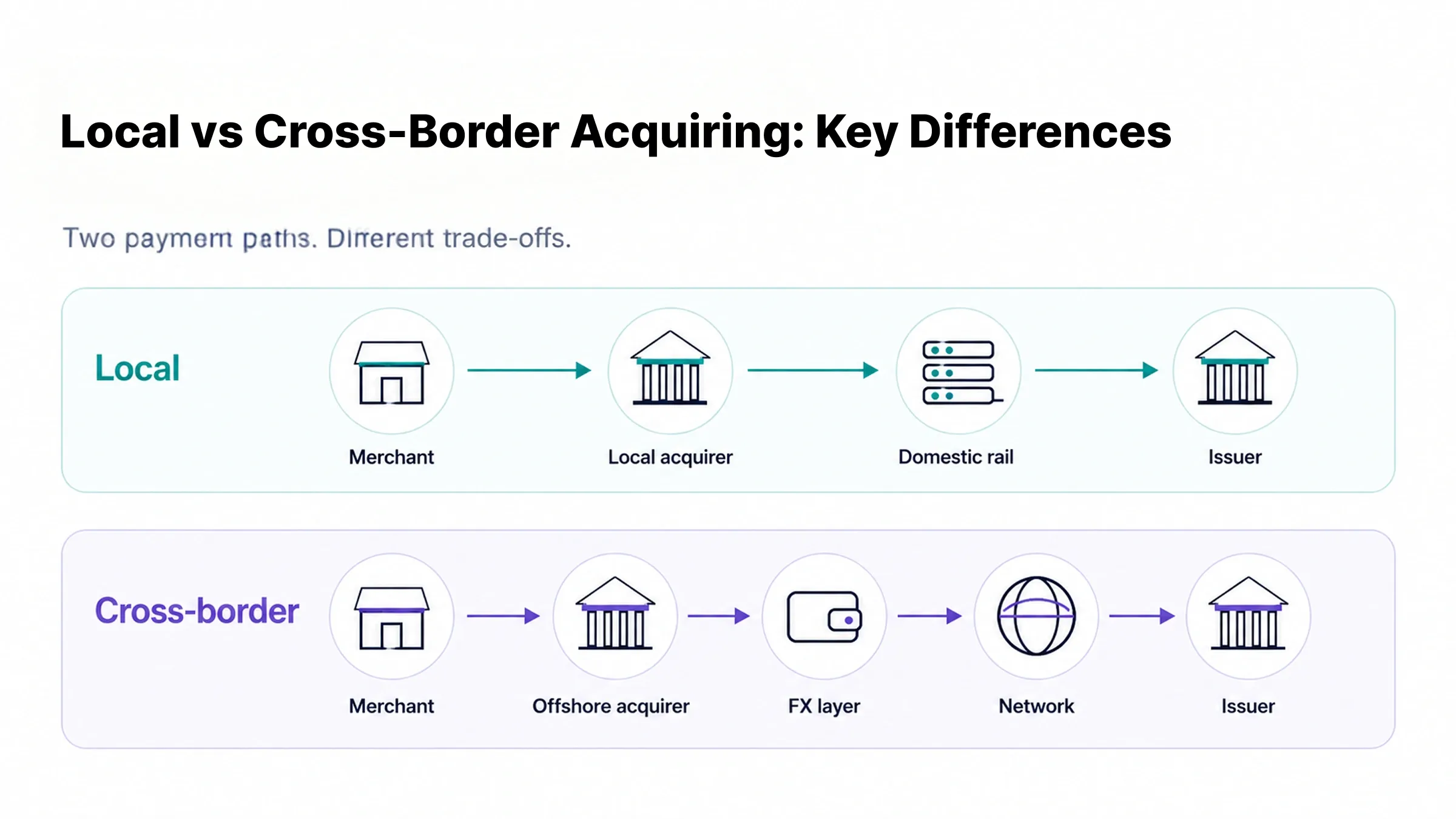
When you sell to customers in multiple countries, one of the most consequential payment decisions is where and how your transactions are acquired. The choice between local acquiring and cross-border acquiring affects checkout experience, authorization outcomes, settlement timelines, compliance exposure, and how your payment stack scales with your business.
This guide explains both models, compares them across the dimensions that matter most to global merchants, and helps you decide which approach fits your expansion strategy.
What is local acquiring?
Local acquiring means your payment transactions are processed by an acquirer — a bank or licensed payment institution — that operates in the same country or region as your customer. When a buyer in the Netherlands pays on your checkout, a locally licensed acquirer in that market processes and clears the transaction through local or regional card networks and clearing systems.
Because the acquiring entity operates under the regulatory framework of the customer's market, the transaction is treated as a domestic payment from the issuing bank's perspective. This can affect how the card issuer evaluates the authorization request, which payment methods are available at checkout, how funds settle, and which compliance rules apply.
Local acquiring typically requires working with an acquirer that holds the relevant local licenses or payment institution authorizations in each target market — either through a direct relationship or through a payment provider that offers local acquiring coverage across multiple regions.
What is cross-border acquiring?
Cross-border acquiring occurs when a transaction in one country is processed by an acquirer based in a different country. A merchant incorporated in Singapore can accept payments from customers in Germany through a Singapore- or US-based acquirer without a locally licensed European entity.
Cross-border acquiring is a common starting point for merchants entering new markets because it removes the need to establish local entities or banking relationships upfront. However, card networks often classify cross-border transactions differently than domestic ones, which can influence interchange fees, issuer authorization behavior, and access to locally preferred payment methods in some markets.
What are the main cross-border acquiring methods?
Cross-border acquiring methods are the different setups a merchant can use to accept payments from customers in other countries. Four approaches cover most real-world configurations:
- Direct cross-border acquiring — your transactions are processed by a single acquirer based outside the customer's country. Fastest to start; card networks classify the transactions as cross-border, which can affect fees and authorization treatment.
- Cross-border acquiring through an international PSP or gateway — a payment provider aggregates acquiring relationships for you, so one integration covers multiple markets while transactions still route cross-border.
- Local acquiring via a locally licensed acquirer — transactions in a market are processed by an acquirer licensed there, typically requiring a local entity or a provider with local connectivity. Transactions clear as domestic payments.
- Global acquiring (hybrid) — a single platform routes each transaction to a locally connected acquirer where available and falls back to cross-border processing elsewhere, keeping one integration and one reconciliation layer.
Which method fits depends on your market commitment, volume, and payment-method requirements — the decision criteria are covered in the sections below.
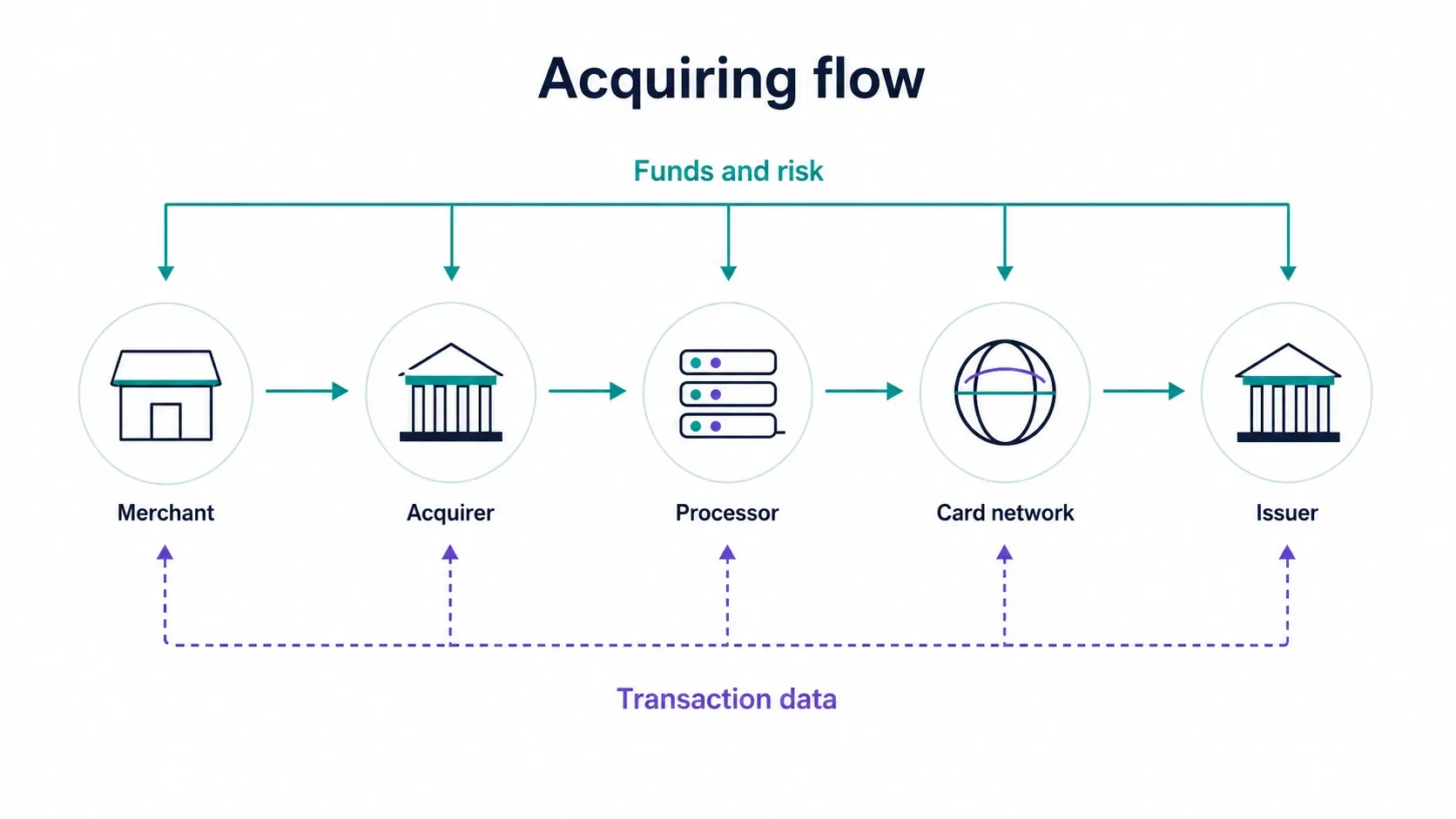
Local acquiring vs cross-border acquiring: key differences
Dimension | Local acquiring | Cross-border acquiring | Why it matters |
|---|---|---|---|
Acquirer location | Licensed and operating in the customer's country or region | Based in a different country from the customer | Affects how card issuers classify and route the transaction |
Customer billing experience | May appear as a domestic charge; local currency billing | May appear as a foreign transaction; can trigger issuer friction | Impacts cardholder trust and checkout abandonment |
Payment method coverage | Can support locally preferred methods such as domestic bank transfers, e-wallets, and local card schemes | Access to locally preferred payment methods may be limited depending on the acquirer's network | Determines whether you can serve the full range of customer payment preferences |
Authorization / approval potential | Issuer may treat the transaction more favorably as a domestic payment in certain markets | Cross-border classification may affect how some issuers evaluate authorization | Influences payment success rates; outcomes vary by market, card type, and issuer |
Fees and FX exposure | May reduce cross-border interchange and scheme fees; actual savings depend on contract, market, and volume | Cross-border fees and FX conversion costs may apply | Directly affects processing cost and margin |
Settlement speed | May settle faster through domestic clearing networks depending on the market | Settlement may be extended by cross-border clearing and FX conversion steps | Affects working capital and cash flow |
Compliance and risk handling | Acquirer operates under local regulatory requirements; local KYC, AML, and risk rules apply | Merchant may face additional compliance obligations across jurisdictions | Determines operational burden and regulatory exposure |
Best-fit merchant stage | Merchants with established or growing volume in a specific market | Merchants testing a new market or consolidating global volume under a single relationship | Helps match the acquiring model to business maturity and expansion stage |
Payment flow
In local acquiring, the transaction travels through a domestic or regional clearing network before reaching the issuer — a shorter, more direct path. In cross-border acquiring, the transaction crosses at least one additional settlement boundary, often with an FX conversion step, which can add processing time and cost depending on the corridor.
Authorization and approval rates
Some issuers in certain markets evaluate domestically acquired transactions differently than cross-border ones. The actual effect on authorization outcomes depends on the market, payment method, card type, and issuer policy. Local acquiring does not guarantee higher approval rates, but it may remove one potential friction point in the authorization chain for certain issuer and market combinations.
Local payment methods and checkout experience
Many markets have strongly preferred local payment instruments — bank transfer schemes, domestic debit networks, and mobile wallet platforms — that may only be accessible through acquirers with local network connections. Examples include PromptPay and GrabPay in Southeast Asia, UPI in India, Pix in Brazil, and Mada in Saudi Arabia, though availability through any specific acquirer will vary by market and provider. For a method-by-method selection framework, see this guide to alternative payment methods. For an implementation-focused walkthrough of adding local methods to your checkout, see local payment acquiring for ecommerce.
Fees, FX, and currency conversion
Cross-border acquiring typically involves additional cost layers: cross-border interchange fees set by card schemes, international processing surcharges, and FX conversion margins. Local acquiring can reduce or eliminate some of these costs where domestic interchange rates differ from cross-border rates. Whether local acquiring is cheaper overall depends on the specific market, your acquiring contract, transaction volume, and currency settlement terms. For a component-by-component breakdown of these cost layers — and the questions to ask before comparing provider quotes — see cross-border acquiring fees.
Settlement and reconciliation
Local acquiring can shorten the settlement chain through domestic clearing systems. Cross-border settlement often involves additional FX conversion and correspondent banking steps that can extend timelines and complicate reconciliation. The degree of difference varies by market, corridor, and provider.
Compliance, licensing, and risk
Acquirers operating locally are subject to the regulatory requirements of the relevant jurisdiction — local KYC, AML, data residency, and consumer protection rules. Merchants expanding into regulated markets in the EU, Southeast Asia, the Middle East, or Latin America should assess both the acquirer's licensing footprint and their own compliance obligations in each country. Platforms that onboard sub-merchants face an additional compliance layer on top of acquiring rules — the payment facilitator compliance checklist outlines those obligations.
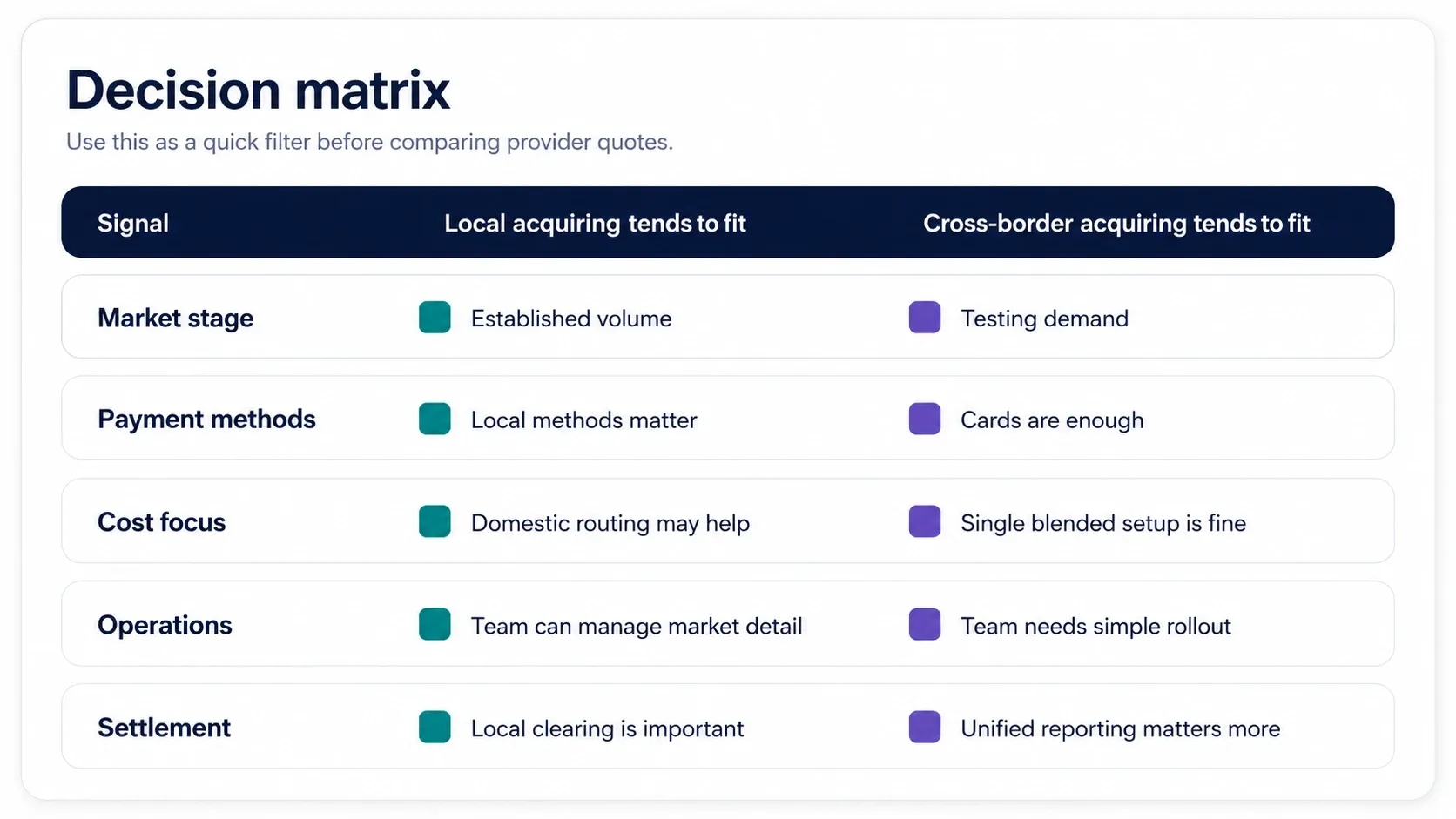
When should ecommerce businesses use local acquiring?
Local acquiring tends to make strategic sense when you have established or growing transaction volume in a specific market and want to optimize payment performance and cost. Key scenarios include:
- Market commitment: You have localized your website, pricing, and customer support for a specific country, and the payment experience needs to match that investment.
- Checkout abandonment: Data shows customers abandoning at the payment stage in a specific market where the acquiring model may be a contributing factor.
- Reliance on local payment methods: Your target customers primarily use payment instruments that are only accessible through local network connections.
- Cost optimization: Cross-border processing fees in a market are materially higher than domestic equivalents, and volume justifies the transition.
- Regulatory alignment: Local regulations or issuer requirements favor or effectively require locally licensed acquirers for certain transaction types.
For a market-specific application of these decisions, see how to evaluate a payment gateway in Hong Kong or a payment gateway in the UAE. If your expansion targets are emerging markets, the next section covers what changes there — local payment habits, what local acquiring involves operationally, and how to check a provider's coverage.
Local acquiring in emerging markets
Merchants expanding into Southeast Asia, Latin America, the Middle East, and other emerging regions often find that payment infrastructure varies considerably from market to market. In many of these markets, consumers rely on local payment methods — domestic bank transfers, mobile wallets, QR-based schemes — that often run on networks separate from international card infrastructure. Local acquiring, or a provider's local payment-method connections, is one of the main ways merchants reach those methods, but it is not a universal upgrade. The decision involves trade-offs across licensing, compliance, and operational complexity.
Why emerging markets have distinct payment needs
Payment behavior in emerging markets often diverges from what merchants are used to in North America or Western Europe. For country-level data, the World Bank Global Findex tracks account ownership, digital payments, and the role of mobile money across economies.
Locally preferred payment methods can be a primary — not secondary — way customers pay. Pix in Brazil and PromptPay in Thailand are two widely adopted examples. Adoption can be fast: a BIS bulletin published in March 2022 reported that Pix had signed up 67% of adults in Brazil a little over a year after its November 2020 launch. A merchant processing through a cross-border acquirer may reach international card networks but have limited access to these domestic methods. That coverage gap is often a reason to evaluate local acquiring, or a provider's local payment-method connections, in a given market.
What local acquiring involves operationally
Operating through local acquiring in these markets involves several connected areas, not just payment method access:
- Acquirer coverage and licensing. Local acquiring relies on an acquirer that is licensed or authorized in the target market. That acquirer may belong to the payment provider's group or be a third-party partner, so ask which applies in each market. Requirements vary by country.
- Payment method access. A locally connected acquirer can reach domestic clearing networks and local card schemes that cross-border channels often cannot.
- Checkout localization. Local currency pricing, local language, and adapted checkout flows sit alongside the acquiring model rather than inside it, and can affect conversion on their own.
- Settlement timing. Actual timing depends on the market, acquirer, payment method, and contract, so confirm the schedule per market.
- Compliance and risk. An acquirer operating under local rules applies local KYC, AML, and risk requirements, and disputes are generally handled under the applicable scheme's rules and that market's regulations.
- Reconciliation. Running several local acquiring relationships can increase reconciliation overhead. Check that finance tooling can handle multi-market settlement reporting before adding several local setups at once.
How to check a provider's local acquiring coverage
Provider marketing often cites a number of markets or licenses. Those counts can be hard to compare, because "local" can mean different things: card acquiring through a locally licensed acquirer, or only a connection to a local payment method with no local card acquiring. Ask for the breakdown market by market:
- In which of my target markets are transactions acquired locally, and in which are they routed cross-border?
- Which locally licensed acquirer processes my transactions in each market, and is it part of the provider's group or a third-party partner?
- Which local payment methods are connected in each market, and can I test them in a sandbox before signing?
- Do I need a local entity or a local bank account in any of these markets to be acquired locally?
- In which currency do I settle in each market, and on what schedule?
- How are refunds, disputes, and chargebacks handled for each local method?
A provider that can break its headline figures down per market makes it possible to compare coverage against your own market list.
When is cross-border acquiring still a good option?
Cross-border acquiring remains a practical choice in several situations:
- Market exploration: Testing demand in a new country before committing to local entity or banking setup.
- Low or unpredictable volume: Transaction volume does not yet justify the operational overhead of a dedicated local acquiring relationship.
- Card-first markets: International cards are the dominant payment method and local payment method access is less critical.
- Speed to market: Payment acceptance is needed in a new market within days rather than weeks.
- Consolidation preference: Your finance team prefers a single settlement account and unified reporting structure over managing multiple local relationships.
What is global acquiring?
Global acquiring does not have one agreed definition. Some providers use the term for a single acquirer that can process payments from anywhere in the world. Stripe's guide to global acquiring, for example, describes an acquirer able to process transactions worldwide regardless of where the payment originates, and contrasts that with local acquiring. The same guide also notes that global acquirers can process payments locally in multiple countries. Other descriptions put the weight on a connect-once model: one integration, local acquiring wherever it is available, and cross-border processing in the remaining markets.
In this guide, global acquiring means the second, hybrid model. A single provider gives merchants access to local acquiring across multiple markets under one platform layer, and falls back to cross-border processing where it has no local connection. The practical question is whether the provider processes transactions through a locally connected acquirer in each market, or routes them cross-border through a single acquirer outside the customer's country. The answer can affect how issuers treat those transactions and which payment methods are actually accessible.
Global acquiring vs local acquiring: how they compare
Dimension | Direct local acquiring | Global acquiring platform |
|---|---|---|
Coverage | Typically one country or region per acquirer relationship | Multiple markets through one provider |
Integration effort | Separate integration per acquirer | Single integration with multi-market access |
Local payment methods | The methods the local acquirer supports in its market | Depends on the provider's local network; confirm per market |
Authorization behavior | Issuer typically treats the transaction as a domestic payment | Depends on whether transactions are acquired locally or cross-border in each market |
Fees | May reduce cross-border interchange; depends on contract and market | Varies by provider and by whether each market is acquired locally or cross-border; confirm in the quote |
Settlement | Domestic clearing timelines per market | Depends on the local acquirers and banking partners the provider uses in each market |
Compliance | Merchant manages obligations market by market | Provider arranges the local acquiring relationships; merchant retains its own compliance obligations |
Operational overhead | Typically higher — separate contracts, reconciliation, and reporting per acquirer | Typically lower — centralized reporting, reconciliation, and support |
Best fit | High-volume merchants in specific priority markets | Merchants selling in several markets at once that need local payment methods or local routing without a contract per market |
Is global acquiring the same as cross-border acquiring?
It depends on how the provider uses the term. Cross-border acquiring means an acquirer based in a different country from your customer processes the transaction. A provider that uses "global acquiring" for a single worldwide acquirer may be describing cross-border acquiring. A global acquiring platform of the hybrid kind routes transactions to a locally connected acquirer in the markets where it has one, and processes cross-border in the rest. Ask which applies in each of your target markets.
When is global acquiring more practical than direct local acquiring?
Direct local acquiring tends to fit when your volume in a specific market justifies a dedicated acquirer relationship, or when you need negotiated rates or deep customization that require a direct contract. It also assumes your payments team has the capacity to run several acquirer integrations and reconciliation workflows. Replicating that model across many markets at once can become resource-intensive.
Global acquiring tends to make more operational sense when you are entering or selling in multiple markets and need coverage without establishing local entities in each one. Whether local acquiring is available without a local entity depends on the provider's model and the market, so confirm it per market. It also fits when you need locally preferred payment methods without maintaining a separate integration per provider, and when you want centralized reporting, settlement, and support.
How global acquiring combines local coverage with cross-border flexibility
In practice, the hybrid model moves the per-country acquirer contracts and connections behind the provider.
Under a global acquiring arrangement, transactions in supported markets may be routed to a locally connected acquirer, while the merchant maintains one integration, one reconciliation layer, and one commercial relationship with the provider. Coverage, payment method support, settlement terms, and licensing arrangements vary by provider and region. Merchants should evaluate providers on the depth of their local network connections, compliance posture, and settlement capabilities.
How HaiPay supports local and global acquiring
HaiPay's payment acquiring solution is built around local network connectivity in the markets HaiPay serves, typically giving merchants access to 150+ local payment methods across key markets — including locally preferred options such as OVO and DANA in Indonesia, PromptPay in Thailand, Pix in Brazil, and Mada in Saudi Arabia — alongside international card schemes, through a single integration. Method availability by market is confirmed in your quote.
Key capabilities include:
- Local payment method coverage: Integrated access to locally preferred payment instruments in supported markets.
- Multi-currency settlement: Settlement in multiple currencies with local clearing network connectivity where available in supported markets.
- Smart routing: Intelligent transaction routing designed to optimize authorization paths across available acquirers.
- Localized risk controls: Market-specific risk rules and compliance configurations to support fraud prevention in local contexts.
- Reconciliation tools: Automated reconciliation to reduce manual overhead across multi-market operations.
HaiPay also provides a cross-border payment solution for merchants serving international customers. Setup and annual fees are US$0, with no minimum monthly billing. Confirm any monthly service fee and other account-specific charges separately. Account eligibility, payment-method availability and settlement arrangements are confirmed after review in the merchant quote.
For specific coverage details, licensing, settlement terms, or payment method availability in your target markets, speak with a HaiPay payments specialist.
Quantified local vs cross-border acquiring evidence
The official sources below do not always disclose a controlled, transaction-level comparison between local and cross-border acquiring. This table therefore reproduces only the figures published by each provider and clearly identifies any missing baselines or methodological limitations.
Market and period | Local acquiring | Cross-border or previous setup | Published difference | Sample and official source | Important limitation |
|---|---|---|---|---|---|
Singapore; case published September 24, 2021; measurement period not disclosed | Absolute payment success rate not disclosed | Previous cross-border payment success rate not disclosed | 3% uplift in payment success after implementing local acquiring in Singapore | One large ESW brand; transaction volume not disclosed. Adyen: ESW case study | The source does not disclose the baseline rate, measurement period, transaction count, card mix, fraud controls, or whether “3% uplift” means a relative increase or percentage-point increase. |
Japan; reported for 2024; measured within a few months of switching | Absolute acceptance rate after direct acquiring not disclosed | Previous acceptance rate not disclosed; the source does not explicitly classify the previous route as cross-border | 4.15% uplift in acceptance rates after merchants switched to direct acquiring | Multiple merchants; merchant count and transaction volume not disclosed. Checkout.com: 2024 Annual Letter | This is a provider-reported aggregate. The source does not disclose the baseline, merchant industries, card mix, fraud settings, or exact measurement dates. |
Middle East, Africa, and Asia portfolio; August to March; year not disclosed | Absolute acceptance rate after localization not disclosed | Previous cross-border acceptance rate and processing cost not disclosed | 3% acceptance-rate uplift across all Majid Al Futtaim brands and markets; 6% increase in card acceptance for Carrefour; AED 4 million in operational savings across the grocery business | All Majid Al Futtaim brands and markets; transaction volume not disclosed. Checkout.com: Majid Al Futtaim case study | The results combine local acquiring with network tokens, fraud tools, reporting improvements, and platform consolidation. The source does not isolate the effect of local acquiring or disclose the comparison year. |
Australia to the United States; case published in 2023; measurement period not disclosed | Local-acquiring rate not separately disclosed; authorization rate after optimized processing routing was 91.19% | Authorization rate before the new routing setup was 69.83%; the source does not confirm that the previous route was cross-border acquiring | Increase of 21.36 percentage points, from 69.83% to 91.19% | One Australian merchant selling into the United States; transaction volume not disclosed. Checkout.com: Reach case study | This is supporting routing evidence, not a controlled local-versus-cross-border comparison. Intelligent Acceptance and other payment optimizations may also have affected the result. |
These published examples indicate that localized or direct acquiring can improve payment performance in specific merchant setups. However, they should not be treated as universal benchmarks or outcomes for every merchant. Authorization rates and processing costs can also be affected by issuer country, card type, transaction currency, merchant category, authentication strategy, fraud rules, payment retries, tokenization, and customer mix.
When comparing providers, merchants should request a controlled test using the same market, period, merchant category, transaction profile, currencies, card mix, fraud settings, and authentication rules. The comparison should separately report authorization rate, processing cost, foreign-exchange cost, settlement time, refund rate, chargeback rate, and transaction volume.
Disclosure: These figures were published by the named payment providers or their customers. HaiPay has not independently audited the underlying transaction data, and the results should not be interpreted as a performance promise.
Ready to evaluate your acquiring strategy?
The right acquiring model depends on your specific markets, transaction volume, payment method mix, and expansion priorities. If you are still mapping out how the acquiring side works before comparing models, start with the fundamentals of merchant acquiring, then return here to weigh local against cross-border.
Explore HaiPay global acquiring to see how local coverage and cross-border flexibility work through a single platform — or talk to our payment experts to discuss your specific requirements.
Source: HaiPay pricing and settlement guidance, accessed October 16, 2026. Account-specific availability, pricing and settlement arrangements are confirmed in the merchant quote.
FAQ
Local acquiring is a payment processing model in which the acquirer is licensed and operating in the same country or region as the customer. The transaction clears through local or regional networks, which can affect payment method availability, authorization handling, settlement speed, and compliance requirements compared with cross-border acquiring.
Cross-border acquiring occurs when a merchant’s transactions in a given country are processed by an acquirer based in a different country. It enables global payment acceptance through a single acquiring relationship without requiring local entity setup. Trade-offs can include additional fees, limited access to locally preferred payment methods, and potentially longer settlement timelines.
In this guide, global acquiring means a single provider giving merchants access to local acquiring across multiple markets through one platform, with cross-border processing where it has no local connection. Some providers use the term for a single acquirer that processes payments worldwide, so check which model a provider means.
Local acquiring may remove one friction point in the authorization process because some issuers evaluate domestically acquired transactions differently from cross-border ones. However, approval outcomes depend on card type, issuer policy, transaction characteristics, fraud scoring, market, and acquirer, so local acquiring does not guarantee higher approval rates in every case.
Local payment methods are payment instruments widely preferred in a specific country or region, often outside international card networks. Examples include Pix in Brazil, UPI in India, GrabPay or OVO in Southeast Asia, and Mada in Saudi Arabia. Access usually depends on local network connections in the relevant market.
Cross-border acquiring is a legal and widely used model, but requirements vary by market. Some jurisdictions may impose restrictions on cross-border payment flows, require local licensing for certain transaction types, or mandate specific data residency and AML controls. Merchants should assess local requirements before entering each market.
Not necessarily. Some merchants operate with a single cross-border acquirer, especially when entering new markets or serving mainly card-based audiences. As volume grows and local payment methods become more important to conversion and cost, adding local or regional acquiring coverage can make commercial sense.
Choose local acquiring when you have committed, growing volume in a specific market and your customers rely on local payment methods. Choose cross-border acquiring when you are testing a new market, volume is still low, or speed to market matters more than per-transaction cost. Many merchants combine both through a global acquiring platform as they scale.

Related HaiPay surfaces
Explore the payment stack
Guide
Merchant Acquiring, Explained
Merchant Acquiring Guide — How acquiring works end to end: players, flows, and how to choose a partner
Product
Global Card Acquiring
Global Card Acquiring — Accept cards worldwide, with local network connectivity across key markets
Blog
Cross-border Acquiring Fees
Cross-border Acquiring Fees — The main cost components of cross-border acquiring, and the questions to ask before comparing quotes
Terms in this guide
Glossary terms covered
Cross-Border Payment
A cross-border payment is a transaction where the payer, merchant outlet, or payment route spans more than one country or jurisdiction, while currency conversion remains a separate event.

Need help mapping your payment stack?
Talk to HaiPay about acquiring, orchestration, local methods, and payout workflows.
Contact us