


Direct Answer
A cross-border payment is one whose parties or route span more than one country. In card rules the test is precise: the Transaction Country is where the merchant outlet is located, and the payment counts as an International Transaction when the card’s issuer is not located in that country. Currency conversion is a separate event and does not define the category. Being cross-border changes which acquirer may accept the transaction and what the issuer must disclose to the cardholder about fees.
Source: Visa, “Visa Core Rules and Visa Product and Service Rules” (Glossary entries “Transaction Country” and “International Transaction”, the latter carrying a US Region carve-out; sections 1.4.3.2 and 1.5.1.1, edition 18 April 2026), accessed 2026-09-04.
What makes a payment cross-border
The label describes a mismatch of countries, not of currencies. Visa defines the Transaction Country as the country in which a Merchant Outlet is located, and an International Transaction as one where the Issuer of the card used is not located there. The issuing bank’s location decides the category.
Source: Visa, “Visa Core Rules and Visa Product and Service Rules” (Glossary entries “Transaction Country” and “International Transaction”, edition 18 April 2026; the International Transaction entry carries a US Region and US Territory carve-out for US Covered Visa Debit Card Transactions for routing and Interchange Reimbursement Fee purposes), accessed 2026-09-04.
Beyond the card networks the term is looser: the Financial Stability Board describes global cross-border payments as carried out through a diverse multi-layered set of networks.
Source: Financial Stability Board, “Enhancing Cross-border Payments – Stage 1 report to the G20” (policy-level description of the networks carrying cross-border payments), accessed 2026-09-04.
Classify the transaction before you diagnose it
Label | Test | What it changes |
|---|---|---|
Domestic Transaction | Issuer in the Transaction Country. | Baseline. |
International Transaction | Issuer outside the Transaction Country. | Fee disclosure attaches. |
Intraregional Transaction | Issuer elsewhere in the same Visa Region. | Isolate first. |
Interregional Transaction | Issuer outside the Visa Region of the transaction. | Segment reporting first. |
Currency conversion | Transaction Currency differs from Billing Currency. | Separate from the country test. |
Source: Visa, “Visa Core Rules and Visa Product and Service Rules” (section 1.4.3.2 “International Transaction and Currency Conversion Fee Disclosure” and Glossary entries “Domestic Transaction”, “International Transaction”, “Intraregional Transaction”, “Interregional Transaction”, “Transaction Currency” and “Billing Currency”, edition 18 April 2026; “Visa Region” is Visa’s own regional terminology, and the International Transaction entry carries a US Region and US Territory carve-out for routing and Interchange Reimbursement Fee purposes), accessed 2026-09-04.
Currency conversion is a separate event
Transaction Currency is the currency in which a transaction is completed; Billing Currency is the one an Issuer bills the Cardholder in. Visa requires an Issuer to disclose fees that may be charged for an International Transaction or when currency conversion occurs. Foreign exchange spread is a separate question.
Source: Visa, “Visa Core Rules and Visa Product and Service Rules” (section 1.4.3.2 “International Transaction and Currency Conversion Fee Disclosure” and Glossary entries “Transaction Currency” and “Billing Currency”, edition 18 April 2026; this section carries no regional suffix and applies to Issuers generally), accessed 2026-09-04.
Stripe adds that a bank or card issuer might charge the customer when the payment method and the business are in different countries, regardless of the currency used.
Source: Stripe, “Supported currencies” (Stripe’s own platform documentation: currency presentment and settlement, cross-country issuer fees, and per-method currency limits), accessed 2026-09-04.
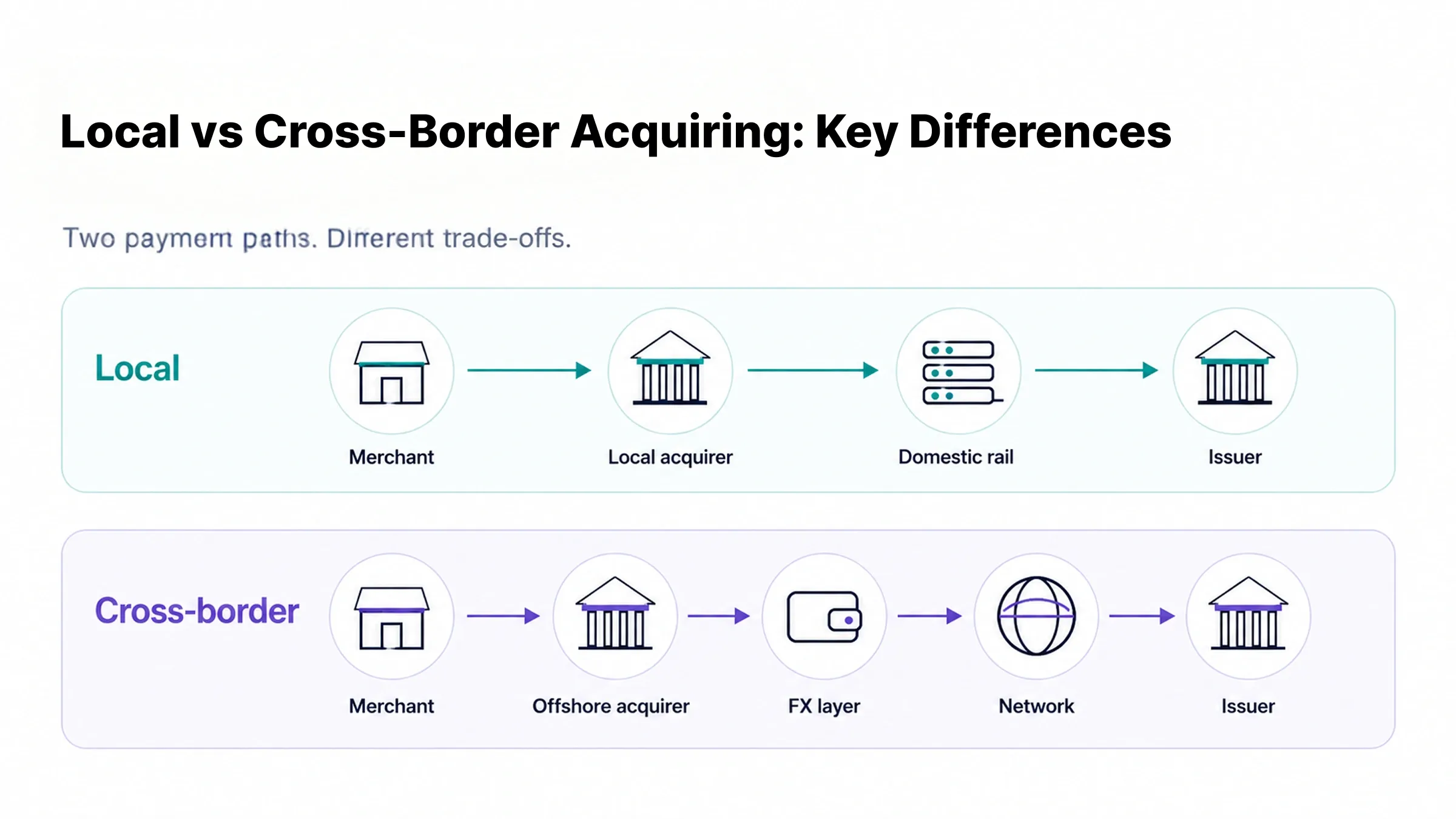
Your acquiring contract can limit the corridor
Visa requires an Acquirer to accept transactions only from a Merchant Outlet within its Country of Domicile and that country’s territories and possessions, unless a listed exception applies — among them Visa’s approval for a member licensed elsewhere and the International Airline Program. The same section lets a payment facilitator sponsor a merchant abroad only if the Acquirer and that merchant share a country and settlement runs through the Acquirer’s jurisdiction.
Source: Visa, “Visa Core Rules and Visa Product and Service Rules” (section 1.5.1.1 “Acquirer Jurisdiction and Restriction of Cross-Border Acquiring”, edition 18 April 2026; the section carries no regional suffix, but it is qualified by LAC Region (Chile and Brazil) footnotes, a Canada and US Region table restricting cross-border acquiring of electronic commerce and mail/phone order transactions, and a Europe Region passporting exception — check the region governing your acquirer), accessed 2026-09-04.
Diagnose declines from your provider’s own codes
No source cited here publishes a universal cross-border approval rate, so treat headline figures as unsourced. Adyen maps the decline “62: Invalid card in this country” to its Restricted Card refusal reason, returns Not supported when the shopper’s bank does not allow that transaction type, and returns Authentication required when the issuer declines an authentication exemption request and requires 3-D Secure. Those are Adyen’s labels for its own responses.
- Store Transaction Country and issuer country separately from currency.
- Record presentment and settlement currency on every attempt.
- Keep the raw network decline code, not a grouped label.
- Segment payment authorization outcomes by corridor.
Source: Adyen, “Refusal reasons” (Adyen’s own refusal codes and network decline mappings), accessed 2026-09-04.
Local methods and screening follow the corridor
Stripe documents that payment methods support certain currencies, countries, products and API options, and that other local payment methods often only support one specific currency. Confirm eligibility per method and per market, then decide whether payment orchestration owns routing.
Source: Stripe, “Payment method support” (Stripe’s country, currency and product limits per payment method); Stripe, “Supported currencies” (Stripe’s own platform documentation: currency presentment and settlement, cross-country issuer fees, and per-method currency limits), accessed 2026-09-04.
Screening obligations are scoped by program. OFAC administers and enforces U.S. economic and trade sanctions, and states that non-U.S. persons are also subject to certain OFAC prohibitions, such as causing or conspiring to cause U.S. persons to violate U.S. sanctions.
Source: U.S. Office of Foreign Assets Control, “Basic Information on OFAC and Sanctions” (scope of U.S. sanctions prohibitions), accessed 2026-09-04.
Read merchant acquirer next, then merchant of record for which entity is the outlet.
FAQ
No. The card-rule classification turns on where the issuer is located relative to the Transaction Country, not on the currency, so a payment can be an International Transaction and still be completed in a single currency. The rules treat the two as separate triggers: Visa requires an Issuer to disclose fees charged for an International Transaction or when currency conversion occurs. Stripe makes the same split from the merchant side, noting a bank or card issuer might charge the customer when the payment method and the business are in different countries, regardless of the currency used.
Source: Visa, “Visa Core Rules and Visa Product and Service Rules” (section 1.4.3.2 “International Transaction and Currency Conversion Fee Disclosure” and Glossary entries “Transaction Currency” and “Billing Currency”, edition 18 April 2026; this section carries no regional suffix and applies to Issuers generally); Stripe, “Supported currencies” (Stripe’s own platform documentation: currency presentment and settlement, cross-country issuer fees, and per-method currency limits), accessed 2026-09-04.
Treat any universal figure as unsourced. Neither the card rules nor the provider documentation cited here publishes a global cross-border approval rate, and outcomes are set per issuer and per corridor. Diagnose instead of estimating: Adyen maps the network decline “62: Invalid card in this country” to its Restricted Card refusal reason, returns Not supported when the shopper’s bank does not support or allow that type of transaction, and returns Authentication required when an authentication exemption request is declined. Read your own provider’s mapping, then segment your data by corridor.
Source: Adyen, “Refusal reasons” (Adyen’s own refusal codes and network decline mappings), accessed 2026-09-04.
They decide whether a market is reachable at all. Stripe documents that payment methods support certain currencies, countries, products and API options, and that other local payment methods often only support one specific currency. Stripe also states that converting prices to local currencies can improve customer conversion and authorization rates, which is that provider’s claim about its own platform rather than a measured industry result. Check eligibility per method and per market before promising coverage.
Source: Stripe, “Payment method support” (Stripe’s country, currency and product limits per payment method); Stripe, “Supported currencies” (Stripe’s own platform documentation: currency presentment and settlement, cross-country issuer fees, and per-method currency limits), accessed 2026-09-04.
The merchant outlet’s country does. Visa requires an Acquirer to accept transactions only from a Merchant Outlet within its Country of Domicile and that country’s territories and possessions, unless a listed exception applies, such as Visa’s approval for a member licensed in another jurisdiction, the International Airline Program, or premises like a military base, embassy or consulate. A payment facilitator may sponsor a merchant outside its own country only when the Acquirer and sponsored merchant share a country and settlement runs through the Acquirer’s jurisdiction.
Source: Visa, “Visa Core Rules and Visa Product and Service Rules” (section 1.5.1.1 “Acquirer Jurisdiction and Restriction of Cross-Border Acquiring”, edition 18 April 2026; the section carries no regional suffix, but it is qualified by LAC Region (Chile and Brazil) footnotes, a Canada and US Region table restricting cross-border acquiring of electronic commerce and mail/phone order transactions, and a Europe Region passporting exception — check the region governing your acquirer), accessed 2026-09-04.

Sources
Related terms
Cross-border and FX
Foreign Exchange Spread
Foreign exchange spread is the markup between the market reference rate and the rate applied to a merchant or payer during currency conversion, often combined with explicit FX fees in cross-border payments.
Acquiring and settlement
Issuing Bank
An issuing bank provides payment cards to customers and manages the accounts used for those cards throughout authorization, clearing, and settlement.
Acquiring and settlement
Merchant Acquirer
A merchant acquirer is a payment service provider that contracts with businesses to accept and process card payments on behalf of participating card networks.
Acquiring and settlement
Payment Authorization
Payment authorization checks whether a card transaction is approved by the cardholder’s issuing institution or a service acting for it before funds can later be captured.
Acquiring and settlement
Merchant of Record (MoR)
A merchant of record is the party legally responsible for a sale to the customer, including tax, compliance, and chargeback obligations tied to that transaction.
Acquiring and settlement
Payment Orchestration
Payment orchestration is the practice of routing each transaction through the optimal acquirer, method, or gateway path based on rules such as cost, authorization rate, geography, and redundancy requirements.
Usage Guide
 Read Guide
Acquiring Decisions
Local Acquiring vs Cross-border Acquiring: Key Differences and When to Use Each
 Read Guide
Payment Roles
Merchant Acquiring Explained: Acquirer vs Processor vs Acquiring Bank vs PayFac

Need help mapping your payment stack?
Collect and settle across currencies with compliance-ready pay-in and payout rails.
Contact Us