


Direct Answer
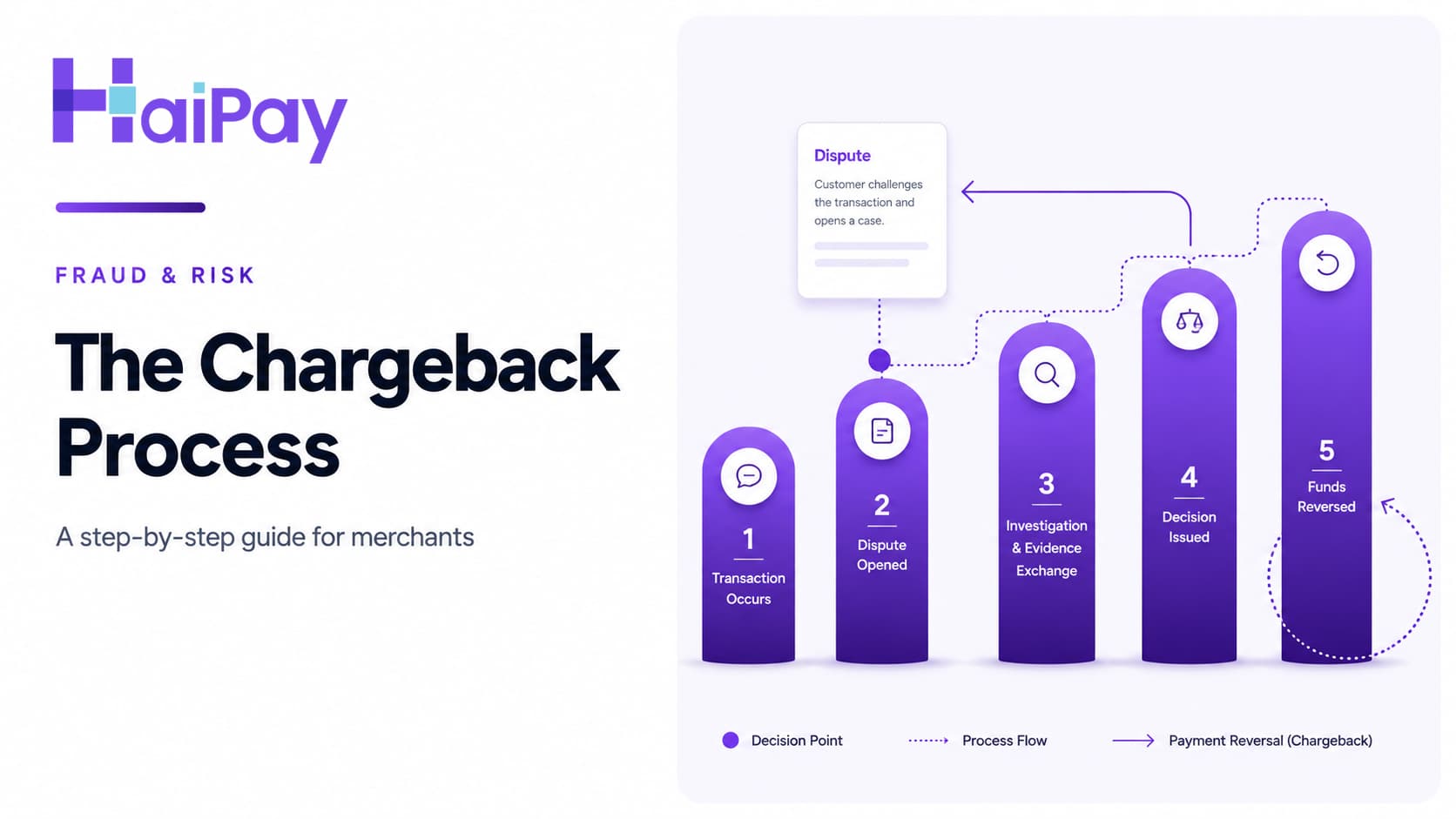
A chargeback is a forced reversal of a card payment. The cardholder asks the bank that issued the card to contest the charge, the issuer files a dispute under a reason code, the network moves the funds, and the merchant is debited before it has answered. Adyen groups the reasons into fraud, consumer disputes, processing errors and authorization. Stripe states that a merchant cannot refund outside the dispute process once a dispute is open, so evidence submitted inside the scheme’s window is the only route back.
Source: Stripe, “How disputes work” (Stripe’s own dispute lifecycle, fees and timing); Adyen, “Understanding and defending disputes” (Adyen dispute categories and flow), accessed 2026-09-04.
What a chargeback actually moves
A chargeback starts outside your systems: the cardholder contacts the bank that issued the card and contests a payment. The issuer files it, the network pulls the funds, and your provider debits you before you have said anything. Stripe documents that order for its own accounts: notify, debit the disputed amount plus a dispute fee, then leave you to accept or challenge the claim. The Visa Rules require the issuer to review a dispute for validity first, out of your view.
Source: Stripe, “How disputes work” (Stripe’s own dispute lifecycle, fees and timing); Visa, “Visa Core Rules and Visa Product and Service Rules” (§11.1.2 “Issuer Responsibilities to Cardholders for Dispute Resolution”; edition 18 April 2026), accessed 2026-09-04.
The roles are fixed. The issuing bank decides the outcome; your merchant acquirer and payment processor carry evidence back up the chain, and the debit reaches you through the merchant account or provider balance. Adyen sorts cardholder reasons into fraud, consumer disputes, processing errors and authorization, and notes that disputability depends on the method: card payments can be disputed, bank transfers cannot.
Source: Adyen, “Understanding and defending disputes” (Adyen dispute categories and flow), accessed 2026-09-04.
Read the reason code before you write anything
The Visa Rules organize dispute conditions under those same four categories, and the condition decides which records count: a “not received” claim and a “not authorized” claim are answered with different files. Visa’s dispute tables can also carry a second column naming the country or region a rule applies to, so check a rule’s stated scope before assuming it reaches your market.
Source: Visa, “Visa Core Rules and Visa Product and Service Rules” (§11.6.1 “Dispute Categories Table Format”, §11.7 “Dispute Category 10: Fraud”, §11.10 “Dispute Category 13: Consumer Disputes”; edition 18 April 2026), accessed 2026-09-04.
Dispute category (Visa Rules) | What the cardholder is claiming | Records Adyen asks for in defense |
|---|---|---|
Category 10: Fraud | The payment was not made by the cardholder; conditions 10.1–10.5 cover card-present and card-absent fraud | Card-absent merchandise: invoice, email conversation, signed proof of delivery with an AVS match, record of previous non-disputed payments. Card-absent digital goods: confirmation email, cardholder IP address, device ID. Card-present: a signed transaction receipt, CCTV footage |
Category 11: Authorization | No valid authorization, or late presentment | Proof that a valid authorization approval took place; proof of capture within the applicable timeframe |
Category 12: Processing errors | Duplicate processing, or already paid another way | Proof of two separate transactions with transaction ID; proof that no other form of payment was used |
Category 13: Consumer disputes | Goods never arrived, or were not as described | Description of the goods, signed proof of delivery and an AVS match, communication confirming possession |
Source: Adyen, “Dispute reason codes and defense requirements” (the defense documents Adyen asks for); Visa, “Visa Core Rules and Visa Product and Service Rules” (§11.7 “Dispute Category 10: Fraud”, §11.8 “Dispute Category 11: Authorization”, §11.9 “Dispute Category 12: Processing Errors”; edition 18 April 2026), accessed 2026-09-04.
Chargeback, refund and inquiry are three different events
A refund is your own reversal of a payment you captured; a chargeback is imposed on you, and Stripe states that once a dispute is open you cannot refund outside it. An inquiry — a retrieval or request for information — sits earlier: Stripe reports that American Express and Discover most often use that stage, Visa and Mastercard no longer do, and an unanswered inquiry can escalate into a chargeback you are unlikely to win.
Source: Stripe, “How disputes work” (Stripe’s own dispute lifecycle, fees and timing), accessed 2026-09-04.
Deadlines belong to the scheme, not to your calendar
Adyen puts the general cardholder window at a maximum of 120 calendar days from the transaction date, and at up to 540 calendar days in some Visa and Mastercard cases where fulfilment comes later — such as pre-orders and travel. Adyen lists separate response and decision windows per scheme. If the member misses the window or accepts responsibility, the Visa Rules close the cycle and leave that member liable for the amount last received.
Source: Adyen, “Dispute timeframes” (Adyen’s scheme-by-scheme timeframe table); Visa, “Visa Core Rules and Visa Product and Service Rules” (§11.2.1 “Dispute Resolution Process General Requirements”; edition 18 April 2026), accessed 2026-09-04.
Consumer-protection law runs on its own clock. In the United States, Regulation Z requires a cardholder’s billing error notice to reach the creditor no later than 60 days after the creditor transmitted the first periodic statement showing the alleged error — a condition on the cardholder’s notice under a US issuer-side rule, not a network deadline, and not portable to other markets.
Source: Consumer Financial Protection Bureau, “§ 1026.13 Billing error resolution” (US Regulation Z open-end credit; not a card-network rule), accessed 2026-09-04.
Decide accept or defend on the evidence you already hold
Some disputes cannot be challenged at all, and Stripe closes those as lost when it notifies you. Where a challenge is possible, the Visa Rules let the acquirer submit specified compelling evidence with a pre-arbitration attempt for certain fraud conditions — for a delivered card-absent order, evidence that the item went to the same physical address for which the merchant received an AVS match of Y or M, with no signature required.
Source: Visa, “Visa Core Rules and Visa Product and Service Rules” (§11.5.1 “Use of Compelling Evidence”; edition 18 April 2026); Stripe, “How disputes work” (Stripe’s own dispute lifecycle, fees and timing), accessed 2026-09-04.
- The authorization and capture records, with the transaction reference the provider asks for.
- Delivery evidence tied to the AVS-matched address, not one added later.
- Terms and cancellation policy as a checkout screenshot — Adyen asks for screenshots or text, not links.
- Contact history with the cardholder, including an empty support queue if they never wrote.
- Whether 3-D Secure covered the payment: Stripe says it supplies 3DS data itself where liability shift applies.
Source: Adyen, “Dispute reason codes and defense requirements” (the defense documents Adyen asks for); Stripe, “How disputes work” (Stripe’s own dispute lifecycle, fees and timing), accessed 2026-09-04.
Your ratio is monitored even on disputes you win
The Visa Rules cover dispute and fraud monitoring under risk: Visa identifies an acquirer under its Acquirer Monitoring Program (VAMP) when it meets the requirements set out in the VAMP guide. Stripe describes the merchant-facing side: crossing a threshold puts the account into a monitoring program with monthly fines and fees, and failing to comply in time can end with the network refusing further payments. Monitoring programs do not consider dispute outcomes, so a dispute you eventually win still counts; refunds are not counted as disputes.
Source: Visa, “Visa Core Rules and Visa Product and Service Rules” (§10.4.2 “Dispute Monitoring”, §10.4.3.1 “Visa Acquirer Monitoring Program (VAMP)”; edition 18 April 2026); Stripe, “Dispute and fraud card monitoring programs” (Stripe’s description of network monitoring programs), accessed 2026-09-04.
Your own count will diverge from the network’s: Stripe attributes the gap to statement-descriptor formatting, multiple MIDs, and disputes it handles for you that never reach your dashboard yet still enter the network’s calculation. Reconcile against the acquiring-side record, and keep settlement and dispute reports separate.
Source: Stripe, “Dispute and fraud card monitoring programs” (Stripe’s description of network monitoring programs), accessed 2026-09-04.
FAQ
No. A refund is a reversal you choose to make; a chargeback is imposed through the issuer and the card network. Stripe states that while a dispute is open you cannot refund outside the dispute process, and that a full refund issued before a dispute does not always stop one — the issuer can miss it and raise the dispute anyway, though Stripe says that rarely happens. For network monitoring, refunds are not counted as disputes.
Source: Stripe, “How disputes work” (Stripe’s own dispute lifecycle, fees and timing); Stripe, “Dispute and fraud card monitoring programs” (Stripe’s description of network monitoring programs), accessed 2026-09-04.
No. Stripe documents unchallengeable disputes that it closes as lost when it notifies you, because network rules or local regulations give you no chance to submit evidence — its examples include Cartes Bancaires disputes for businesses in the SEPA area and Nigerian payment methods. Where a challenge is possible, the Visa Rules list allowable compelling evidence only for fraud conditions 10.1, 10.3 and 10.4, and Adyen states that meeting the defense requirements does not guarantee a win.
Source: Stripe, “How disputes work” (Stripe’s own dispute lifecycle, fees and timing); Visa, “Visa Core Rules and Visa Product and Service Rules” (§11.5.1 “Use of Compelling Evidence”, Table 11-6; edition 18 April 2026); Adyen, “Dispute reason codes and defense requirements” (the defense documents Adyen asks for), accessed 2026-09-04.
Fees come from your provider and acquirer agreement, not from the definition of a chargeback. Stripe, as one documented example, debits a dispute fee when a cardholder initiates a dispute, treats that fee as non-refundable outside Mexico, adds a separate countered fee that it returns if you win, and charges no received fee on Cartes Bancaires card payments for businesses in the SEPA area. Network monitoring programs can add their own fines and fees. Read your own contract rather than generalizing.
Source: Stripe, “How disputes work” (Stripe’s own dispute lifecycle, fees and timing); Stripe, “Dispute and fraud card monitoring programs” (Stripe’s description of network monitoring programs), accessed 2026-09-04.
It depends on the scheme and the stage. Adyen puts the general cardholder window at a maximum of 120 calendar days from the transaction date, and up to 540 calendar days in some Visa and Mastercard cases where fulfilment comes later, with separate response and decision windows per scheme. Stripe describes a full lifecycle of roughly two to three months from initiation to final decision, and says you cannot reliably speed it up except by accepting the dispute.
Source: Adyen, “Dispute timeframes” (Adyen’s scheme-by-scheme timeframe table); Stripe, “How disputes work” (Stripe’s own dispute lifecycle, fees and timing), accessed 2026-09-04.

Sources
Related terms
Acquiring and settlement
Issuing Bank
An issuing bank provides payment cards to customers and manages the accounts used for those cards throughout authorization, clearing, and settlement.
Acquiring and settlement
Merchant Acquirer
A merchant acquirer is a payment service provider that contracts with businesses to accept and process card payments on behalf of participating card networks.
Acquiring and settlement
Payment Authorization
Payment authorization checks whether a card transaction is approved by the cardholder’s issuing institution or a service acting for it before funds can later be captured.
Risk and compliance
Address Verification Service (AVS)
Address Verification Service (AVS) compares the billing address submitted at checkout with the address on file at the card issuer to flag mismatches that may indicate fraud.
Card scheme basics
3-D Secure (3DS)
3-D Secure (3DS) is a cardholder authentication protocol that adds a step-up challenge during online checkout so issuers can confirm the payer before authorizing high-risk transactions.
Acquiring and settlement
Settlement (Card Payments)
Card payment settlement transfers funds between participating financial institutions to meet obligations from processed card transactions after clearing has been completed.
Usage Guide
 Read Guide
Fraud & Risk
The Chargeback Process: A Complete Step-by-Step Guide for Merchants
 Read Guide
Payment Roles
Merchant Acquiring Explained: Acquirer vs Processor vs Acquiring Bank vs PayFac

Need help mapping your payment stack?
Accept major card networks with routing, 3DS, and settlement built for cross-border sales.
Contact Us