


Direct Answer
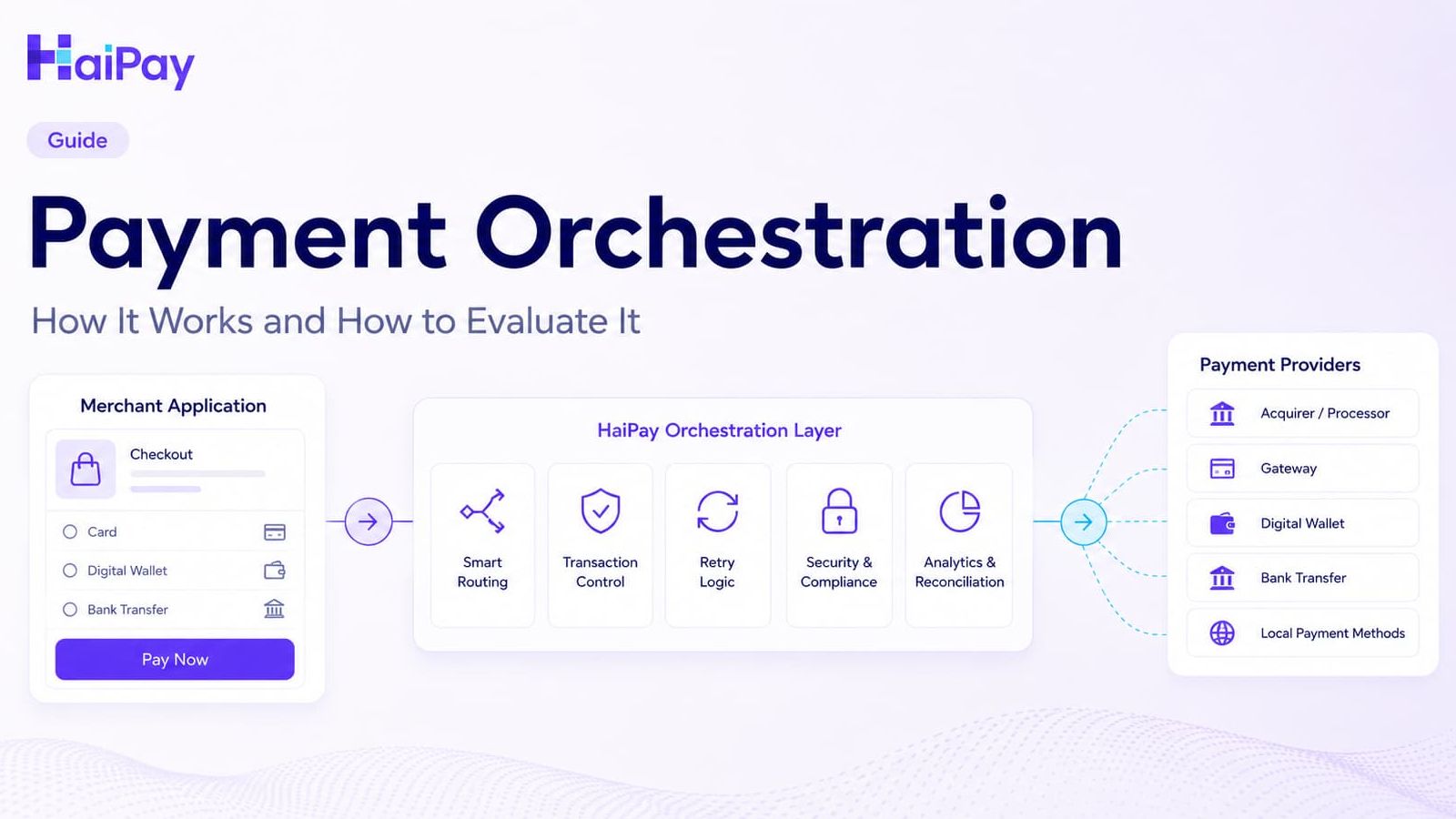
Payment orchestration puts a rule layer in front of more than one payment connection and decides, per transaction, which provider handles the attempt and what happens if it fails. In Stripe’s documented setup, rule conditions test payment attributes such as card country, currency and amount, and a retry action can send a failed attempt to a second processor. Orchestration changes routing, not the underlying relationships: there the destination processor still acts as the processor, and its fees, liability, disputes and settlement stay with it.
Source: Stripe, “Orchestration” (Stripe’s private-preview multiprocessor routing product); Stripe, “Route payments to multiple processors” (Stripe rule conditions, cross-processor retry and destination onboarding), accessed 2026-09-04.
What the routing layer decides
Payment orchestration sits above more than one processing connection and makes a per-transaction choice: which provider receives this attempt, and what happens if it fails. In Stripe’s Orchestration, which is in private preview, that choice is written as dashboard rules whose conditions test card country, currency and amount, with an optional action that retries a failed payment once on another chosen processor.
Source: Stripe, “Orchestration” (Stripe’s private-preview multiprocessor routing product); Stripe, “Route payments to multiple processors” (Stripe rule conditions, cross-processor retry and destination onboarding), accessed 2026-09-04.
Keep the routing layer distinct from the components it selects between: a payment gateway, a payment processor and a merchant acquirer each have their own entry in this glossary. Orchestration chooses among those connections rather than replacing any of them — in Stripe’s product a third-party processor continues to act as the processor for payments routed to it.
Source: Stripe, “Orchestration” (Stripe’s private-preview multiprocessor routing product), accessed 2026-09-04.
Routing does not move the contract
Stripe adds that all related activity, including processing fees and liability for transaction losses, stays subject to the terms you agreed with that processor, and that its Orchestration does not support disputes or settlement-related activity — those go to the third-party processor’s own dashboard. Onboarding a destination is its own project: under Visa’s rules, before contracting with a prospective merchant an acquirer or payment facilitator must conduct an adequate due diligence review, including a site visit to the business premises (if applicable) or suitable alternative.
Source: Stripe, “Orchestration” (Stripe’s private-preview multiprocessor routing product); Visa, “Visa Core Rules and Visa Product and Service Rules” (§5.2.1.2 “Due Diligence Review of Prospective Merchant or Sponsored Merchant”; the section carries no regional limiter, unlike the neighbouring US Region rules §5.2.1.4 and §5.2.1.5; edition 18 April 2026), accessed 2026-09-04.
So chargebacks, refunds and funding records stay attached to whichever provider ran the payment. In Stripe’s setup each destination is a processor you supply API keys for in the Stripe Dashboard, so the merchant identification number and merchant account behind it still matter to reconciliation. How a routing layer relates to your acquiring relationships differs by provider.
Source: Stripe, “Orchestration” (Stripe’s private-preview multiprocessor routing product); Stripe, “Route payments to multiple processors” (Stripe rule conditions, cross-processor retry and destination onboarding), accessed 2026-09-04.
Retry rules run inside scheme limits
A retry is not a free choice. Visa’s rules set what a merchant may do after each class of decline, and they also govern routing reference data: an acquirer that chooses to use the Account Range table Visa provides to determine authorization routing must install and use it within 6 business days of receipt.
Source: Visa, “Visa Core Rules and Visa Product and Service Rules” (§7.3.1.1 “Account Range Table for Authorization Routing”; the section carries no regional limiter, unlike §7.3.1.2, which applies in the AP Region only; edition 18 April 2026), accessed 2026-09-04.
Table 7-2 sets the reattempt limit per decline category, unless §7.3.6.2 specifies otherwise for Mobility and Transport Transactions. The examples below exclude codes 70 and 1A, which the table limits to the CEMEA and Europe Regions.
Decline category (Visa Table 7-2) | Example response codes | Merchant reattempt limit |
|---|---|---|
Category 1: issuer will never approve | 04, 41, 43, 46, 57, R0, R1, R3 | Never resubmit the authorization request or account verification for the same payment credential. |
Category 2: issuer cannot approve at this time | 51, 59, 61, 91 | Reattempt permitted, up to 20 attempts in 30 days. |
Category 3: data quality — revalidate payment information | 54, 55, 82, N7 | Reattempt permitted, up to 20 attempts in 30 days. |
Category 4: generic response codes | All other decline response codes | Reattempt permitted, up to 20 attempts in 30 days. |
Source: Visa, “Visa Core Rules and Visa Product and Service Rules” (§7.3.6.3 “Use of Authorization Response Codes” and Table 7-2 “Decline Response Code Use”; the section carries no regional limiter, and regional codes are excluded above; edition 18 April 2026), accessed 2026-09-04.
Failover carries a second constraint. §1.7.2.1 says a party that reattempts an authorization request following a decline response must not intentionally manipulate any data elements from the original request, and it names the acquiring identifier, acquirer and merchant country, MCC, point-of-sale entry mode and the electronic commerce indicator among them; merchant outlet country data must stay the same throughout the transaction life cycle. The rule addresses manipulation of the original request’s data, not which acquirers you contract with, so how a cross-processor failover is treated is a question to settle with each acquirer before relying on it.
Source: Visa, “Visa Core Rules and Visa Product and Service Rules” (§1.7.2.1 “Complete and Valid Transaction Data”; a Visa Core Rule with no regional limiter; edition 18 April 2026), accessed 2026-09-04.
Feature parity is where multi-processor routing breaks
Stripe warns that a feature which normally works on Stripe may fail on the destination, returning a 400 error code of orchestration_unsupported. Its documented gaps include multicapture, 3-D Secure with Apple Pay and Google Pay (DPAN), and Google Pay (FPAN) on Adyen; an optional error-protection setting routes such payments back to Stripe instead. Those are one provider’s limits across its three supported destinations, not a general property of orchestration.
Source: Stripe, “Supported Orchestration features” (feature gaps across Stripe’s three supported destination processors), accessed 2026-09-04.
- Capture behaviour: automatic and manual, and whether more than one capture is supported.
- Whether 3-D Secure runs on the destination, and on which wallet paths it does not.
- Refunds: full and partial support, and which provider administers them.
- Wallet and network-token support, destination by destination.
- Recurring and stored-credential handling.
- Statement descriptor fields, which differ between processors.
Source: Stripe, “Supported Orchestration features” (feature gaps across Stripe’s three supported destination processors); Stripe, “Orchestration” (Stripe’s private-preview multiprocessor routing product), accessed 2026-09-04.
Stored credentials do not travel for free
Moving a saved card between processors is its own problem. Stripe’s Vault and Forward API tokenizes card details in its vault and routes that data to third-party endpoints, and the same page records the edges. Credentials saved through Link cannot be transferred between processors and are excluded from forwarding. Card security codes expire after a period and on use with the API. The forwarding API does not confirm or capture PaymentIntents, so it is possible to capture on Stripe a payment already captured elsewhere.
Source: Stripe, “Forward card details to third-party API endpoints” (Stripe vault portability limits and duplicate-capture warning), accessed 2026-09-04.
Measure it honestly
Approval-rate comparisons need a stated denominator. Stripe’s declines guidance says to analyze unique declines and exclude failed retries when reviewing authorization rates, because a layer that retries raises the attempt count and moves an unadjusted rate without anything improving. Read the payment result, not the transport: Adyen returns HTTP status code 200 with a message of OK even when an authorization is refused, and its resultCode, refusalReason and refusalReasonCode carry the real outcome.
Source: Stripe, “Declines” (Stripe guidance on measuring authorization and decline rates); Adyen, “Refusal reasons” (Adyen HTTP-versus-payment-result distinction and refusal codes), accessed 2026-09-04.
Continue with Payment Authorization for the approval step itself, and Cross-Border Payment for the cross-border context these routing decisions sit in.
FAQ
Not by definition, but coverage is provider-specific. Stripe documents that Orchestration feature support does not include non-card payments or Link, and that Link credentials cannot be transferred between processors and are always processed on Stripe. Treat a routing layer as covering exactly the methods its provider lists, and check that list before assuming bank transfers, wallets or local methods you already accept will follow the same rules.
Source: Stripe, “Orchestration” (Stripe’s private-preview multiprocessor routing product); Stripe, “Route payments to multiple processors” (Stripe rule conditions, cross-processor retry and destination onboarding), accessed 2026-09-04.
Only if you route to more than one acquiring relationship. Stripe requires you to supply API keys for each destination processor and states that the processor continues to act as the processor, with fees and liability under the terms you agreed with it. On the acquiring side, Visa requires an acquirer or payment facilitator to conduct an adequate due diligence review before contracting with a prospective merchant. Routing between methods inside one provider needs no additional acquiring identity.
Source: Stripe, “Route payments to multiple processors” (Stripe rule conditions, cross-processor retry and destination onboarding); Stripe, “Orchestration” (Stripe’s private-preview multiprocessor routing product); Visa, “Visa Core Rules and Visa Product and Service Rules” (§5.2.1.2 “Due Diligence Review of Prospective Merchant or Sponsored Merchant”; no regional limiter; edition 18 April 2026), accessed 2026-09-04.
It can change which processor sees each attempt and add one retry elsewhere, but the measurement is the hard part. Stripe advises analyzing unique declines and excluding failed retries when reviewing authorization rates, so a rate that counts retries is not comparable to one that does not. Visa Table 7-2 also caps the retry budget: Category 1 declines must never be resubmitted for the same payment credential, and other categories permit up to 20 attempts in 30 days.
Source: Stripe, “Declines” (Stripe guidance on measuring authorization and decline rates); Visa, “Visa Core Rules and Visa Product and Service Rules” (§7.3.6.3 “Use of Authorization Response Codes” and Table 7-2; §7.3.6.2 sets separate terms for Mobility and Transport Transactions; edition 18 April 2026), accessed 2026-09-04.
The provider that processed it. Stripe documents that Orchestration does not support disputes or settlement-related activity and directs you to the third-party processor’s dashboard for those, and that refunds for payments routed to a third-party processor are administered by that processor. A routing layer can centralize the authorization decision while dispute evidence, refunds and funding records stay split across providers, so plan reconciliation around that split.
Source: Stripe, “Orchestration” (Stripe’s private-preview multiprocessor routing product), accessed 2026-09-04.

Sources
Related terms
Acquiring and settlement
Payment Gateway
A payment gateway is technology that passes payment information from a business's checkout to the systems that process the transaction.
Acquiring and settlement
Payment Processor
A payment processor is a service that handles transaction messages between businesses, financial institutions, and payment networks during authorization, capture, and related status updates.
Acquiring and settlement
Merchant Acquirer
A merchant acquirer is a payment service provider that contracts with businesses to accept and process card payments on behalf of participating card networks.
Acquiring and settlement
Merchant Account
A merchant account is an account used to accept and manage card-payment proceeds before they reach a business bank account.
Acquiring and settlement
Merchant Identification Number (MID)
A merchant identification number is an identifier assigned within a card-processing arrangement to identify a merchant or its merchant account.
Acquiring and settlement
Payment Authorization
Payment authorization checks whether a card transaction is approved by the cardholder’s issuing institution or a service acting for it before funds can later be captured.
Cross-border and FX
Cross-Border Payment
A cross-border payment is a transaction where the payer, merchant, acquirer, or settlement currency spans different countries, triggering FX conversion, local method requirements, and compliance checks.
Usage Guide
 Read Guide
Payment Orchestration
What Is Payment Orchestration? How It Works and How to Evaluate It
 Read Guide
Payment Roles
Merchant Acquiring Explained: Acquirer vs Processor vs Acquiring Bank vs PayFac

Need help mapping your payment stack?
Offer wallets, bank transfers, and regional methods in the markets you sell into.
Contact Us