


Payment Settlement Time: What T+N Actually Means and When Your Money Arrives
Reviewed by Wesley Wang










Last updated: September 10th, 2026
The unit is the timeline
A settlement quote of "T+2" is incomplete until you know three things: which clock it describes, what unit the days are counted in, and what payout schedule sits on top of it. Business days and calendar days can move the same Friday sale by two or three days — and the unit can change inside one provider: Stripe publishes an initial settlement timing in calendar days next to a default ongoing timing in business days. HaiPay counts its tiers in calendar days and settles on working days — a weekend or holiday pushes the arrival to the next working day — with your actual settlement timeline confirmed in your quote.
Payment settlement time is the gap between a customer paying and the money becoming yours to use. The number you were quoted — something like "T+2" — does not tell you what you think it tells you. T is the day the transaction is captured — when the sale is finalized for settlement, not the moment the customer clicks pay; the number after it counts days. Settlement runs on three separate clocks: the settlement schedule (when your provider receives cleared funds), the payout schedule (when it releases them to you), and bank transit. The "N" comes in two different units — business days or calendar days — which can move the same Friday sale's arrival by two or three days. The unit is part of the answer, not a footnote.
The three clocks behind "when do I get my money"
Merchants asking this question are rarely confused about one number — they are confused because three numbers are stacked on top of each other and nobody labels them.

A T+N quote labels only one clock unless settlement, payout, and bank transit are separated.
Clock one: the settlement schedule. After a card payment is authorized and captured, it is batched, cleared through the card network, and settled to your provider. This is the "T+N" part of any quote. Stripe's documentation defines it directly: "The settlement timing refers to the amount of time it takes for your funds to become available. Settlement timing varies per country and is typically expressed as 'T+X' days" (Stripe docs, accessed 2026-08-23).
Clock two: the payout schedule. Settled funds are not automatically moving funds. Providers pay out daily, weekly, or monthly, and the payout schedule stacks on top of settlement. Checkout.com's docs walk the exact case: a Tuesday payment at T+2 becomes available Thursday — but if payouts run weekly on Fridays, it leaves on Friday (Checkout.com docs, accessed 2026-08-23). Note the vocabulary clash: Checkout.com calls that cadence its settlement schedule, which is this article's clock two.
Clock three: bank transit. Even after payout, the transfer itself takes time. Adyen's documentation notes that "it may take up to two days for the payout funds to arrive in your account" depending on the currencies and banks involved (Adyen docs, accessed 2026-08-23).
A merchant on r/ShopifyeCommerce described the result of these unlabeled stacked clocks precisely:
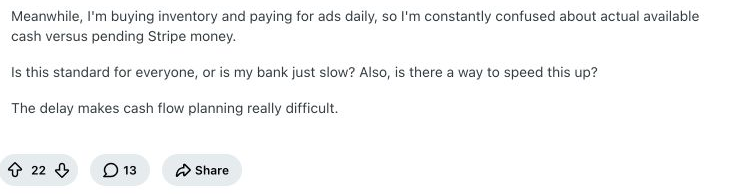
A merchant described being “constantly confused about actual available cash versus pending Stripe money.” Source: r/ShopifyeCommerce, accessed 2026-08-24.
"constantly confused about actual available cash versus pending Stripe money", adding that "the delay makes cash flow planning really difficult." Both halves are the problem — the wait costs money, and not knowing which of the three clocks you are waiting on costs you the ability to plan around it (r/ShopifyeCommerce, accessed 2026-08-23).
The unit trap: business days or calendar days?
Here is the part almost no explainer covers. The "N" in T+N has two possible units, and the difference is largest exactly when you care most — at the end of the week.
Take one $1,000 sale captured on a Friday, quoted at T+2:
Unit | How the days count | Funds available |
|---|---|---|
T+2 business days | Saturday and Sunday do not count | Tuesday |
T+2 calendar days | Every day counts | Sunday |
One quote, one transaction, two arrival dates two days apart — and a public holiday on Monday stretches the business-day version to Wednesday.

A Friday T+2 quote reaches Tuesday in business days and Sunday in calendar days; a Monday public holiday moves the business-day result to Wednesday—illustrative figures, actual timeline confirmed in your quote.
Adyen's docs confirm the mechanics from the provider side: "The payout delay for a currency increases when a bank holiday falls on the sales day, the payout day, or in between" (Adyen docs, accessed 2026-08-23).
This is not a theoretical distinction — providers document it themselves. Stripe's payouts documentation states plainly that "there are two definitions of days that affect settlement and payout timing", and works the same trap with a Saturday charge: "If you use calendar days, Saturday is day 0. If you use business days, the next Monday is day 0" (Stripe docs, accessed 2026-08-23). Airwallex's settlement documentation puts its own default in one line — "Most card and direct debit settlements count business days only" — and shows both sides: "If a T+1 payment is cleared on a Friday, it will settle on Monday", while "methods like PayNow count every day. A T+1 payment on Friday settles on Saturday" (Airwallex docs, accessed 2026-08-23). Same notation, same day of the week, two different answers — which is why a one-number quote without a unit is incomplete.
How the major providers actually quote settlement
Comparison scope: published pay-in settlement and payout timing for card payments, from each provider's own public documentation or help pages; all pages fetched and quoted on 2026-08-23; sources numbered below. Fees, reserves, and eligibility conditions are excluded — this compares stated timing only, and any provider's actual terms for your account are set in your agreement.
Provider | Published timing | Unit used |
|---|---|---|
Stripe | Settlement timing published per country as T+X, with a separate initial timing for your first payout — Stripe "typically schedules your initial payout for 7-14 days after you successfully receive your first payment"; bank-debit methods run longer (ACH Debit 4 business days, SEPA Direct Debit 6) | Both — the docs define calendar and business days as two separate timing definitions |
PayPal (clock three only — withdrawal timing, not card settlement) | Standard bank transfers typically complete in 1-3 business days; "Holidays and weekends will delay withdrawal arrival timeframes by at least 1 business day" (PayPal help, accessed 2026-08-23) | Business days |
Adyen (payout delay — Adyen states it does not track scheme settlement timelines) | 2 business days when at least 80% of transactions are in a listed currency (USD, EUR, GBP and others) and acquired in that currency's own country or region; 3 business days for other accounts, and 3, 7 or 12 for partner-onboarded accounts by industry; American Express carries a 7-day settlement delay | Business days |
Airwallex | Per-method T+N schedules; its docs teach the unit rule explicitly: a T+1 card payment cleared on Friday settles Monday, while calendar-day methods like PayNow settle Saturday | Both — split by method |
Checkout.com | T+2 for major domestic currencies (GBP, EUR, USD, AED, HKD, SGD, AUD, NZD, CAD), T+3 or above for others; "X is the number of business days" | Business days |
Two patterns worth noticing. First, there is no single unit to assume — the unit can change inside a single provider.
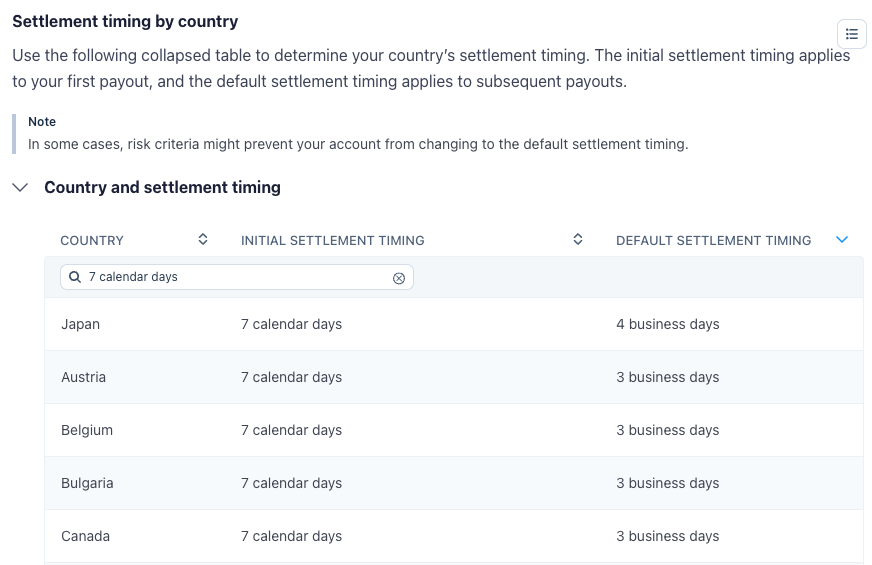
Stripe's country table uses 7 calendar days for initial settlement and 3 business days by default for most shown countries, with Japan at 4 business days. Source: Stripe Documentation, accessed 2026-08-24
Stripe publishes two numbers per country: an initial settlement timing, quoted as "7 calendar days" for most of the countries listed, and a default ongoing timing, quoted in business days ("3 business days" for most, "4 business days" for Japan). One table, one country, and the unit switches depending on which row of your account's life you are reading. Second, the range across providers for the same merchant profile spans days, not hours: the answer to "how long does settlement take" is genuinely "it depends", but in a way you can now interrogate line by line.
Why settlement time estimates disagree — and the three questions that resolve them
Search this topic and the answers disagree with each other — and one page disagrees with itself. IXOPAY's guide describes ACH (the US bank-transfer network) twice: once as taking "3-5 days" with no unit named, and once, further down the same page, as "3-5 business days". Spreedly's guide says ACH transactions "are typically settled on the next business day" (IXOPAY and Spreedly, both accessed 2026-08-23). Three statements about one rail — and one of them omits the unit entirely, so a reader cannot tell whether "3-5 days" means the same thing as "3-5 business days" written a few paragraphs below it.
The disagreement is structural, not sloppy arithmetic: each explainer silently fixes a different combination of the three clocks, a different scope, and — when it bothers to name one — a different unit. Which is why the practical skill is not memorizing a number — it is asking three questions of any provider: Which clock does this number describe? What unit is it in? And what is the payout schedule on top of it?
HaiPay's settlement tiers: one unit, stated up front
Our own tiers are counted in calendar days, and settlement runs on working days: transactions captured over a weekend or a public holiday are settled together on the next working day. A Friday capture on a T+1 method therefore settles on Monday alongside the weekend's transactions, and if that Monday is a holiday it moves to the first working day after it. That is the part worth writing down — not a claim to be faster, but a rule you can plan against. Our standard tiers by market group:
Your actual settlement timeline is confirmed in your quote — it depends on your contracting entity, transaction volume, and transaction quality.
Typical tier (calendar days) | Markets |
|---|---|
T+1 | Indonesia · Vietnam · Thailand · Philippines · India · Brazil · Mexico (SPEI) · Bangladesh · stablecoin settlement |
T+2 | Singapore · Hong Kong/Macau · Malaysia |
T+3 | Pakistan · Egypt · Nigeria · Kenya · Tanzania · Ghana · South Africa · Cameroon |
T+5 | International card acquiring · Mexico (OXXO) |
T+7 | South Korea · Middle East markets (GCC, Iraq and Jordan) · Taiwan (JKO Pay) |
T+15 | Japan |
T+20 | Taiwan — LINE Pay |
Weekly cycle | Taiwan — bank transfer (each Friday settles the prior seven days) |
Read these with the working-day rule above: the tier is the count, and the arrival date is the first working day at or after that count.

HaiPay tiers count calendar days, while settlement runs on working days; weekend and public-holiday transactions settle together on the next working day.
A tier of T+1 does not mean a Saturday arrival on a Friday sale — it means the weekend's transactions clear together on Monday. Our card acquiring tier and the fees that sit alongside it are summarized on our pricing page; to see the tier that applies to your own markets in writing, ask us for a quote.
For a cross-border merchant, the unit discipline matters more than the headline number: once every market's tier is stated in the same unit, you can reconcile your settlements against expected dates instead of guessing, the same way an itemized interchange-plus quote lets you audit fees line by line. The full fee context around settlement lives in our payment gateway fees guide.
What can slow your settlement down
Four multipliers sit outside the quoted tier — three are documented by the providers themselves; the remaining one, platform layers, is reported by merchants rather than published. All are worth checking before assuming your quote is being missed:
- First-payout review. New accounts can settle slower for the first cycle: Stripe "typically schedules your initial payout for 7-14 days after you successfully receive your first payment" (Stripe docs, accessed 2026-08-23). Other providers describe a first-cycle review without publishing a figure.
- Risk holds and reserves. A rolling reserve holds a slice of settled funds for a defined window; Airwallex's docs describe funds moving only after "the payment method's settlement period or your reserve period — whichever is longer" (Airwallex docs, accessed 2026-08-23).
- Platform layers. If you sell through a platform (a CRM, a marketplace, a storefront), it can add its own payout delay on top of the processor's schedule — a delay neither you nor the processor's public table will show.
- Cut-off times. Every settlement batch has a closing time, and a transaction captured after it belongs to the next day. on Adyen's default Sales day payout model, the payable batch "always closes two hours after your sales day closing time" (Adyen docs, accessed 2026-08-23), and Airwallex runs its main batch at 23:00 in the time zone of its own entity — "not your own local time zone" (Airwallex docs, accessed 2026-08-23).
FAQ
It depends on the provider, the market, and the payment method. Checkout.com publishes T+2 business days for its main domestic currencies; Adyen publishes a payout delay starting at 2 business days for qualifying currency-and-region combinations; Stripe publishes per-country tiers; and bank-debit methods run longer everywhere. The honest answer has a structure, not a single number: settlement tier + payout schedule + bank transit, in a stated unit. HaiPay's standard international card acquiring tier is typically T+5 calendar days, settling on the next working day if that day falls on a weekend or holiday, and it does not apply automatically to every market — your actual timeline is confirmed in your quote.
T is the capture date; 2 is the number of days until funds settle. The quote is incomplete until you know the unit: T+2 business days turns a Friday sale into Tuesday availability, T+2 calendar days into Sunday. Providers differ on which unit they use — Checkout.com states its own outright ("X is the number of business days after the transaction date"), while Stripe's documentation defines calendar days and business days as two separate timing definitions. The notation looks identical; the unit underneath it does not have to be, so ask.
There is no industry default — it splits by provider, and inside a provider it can split by payment method or by account stage. Checkout.com quotes its card availability speed in business days and Adyen quotes its payout delay the same way; Airwallex says of its own settlements that "most card and direct debit settlements count business days only" while methods like PayNow count every day; and Stripe publishes an initial timing in calendar days alongside a default ongoing timing in business days. Because there is no safe default, the unit has to be asked for. HaiPay counts its tiers in calendar days and settles on working days — a weekend or holiday pushes the arrival to the next working day — with your actual settlement timeline confirmed in your quote.
New accounts go through risk review before funds flow at the standard tier. Stripe is the provider that publishes a specific window — it "typically schedules your initial payout for 7-14 days" after your first payment — while others describe first-cycle review without naming a figure. Either way this is a one-time multiplier, not your ongoing tier: if settlement is still slow after the first cycle, look at holds, reserves, or a platform layer instead.
Settlement is funds reaching your provider from the card network; payout is your provider releasing funds to your bank. They run on separate schedules that stack: a T+2 settlement with a weekly Friday payout means a Tuesday sale leaves on Friday. When comparing providers, ask for both numbers — a short settlement tier stacked on a slow payout schedule still arrives late.
By market tiers, all quoted in calendar days. T+1 applies to selected local payment methods in Indonesia, Vietnam, Thailand, the Philippines, India, Brazil, Bangladesh and Mexico — Mexico for SPEI, while Mexico OXXO sits at T+5 — and to stablecoin settlement. T+2 covers Singapore, Hong Kong/Macau and Malaysia; T+3 covers Pakistan and our African markets (Egypt, Nigeria, Kenya, Tanzania, Ghana, South Africa and Cameroon); T+5 covers international card acquiring; and the slower tail runs T+7 in South Korea and the Middle East (GCC, Iraq and Jordan), T+15 in Japan, and up to T+20 or a weekly cycle in Taiwan. Settlement runs on working days throughout: a weekend or public holiday pushes the arrival to the next working day. These are standard published levels, with your actual timeline confirmed in your quote based on contracting entity, volume, and transaction quality.
