Payment gateway reconciliation: match orders, payment records and bank deposits
Reviewed by YuanQiang Wu


Last updated: November 18th, 2026
Payment reconciliation at a glance
Payment gateway reconciliation matches your order records, provider records and bank deposits, then explains any difference between them.
A paid order, an available platform balance and money received by your bank are different events. Treating them as interchangeable makes normal timing differences look like missing money—and can hide a genuine problem.
This guide provides a five-step process, a worked example and a record layout. It also explains how to separate Indian customer collections from payments to creators, contractors or suppliers.
Disclosure: HaiPay publishes this guide and offers related payment services. The example amounts are fictional. The workflow is an editorial operating aid, not accounting or investment advice for a particular business.
Start with three sources
Collect the records for the period before comparing totals:
Source | What you need from it | What it cannot establish alone |
|---|---|---|
Your order system | Order reference, amount, currency and fulfilment record | Whether the provider has transferred funds to your bank |
Payment provider | Transactions, adjustments, balance movements and transfers | Whether the destination bank has credited the transfer |
Company bank | Actual credits and debits, dates and references | Which customer orders make up an aggregated transfer |
Use this as a working record structure, not a promise that every provider exports identically named fields. Record missing fields and ask the provider which references can connect the records.
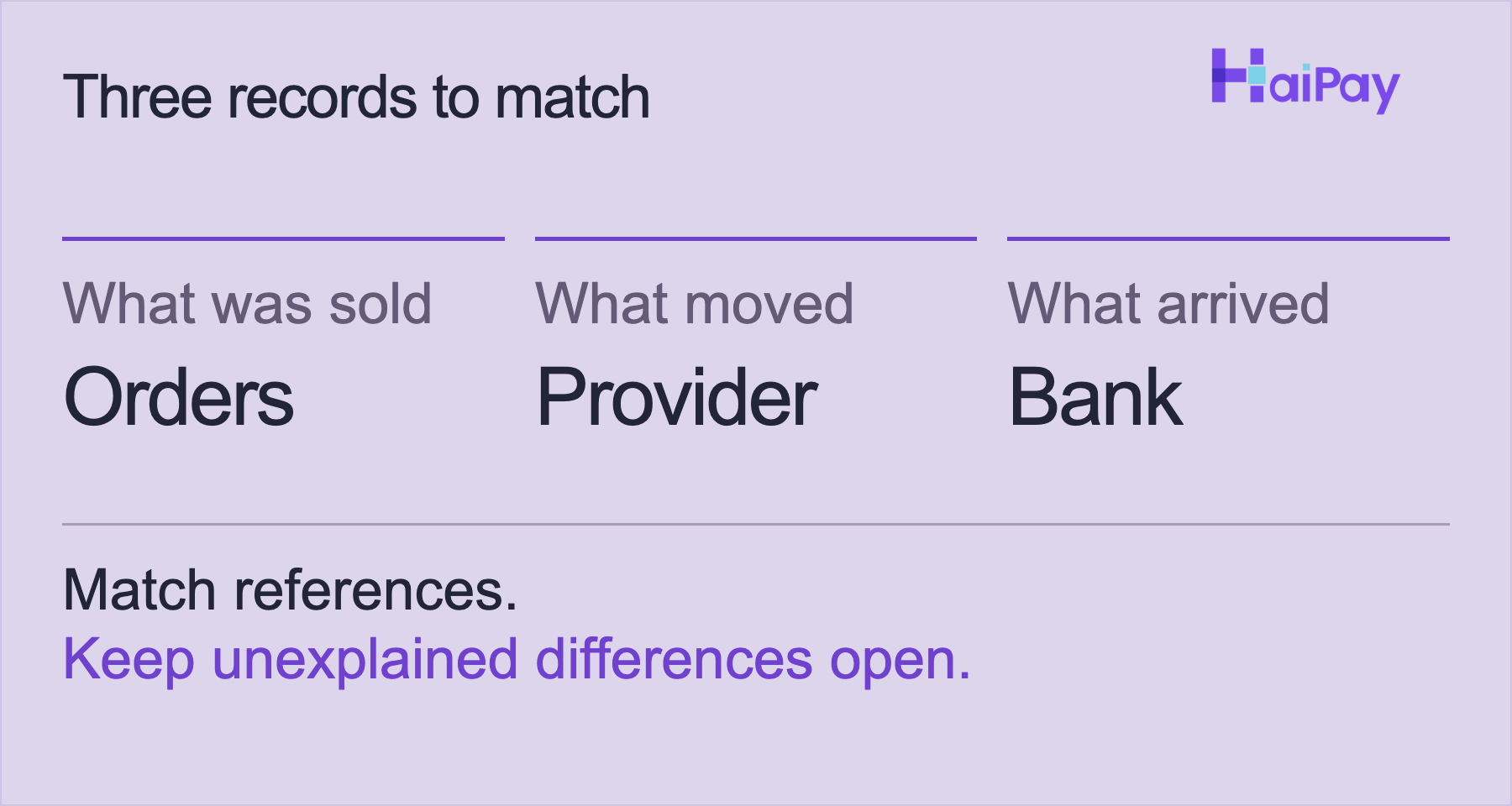
Conceptual record map. Each source answers a different question; the figure does not show completed reconciliation.
Stripe's bank reconciliation documentation illustrates the distinction between payouts and deposits in a bank account. Its documented feature has account and geographic restrictions; it is not a description of functionality available in every payment system.
Source: Stripe, “Bank reconciliation”, accessed 5 November 2026; cited for the separation of provider transfers and bank receipt.
GOV.UK Pay documents another useful distinction: its admin tool uses local UK time, while downloaded reports and its API use Coordinated Universal Time (UTC). Check the timestamps in each system before matching records across a reporting boundary.
Source: GOV.UK Pay, “Reconcile and report on payments”, accessed 5 November 2026. This example describes GOV.UK Pay, not the timezones used by every provider.
Reconcile in five steps
1. Fix the reporting scope
Record the provider account, date range, timezone and currency. Decide whether the report period is based on payment time, settlement availability or bank receipt. Keep those dates as separate columns.
For example, a customer payment recorded on the last day of a month may belong in a different bank-receipt period. Retain the link between the events instead of moving the payment date to force a match.
Before matching, check that the export covers the full selected period. Record row counts and any missing pages, files or accounts. Preserve the original extract, and keep a separate log of exclusions and suspected duplicates.
2. Match the bank deposit to the transfer
Start with a bank credit and find its provider transfer or batch reference. A batch is a group of transactions and adjustments included in a transfer.
Check the expected amount and currency, then identify any separately recorded bank or transfer charges. If the bank entry has no usable reference, record that limitation before attempting an amount-and-date match.
3. Match the underlying payment records to orders
Within the transfer or report, connect payments to your order references. Retain both your merchant reference and the provider's transaction reference where available. On no-code checkout URLs, lock order references before sending—see how to create a payment link.
Handle refunds, disputes and adjustments as their own records. They may relate to an earlier order or reporting period. Do not turn every statement line into a new sale.
4. Explain the remaining difference
Assign a supported reason to each difference: fee, refund, currency conversion, timing, adjustment or a suspected processing error. Keep unexplained entries open with an owner and next action.
Do not insert a balancing fee just to make the totals agree. An exact total with invented inputs is not a reconciled record.
5. Close supported items and carry exceptions forward
For each closed item, retain the evidence used to match it. For an open item, record the last observed status, observation time and the next review date.
A finance lead should be able to read the exception list without reconstructing the investigation from chat messages. Give support the original references when escalating a missing or unclear payment.
Worked example: explain a bank deposit
The following amounts are invented for arithmetic only. They are not HaiPay prices, an India quote or a customer's transaction history.
Assume one US-dollar report contains sales, recorded processing fees, a completed refund and a transfer charge. All entries use the same currency, and no other adjustments apply in this example.
Report entry | Amount | Evidence in a real reconciliation |
|---|---|---|
Gross payments | $2,000 | Matched payment records |
Recorded processing fees | −$60 | Actual fee lines and the merchant agreement |
Completed refund principal | −$100 | Refund record linked to the original payment |
Recorded transfer charge | −$10 | Transfer-charge entry |
Expected bank credit | $1,830 | The four entries above |
Observed bank credit | $1,830 | Bank statement |
Unexplained difference | $0 | Observed credit minus expected credit |
The calculation is $2,000 − $60 − $100 − $10 = $1,830. If the bank instead shows $1,825, the remaining $5 stays unexplained until a record supports its cause.
In a real report, check whether refund amounts, refunded fees and transfer charges are already included in a net total. Subtracting them again creates a second mismatch.
For cross-currency payments, reconcile the original-currency amounts and the converted amounts using the recorded conversion. Do not subtract an Indian-rupee refund directly from a US-dollar bank deposit.
Investigate the difference at the right event
Observation | Check next | Avoid this shortcut |
|---|---|---|
Order exists, payment record is missing | Original order query and provider reference | Marking the order paid from the customer's return page |
Payment succeeded, bank credit is absent | Platform availability, transfer instruction and bank receipt separately | Calling the payment failed because no deposit is visible |
Deposit is smaller than the gross payments | Recorded fees, refunds, adjustments and conversion | Applying a guessed percentage to close the gap |
Two entries share an order reference | Their distinct provider references and event types | Deleting one as a duplicate without investigating |
Refund request exists, refund result is absent | Refund handling record and current result | Marking the refund complete from the request alone |
A transfer or payout remains unresolved | Original transaction status and escalation record | Creating another payment because a request timed out |
These are investigation steps. Their labels are not provider API status codes and should not be copied into an integration as if they were.
Keep currency and timing visible
Record the payment currency, balance currency and bank-credit currency wherever they differ. Retain the conversion amount, rate and related charges exposed by your actual records.
Keep the clock equally explicit. A settlement estimate needs a starting event and a day-counting rule. It also needs to say whether it describes platform availability, transfer release or bank arrival.
For provider-specific terms, use the agreement and relevant statements. This article does not quote a universal settlement period, local-payment fee or currency-conversion rate.
India collections and recipient payouts need separate records
Consider a fictional content platform. Viewers pay for access, while creators receive earned income. The platform has incoming customer payments and outgoing recipient payments; the two flows should not share a single “paid” flag.
For HaiPay's India service, collection funds and payout funding are accounted for separately. The confirmed payout funding arrangement uses a US-dollar corporate transfer. Conversion takes place when the recipient payout is initiated.
Source: HaiPay product-owner confirmations supplied for this project; reviewed 5 November 2026. Scope: India funding and separate accounting. This is not evidence of an automatic transfer between balances.
Flow | Record to retain | Question it answers |
|---|---|---|
Customer collection | Order reference, payment amount, currency and confirmed result | Did this viewer pay? |
Collection funds available | Platform balance and settlement record | Are the collected funds available under the agreed terms? |
Company withdrawal | Transfer instruction, conversion and applicable charges | What was sent to the company's bank? |
Company bank receipt | Bank credit and reference | What actually arrived? |
Payout funding | Corporate transfer and payout-balance record | Was the outgoing balance funded? |
Creator payment | Approved payable, payout reference and final result | What happened to the creator's payment? |
Example: a successful collection and an unresolved creator payment
Suppose order DEMO-C101 has a confirmed customer payment. A separate creator payout, DEMO-P201, has no final result. These references are fictional and show a record-keeping method only.
The collection can be matched to its order without declaring the creator paid. Leave the payout exception open, query DEMO-P201 through the relevant provider process and retain the response time. Do not create a second payout merely to obtain a faster answer.
Likewise, do not mark a company bank withdrawal complete just because the related collection balance is available. Match the withdrawal to its own bank evidence.
India UPI refunds are supported. Keep a refund handling record linked to the original collection, with the outcome tracked separately. The original payment result does not establish the refund result.
Source: HaiPay product-owner confirmations, reviewed 5 November 2026, for India refund support. The fictional references and exception workflow are editorial examples, not payment tests.
For the earlier setup decisions, use the India payment gateway guide. For outgoing payments, review the mass payouts service.
Use a worksheet that preserves the unknowns
Use one row per event, with linked references for related events. A payment, refund and bank transfer should remain distinguishable even when they belong to the same commercial transaction.
Field group | Suggested columns |
|---|---|
Identity | Event type, merchant reference, provider reference, related reference, batch or transfer reference |
Money | Original amount and currency, conversion details, fees, expected amount, observed amount and currency |
Timing | Event time, provider observation time, bank date and timezone |
Review | Match status, evidence location, unexplained difference, owner, next action and review date |
Leave an unknown amount blank. Use zero only when the evidence actually records zero. Keep unresolved statuses explicit rather than replacing them with “failed” or “matched.”
Download the blank reconciliation event log and the fictional arithmetic example. They contain no real customer data and do not require bank credentials.
Decide what to automate
Agree a review schedule and exception owner before automating. For example, a team may review open payment exceptions each working day and complete a documented period-end close. Choose the schedule for your volume and reporting needs; this is a planning example, not a universal requirement.
Start by measuring the work: how many records require manual matching, which fields are missing and which exceptions recur. A stable reference mapping may solve more than another dashboard.
Automate repeatable matches with documented rules, then review exceptions separately. Keep a record of why an item matched. Do not build a rule that closes unknown results simply because their amounts are small.
For an integration review, bring a redacted order record, provider record and bank entry for the same flow. The API integration overview is the next step when your team needs to connect those records.
Sources and scope
- Stripe, “Bank reconciliation”, accessed 5 November 2026. Supports the distinction between provider payouts and actual bank deposits. Stripe feature eligibility is not extended to other providers.
- HaiPay product-owner confirmations supplied directly for this project; reviewed 5 November 2026. Supports the India-specific separate funding and refund statements. These are internal first-party confirmations, not independent payment-test evidence.
- The five-step workflow worksheets, fictional references and arithmetic example are editorial working methods. They are not an API schema, fee quote or accounting determination for a particular business.
- GOV.UK Pay, “Reconcile and report on payments”, accessed 5 November 2026. Supports the scoped example of different timezones in the admin tool and reports.
FAQ
It matches order records, provider payment and transfer records, and bank deposits, then explains the differences between them.
Check recorded fees, refunds, adjustments, currency conversion and timing. Use the underlying records to establish the cause; do not invent a deduction to force a match.
Keep the event open, query the original transaction and retain the response and observation time. Do not create another payment merely because the original request timed out.
No. Every amount in the example is fictional and demonstrates arithmetic only. Use actual statement entries and merchant terms for a real reconciliation.
For HaiPay's India service, the two flows are accounted for separately. Verify the payout funding and balance rather than assuming incoming collections automatically fund recipient payments.
It provides an event log for references, amounts, currencies, status, evidence and exception ownership, plus a separate fictional reconciliation example.
