


Interchange Plus Pricing: How to Read the Quote and Do the Math
Reviewed by Wesley Wang










Last updated: September 10th, 2026
The plus is the price
Interchange and assessments are set by the card networks — nobody at your negotiating table controls them. The markup is the only layer you can move, and the only layer a quote can hide: the same "+0.50" can mean 50 basis points or a $0.50 fixed fee, which on small tickets is a five-fold difference. Get the markup in writing as two numbers — basis points and cents per transaction — and every interchange-plus statement becomes auditable. The other number worth getting in writing is the timing. Our payment settlement time guide covers what T+N actually counts, why providers disagree on the unit, and the market-by-market tiers we settle on.
Interchange plus pricing is a card-processing model that itemizes each transaction fee into its three real components: interchange to the card-issuing bank, an assessment to the card network, and your processor's markup — the "plus". Only that last layer is negotiable, which makes interchange plus the one pricing model where you can see exactly what you are paying for. But visibility has a catch: quotes arrive as a single innocent-looking number, and the units behind that number decide everything. This guide walks the model layer by layer, works a real calculation, shows how a "+0.50" quote can mean three very different prices, and covers what merchants report actually paying.
What interchange plus pricing actually is
Every card payment routes value to three parties, and interchange plus prices each one as its own line:
Component | Who sets it | Who receives it | Negotiable? |
|---|---|---|---|
Interchange | The card networks | The cardholder's issuing bank | No |
Assessment / scheme fee | The card networks | Visa, Mastercard, etc. | No |
Markup — the "plus" | Your processor | Your processor or acquirer | Yes — the only layer that is |
The mechanics matter more than the labels. Visa's own explainer is precise about the flow: merchants do not pay interchange directly — they pay a merchant discount negotiated with their acquirer, and interchange is a transfer between the acquiring and issuing banks inside that price (Visa, accessed 2026-08-19). Mastercard likewise sets interchange rates itself but explicitly disclaims any role in what acquirers charge merchants (Mastercard, accessed 2026-08-19).
Put those two statements together and you have the whole logic of this pricing model: the networks fix the bottom two layers, nobody at the table controls them, and every negotiation you will ever have lives in the markup. Interchange plus simply stops hiding that fact.

Only processor markup—the “plus”—is negotiable; the article's selectable component table remains the source of record.
A worked example with honest numbers
Most explainers illustrate interchange plus with invented figures (Stripe, PayPal, Paysafe, all accessed 2026-08-19). Here is one anchored to a published rate card: on HaiPay's Interchange++ pricing, an illustrative US$100 transaction breaks down as interchange 1.80% + scheme fee 0.20% + processing markup 0.50% — a 2.50% total, or US$2.50, with each component visible as its own line (IC++ is available from a minimum monthly processing volume of US$1,000 — a volume requirement, not a fee — and your exact components are confirmed in your quote).
Notice something about that total: 2.50% is the same headline percentage as a blended rate that starts at 2.5% + $0.30 — though not the same price: on this $100 transaction, blended comes to $2.80 once the fixed fee rides on top, IC++ to $2.50.

On the same $100 transaction, IC++ totals $2.50 while blended 2.5% + $0.30 totals $2.80; illustrative figures, actual rates confirmed in your quote.
What interchange plus really changes is what you can see. Under blended pricing the three layers are averaged into one number that never changes; under interchange plus, a $100 payment on a cheap domestic debit card and a $100 payment on a premium rewards card produce visibly different costs, because the interchange line moves and the markup line does not. Which structure wins depends on your card mix — our payment gateway fees guide works that comparison in both directions. Published structures for both models are on our pricing page.
The unit trap: what does "+0.50" actually mean?
Here is the part no pricing explainer covers, illustrated by a real case from r/smallbusiness (thread, accessed 2026-08-19). A retail merchant processing $1.2 million a year at a 3% flat rate was offered a switch to "interchange + 0.50 for all card types." A good deal? It is impossible to say — because "+0.50" has at least three readings:
If "+0.50" means… | The markup is | On a $20 ticket that's |
|---|---|---|
0.50% (50 basis points) | 0.50% of volume | $0.10 |
$0.50 per transaction | A fixed fee per sale | 2.5 percentage points |
50 bps + a per-transaction fee | Both, stacked | Depends on the fee |

A quote of “+0.50” is not comparable until percentage and per-transaction units are written separately.
The thread demonstrated the stakes with the merchant's own numbers: modeling the offer as $0.50 per transaction, one payments professional worked its $2,991.50 in fees against $86,562 of volume and called the result "Interchange plus 345 basis points" — an effective markup of roughly 3.5% of volume before interchange is even added, on an offer that sounded like half a percent. The merchant himself had to correct his own description mid-thread ("I misspoke on that comment. It's .50 basis points, not cents"), which is exactly the confusion sellers can exploit. A veteran in the same thread flagged the companion risk: "Often claims that are made aren't consistent with the agreement."
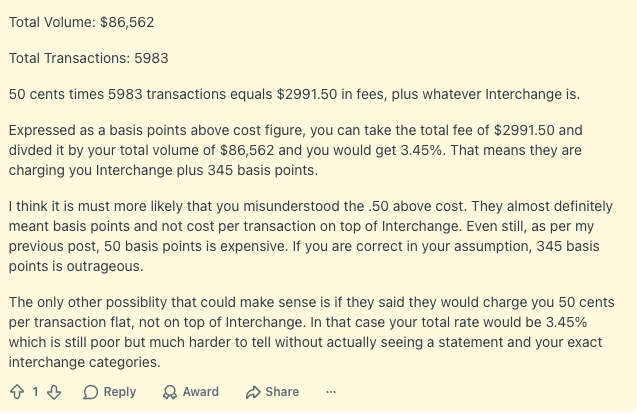
A payments professional modeled $2,991.50 in fees over $86,562 in volume and described the offer as “Interchange plus 345 basis points.” Source: r/smallbusiness, accessed 2026-08-19.
The defense takes one sentence: ask for the markup in writing as two separate numbers — basis points on volume, and cents per transaction — and check both against the contract. Any quote that resists being stated that way is telling you something.
What a fair markup looks like
Interchange plus does not guarantee a good price; it makes the price auditable. What merchants report paying gives the audit its benchmarks — from the same community thread, treated as self-reported figures rather than published rates:
- A similar-volume retail merchant: "I was told between 1.95 and 2.1%" all-in, and his actual rates "have fallen into the range"
- The same merchant's structure: "5 cents + interchange + a tiny percentage"
- Two payments professionals on the 50-bps offer above: "0.50% markup is high" and "$0.50 is greedy" at a small average ticket
- The most useful advice in the thread reframes the question entirely: "don't think of it in terms of 'What percent will I pay' — because nobody has control over that. It completely depends on the types of cards you are accepting." What you control is the markup you agree to.
Treat these as community-reported data points, not benchmarks to demand — but the pattern matches the model's logic: at meaningful volume, all-in effective rates around 2% are repeatedly reported, and the difference between a fair deal and an expensive one lives almost entirely in the plus.
Interchange plus vs blended: when each one wins
The honest comparison is the one our pillar guide makes, and it cuts both ways:
- Interchange plus tends to win when your card mix is dominated by low-interchange cards — domestic consumer debit especially — and your volume justifies statement review. You capture the savings blended pricing would average away.
- Blended tends to win on predictability and on mixed card portfolios: with international and commercial cards in the mix, the averaged rate frequently comes out lower than the sum of their true interchange, and reconciliation is simpler. You can compare both models on your own numbers: the calculator has a Blended and an Interchange++ mode, so you can enter your interchange, scheme fee and markup and see the effective rate next to a blended quote.
There is no universally cheaper model — there is a model that fits your mix. The way to find out is not a guess: run one month of statements through both structures and compare effective rates, the check our credit card processing fees guide walks through step by step.
The cross-border line most explainers skip
None of the major explainers we reviewed for this topic mention foreign-issued cards at all — yet for a cross-border merchant that is where interchange plus earns its keep. Interchange on foreign-issued cards runs higher than domestic, and under blended pricing that premium disappears into the average, invisible and unauditable. Under interchange plus it surfaces as its own line: you see precisely what the cross-border portion of your business costs, card by card, market by market.
Seeing the premium is not the same as escaping it — per our own pillar's rule, heavily mixed international portfolios often still reconcile cheaper on blended pricing. The value is decision-grade visibility: once the cross-border line is explicit, you can price your markets, route payments, and negotiate with facts instead of averages. That visibility is why cross-border merchants ask for IC++ quotes even when they ultimately choose blended.
Reading your first interchange-plus statement

Use the written markup units and monthly effective rate to expose statement drift.
An interchange plus statement carries more lines by design — every card category your customers used becomes its own interchange entry. Three checks keep it honest:
- Find the markup lines and confirm they match the two written numbers from your quote (basis points and per-transaction).
- Compute your effective rate — total fees divided by total card volume — monthly; it is the only number comparable across models and providers.
- Reconcile fees as their own category so drift surfaces early — the workflow our payment gateway reconciliation guide covers step by step.
Sources
- Visa — Credit Card Processing Fees & Interchange Rates (merchants pay a negotiated merchant discount, not interchange directly). Accessed 2026-08-19.
- Mastercard — Merchant Interchange Rates (Mastercard sets interchange; disclaims acquirer pricing). Accessed 2026-08-19.
- Stripe — Interchange Plus Pricing Explained (model definition; three-subfee structure). Accessed 2026-08-19.
- PayPal — What is Interchange ++ (IC++)? (IC++ terminology; blended contrast). Accessed 2026-08-19.
- Paysafe — Understanding Interchange Plus Pricing (cost-plus terminology; worked illustration). Accessed 2026-08-19.
- r/smallbusiness — Interchange vs flat rate credit card processing fees (community-reported quotes, benchmarks, and the unit-trap case). Accessed 2026-08-19.
- Federal Reserve — Average Debit Card Interchange Fee by Payment Card Network (Regulation II cap $0.21 + 0.05%; 2024 covered-transaction average $0.23 / 0.47%). Accessed 2026-08-19.
FAQ
IC++ is the fully itemized version of the model: interchange, the card network's scheme fee, and the processor markup each appear as separate lines rather than the scheme fee being folded into the "plus". On HaiPay's IC++ pricing, an illustrative US$100 transaction shows interchange 1.80% + scheme fee 0.20% + processing 0.50% = 2.50%, with the exact components confirmed in your quote.
There is no single rate — the networks publish hundreds of categories that vary by card type, region, and how the payment is made, with premium rewards and commercial cards priced above standard consumer debit. That variability is the point of the model: interchange plus passes each transaction's true category through instead of averaging them. One regulated segment does carry a public number: US debit interchange for covered large-bank issuers is capped at $0.21 + 0.05% of the transaction, and averaged $0.23 — about 0.47% of a $48.95 average transaction — in 2024 (Federal Reserve, accessed 2026-08-19).

For covered U.S. debit transactions, the Federal Reserve reports a $0.21 + 0.05% cap and a 2024 average of $0.23, or 0.47% on $48.95. Source: Federal Reserve Board, accessed 2026-08-19.
No. Interchange and assessments are set by the card networks; Visa notes merchants pay a negotiated merchant discount rather than interchange directly, and Mastercard explicitly disclaims any role in what acquirers charge. The processor markup is the only negotiable layer — which is why quotes should state it explicitly.
Sometimes. It tends to win when your customers mostly use low-interchange cards, and to lose on predictability and on heavily mixed portfolios with many international or commercial cards. The only reliable answer is arithmetic: run a month of your own statements through both structures and compare the effective rates.
It is ambiguous until you make it precise: 0.50 could be a percentage of volume (50 basis points), a fixed $0.50 per transaction — which on a $20 ticket is 2.5 percentage points on its own — or basis points stacked with a separate per-transaction fee. Ask for the markup in writing as two numbers, basis points and cents per transaction, before comparing anything.
For visibility, usually yes: foreign-issued cards carry higher interchange, and interchange plus is the only model that shows that premium as its own auditable line. Whether it is cheaper than blended depends on your mix — heavily international portfolios often still reconcile lower on a blended rate, so treat IC++ quotes as a diagnostic even if you end up choosing blended.
