


Credit Card Processing Fees: Rates, Real Merchant Numbers, and How to Lower Yours
Reviewed by YuanQiang Wu










Last updated: September 10th, 2026
Effective rate is the metric
Published rates cluster at 1.5%–3.5%, but merchants comparing real statements report 2%–3.2% all-in — and the gap between the two is your negotiable markup layer plus fixed fees on small tickets. Divide one month's total fees by total card volume: that single number beats every headline rate comparison. One merchant in our sources cut 3.1% to 2.4% just by getting the statement checked line by line.
Credit card processing fees are what a business pays to accept card payments — typically 1.5% to 3.5% of each transaction in the US (NerdWallet's 2026 guide, accessed 2026-08-17). Every fee splits three ways: interchange to the cardholder's bank, assessments to the card network, and a markup to your processor. Published rates, however, are not what businesses actually pay: the number that matters is your effective rate — total fees divided by total volume. This guide breaks down the three layers, shows the rates merchants report actually paying, walks through the math on a real transaction, and covers the two things most fee guides skip: what happens when the card is foreign-issued, and what the card networks' own rules say about passing fees to customers.
The three layers inside every processing fee
Whatever your statement calls it, a card processing fee decomposes into three components:
Layer | Who receives it | Typical range | Negotiable? |
|---|---|---|---|
Interchange | The cardholder's issuing bank | 1.15%–3.30% + $0.05–$0.10, by card type (Stripe, accessed 2026-08-17) | No — set by the networks |
Assessment / network fee | Visa, Mastercard, Discover, Amex | roughly 0.13%–0.15% (Bankrate, accessed 2026-08-17) | No |
Processor markup | Your processor or gateway | The remainder of your rate above wholesale cost | Yes — the only layer you can negotiate |
Two consequences follow. First, most of your fee is wholesale cost: as one merchant-services thread put it (r/smallbusiness, accessed 2026-08-17), "the bulk of that is going to be the wholesale cost of the transaction. The amount you can cut beyond that is marginal, unless you fit some really niche circumstances." Second, when a provider quotes one blended number, all three layers are inside it. Whether that bundling helps or hurts you depends on your card mix — the same trade-off as gateway fees versus processing fees, which have their own layer split.

Interchange and network assessments are wholesale costs; processor markup is the only layer you can negotiate.
Rewards and commercial cards carry higher interchange than plain debit — which is why your rate moves when your customer mix does, even if your contract never changes.
What merchants report actually paying
Published pricing pages tell you list prices. Merchants comparing notes tell you street prices. From two r/smallbusiness threads (thread 1, thread 2, both accessed 2026-08-17), community-reported all-in rates:

A merchant reports 2.9% on roughly $200K/month, including ACH/eCheck fees; self-reported, not a benchmark. Source: r/smallbusiness, accessed 2026-08-17.
Reported effective rate | Context reported |
|---|---|
2.0% | Restaurant on $21M volume — interchange 1.58% + $0.15 |
2.3% | Thread poster's baseline; called "a fine rate" in the thread |
2.4% | After a line-by-line statement audit brought it down from 3.1% |
2.66% | Interchange-plus, "soup to nuts" all-in |
2.9% | ~$200K/month card volume |
3.2%+ | "We usually see 3.2+" — small merchant without negotiated pricing |
5.75%–6% | Vending — an industry with roughly three provider choices |
Treat these as self-reported data points, not benchmarks — but the pattern is consistent: volume and pricing model move the number far more than provider logos do, and sustained US all-in rates below about 2% are essentially absent from both threads.

Self-reported rates run from 2.0% to 3.2%+ in these threads; vending at 5.75%–6% is a special-industry outlier, not a benchmark.
Effective rate: the only number that matters
The community metric is the right one: effective rate = total fees ÷ total card volume, measured over a full month, including every per-transaction, monthly, and incidental fee. If you want that number for your own mix without a spreadsheet, our credit card processing fee calculator takes your average ticket, monthly volume and international share and returns the effective rate — every rate in it links to its published source.
Fixed fees make ticket size the hidden variable. Take a small-ticket business on HaiPay's blended pricing, which starts at 2.5% + $0.30 per transaction ($0 setup and $0 monthly fees; your exact rate and fee schedule are confirmed in your quote). On a $20 ticket, that $0.30 is 1.5 percentage points on its own — an effective rate of 4.0% at the starts-at rate. On a $200 ticket, the same fee structure works out to 2.65%. Same contract, wildly different cost — this is why comparing headline percentages across providers, without your own average ticket in the formula, tells you almost nothing. Current published structures for both blended and interchange-plus models are on our pricing page.

At HaiPay's starts-at 2.5% + $0.30 structure, the same fixed fee lifts a $20 ticket to 4.0% but a $200 ticket to 2.65%.
To run the check on your own business: pull one month's statement, add every fee line, divide by that month's card volume. If the result is more than half a point above the rates in the table above for your volume tier, the gap is usually the processor markup layer — the one that negotiates.
Why card-not-present costs more
Every range in this article shifts upward when the card isn't physically presented. Online, keyed-in, and invoice payments carry higher interchange because fraud risk transfers to the transaction type. Square's own published pricing makes the ladder concrete: 2.6% + 15¢ for in-person payments, 2.9% + 30¢ for online, and 3.5% + 15¢ for manually keyed transactions (Square, accessed 2026-08-17). If you sell online, card-not-present pricing is your pricing — an "average" that blends in-person rates will flatter every quote you compare.
The cross-border layer most fee guides skip
Every major fee guide we reviewed for this article covers domestic US transactions only. But the moment your customer's card was issued in another country, two more costs enter the same three-layer stack:
- Cross-border interchange and network fees. The networks price foreign-issued-card transactions higher than domestic ones, and most processors add an international surcharge on top — visible in published US pricing as line items like Stripe's +1.5% for international cards.
- Currency conversion. If the payment currency differs from your settlement currency, conversion happens before the money reaches you — a cost that is invisible in a headline rate comparison. And note where conversion happens: a provider's FX fee at settlement and your own bank's treasury conversion after settlement are separate costs, and pricing one does not include the other.Timing deserves the same scrutiny as cost. Our payment settlement time guide breaks down the three clocks that decide when settled funds actually become usable, and lists our settlement tier for each market.
For a cross-border merchant, these two lines can exceed the entire domestic processing fee. That is why quotes built for international acceptance price them explicitly: HaiPay's cross-border card surcharge depends on card type and entity region, and its outbound FX fee runs from 1% to 2.5% by market — both confirmed in your quote rather than hidden in a blended number. Whichever provider you use, ask for the foreign-card rate and the FX margin in writing before comparing anything else; a domestic headline rate tells a cross-border business almost nothing.
Can you pass fees to customers? What the network rules actually say
The most-asked questions on this topic are about surcharging — and the answers in most guides stop at "it depends." The card networks publish their actual rules; here is what they say (Visa, Mastercard, both accessed 2026-08-17):
Rule | Visa | Mastercard |
|---|---|---|
Surcharging credit cards | Permitted, with conditions | Permitted, with conditions |
Surcharging debit / prepaid | Not permitted | Not permitted |
Advance notice | 30 days to your acquirer | 30 days to Mastercard and your acquirer |
Structure | Credit-card surcharge rules apply | Brand-level or product-level, one method |
Maximum surcharge | Lower of your merchant discount rate or 3% | 4% cap |
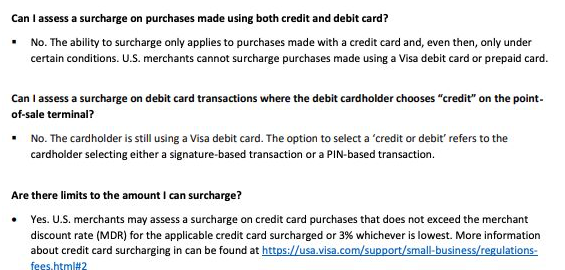
Visa permits credit-card surcharges only; Visa debit and prepaid cards cannot be surcharged, and the cap is the lower of MDR or 3%. Source: Visa, U.S. Merchant Surcharge Q and A, accessed 2026-08-17.
Two practical warnings from merchants who run these programs: several US states restrict or ban surcharging, so network permission is necessary but not sufficient — verify your state's current law before implementing (this article describes network rules, not legal advice). And customer tolerance is a real cost: in the threads above, customers state flatly that they avoid businesses that add card fees, and "cash discount" framing draws the same reaction. Model the revenue you might lose before treating a 3% surcharge as 3% saved.
Five moves that actually lower your effective rate
- Audit one statement line by line. The single best-documented win in the merchant threads: one business went from 3.1% to 2.4% by getting the statement checked line by line.
- Match your pricing model to your card mix. Interchange-plus exposes the markup layer and usually wins for mixed or high-volume businesses; blended pricing wins on predictability and small-ticket simplicity. The decision logic is the same one we detail for gateway pricing models.
- Use your volume. The markup layer is negotiable, and the negotiation is quarterly, not one-time. Bring competitor quotes and your actual effective rate. Work out that effective rate first: the fee calculator shows how much of it is the fixed fee, the international surcharge and currency conversion.
- Route around cards where the economics support it. Bank transfer and local payment methods carry different fee structures than card networks; for invoice-heavy businesses, one thread's ACH-plus-early-pay-discount setup replaced a 2.9% card cost entirely.
- Reconcile monthly. Fee creep is a line-item phenomenon — new fees appear quietly. A monthly settlement reconciliation that isolates fees as their own category is what makes creep visible while it's still small.
Sources
- NerdWallet — Credit Card Processing Fees: A 2026 Guide (1.5%–3.5% typical range). Accessed 2026-08-17.
- Stripe — Credit card payment processing fees for businesses (interchange ranges by network; MDR 1%–3%). Accessed 2026-08-17.
- Bankrate — Average Cost of Credit Card Processing Fees (network assessment fee ranges). Accessed 2026-08-17.
- Square — Credit Card Processing Fees and Rates Explained (in-person vs card-not-present vs keyed rate ranges). Accessed 2026-08-17.
- Visa — Small business regulations and fees (30-day acquirer notice) and Visa — Merchant surcharging Q&A (PDF) (surcharging limited to credit cards; debit and prepaid cannot be surcharged). Accessed 2026-08-17.
- Mastercard — Merchant surcharge rules (credit-only surcharging; debit/prepaid prohibited; notice requirements). Accessed 2026-08-17.
- r/smallbusiness — What do you guys pay for credit card processing and Credit card processing fee, what percentage do you pay (community-reported effective rates). Accessed 2026-08-17.
FAQ
Published US ranges cluster at 1.5%–3.5% of the transaction. Merchants comparing real statements report all-in effective rates mostly between 2% and 3.2% — the low end requires serious volume or interchange-plus pricing, and reports below about 2% all-in are essentially absent from merchant threads. For online-only businesses, expect the upper half of any published range.
Not under network rules, if you follow them: Visa and Mastercard both permit credit-card surcharges with 30 days' advance notice to your acquirer (Mastercard also requires notifying the network), and both prohibit surcharging debit and prepaid cards. State law is the second gate — several US states restrict or ban surcharging, so check your state's current rules before implementing. This is a description of network rules, not legal advice.
The same conditions apply as for any surcharge amount: credit cards only, advance notice, and your surcharge cannot exceed your actual cost of acceptance — Visa caps it at the lower of your merchant discount rate or 3%. A cash discount — pricing in the fee and discounting for cash — is the common alternative where surcharging is restricted, though customers in merchant forums treat the two as the same thing.
Card-not-present transactions carry higher fraud risk, and pricing follows that risk. Square's published rates illustrate the ladder: 2.6% + 15¢ in person, 2.9% + 30¢ online, and 3.5% + 15¢ manually keyed — the same structure most providers follow. If you sell online, compare providers on card-not-present rates only.
Divide one month's total card fees — every percentage, per-transaction, monthly, and incidental line — by that month's total card volume. That effective rate is the only number comparable across providers and pricing models. Run it on your average ticket too: at a $20 ticket, a $0.30 fixed fee alone adds 1.5 percentage points; at $200 it adds 0.15 percentage points.
In order of documented impact: audit a full statement line by line (one merchant cut 3.1% to 2.4% this way), match your pricing model to your card mix, negotiate the markup layer using your volume, offer lower-cost payment routes like bank transfer where your customers accept them, and reconcile monthly so new fee lines surface immediately.
