


Local Payment Acquiring for Ecommerce: A Practical Guide










Last updated: September 10th, 2026
Insights
A practical guide to local payment acquiring for ecommerce — covering checkout integration, local payment methods, authorization, settlement, refunds, and how to evaluate an acquiring provider.
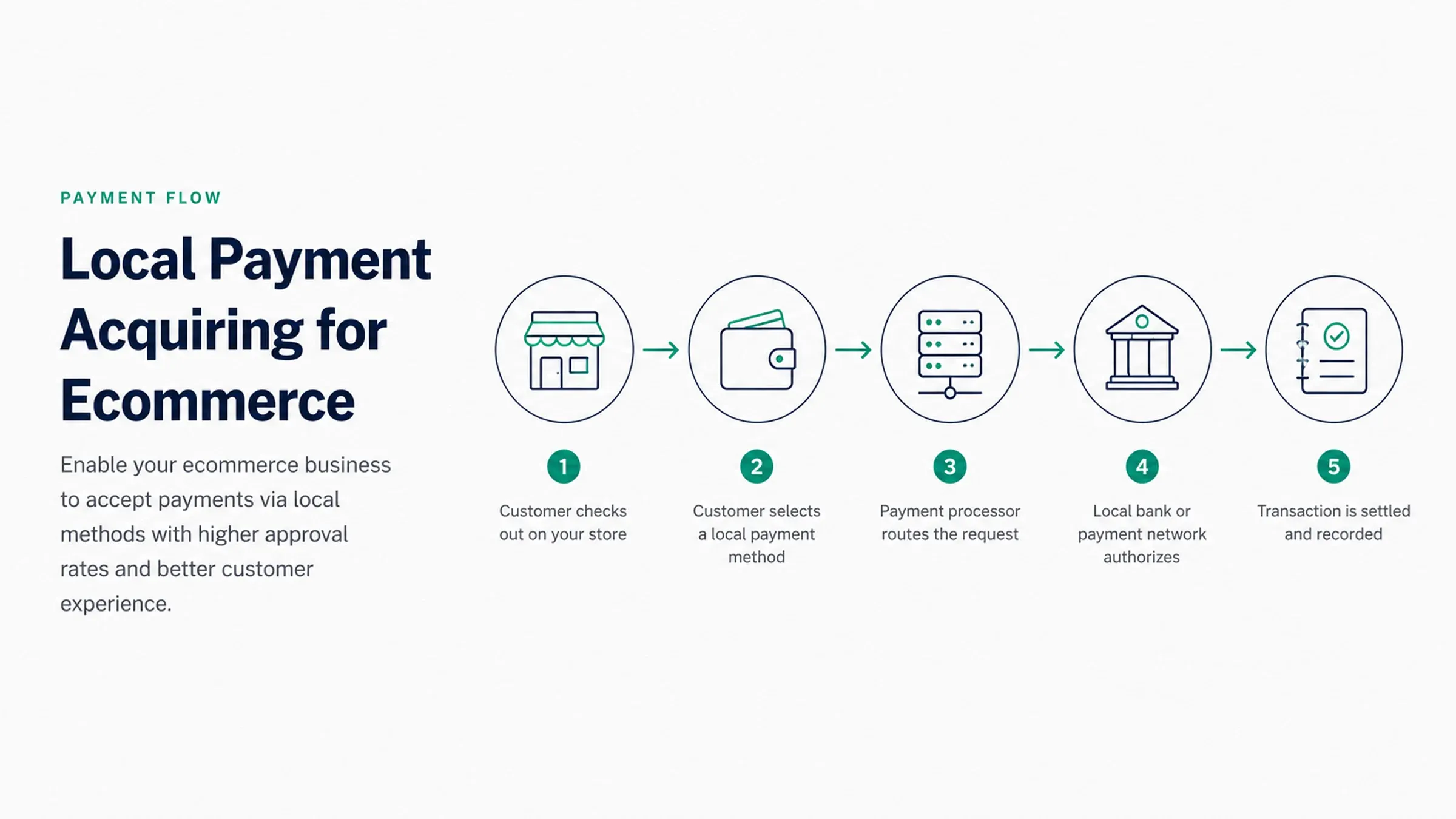
For ecommerce teams, the acquirer layer sits directly beneath checkout and determines which payment methods customers can use, how authorization requests are evaluated, how funds settle, and how disputes are handled. Evaluating acquiring and checkout as a single decision — rather than separately — matters more as you expand across markets.
Acquiring and Checkout Are One Decision
Your checkout can only present payment methods your acquiring infrastructure can process. A locally preferred bank transfer, e-wallet, or domestic card scheme requires connectivity to the local network that handles it. Without that connectivity in a given market, those methods cannot appear at checkout regardless of front-end design.
Baymard checkout research identifies limited payment options as a factor in checkout abandonment, though figures vary by market and merchant type. The Worldpay Global Payments Report shows that payment method preferences differ substantially by country, with local instruments — bank transfers, e-wallets, domestic card schemes — accounting for a significant share of ecommerce payments in many markets.
The full comparison between local and cross-border acquiring models is covered in the local acquiring vs cross-border acquiring guide. The sections below focus on what local acquiring means for ecommerce specifically.
Four checkout practices that consistently matter across markets:
- Price in the local currency — and settle the FX question before checkout, not on the card statement.
- Order payment methods by local preference — the method a customer uses daily belongs above the card form, not below it.
- Localize the checkout language — including payment-method names as customers know them, not translated labels.
- Match the confirmation flow to the method — real-time transfers confirm instantly; voucher and convenience-store payments need a clear pending state and expiry time.
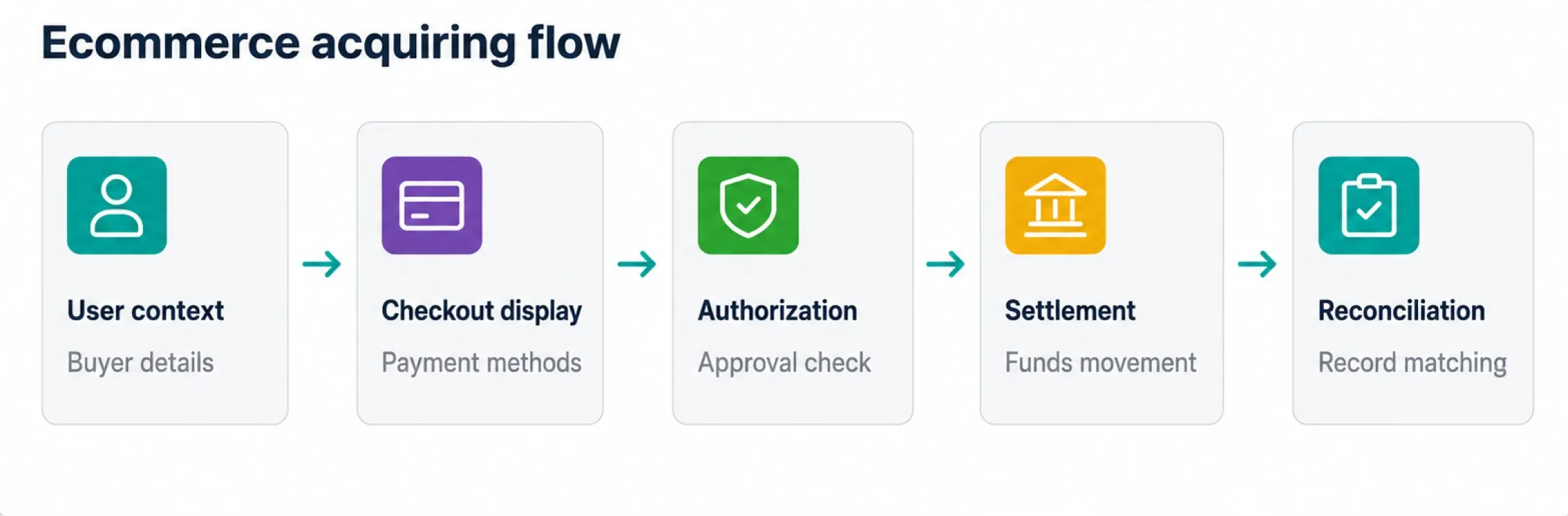
Local Payment Methods in Ecommerce
Local payment methods are instruments tied to domestic networks, banking systems, or regulatory frameworks. Examples include Pix in Brazil, OVO and DANA in Indonesia, PromptPay in Thailand, GCash in the Philippines, OXXO in Mexico, Mada in Saudi Arabia, and KNET in Kuwait. These are illustrative examples — actual availability for any merchant depends on the acquirer's network, licensing, and market agreements.
Whether offering local payment methods affects your conversion meaningfully depends on the market. In markets where a local instrument is how most people pay online, not offering it can limit your addressable customer base. In markets where international cards dominate, the effect is smaller. The Worldpay Global Payments Report provides useful payment preference data by market and channel that is worth reviewing before finalizing your checkout scope.
Where HaiPay supports local payments today
The tables below mirror our pricing page, including the African local pay-in methods in the current update. Local payment methods are priced from 0.8%, by market.
Market | Cards | Wallets | Bank transfers | Others (named local methods) |
|---|---|---|---|---|
Hong Kong SAR | ✓ | ✓ | ✓ | — |
Macau SAR | ✓ | ✓ | ✓ | — |
Taiwan, China | ✓ | ✓ | ✓ | Offline ATM Transfer, Convenience Store |
Japan | ✓ | ✓ | ✓ | Convenience Store, Pay-easy |
South Korea | ✓ | ✓ | ✓ | — |
Indonesia | ✓ | ✓ | ✓ | VA, QRIS |
Malaysia | ✓ | ✓ | ✓ | DuitNow QR |
Singapore | ✓ | ✓ | ✓ | PayNow |
Vietnam | ✓ | ✓ | ✓ | VietQR |
Thailand | ✓ | ✓ | ✓ | PromptPay |
Philippines | ✓ | ✓ | ✓ | QR Ph |
Pakistan | ✓ | — | ✓ | — |
Bangladesh | ✓ | — | — | — |
India | ✓ | — | — | UPI |
Saudi Arabia | ✓ | ✓ | ✓ | — |
UAE | ✓ | ✓ | — | VA |
Qatar | ✓ | ✓ | ✓ | — |
Kuwait | ✓ | ✓ | ✓ | — |
Bahrain | ✓ | ✓ | ✓ | — |
Oman | ✓ | ✓ | — | — |
Iraq | ✓ | ✓ | — | — |
Jordan | ✓ | — | — | CliQ |
Egypt | ✓ | ✓ | — | — |
Europe | ✓ | ✓ | ✓ | — |
United States | ✓ | ✓ | ✓ | — |
Canada | ✓ | ✓ | ✓ | — |
Mexico | ✓ | — | — | — |
Brazil | ✓ | — | — | — |
Named local pay-in methods in selected African markets
HaiPay supports the following named local pay-in methods across selected African markets. Availability and commercial terms are confirmed per merchant and market in the final quote.
Market | E-wallets | Bank transfer | Other local methods |
|---|---|---|---|
Egypt | Vodafone, Fawry | — | OTC via convenience stores or mobile-operator outlets |
Nigeria | OPay | Mainstream banks | — |
Kenya | M-Pesa | Mainstream banks | — |
Tanzania | M-Pesa, Tigo Pesa, HaloPesa | — | — |
Ghana | MTN MoMo, Vodafone, Airtel Money | — | — |
South Africa | — | Instant EFT | — |
Cameroon | MTN MoMo, Orange | — | — |
A dash in the Africa table means the master matrix does not name a method in that category; it is not an inferred statement about other payment capabilities.
Coverage, named methods and rates are maintained in the same market dataset — see HaiPay pricing for the current matrix.
Authorization, FX, and Settlement
When a customer completes a payment, an authorization request flows to the issuing bank. Local acquiring — where the acquirer is licensed in the customer's market — may result in the issuing bank treating the transaction as a domestic payment. This can affect authorization outcomes in some markets and for certain card types. It does not guarantee higher approval rates; results vary by market, issuer, payment method, and transaction context.
FX handling differs between models. Cross-border acquiring typically involves currency conversion at one or more points in the settlement chain, while local acquiring may reduce those steps depending on contract structure. Settlement timelines also vary. Local clearing infrastructure can enable faster settlement in some markets, but timelines should be confirmed at the contract level. For a breakdown of fee structures, cross-border acquiring fees covers the main components.
Refunds, Disputes, and Reconciliation
Refunds typically process through the same rails as the original payment. Disputes under local acquiring are often handled under the rules of the local card scheme, which can simplify documentation and timelines for teams managing high volumes in a specific market — though this depends on the acquirer's capabilities.
Reconciliation is where complexity tends to accumulate most visibly. Merchants processing payments across multiple markets, currencies, and payment methods need tooling that can aggregate transaction data, match settlements, and flag discrepancies automatically. Evaluating reconciliation capabilities should be part of any acquirer assessment, not an afterthought.
When to Stay with Cross-Border Acquiring
Cross-border acquiring through a global acquiring arrangement is often the practical starting point, particularly for merchants testing new markets or operating where card payments dominate. It removes the need for local entities or separate acquirer contracts in each market.
The picture shifts when volume in a specific market grows, when local payment method access becomes important to conversion, or when settlement efficiency becomes a working capital consideration. For context on how these trade-offs play out in growth markets, local acquiring in emerging markets covers the relevant considerations.
Can you accept local payment methods without a local entity?
Yes — in many markets you can accept local payment methods without incorporating locally, by processing through a provider that already holds the local acquiring relationships and licenses. That is the model HaiPay operates: your business contracts with one provider, and payments are acquired locally on your behalf.
The two routes differ in what you own. Through a provider, you rely on the provider's local licenses and banking relationships; onboarding is one integration and one contract, and funds are settled to you cross-border. With your own local entity, you hold the local merchant relationships yourself — which means local incorporation, tax registration, bank accounts and ongoing filings in each market.
A local entity becomes hard to avoid in some situations: where regulators require domestic incorporation for your business category, where you need to hold and spend funds domestically, or where a scheme restricts certain methods to locally registered merchants. If your plans include any of those, check the market's rules before choosing a route.
Settlement also differs. Provider-routed local collections are typically consolidated and remitted to your home account, while an own-entity setup keeps funds in a domestic account you manage — with the treasury and compliance work that follows. For how this connects to acquiring strategy, see local vs cross-border acquiring.
Evaluating an Acquiring Provider
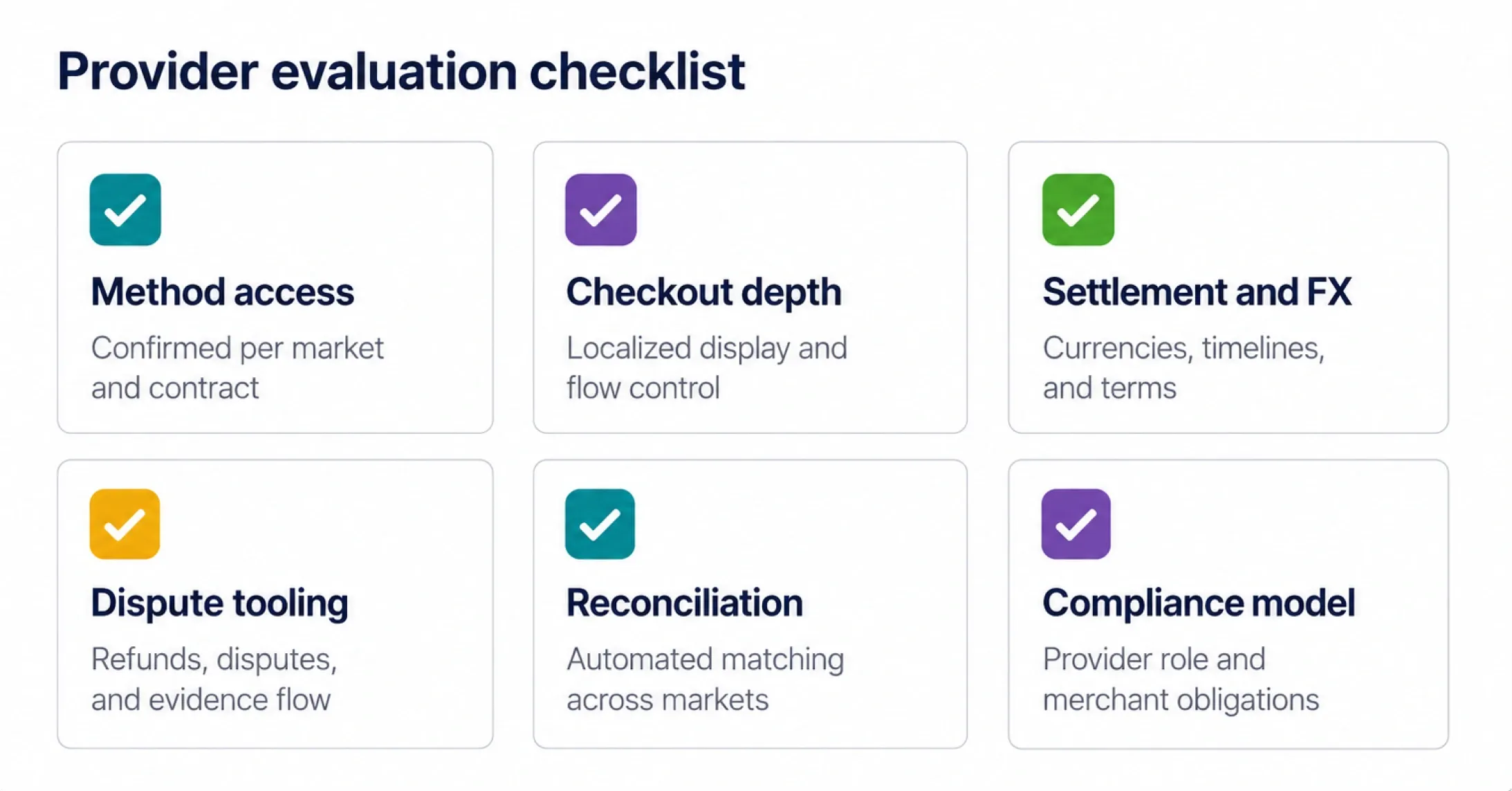
When assessing a payment acquiring solution for ecommerce, the evaluation should cover:
Payment method access. Which local methods does the provider support in your specific markets, confirmed for your merchant category and contract structure?
Checkout integration. How does the Checkout layer connect to acquiring? Integration depth affects payment method display, localization, and flow control.
Settlement and FX. What currencies are available for settlement, on what timelines, and at what FX terms — per market, not just in aggregate?
Dispute and reconciliation tooling. Does the provider offer automated reconciliation and dispute workflows with per-market reporting?
Compliance and licensing. Does the provider hold relevant authorizations in your target markets, or operate through partners? Understand what that means for your regulatory obligations.
How HaiPay Supports Ecommerce Acquiring
HaiPay's E-commerce solution is designed for merchants operating across multiple markets. The underlying payment acquiring solution supports pay-in coverage across multiple supported markets, with local payment method examples that may include OVO, DANA, PromptPay, GCash, OXXO, Pix, Mada, and KNET depending on market availability.
The Checkout layer supports localized payment method presentation, multi-currency billing, and multilingual UX. Reconciliation is automated. Disputes are handled by localized teams with 24/7 support availability. HaiPay's public materials describe 100+ integrated payment methods and no setup fees; actual payment method availability, onboarding scope, and commercial terms vary by market and merchant profile. For merchants evaluating global acquiring alongside local coverage, both models can be supported within a single provider relationship.
For a broader comparison of local and cross-border acquiring across authorization, settlement, and compliance dimensions, see the local acquiring vs cross-border acquiring guide.
Ready to evaluate local payment acquiring for your ecommerce operation? Explore HaiPay's E-commerce solution or review acquiring options.
FAQ
Local payment acquiring for ecommerce means your transactions are processed by an acquirer licensed and operating in the same country or region as your customer. This enables access to local payment methods, local currency billing, and settlement through domestic clearing networks. Specific availability depends on the acquirer, market, and contract.
Local acquiring determines which payment methods can be presented at checkout. Without connectivity to local payment rails, your checkout cannot offer locally preferred instruments in most markets. It can also affect how issuing banks classify authorization requests, though outcomes vary by market, card type, and issuer.
It depends on the market. Where a local method is the dominant way customers pay online, not offering it may reduce your addressable audience. Where international cards dominate, the impact is smaller. Payment preference data by market — such as the Worldpay Global Payments Report — is useful for this analysis, which should be done market by market.
No. Local acquiring may reduce cross-border classification friction in some markets, but authorization outcomes depend on the market, issuer, card type, and transaction context. No acquiring arrangement guarantees approval rates. Authorization performance should be one input in a broader evaluation, not a primary selection criterion.
Focus on confirmed payment method access in your specific markets, checkout integration depth, settlement currencies and timelines, reconciliation and dispute tooling, and the provider's licensing structure in your target markets. Review cross-border acquiring fees as part of cost benchmarking, and confirm availability at the contract level rather than relying on headline coverage figures.
Local payment methods are the ways customers already pay domestically — for example QRIS in Indonesia, PromptPay in Thailand, PayNow in Singapore, UPI in India, M-Pesa in Kenya and Tanzania, OPay in Nigeria, and MTN MoMo in Ghana and Cameroon. HaiPay aggregates 150+ local payment methods through one integration; the market tables above show current public coverage and named methods for selected African markets.
