


Low-Cost Payment Gateways for Small Businesses: Compare Total Cost










Last updated: September 11th, 2026
Total cost beats the headline rate
No single payment gateway minimizes cost for every small business. Compare public transaction, recurring, cross-border, FX, payout, and operating costs using a source-dated matrix and three reproducible scenarios.
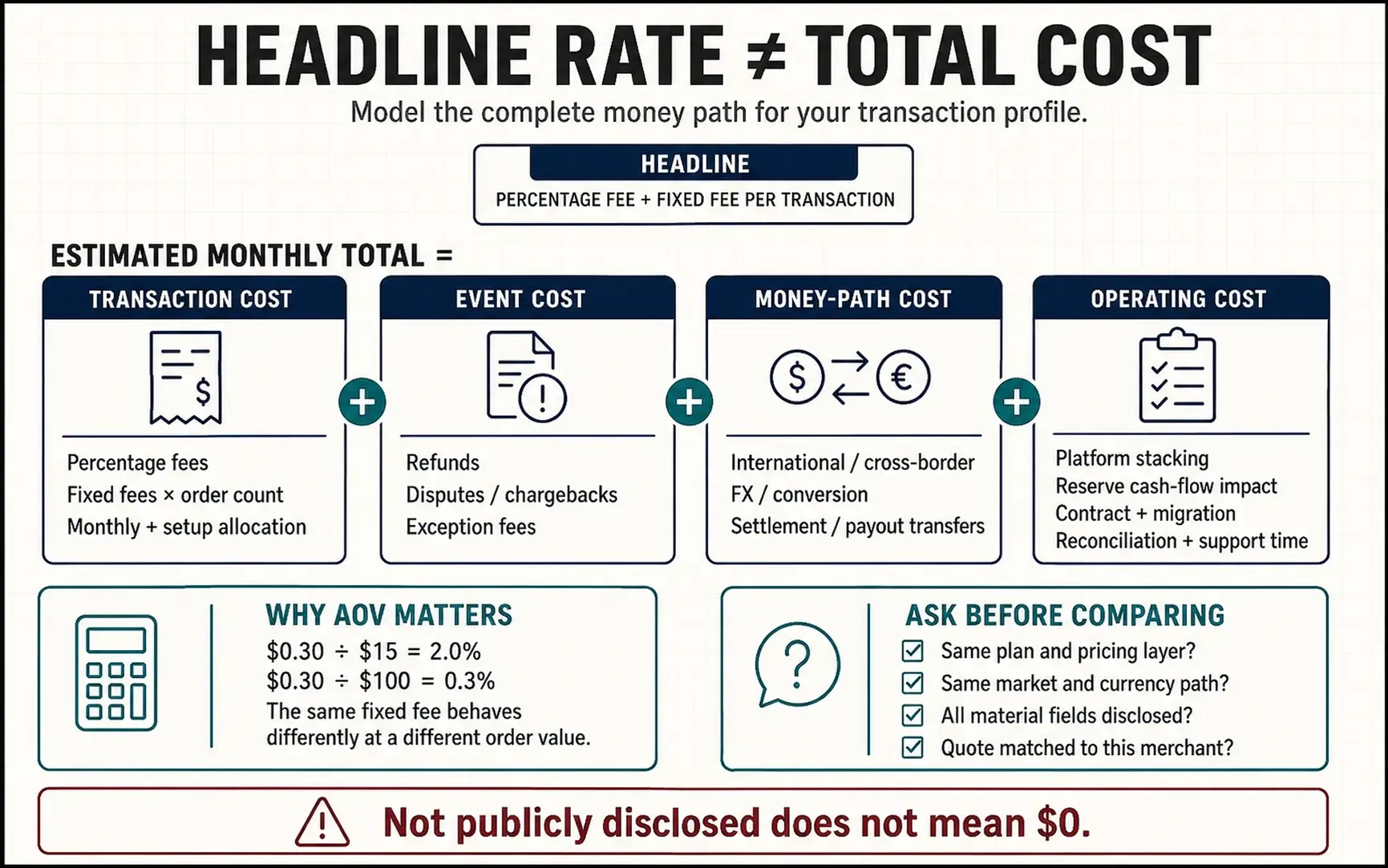
The cheapest payment gateway for one small business may not be the cheapest for another. Total cost changes with monthly sales, order count, average order value, payment-method mix, customer location, settlement currency, refunds, disputes, and payout choices. Start with this model:
Estimated monthly total = percentage fees + fixed per-transaction fees + recurring fees + refund and dispute fees + cross-border and FX costs + payout fees + platform and migration costs.
Use the public-price matrix and three worked scenarios below to create a shortlist. Then confirm every starting rate and provider-specific item in a written offer for your business before choosing.
What “low-cost” means for a small business
A headline percentage is only one input. A $0.30 fixed fee represents 2% of a $15 order before the percentage fee is added. The same $0.30 is 0.3% of a $100 order. That is why a provider can look attractive for larger tickets yet produce a different result for a high-frequency, low-average-order-value business.
Use five inputs before comparing providers:
- Monthly processed value: the dollar value successfully paid.
- Transaction count and average order value: fixed fees multiply by order count.
- Payment mix: domestic cards, international cards, bank payments, wallets, and local payment methods can have different prices.
- Money path: presentment currency, conversion, settlement currency, and transfer frequency determine whether cross-border, FX, or payout fees apply.
- Operating events: refunds, disputes, reserves, platform charges, and migration work can change both cost and cash flow.
The basic card calculation is:
monthly card fee = (processed value × percentage rate) + (successful transactions × fixed fee)
That calculation is incomplete until applicable monthly, platform, refund, dispute, international, currency-conversion, and transfer costs are added. For a full explanation of each fee type, use HaiPay’s payment gateway fees guide. To get the total for your own sales profile, the fee calculator adds those international, conversion, refund and dispute items on top of the headline rate.
Source: arithmetic example; public provider fee schedules listed in the Sources section.
Comparison method and commercial disclosure
This comparison covers public US online-payment offers that a small business may evaluate as a gateway, processor, payment service provider, merchant-account bundle, or commerce-platform payment service. These categories are not identical, so the exact plan is named in every row.
- Scope: US merchant perspective, online payments, public standard pricing; negotiated enterprise offers are outside the numeric comparison.
- Fee coverage: transaction percentage, fixed fee, monthly and setup charges, refund and dispute charges, cross-border and FX additions, payout charges, minimums, reserves, contract terms, and eligibility.
- Sorting: providers are alphabetical, not ranked by price or editorial preference.
- Data date: official pages were checked on August 21, 2026.
- Source method: only current provider-owned pricing pages, fee disclosures, help centers, and legal terms support product and price facts. Secondary lists and search features do not support the numbers. This is desk research; no provider product was hands-on tested for this comparison.
Where a provider does not state a fee or condition on the reviewed public page, the table says exactly what the merchant needs to confirm. An unpublished amount is never treated as zero, and a starting rate is not a promised effective rate.
Commercial disclosure: HaiPay publishes this article and may benefit if a reader becomes a customer. HaiPay receives the same fields, source-date rule, limitations, and no-ranking treatment as every other provider. The tables do not constitute a quote or recommendation.
Public pricing matrix for small-business payment gateways
Published fee components
Provider and US plan | Published online transaction price | Monthly fee | Setup fee | Refund fee | Chargeback or dispute fee | Cross-border and FX disclosure | Settlement or payout transfer fee |
|---|---|---|---|---|---|---|---|
Authorize.net — All-in-One | 2.9% + $0.30 | $25 | $0 | No complete All-in-One refund cost is stated on the reviewed public pricing page | Gateway chargeback fee: $0; confirm any All-in-One merchant-account chargeback terms at signup. | No amount stated on the reviewed public pricing page | No amount stated on the reviewed public pricing page |
HaiPay — eligible blended card pricing | Starts at 2.5% + $0.30; local payment methods from 0.8%; actual quote depends on merchant entity, market, volume, transaction quality, and contract | $0 | $0 | $0.30 for a merchant-initiated refund | Confirm in the written provider quote | Cross-border additions may apply; current outbound FX disclosure is from 1% to 2.5% by market, subject to quote | $15 per USD settlement transfer |
Helcim — online/keyed, $0–$50,000 rolling-average tier | Interchange and network cost + 0.50% + $0.25; lower published margins apply at higher three-month rolling-average tiers | $0 for standard processing | $0 | No additional refund fee; original processing costs are not returned | $0 for cases resolved in the merchant’s favor; $15 if the merchant loses. | Published USD card-not-present network additions: Visa +1.45% + $0.04, Mastercard +1.45%, Discover +1.30%, Amex +1.00%; these are not a universal FX markup | Standard deposits $0; next-business-morning availability depends on eligible US bank rails, with other standard rails taking longer |
PayPal — Advanced Credit and Debit Card Payments | 2.89% + $0.29 | $0 | $0 | No fee to issue; original processing fee is not returned | Advanced unbranded card processing: $20 USD chargeback fee. PayPal’s $15 standard and $30 high-volume Dispute Fees apply to PayPal-account or PayPal Guest Checkout transactions, not Advanced unbranded processing. | +1.5 percentage points for qualifying international commercial transactions; currency conversion is generally 3% or 4% depending on transaction type | Eligible standard bank transfer $0 when no currency conversion applies; instant transfer 1.5%, $0.50 minimum. |
Shopify — Basic, monthly billing | Standard domestic consumer cards 2.9% + $0.30; Premium domestic cards 3.5% + $0.30. The numeric scenarios use Standard domestic consumer cards. | $39 | $0 | No additional transaction fee; original card-processing fee is not returned | $15; returned if the merchant wins the chargeback | +1% for international cards; US currency-conversion fee 1.5% when applicable. Basic charges 2% on transactions processed by a third-party provider. If Shopify Payments is used alongside a direct third-party provider, Shopify says Shopify Payments transactions use standard rates plus a 1.25% premium, subject to method and market rules. | A domestic USD payout to a US bank has no Multi-Currency Payout fee; Basic is not eligible for Multi-Currency Payouts |
Square — Free, Online API | 2.9% + $0.30 | $0 | $0 / no activation fee | Square says the original processing fee is not returned when a payment is refunded; the reviewed official refund page does not list a separate refund-issuance fee. | No fee for Square’s chargeback dispute-management service. | +1.5% for internationally issued cards; the US Square account processes this flow in USD, and cardholder conversion, if any, is handled by the issuer | Standard next-business-day transfer $0; eligible expedited transfer options 1.95% |
Stripe — standard online cards | 2.9% + $0.30 | $0 | $0 | No additional refund fee for standard card payments; payment processing, Connect, and currency-conversion fees from the original transaction are not returned. | $15 when a dispute is received plus $15 when it is countered manually; the countering fee is returned if the dispute is won, and rare network fees may apply | +1.5% for international cards; +1% if currency conversion is required | Standard payout schedule $0; Instant Payouts 1.5%, $0.50 minimum |
Conditions that affect comparability
Provider | Minimum-volume requirement | Reserve requirement | Contract or termination cost | Merchant eligibility | Suitable transaction profile | Important limitation | Official source and verified date |
|---|---|---|---|---|---|---|---|
Authorize.net | No amount stated on the reviewed public pricing page for All-in-One | No amount stated on the reviewed public pricing page | No long-term contract or early-termination fee for the public gateway offer | Application and merchant-account approval required | A business that wants a gateway and merchant account in one public package | Gateway Only has a different fee structure; acquiring and payout costs can differ | Authorize.net pricing, Aug. 21, 2026 |
HaiPay | $1,000 monthly processing volume for IC++ pricing; blended-price eligibility is quote-specific | Confirm in the written provider quote | Confirm in the written provider quote | Entity, market, volume, transaction quality, and contract determine availability | Small-ticket, high-frequency, cross-border operations that need eligible local payment methods and currencies | Published figures are starting points; card settlement is typically T+5 (calendar days), subject to quote and the applicable payment route | HaiPay pricing, Aug. 21, 2026 |
Helcim | No processing minimum; the first published margin tier starts at a $0 three-month rolling average | No standard public amount; case-specific reserves may be imposed under the public terms | No long-term contract or cancellation fee for standard processing | US or Canadian application and underwriting conditions apply | Merchants able to evaluate interchange-plus pricing, especially as rolling-average volume changes | The published margin is not the total rate because interchange and network costs pass through | Helcim pricing, US fee disclosure, and US terms, Aug. 21, 2026 |
PayPal | No amount stated on the reviewed public pricing page | No standard public amount; PayPal may establish a rolling or minimum reserve based on account risk and applicable product terms. | No amount stated on the reviewed public fee page | Account, business, country, product, and risk conditions apply | Businesses that value PayPal checkout options and public pay-as-you-go card pricing | Wallet, standard card, Advanced card, invoicing, and other PayPal transaction paths have different fees | PayPal US business fees, Aug. 21, 2026 |
Shopify | No amount stated on the reviewed public pricing page | No standard public amount; Shopify may impose an account-specific reserve, payout hold, or payout delay after risk review. | Subscription and cancellation terms apply | Requires a Shopify store and Shopify Payments eligibility for the listed processing rates | An online store already using Shopify’s commerce platform | Card class changes the rate; platform subscription and possible third-party transaction fees make it unlike a standalone gateway quote | Shopify pricing, Aug. 21, 2026 |
Square | No amount stated on the reviewed public pricing page | No amount stated on the reviewed public pricing page | Free plan has no long-term subscription commitment; account terms still apply | US business and account eligibility rules apply | Small businesses needing online and in-person tools in one ecosystem | Online API, invoice, keyed, and in-person rates differ | Square pricing and processing-fee help, Aug. 21, 2026 |
Stripe | No amount stated on the reviewed public pricing page | No amount stated on the reviewed public pricing page; account terms can affect fund availability | No setup or monthly fee on standard pricing; account closure is governed by the Services Agreement, and outstanding obligations may survive termination. | Supported-country, business, product, and account conditions apply | Online businesses that want public flat-rate card pricing and a broad developer platform | Extra products, international cards, conversion, disputes, and accelerated payouts add separate costs | Stripe pricing, Aug. 21, 2026 |
The matrix is a screening tool, not a total-cost result. Ask each shortlisted provider to fill every nonpublic field in writing for the same business profile.
Source: provider-owned pages linked in the table; verified August 21, 2026.
Three reproducible total-cost scenarios
The following examples deliberately avoid a winner label. They show how the same published inputs behave under specific assumptions. Dollar figures are monthly known-cost subtotals, not quotes.
Scenario 1: low monthly volume and low average order value
Assumptions: 200 successful domestic online-card transactions, $15 average order value, $3,000 processed in USD, no refunds or disputes, no FX, no platform add-ons, and one standard payout or transfer. Shopify transactions are 100% Standard domestic consumer cards; Premium cards are not modeled. Helcim’s three-month rolling average is assumed to be $3,000, which stays in its published first tier. Setup costs are not amortized. Tax, hardware, PCI, migration, reserve, and every nonpublic item are excluded.
Formula: (public card percentage × $3,000) + (public fixed fee × 200) + public monthly fee + disclosed standard payout/transfer fee
Provider | Reproducible calculation | Published known-cost subtotal | What remains outside the subtotal |
|---|---|---|---|
Authorize.net | (2.9% × $3,000) + ($0.30 × 200) + $25 | $172.00 | Payout and any nonpublic merchant-account costs |
HaiPay | (2.5% × $3,000) + ($0.30 × 200) + $0 + one $15 USD transfer | $150.00 from the published starting rate | Actual quote, eligibility, and any route-specific charges |
Helcim | (0.50% × $3,000) + ($0.25 × 200) | $65.00 plus interchange and network costs | The pass-through components and any nonpublic items |
PayPal Advanced | (2.89% × $3,000) + ($0.29 × 200) | $144.70 | Product-path differences and any nonpublic items |
Shopify Basic | Standard domestic consumer cards: (2.9% × $3,000) + ($0.30 × 200) + $39 | $186.00 | Premium cards, actual card mix, other Shopify services, and nonpublic items |
Square Online API | (2.9% × $3,000) + ($0.30 × 200) | $147.00 | Any nonpublic items or nonstandard transfer choice |
Stripe | (2.9% × $3,000) + ($0.30 × 200) | $147.00 | Extra products and any nonpublic items |
Why this does not generalize: one refund, dispute, accelerated payout, international card, negotiated quote, or different plan can change the result. Helcim’s number is not a total because the largest variable component is not fixed in advance. HaiPay’s number uses a starting rate, not an approved merchant quote.
Scenario 2: higher volume with a low average order value
Assumptions: 10,000 successful domestic online-card transactions, $12 average order value, $120,000 processed in USD, otherwise the same exclusions as Scenario 1. Shopify transactions are 100% Standard domestic consumer cards; Premium cards are not modeled. Helcim’s three-month rolling average is assumed to be $120,000, qualifying for its published $100,001–$500,000 online/keyed margin tier.
Formula: (public card percentage × $120,000) + (public fixed fee × 10,000) + public monthly fee + disclosed standard payout/transfer fee
Provider | Reproducible calculation | Published known-cost subtotal | What the model demonstrates |
|---|---|---|---|
Authorize.net | (2.9% × $120,000) + ($0.30 × 10,000) + $25 | $6,505.00 | Monthly fee is diluted, while the fixed fee remains material |
HaiPay | (2.5% × $120,000) + ($0.30 × 10,000) + one $15 USD transfer | $6,015.00 from the published starting rate | A written quote is still required; this is not a promised effective rate |
Helcim | (0.35% × $120,000) + ($0.20 × 10,000) | $2,420.00 plus interchange and network costs | Margin tiers cannot be compared with flat rates until pass-through costs are added |
PayPal Advanced | (2.89% × $120,000) + ($0.29 × 10,000) | $6,368.00 | A one-cent fixed-fee difference compounds across many orders |
Shopify Basic | Standard domestic consumer cards: (2.9% × $120,000) + ($0.30 × 10,000) + $39 | $6,519.00 | Premium cards, actual card-class mix, and the rest of the commerce-stack cost remain outside the model |
Square Online API | (2.9% × $120,000) + ($0.30 × 10,000) | $6,480.00 | Channel-specific rates still need confirmation |
Stripe | (2.9% × $120,000) + ($0.30 × 10,000) | $6,480.00 | Added products and operating events remain outside the model |
Why this does not generalize: approval, negotiated pricing, card mix, interchange categories, refunds, disputes, reserve conditions, and payout timing can dominate a high-volume quote. The model also excludes migration and engineering work.
Scenario 3: international cards and a local-payment-method mix
Assumptions: 2,000 successful $25 transactions and $50,000 monthly value. Half are foreign-issued cards presented in a non-USD currency and settled to the merchant in USD; half use an eligible local bank payment method. The illustration assumes 1,000 transactions and $25,000 for each half, no refunds or disputes, and one standard payout or USD settlement transfer. For the Stripe illustration, the local-method half consists of 1,000 successful $25 USD ACH Direct Debit charges from eligible US bank accounts using standard four-business-day settlement. The model excludes optional Financial Connections verification ($1.50 per verification), accelerated settlement, failed-payment fees, and disputes.
Formula: international-card component + local-method component + monthly fee + disclosed transfer fee
Provider | Publicly reproducible portion | Result and unresolved fields |
|---|---|---|
HaiPay | Card base: (2.5% × $25,000) + ($0.30 × 1,000) = $925. Local-method starting component: 0.8% × $25,000 = $200. One USD transfer: $15. If the public outbound-FX range applies to the $25,000 converted card volume, add 1%–2.5% × $25,000 = $250–$625. | $1,140 base/method/transfer starting subtotal; $1,390–$1,765 if the public outbound-FX range applies. Cross-border, route, eligibility, local-method, and contract terms still require a written quote. This is an illustrative starting-rate model that has not been matched to a specific payment route. The 0.8% local-method rate and 1%–2.5% outbound FX range may not apply to the same market, entity, method, or currency path. Confirm all route-specific inputs in a written quote. |
Stripe | International card requiring conversion: (2.9% + 1.5% + 1%) × $25,000 + ($0.30 × 1,000) = $1,650. US ACH Direct Debit illustration: 1,000 × ($25 × 0.8%) = $200. The calculated fee is $0.20 per successful charge, below Stripe’s $5 fee cap per transaction. | $1,850 for the stated Stripe method mix, excluding optional Financial Connections verification, accelerated settlement, failed-payment fees, disputes, refunds, and nonpublic conditions. |
Other matrix providers | Not modeled: no matched method and currency path was built for these providers from the cited official pages, so no like-for-like figure is shown. | Unresolved method or product scope is preserved rather than replaced with zero or a secondary-source estimate. |
Why this does not generalize: “local payment method” is market- and provider-specific. Card origin, presentment currency, settlement currency, payment route, and method eligibility must match before two quotes are comparable. For route selection, see local acquiring versus cross-border acquiring and HaiPay’s local payment product page.
Source: official pricing pages listed in the matrix; formulas use the stated assumptions only.
Which cost model fits which small-business profile?
Business profile | Model to test first | Why | Decision action |
|---|---|---|---|
Low, unpredictable monthly volume | Pay-as-you-go flat pricing with no monthly fee | Avoids a recurring fee during quiet months, but fixed transaction fees can still be significant | Model three months of actual sales, not the best month |
High transaction count and low order value | A quote with a lower fixed fee or a suitable local bank method | A few cents per transaction compound quickly | Compare both percentage and fixed components at the same transaction count |
Higher stable volume | Interchange-plus, IC++, negotiated flat pricing, or a membership model | Tiered or negotiated economics may become relevant | Obtain an all-in statement estimate, including network and exception fees |
Shopify-based store | Shopify Payments and a qualified standalone alternative | The platform subscription and possible third-party transaction fee affect the stack | Compare platform plus processing, not processing alone |
Cross-border digital business | Provider quote matched to country, method, currency, and settlement path | International card, local method, FX, and transfer charges interact | Build a country-by-country payment and settlement map |
Refund- or dispute-prone category | A plan with transparent refund, dispute, reserve, and evidence-handling terms | Operational events can outweigh a small rate difference | Stress-test the model with the last 12 months of events |
The “best” payment gateway for a small business is therefore a profile match, not a universal provider label. A provider that suits a domestic retail store may not suit a cross-border digital-goods business, and vice versa.
Hidden costs that can change the result
Before accepting a quote, request a written answer for each of these items:
- Refund economics: Is there an additional fee, and are original processing, FX, or platform fees returned?
- Disputes and chargebacks: Is there an initial fee, a response fee, a refund when the merchant wins, or a separate representment service charge?
- International and currency costs: Which event triggers cross-border, international-card, scheme, FX, or settlement-conversion fees?
- Payouts: What does the standard schedule cost? What do accelerated or cross-currency transfers cost? How often will you transfer?
- Reserves and cash flow: Can the provider hold a rolling or fixed reserve, delay funds, or change funding terms after a risk review?
- Platform stacking: Does an ecommerce platform add a transaction fee when an external processor is used?
- Minimums and contracts: Is there a monthly minimum, invoice minimum, setup fee, termination fee, or nonrefundable subscription?
- Migration and operations: Include engineering, app subscriptions, retraining, failed-payment recovery, reconciliation, and support time.
If a field is material and the provider will not disclose it before onboarding, treat it as an unresolved risk rather than a free item.
Cost versus payment-method and market fit
A lower modeled subtotal has little value if the provider cannot support the customer’s preferred method, merchant entity, transaction size, target market, or settlement currency. Compare the full route:
customer country → payment method → processing entity → presentment currency → conversion event → settlement currency → bank transfer
For every market, ask:
- Is the method available to this merchant entity and business category?
- Is the published price the method fee alone or an all-in processing price?
- Does an international-card or cross-border addition also apply?
- Who performs currency conversion, at what disclosed markup or benchmark?
- What settlement timing and transfer charge appear in the contract? Many providers quote settlement in business days, so confirm each provider's counting basis and arrival rule before comparing timelines.
- Are refunds, disputes, reserves, and minimum volume handled differently for this route?
Use HaiPay’s broader international payment gateway guide to compare coverage and operational fit. This page remains focused on cost calculation.
Payment gateway cost decision tree
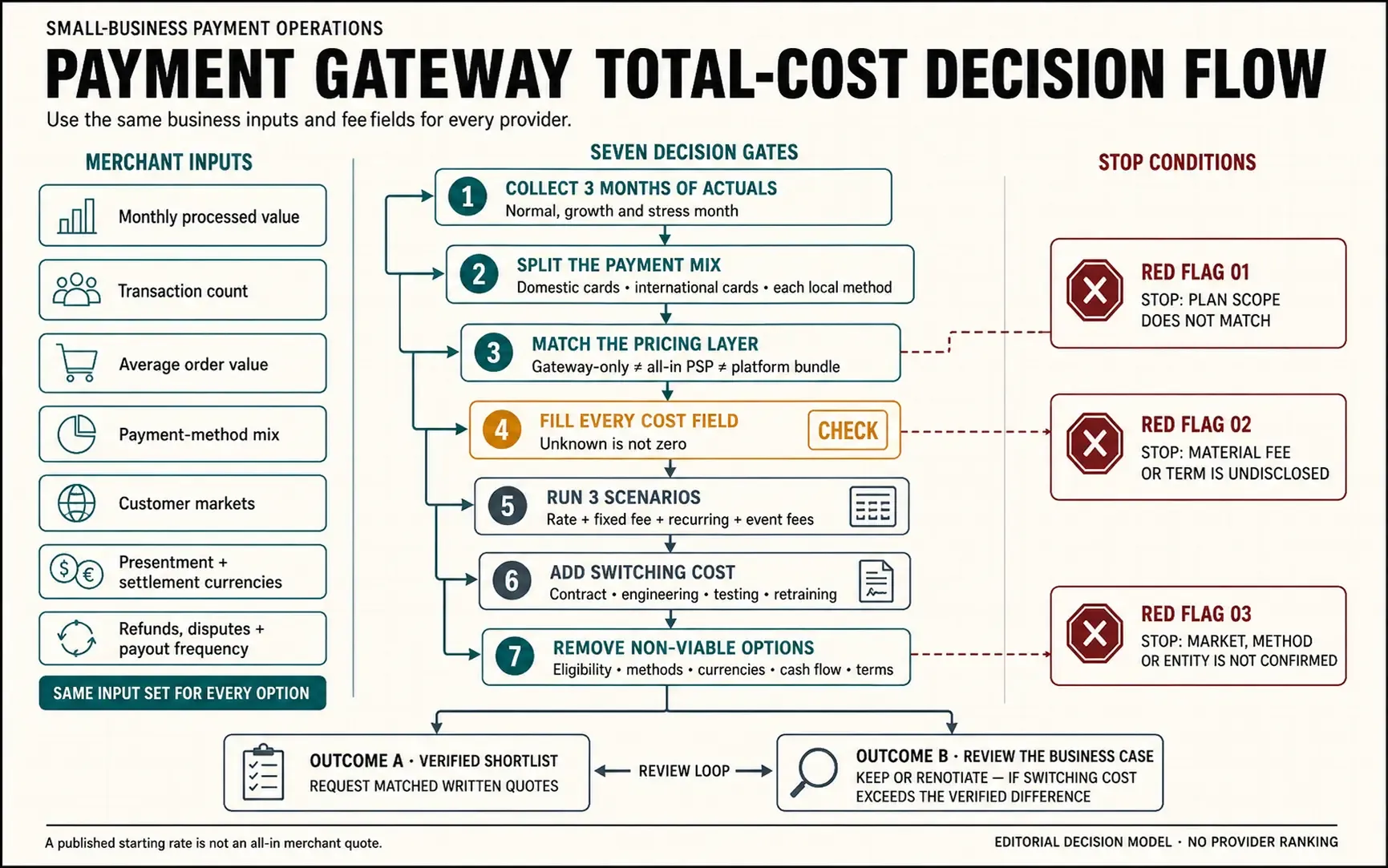
- Calculate your baseline. Export three months of processed value, transaction count, average order value, refunds, disputes, and payout frequency.
- Separate the mix. Split domestic cards, international cards, and each bank, wallet, or local payment method. Record presentment and settlement currencies.
- Select comparable plans. Do not compare a gateway-only fee with an all-in merchant-account rate or a platform bundle without adding the missing layer.
- Fill the matrix. Replace every starting rate, nonpublic field, and quote-dependent item with a written provider response.
- Run at least three cases. Model a normal month, a growth month, and a stress month with refunds, disputes, and additional transfers.
- Add switching cost. Estimate contract exit, engineering, testing, retraining, app changes, and parallel-running time.
- Choose the viable shortlist. Eliminate options that fail eligibility, payment-method, currency, cash-flow, or contract requirements before comparing final cost.
Where HaiPay may fit
HaiPay may merit a written quote for an eligible small-ticket, high-frequency cross-border business that needs a mix of cards and local payment methods. Its current public pricing states the figures below. These are published list figures; the rates, fees and minimums that apply to your account are confirmed in your quote.
- Eligible card pricing starts at 2.5% + $0.30 per transaction.
- Eligible local payment methods start from 0.8%.
- Setup and monthly fees are $0.
- A merchant-initiated refund is $0.30.
- A USD settlement transfer is $15.
- IC++ pricing has a $1,000 minimum monthly processing volume.
- Card settlement is typically T+5 (calendar days), subject to the applicable quote and payment route.
- HaiPay publishes support for 140+ settlement currencies and 150+ local payment methods across key markets. Method availability by market is confirmed in your quote.
These are starting disclosures, not an approval, universal availability promise, or all-in quote. Merchant entity, market, volume, transaction quality, route, currency, and contract determine the applicable offer. Review the current HaiPay pricing page, then contact HaiPay with the exact scenario used in your comparison.
Source: the HaiPay pricing page linked above; verified August 21, 2026.
Where HaiPay may not fit
HaiPay may not fit when:
- a business needs a fully self-serve, final all-in price before supplying its merchant profile;
- the $15 USD settlement transfer is material at the planned transfer frequency;
- the business cannot meet the $1,000 monthly processing minimum for HaiPay’s IC++ option;
- the required payment method, entity, market, route, or currency is not confirmed in the written offer;
- typical T+5 (calendar days) card settlement does not meet the business’s cash-flow requirement; or
- quote-specific cross-border, FX, chargeback, reserve, or contract terms make another viable offer a better operational fit.
This is why the decision should follow matched written quotes rather than a headline-rate table alone.
Sources
This article compares public fee disclosures for procurement research. It does not constitute a merchant quote or financial, legal, tax, investment, or compliance advice. Confirm pricing, eligibility, funding, reserve, and contract terms with each provider.
All pages below were accessed on August 24, 2026.
- HaiPay Pricing — HaiPay. Published starting card rate, local-method starting rate, refund fee, USD settlement transfer fee, IC++ minimum volume and settlement tier used in the HaiPay rows.
- Stripe Pricing — Stripe. Standard online card rate and fixed fee, international-card and currency-conversion additions, and standard versus Instant Payout fees used in the Stripe rows.
- Stripe Disputes Pricing — Stripe. Dispute fee, manual-counter fee and refund-on-win rule used in the chargeback column.
- Stripe ACH Direct Debit — Stripe. ACH Direct Debit rate, per-transaction fee cap, standard settlement timing and Financial Connections verification cost used in Scenario 3.
- Square US Pricing — Square. Free plan Online API rate and fixed fee and the internationally issued card addition used in the Square rows.
- Square Processing Fees Help — Square. Channel-specific processing rates (Online API, invoice, keyed, in-person) cited in the conditions table.
- Square Refunds Help — Square. Refund treatment (original processing fee not returned) used in the refund column.
- Square Transfers Help — Square. Standard next-business-day transfer at no fee and expedited transfer pricing used in the payout column.
- PayPal US Business Fees — PayPal. Advanced Credit and Debit Card Payments rate, international and currency-conversion additions, chargeback fee and transfer fees used in the PayPal rows.
- Helcim Pricing — Helcim. Interchange-plus margin tiers by three-month rolling-average volume, chargeback fee and no-monthly-fee terms used in the Helcim rows.
- Helcim US Fee Disclosure — Helcim. Published USD card-not-present network additions by card brand used in the cross-border column.
- Authorize.net Pricing — Authorize.net. All-in-One rate, monthly fee, no setup fee and gateway chargeback fee used in the Authorize.net rows.
- Shopify Pricing — Shopify. Basic plan monthly fee, Standard and Premium domestic card rates and third-party transaction fee used in the Shopify rows.
- Shopify Payments Fees and Costs — Shopify. Shopify Payments processing costs and the transaction-fee rule when a third-party provider is used.
- Shopify Card Rate Definitions — Shopify. Definitions of Standard and Premium card classes used in the scenario assumptions.
- Shopify Refunds — Shopify. Refund treatment (original card-processing fee not returned) used in the refund column.
- Shopify Chargebacks — Shopify. $15 chargeback fee and refund-on-win rule used in the chargeback column.
- Shopify US Payouts — Shopify. US payout schedule and domestic USD payout terms used in the payout column.
- Shopify International Fees — Shopify. International-card addition and US currency-conversion fee used in the cross-border column.
- Helcim US Terms of Service — Helcim. Reserve, contract and cancellation terms used in the conditions table.
- Helcim Bank Deposit Requirements — Helcim. Deposit timing and eligible US bank rails used in the payout column.
- PayPal Checkout and Expanded Checkout — PayPal. Product scope of Advanced (unbranded) card processing versus PayPal checkout paths.
- PayPal Dispute Fee — PayPal. Standard and high-volume Dispute Fee amounts and the transaction types they apply to.
- PayPal US User Agreement — PayPal. Reserve and account-risk terms used in the conditions table.
- Shopify Risk and Reserves — Shopify. Account-specific reserve, payout hold and payout delay terms used in the conditions table.
- Shopify Multi-Currency Payouts — Shopify. Multi-Currency Payout eligibility by plan used in the payout column.
- Square Accepted Cards — Square. Internationally issued card handling and USD processing used in the cross-border column.
- Square Reserves FAQ — Square. Reserve conditions used in the conditions table.
- Stripe Services Terms — Stripe. Account closure and surviving-obligation terms used in the contract column.
FAQ
A plan can have a $0 monthly or setup fee and still charge for each transaction, refund, dispute, international card, currency conversion, transfer, platform, or optional product. “No monthly fee” is not the same as zero total cost.
Multiply each payment method’s processed value by its percentage rate, multiply its transaction count by the fixed fee, then add monthly, setup-allocation, refund, dispute, international, FX, payout, platform, and migration costs. Keep nonpublic items unresolved until the provider answers them in writing.
The best fit is the viable provider with the strongest result for your actual volume, order count, payment mix, markets, currencies, cash-flow needs, integration, support, and contract conditions. There is no provider that minimizes every business’s cost.
The fixed fee is divided by the order value. A $0.30 fee is 2% of a $15 order but only 0.3% of a $100 order, before the percentage rate is added.
Check the base method fee, international-card and cross-border additions, scheme fees, currency-conversion rate or markup, settlement currency, transfer fee, refund treatment, dispute cost, reserve, minimum volume, and route eligibility.
Recalculate after a major change in volume, order value, customer geography, payment-method mix, refund or dispute rate, platform, settlement currency, or fee schedule. Compare the annual modeled difference with contract and migration costs before switching.
