
Direct Answer
Choosing a payment gateway for Vietnam requires distinguishing international cards (Visa, Mastercard), e-wallet flows (MoMo, ZaloPay, ViettelPay), and NAPAS247 VietQR bank transfers, then verifying VND vs. USD presentment, USD settlement clocks, FX conversion rules, and refund paths in your merchant quote.
This guide is for cross-border e-commerce, gaming, digital-content, software-as-a-service (SaaS) and subscription businesses. It distinguishes public market evidence from provider documentation and merchant-specific approval. HaiPay publishes this guide and provides payment services, so its own coverage is assessed under the same evidence rules. It is educational information, not financial, investment, legal or tax advice.
What a Vietnam payment gateway needs to support
Begin with six questions that describe the payment operation you need:
- Customer: Is the buyer a Vietnamese resident using a local wallet or bank app, or an international cardholder?
- Method: Does the checkout need cards, MoMo, bank-account QR, bank transfer, or a combination?
- Entity: Which legal entity signs the agreement, and is that business model approved?
- Currency: What does the buyer see, which balance is credited, and which currency reaches the merchant bank?
- Operations: Which callback, query, refund, dispute and reconciliation steps are available for each route?
- Commercial terms: Which transaction, foreign-exchange (FX), tax, transfer, reserve and settlement terms appear in the signed quote?
If a provider answers with a method count or the word “multi-currency”, the answer is incomplete. Each question needs a route-level response.
For a broader view of gateway roles, start with the international payment gateway guide. The distinction between local and cross-border acquiring also helps locate FX and settlement responsibilities.
HaiPay Vietnam commercial snapshot: supported methods, currencies, settlement, and fees
Before diving into route-by-route due diligence, use the table below to benchmark HaiPay's published Vietnam payment methods, currency handling, settlement cadence, and fee structure against the items that must be confirmed in your merchant agreement:
Commercial Dimension | Published HaiPay Vietnam Scope | What to Confirm in Your Written Quote |
|---|---|---|
Supported Payment Methods | Digital wallets & QR: MoMo, ZaloPay, ViettelPay, VietQR. Banks: Vietcombank, BIDV, VietinBank, Techcombank, ACB, MBank. Cards: Visa, Mastercard (APAC Coverage). | Exact route codes and payment methods enabled for your contracting entity, MCC, and integration mode (Direct API, Hosted Checkout, or Payment Links). |
Transaction & Settlement Currencies | VND presentment where enabled across 140+ transaction currencies; settlement is in USD by default, with additional settlement currencies available in selected markets as confirmed in your merchant quote. | Presentment (VND or USD) vs. settlement currency pairing, FX benchmark source, and conversion spread (published outbound FX range: 1.0%–2.5% by market). |
Settlement Cycle & Timing (T+N) | Standard credit and debit card settlement is typically T+5 (calendar days); local payment method settlement follows the contracted Vietnam corridor schedule (see Payment Settlement Time Guide). | T+0 trigger event (capture vs. clearing), calendar vs. business day counting, minimum settlement transfer threshold, and rolling reserve percentage/release window. |
Published Starting Rates & Fee Tools | Cards from 2.5% + US$0.30 on the US blended plan (or IC++; +1.5% for international cards); local payment methods from 0.8%, priced by market; refund US$0.30; dispute US$20 (see HaiPay Pricing and Payment Gateway Fees Guide). | Contracted Vietnam method MDR, per-transaction fixed fee, USD wire fee (US$15 where applicable), and modeled effective cost via the Credit Card Processing Fee Calculator. |
Refunds, Webhooks & Reconciliation | Signed asynchronous webhook callbacks, order-status query endpoints, and settlement batch reporting across Local Payment and Global Credit Card. | Whether each enabled Vietnam wallet, QR, or bank rail supports API refunds and partial refunds, or requires an alternative customer payout path. |
Evaluate HaiPay for Vietnam checkout: Review published method coverage on APAC Local Payment Coverage, check starting rates on HaiPay Pricing, model your transaction mix with the Credit Card Processing Fee Calculator, or contact HaiPay for a written Vietnam quote.
Vietnam's card, wallet and bank-QR landscape
Three method families matter here, and they should not be collapsed into one “local payments” label.
- Cards let a buyer enter card credentials at checkout. The merchant still needs an approved card route, authentication design and dispute process.
- MoMo is a wallet and payment product. A customer approves through the MoMo environment; the exact mobile or desktop handoff depends on the integration.
- VietQR is a common brand used with National Payment Corporation of Vietnam (NAPAS)-related bank-account QR transfers; it is not an electronic-wallet product. The code identifies an account-based transfer destination. A compatible scanner can be a bank or payment app, so the scanning app alone does not define the payment route.
State Bank of Vietnam (SBV) material on the VietQR/NAPAS247 launch describes a common brand used through NAPAS, member banks and intermediaries. NAPAS describes the underlying flow as account-to-account transfer by QR. These market facts do not prove that any gateway or merchant account has the route enabled.
Source: SBV-hosted VietQR/NAPAS247 bulletin and NAPAS 247 with VietQR, verified 2026-09-03.

Card payments for international merchants
Cards can remain useful for international customers, subscriptions and buyers who do not use a Vietnamese wallet or bank app. A card option does not remove the need for local methods, and a Vietnam method list does not establish the card flow for your account.
HaiPay's public pricing page lists Visa and Mastercard under Vietnam. Its current Vietnam application programming interface (API) method table does not show a separate card collection row. A merchant should therefore ask which card product and production application identifier (appId) apply, which currencies are accepted, and how authentication, recurring payments, refunds and disputes work.
Do not transfer a general card ticket range to a local wallet, QR or bank route that processes Vietnamese dong (VND). Method limits and operating rules belong to the approved route.
Source: HaiPay Pricing and HaiPay Vietnam API, verified 2026-09-03.
MoMo wallet payments
MoMo is a wallet product, not a synonym for Vietnamese QR payments. First-party MoMo onboarding material says direct merchants register through MoMo for Business, submit company information, enter testing, and complete technical integration and company-account verification before production keys are issued.
Those are MoMo's direct onboarding facts. They do not describe an aggregator's eligibility, commercial terms or settlement. A merchant considering MoMo through another provider should ask:
- What name and logo will appear at checkout?
- Does a desktop customer scan a wallet QR, while mobile redirects to or opens the wallet app?
- Which production appId and route are approved for the merchant entity?
- Which callback and query status can trigger fulfilment?
- Are refunds supported for this route, and how are they reconciled?
- What are the presentment, balance and settlement currencies?
Source: MoMo merchant-profile onboarding, verified 2026-09-03. The source describes direct MoMo onboarding, not HaiPay account terms.
VietQR and bank-account QR payments
VietQR belongs to the bank-account QR path. NAPAS describes its service as a QR-enabled account-to-account transfer through the NAPAS network. An SBV-hosted launch bulletin connects the common VietQR brand to EMVCo payment-QR specifications and the basic QR standard issued under Decision 1928.
A later SBV release describes Decision 2525 and the customer-presented QR standard numbered TCCS 04:2024. That is a different presentation direction. The release does not establish that Decision 2525 replaced Decision 1928.
The label on the provider side still matters. A generic QR route may return a QR code without proving that the underlying standard or brand is VietQR. Ask the provider to identify the standard or brand, supported customer apps, production route, callback and reconciliation fields in writing.
NAPAS-level institution counts or transaction ceilings should not be used as a gateway's account coverage or route limit. The provider and merchant agreement control that narrower scope.
Source: NAPAS 247 with VietQR, SBV-hosted VietQR/NAPAS247 bulletin and SBV release on Decision 2525, verified 2026-09-03.
MoMo versus VietQR: different customer flows
Decision field | MoMo | VietQR |
|---|---|---|
Product category | Wallet and payment product | Common brand used with NAPAS-related bank-account QR transfers; not an electronic wallet |
Customer account | MoMo wallet account | The transfer destination is identified through an account-linked QR; the scanning app and funding source can vary |
Customer action | Approve inside the wallet environment; the exact scan or redirect flow depends on integration | Scan or present a compatible VietQR code and approve the transfer in a supported bank or payment app |
Market proof | MoMo first-party product and onboarding sources | NAPAS and SBV sources |
Provider proof needed | Named MoMo route, display flow and appId | Named scheme and route; a generic QR label is insufficient |
Merchant proof needed | Entity approval, production activation and route-level operations | Entity approval, production activation, supported apps and route-level operations |
Common category error | Treating every QR as MoMo | Calling VietQR itself a wallet, or assuming every app that scans it uses the same route or funding source |
Choose between these flows by the customer's account and action. Do not choose by the fact that both may involve a QR image.
Market availability, published route and merchant activation
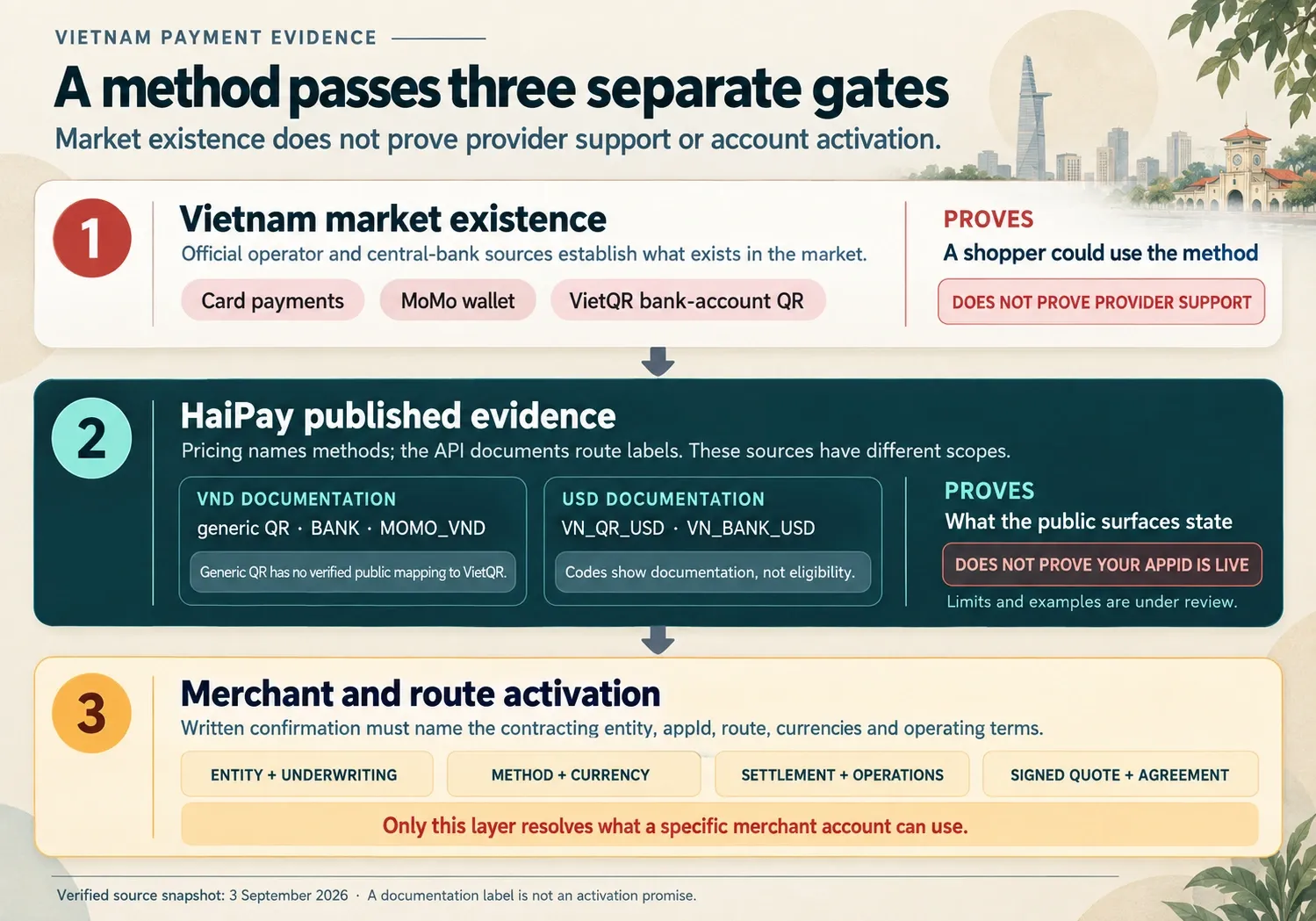
A payment method passes three separate gates:
- Market existence: an operator or official source shows that the method exists in Vietnam.
- Provider documentation: a provider publishes a method, route label or API path for Vietnam.
- Merchant activation: the provider confirms the route for the merchant's entity, appId, currencies and production account.
Evidence does not move from one gate to the next automatically. The existence of VietQR does not prove provider support. A published route does not prove that a given merchant can activate it.
Source: HaiPay Pricing, HaiPay Vietnam API, MoMo, NAPAS and SBV sources cited above; verified 2026-09-03.
VND and US dollars (USD): presentment, balance and settlement are different
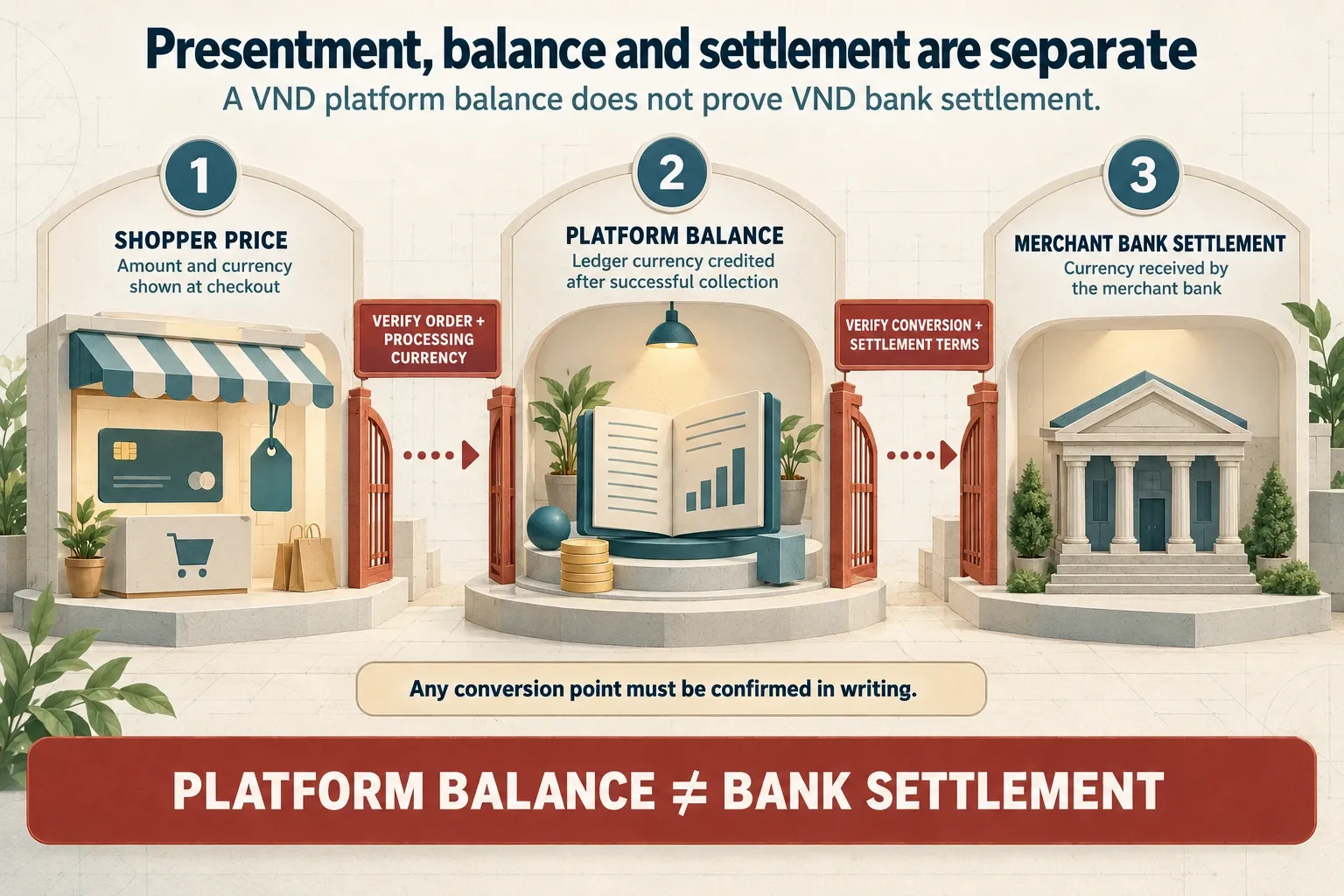
“Supports VND” can refer to several different points in the funds flow. Ask about each one:
- The amount and currency shown to the shopper.
- The order currency sent to the collection endpoint.
- The payment-method processing currency.
- The platform balance credited after collection.
- The point, if any, where conversion occurs.
- The merchant settlement currency.
- The payout account, bank currency, fees and transit time.
The current Vietnam API describes VND and USD collection paths and says successful transactions increase the corresponding platform balance. That is evidence about order and balance currency. It does not say which currency reaches a specific merchant bank account.
The same rule applies to a Global Cashier response that contains original-currency and floating-rate fields. A rate field shows a conversion result was represented; it does not identify the benchmark, price side, sample time, markup or settlement currency.
Source: HaiPay Vietnam API and Global Cashier, verified 2026-09-03.
Fees, tax, FX and settlement
Compare the complete commercial stack, not one transaction percentage.
Published pricing is a starting structure
HaiPay's public schedule lists the following general fields:
Published field | Public schedule | Scope to confirm |
|---|---|---|
US card product | US-issued cards from 2.5% + US$0.30; non-US-issued cards from 4.0% + US$0.30 | US merchants contracting through HaiPay’s US entity; business and risk review. Not a Vietnam-specific card quote. |
Local payment methods | From 1.2%, such as QRIS in Indonesia | Not a Vietnam method rate. Confirm each method, FX and applicable local taxes in the quote. |
Processed refunds | US$0.30 each | Confirm route support, partial refunds and original-fee return terms. |
USD settlement wire | US$15 per wire | Intermediary bank fees are borne by the recipient. Confirm the settlement currency and payout arrangement. |
Setup and annual fees | US$0 setup; US$0 annual fee | Other account-specific charges require the signed quote. |
Monthly billing | No minimum monthly billing | Confirm any monthly service fee separately. |
IC++ pricing | Request an itemized quote | Confirm model eligibility and any processing-volume terms in writing. |
None of these fields is a quoted price for MoMo, VietQR, BANK, MOMO_VND or another specific Vietnam route. The merchant entity, route, market, volume, transaction quality, risk review and signed agreement determine the applied terms.
Source: HaiPay Pricing, verified 2026-09-03.
Treat settlement as three clocks
A settlement tier is only one clock. The payout schedule controls when a provider releases funds, and bank transit controls when the destination bank posts them. A complete quote should also name the day convention and explain weekends and public holidays.
Selected local payment methods in Vietnam can settle as fast as T+1. This does not assign a schedule to every Vietnam route or define the day unit. Confirm the starting event for T, day-counting unit, cut-off, payout schedule, holiday treatment and bank transit for each enabled method in your merchant quote. A T+N label alone does not establish a bank-arrival date.
Source: HaiPay settlement guide, accessed October 16, 2026; account-specific schedules require the merchant quote.
Make the FX definition reproducible
Ask the provider to confirm the applicable FX reference and final applied rate in the merchant quote. The quote should define the source, currency pair, buy or sell side, sampling time and timezone, aggregation method, markup, outbound fee and route.
An FX reference does not imply any additional payment or settlement method.
How to verify a tax line in a Vietnam quote
Do not turn an unexplained quote percentage into a national payment-gateway tax rate. Vietnam's value-added tax (VAT) and corporate-income-tax framework has changed across laws, decrees and circulars, including amendments effective in 2026. The applicable treatment can depend on the contracting entity, income or service classification, contract allocation, calculation method and transition rules.
For every tax or tax-handling line, obtain:
- The exact legal or contractual name.
- The current legal basis.
- The tax base: gross merchandise value, processing fee, net settlement or another defined amount.
- The party that withholds and the party that declares or remits.
- Whether the amount is included in the quote or added to it.
- The contracting entity, route and merchant type.
- The gross-up rule, effective date, transition treatment and exceptions.
- Written confirmation from the relevant tax or compliance owner.
This checklist is due diligence, not tax advice. An accountant or tax adviser should assess the merchant's own facts and current law.
Source: Vietnam Law 09/2026/QH16 and Circular 20/2026/TT-BTC, verified 2026-09-03.
Merchant entity and route activation
Resolve the legal entity before building around a method. A method can exist in the market and appear on a pricing page, yet remain unavailable for a specific business model or account.
Send the provider a compact activation pack:
- Full merchant legal name, incorporation country and website.
- Product or service, customer locations and fulfilment model.
- Expected monthly value, transaction count and average order value.
- Refund, subscription, dispute and delivery profile.
- Required methods, currencies and countries.
- Desired settlement currency and destination bank account.
- Required production date and integration model.
Ask for the contracting entity, approved route, appId, method display name, presentment currency and settlement terms in the same written response. A sandbox credential or documentation page is not production approval.
Status, refunds, disputes and reconciliation
Checkout success is only the first operating state. Before launch, map the route across the full lifecycle:
Operation | Question to resolve |
|---|---|
Create | Which idempotency key prevents duplicate payment creation? |
Redirect or QR | When does the customer-facing session expire, and can it be regenerated? |
Callback | How is the message authenticated, retried and de-duplicated? |
Query | Which server-side state is authoritative when browser and callback disagree? |
Fulfilment | Which state may release digital goods or credit an account? |
Refund or cancel | Which operation is supported, in which currency, and with what fee? |
Dispute | What evidence window, fee and notification channel apply? |
Reconciliation | Which order, provider payment, fee, FX, refund and payout identifiers can be joined? |
Settlement file | Can finance review a sample before integration? |
The current public Vietnam documentation contains inconsistent numerical ranges and sample fields that do not all align with a Vietnam collection flow. This guide therefore does not reproduce route limits or code examples. Obtain a current production specification and test it through approved user acceptance testing (UAT) cases.
Vietnam Payment-Route Evidence Matrix
This matrix reports what the current public sources establish. “Documented” does not mean activated.
Route family | Market existence | HaiPay published evidence | API label | Order / balance currency | Limit treatment | Customer action | Account activation | Settlement currency | Refund / reconciliation | Tax / FX | Evidence status |
|---|---|---|---|---|---|---|---|---|---|---|---|
International cards | Card acceptance exists in Vietnam | Pricing lists Visa and Mastercard for Vietnam | No separate card row in the current Vietnam method table | Route-level currency not established here | Confirm the approved card route | Enter card details and complete required authentication | Written entity and card-product approval | Confirm in quote | Confirm route support, fee and file fields | Confirm quote terms | Marketing evidence; card route confirmation required |
VND QR | VietQR exists as a common brand for bank-account QR transfers; generic QR also exists as a technical format | Pricing names VietQR | QR / QR, which is generic | VND order path; VND platform balance | Not reproduced because the source ranges conflict | Scan/approve flow must identify the actual standard or brand and supported app | Written appId, route and entity approval | Confirm in quote; VND balance is not bank settlement | Confirm callback, refund and reconciliation | No public route-specific proof | API label documented; engineering must verify whether it maps to VietQR |
VND bank transfer | Bank transfer is a payment family | Pricing says “Mainstream banks”, without a collection coverage list | BANK_TRANSFER / BANK | VND order path; VND platform balance | Not reproduced because the source ranges conflict | Confirm the bank-selection or transfer experience | Written appId, route and entity approval | Confirm in quote | Confirm route operations and settlement file | No public route-specific proof | API label documented; bank coverage and activation require confirmation |
MoMo VND | MoMo wallet exists | Pricing names MoMo | EWALLET / MOMO_VND | VND order path; VND platform balance | Confirm in the production specification | Approve in the MoMo environment; exact HaiPay handoff must be tested | Written appId, route and entity approval | Confirm in quote | Confirm callback, query, refund and reconciliation | No public route-specific proof | Wallet product and API label are documented; merchant activation is required |
Vietnam QR USD | Provider-documented route; no separate operator proof for a “USD QR” product | No public marketing-to-code mapping | QR / VN_QR_USD | USD order path; USD platform balance | Not reproduced because currency/range rules conflict | Confirm the scheme and checkout flow | Written appId, route and entity approval | Confirm in quote | Confirm route operations | Ask the quote to define the FX reference and applied rate | API label documented; scheme and activation require confirmation |
Vietnam bank USD | Bank transfer exists as a family | No public marketing-to-code mapping | BANK_TRANSFER / VN_BANK_USD | USD order path; USD platform balance | Not reproduced because currency/range rules conflict | Confirm the checkout transfer flow | Written appId, route and entity approval | Confirm in quote | Confirm route operations | Ask the quote to define the FX reference and applied rate | API label documented; activation requires confirmation |
Source: HaiPay Pricing, HaiPay Vietnam API, MoMo onboarding, NAPAS and SBV sources cited above; verified 2026-09-03.
A practical route-selection flow
- Fix the contracting entity. Stop if the provider cannot name it or assess the business model.
- List real customer contexts. Separate local wallet users, compatible bank-app users and international cardholders.
- Choose the method family. Keep cards, MoMo, bank-account QR and bank transfer distinct.
- Name the production route. Do not accept “QR” as proof of a specific scheme.
- Split the currency chain. Record presentment, order, balance, conversion, settlement and bank-account currency.
- Test the state machine. Cover callback, query, duplicate events, expiry, fulfilment, refund and dispute cases.
- Review the reconciliation file. Finance should be able to join the order, payment, fee, FX, reversal and payout.
- Sign the complete quote. Include route, tax, FX, settlement, payout, reserve and exception terms.
Stop at any unresolved gate. Integration effort should follow written activation, not precede it.
Where HaiPay may fit—and what to confirm
HaiPay's public Vietnam row lists cards, MoMo, bank transfers and VietQR. Its Vietnam API separately documents generic VND QR, bank and MoMo labels, plus USD QR and bank labels. These sources make HaiPay a candidate for a scoped discussion, but they do not activate a merchant account.
Source: HaiPay Pricing and HaiPay Vietnam API, verified 2026-09-03.
HaiPay may fit if the required method, entity and currency path are confirmed together, and if the operations package meets the merchant's refund, dispute and reconciliation needs. Review the local payment product, card product and public pricing structure, then contact HaiPay with the route-selection checklist.
Request one written response that covers:
- Contracting entity and approved merchant profile.
- Production appId, route code and checkout display name.
- VND or USD presentment, balance, conversion and settlement path.
- Customer action on desktop and mobile.
- Route limits in the current production specification.
- Callback, query, refund, cancel, dispute and reconciliation behaviour.
- Settlement clock, payout schedule, bank transit and transfer charges.
- Exact tax and FX definitions, including scope and effective date.
Sources
- State Bank of Vietnam, VietQR/NAPAS247 launch bulletin. Accessed 2026-09-03. Supports the common-brand, operator and Decision 1928 context.
- NAPAS, NAPAS 247 with VietQR. Accessed 2026-09-03. Supports the bank-account QR and NAPAS-network flow.
- MoMo Developer, Merchant Profile onboarding. Accessed 2026-09-03. Supports direct MoMo registration, testing and production-key prerequisites.
- State Bank of Vietnam, Decision 2525 and TCCS 04:2024 release. Accessed 2026-09-03. Supports the later customer-presented QR standard context.
- HaiPay, Payment Gateway Pricing. Accessed 2026-09-03. Supports public pricing structure, Vietnam marketing labels and quote limitations.
- HaiPay, Vietnam API. Accessed 2026-09-03. Supports documented collection paths, route labels and platform-balance wording; numerical limits and sample payloads are intentionally not reproduced.
- HaiPay, Global Cashier. Accessed 2026-09-03. Supports the VN currency row and original-currency/rate response fields, not a benchmark or settlement claim.
- HaiPay, Payment Settlement Time. Accessed 2026-09-03. Supports the separation of settlement, payout and bank transit; day units and account schedules require the merchant quote. Commercial timing guidance rechecked October 16, 2026.
- Vietnam Government Portal, Law 09/2026/QH16. Accessed 2026-09-03. Supports the current amendment layer across VAT and corporate income tax.
- Vietnam Government Portal, Circular 20/2026/TT-BTC. Accessed 2026-09-03. Supports current foreign-enterprise corporate-income-tax implementation and transition context.
Source: HaiPay pricing and settlement guidance, accessed October 16, 2026. Account-specific availability, pricing and settlement arrangements are confirmed in the merchant quote.
FAQ
Consider international cards, the MoMo wallet, VietQR or another verified bank-account QR flow, and bank transfer. The right mix depends on customer accounts, device flow, merchant entity, approved route, currencies and post-payment operations.
No. MoMo is a wallet and payment product; VietQR is a common brand used with NAPAS-related bank-account QR transfers, not an electronic wallet. The brand, funding source, approval flow and provider route still need separate confirmation. A QR image or scanning-app logo alone does not establish that they are the same product.
No. The current Vietnam API uses a generic QR label, while the pricing page separately names VietQR. Ask HaiPay to confirm the VietQR-to-route mapping, supported customer apps and production appId in writing.
No. A VND balance describes a platform ledger layer. Settlement currency, payout account currency, conversion point, transfer fee and bank transit require separate confirmation.
Model the approved route's percentage and fixed fee together with FX, tax treatment, refunds, disputes, settlement transfers, reserves and minimum-volume terms. Use the signed quote rather than applying a general starting rate to every Vietnam method.
It should name the settlement tier, calendar-day or business-day convention, working-day execution rule, payout schedule, weekend and holiday treatment, bank transit, destination currency and any transfer fee.
Not automatically. Ask for the exact tax name, legal or contractual basis, tax base, withholding and filing parties, contracting entity, route, effective date, inclusion or gross-up treatment and tax-owner approval. Obtain advice for your own facts.
Ask the provider to confirm the applicable FX reference and final applied rate in the merchant quote. The written definition should state the pair, source, side, sampling time, aggregation rule, markup, fees, route and contracting entity.

Related HaiPay surfaces
Explore the payment stack
Guide
International Payment Gateway
Compare international gateway options by merchant eligibility, payment methods, currencies, settlement and operational fit.
Guide
Local Acquiring vs Cross-Border Acquiring
Understand how route structure can affect acceptance, currency handling, settlement and the contracting model.
Product
Local Payment Methods
Explore HaiPay's local-payment product, then confirm Vietnam method and account eligibility in writing.
Product
Credit Card Acceptance
Review the card product and confirm the approved Vietnam card route, currencies and operations for your account.

Need help mapping your payment stack?
Talk to HaiPay about acquiring, orchestration, local methods, and payout workflows.
Contact us