
Direct Answer
To accept online payments from German customers with high checkout conversion, international merchants must combine digital wallets, invoice or pay-by-bank rails, SEPA Direct Debit (Lastschrift), and co-badged debit/credit cards (Visa and Mastercard). According to the EHI Retail Institute's Online-Payment 2025 study (45.1 billion EUR in 2024 German online revenue), PayPal leads at 28.5%, followed by invoice billing (25.8%), SEPA Direct Debit (17.3%), cards (12.3%), and installments (4.3%). Following the shutdown of Giropay on 31 December 2024 and standalone SOFORT on 31 March 2025, merchants can onboard non-German entities via cross-border KYB, enforce PSD2 3DS2 and EU 2024/886 Verification of Payee rules, and settle natively in EUR.
Choosing a payment gateway for Germany takes more than enabling a standard credit card form. German shoppers strongly favor digital wallets, open-invoice billing, and direct bank pulls over revolving credit cards. International merchants that ignore local German checkout habits face high cart abandonment and avoidable foreign exchange spreads.
The EHI Retail Institute's Online-Payment 2025 study analyzed 45.1 billion EUR in 2024 net online revenue across 153 German retailers. PayPal (28.5%), invoice billing (25.8%), SEPA Direct Debit (17.3%), and cards (12.3%) dominate German e-commerce. Meanwhile, Giropay shut down on 31 December 2024 and standalone SOFORT retired on 31 March 2025.
How German Customers Pay Online: EHI 2025 Shares, Bundesbank Data, and the Post-Giropay Shift
Germany is Europe's largest economy, yet its payment culture differs sharply from the United States or the United Kingdom. In the Deutsche Bundesbank's 2023 payment behaviour study, cash accounted for 51% of point-of-sale transactions and 26% of expenditure. Debit cards accounted for 27% of transactions and led total point-of-sale turnover at 32%.
In online commerce, German buyers prioritize buyer protection and direct bank-account control. EHI Retail Institute data published in May 2025 shows that wallets, invoice payments (Kauf auf Rechnung), and SEPA bank payments capture over 71% of German online retail revenue. Installment financing (Ratenkauf) also doubled its revenue share over three years to reach 4.3%.
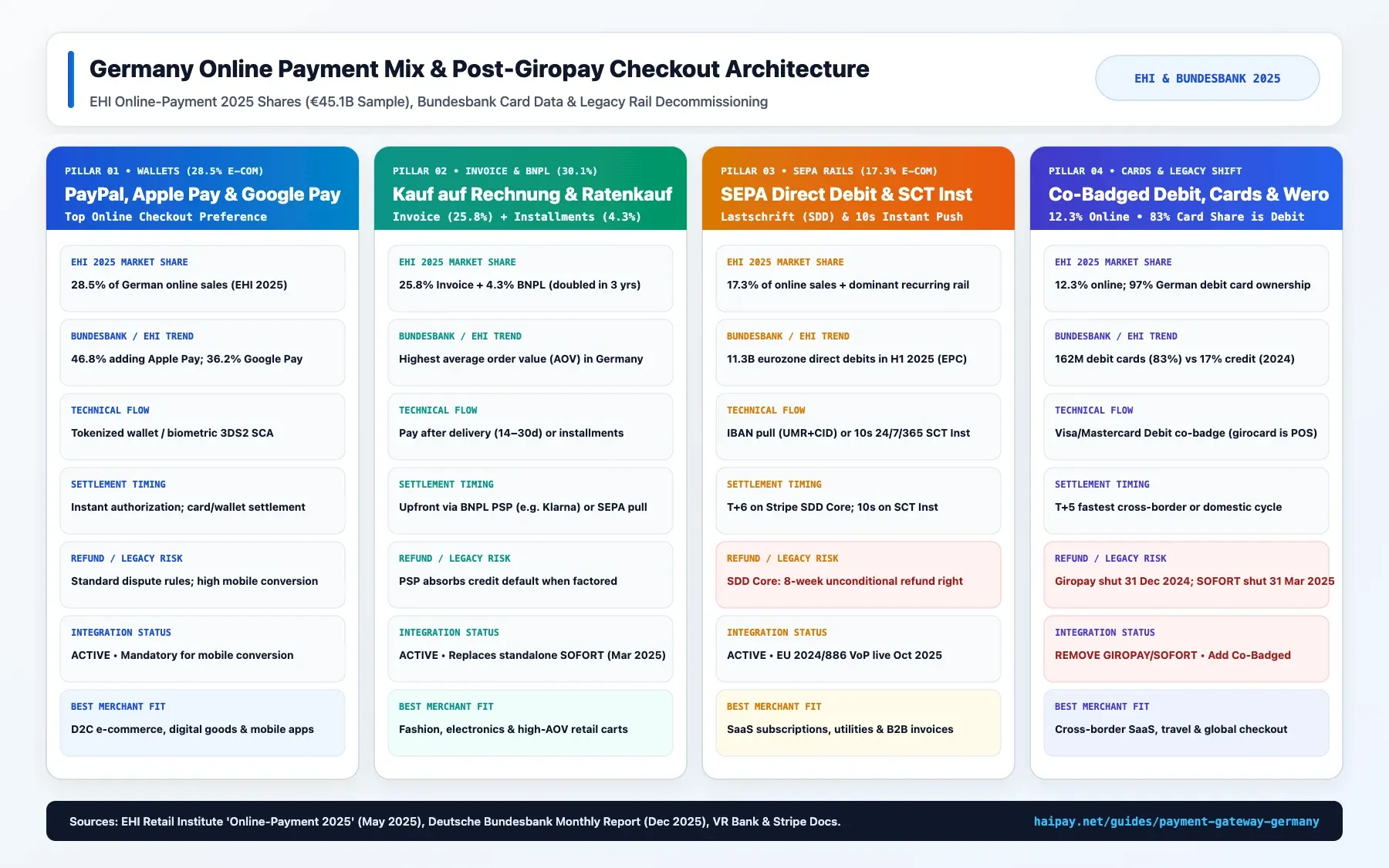
German Payment Rail | Verified Share & Adoption | Settlement & Flow | Integration Action |
|---|---|---|---|
PayPal, Apple Pay & Google Pay | 28.5% PayPal (EHI 2025); 46.8% adding Apple Pay, 36.2% Google Pay. | Instant auth; mobile card share rose from 5% to 16% (2022–2024). | Enable Apple Pay and Google Pay for 14-second mobile checkouts. |
Invoice & BNPL (Rechnung / Ratenkauf) | 25.8% Rechnung + 4.3% Ratenkauf (EHI 2025, 45.1B EUR sample). | Buyer pays 14–30d post-delivery or in installments; PSP pays upfront. | Replace retired SOFORT with Klarna pay-in-full or invoice rails. |
SEPA Direct Debit & SCT Inst | 17.3% online share (EHI 2025); 11.3B eurozone debits in H1 2025. | SDD Core settles T+6 on Stripe; SCT Inst settles <=10s 24/7/365. | Use SDD Core for subscriptions and SCT Inst or SDD B2B for invoices. |
Co-Badged Debit & Credit Cards | 12.3% online share; 97% debit ownership; 83% of 196M cards are debit. | Pure girocard is POS only; online uses Visa/Mastercard Debit & credit. | Support Visa Debit, Mastercard Debit, and EMV 3DS2 for 162M cards. |
Legacy Giropay / SOFORT vs. Wero | Giropay shut 31 Dec 2024 (Stripe 30 Jun 2024); SOFORT ended 31 Mar 2025. | EPI launched Wero in July 2024 for sub-10-second A2A bank transfers. | Remove hardcoded giropay and sofort API calls immediately. |
Why Giropay Shut Down on 31 December 2024 and Why Standalone SOFORT Retired
Many cross-border checkouts still show broken buttons for legacy German bank redirects. German banks officially shut down giropay (including paydirekt) on 31 December 2024. The giropay Geld senden P2P service closed on 12 December 2024, and Stripe partners halted giropay transactions after 30 June 2024.
Stripe also discontinued SOFORT as a standalone payment method on 31 March 2025. Merchants must remove legacy giropay and standalone SOFORT parameters from checkout code. German bank-redirect traffic now routes to SEPA Instant (SCT Inst), Klarna's pay-in-full option, and EPI's Wero wallet (launched July 2024).
The Girocard vs. Visa/Mastercard Co-Badged Debit Shift in Germany
The Deutsche Bundesbank's December 2025 Monthly Report highlights a major shift in German card issuing. By 31 December 2024, German PSPs had 196 million payment cards in circulation (26% of eurozone cards). Debit cards represented 83% (162 million cards, up from 111 million in 2018), while credit cards fell from 24% to 17%. Compare how neighboring France handles co-badged domestic debit routing in our France payment gateway and Cartes Bancaires (CB) guide.
Germany's domestic girocard scheme captures nearly 72% of debit card revenue and costs physical stores €0.60 per transaction (under 1% of turnover). However, a standalone girocard without a co-badge works almost exclusively at physical terminals. For e-commerce, German banks issue Visa Debit and Mastercard Debit cards. Annual German debit transactions rose from 3.9 billion (€206 billion) in 2018 to 10.9 billion (nearly €420 billion) in 2024.
Source: EHI Retail Institute 'Online-Payment 2025' (7 May 2025), Deutsche Bundesbank Monthly Report (16 Dec 2025), VR Bank giropay notice, and Stripe docs.
Can an Overseas Company Accept Payments from Germany Without a Local GmbH?
Many international SaaS, e-commerce, and digital content teams assume selling into Germany requires a local GmbH (€25,000 share capital). In practice, qualified companies incorporated in the US, UK, Hong Kong, Singapore, or another EU state can collect EUR from German buyers without a local subsidiary. Review our cross-border payments and European clearing guide to compare direct overseas onboarding against local European entity structures.
In Germany, payment and e-money institutions are supervised under the Payment Services Supervision Act (ZAG) by BaFin and the Deutsche Bundesbank alongside Directive (EU) 2015/2366 (PSD2). International merchants do not need their own BaFin license when contracting with a compliant gateway. Instead, merchants pass KYB underwriting and follow German checkout rules.
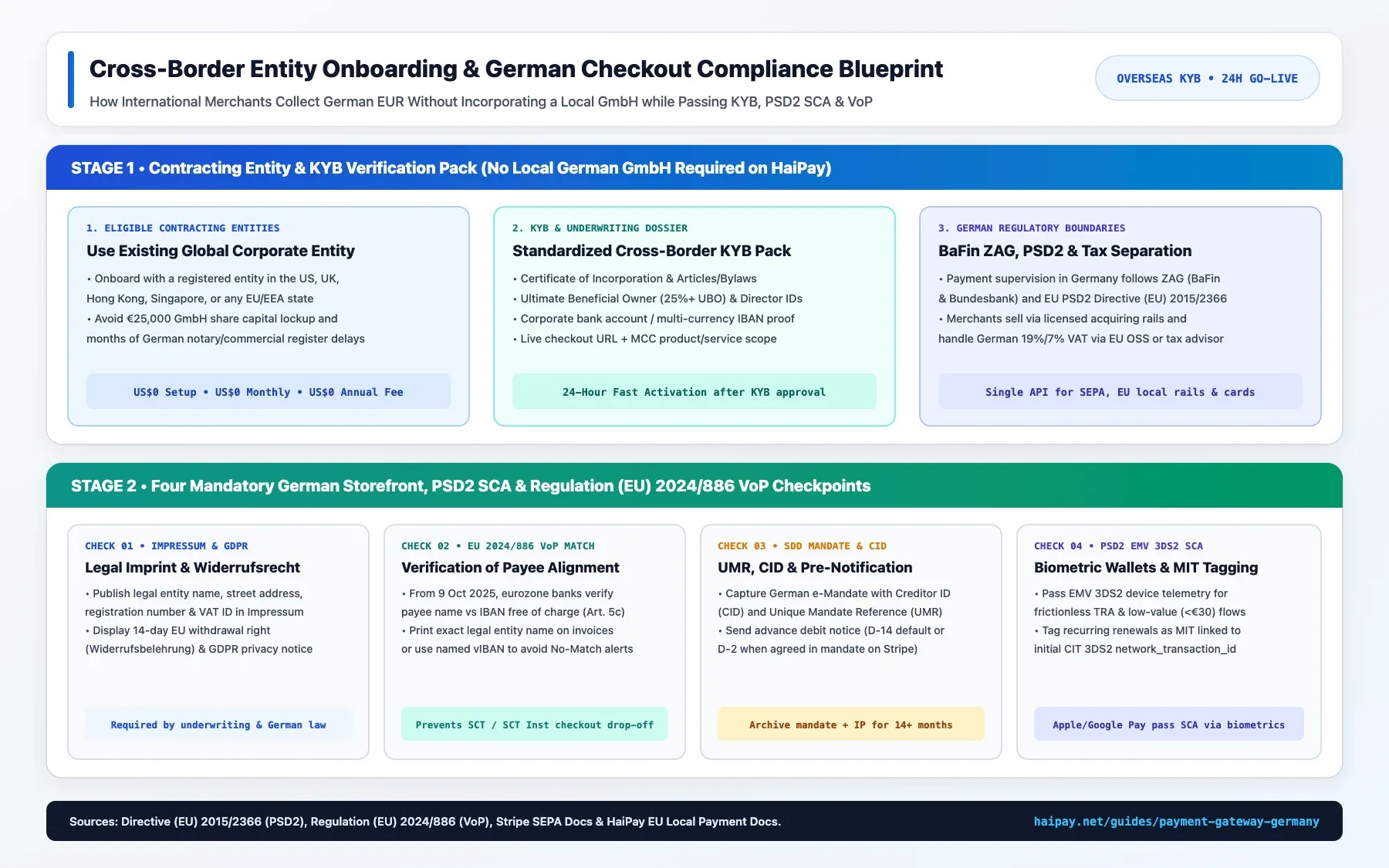
- Corporate KYB & UBO Dossier: Submit your Certificate of Incorporation, registry extract, 25%+ UBO and director IDs, and corporate bank proof.
- German Impressum & 14-Day Widerrufsrecht: Publish an Impressum with your legal entity name, address, registration number, VAT ID, GDPR terms, and 14-day withdrawal notice.
- Regulation (EU) 2024/886 Verification of Payee (VoP): From 9 October 2025, eurozone bank PSPs verify the beneficiary name against the IBAN free of charge before payer authorization (Article 5c; EMIs follow in 2027). Print your exact legal entity name on invoices or use a named vIBAN to prevent No-Match warnings.
- SEPA Creditor Identifier (CID) & Mandate Storage: Ensure your gateway assigns a Creditor Identifier (CID) and archives a Unique Mandate Reference (UMR) for every signed SDD mandate.
Source: Directive (EU) 2015/2366 (PSD2), EUR-Lex Regulation (EU) 2024/886 (Articles 5a–5d), and ECB Instant Payments timeline.
Managing German Refund Risk: SDD Core 8-Week Recalls, High Return Rates, and PSD2 3DS2
Operating a profitable checkout in Germany requires managing two local risk factors: SEPA Direct Debit (Lastschrift) unconditional bank recalls and high e-commerce return rates. Treating every payment rail as final exposes merchants to principal losses and €20.00 dispute fees. See our merchant account rolling reserve and working capital guide to understand how dispute ratios affect processor holdbacks and liquidity.
The SDD Core 8-Week No-Questions-Asked Refund Trap vs. SDD B2B Finality
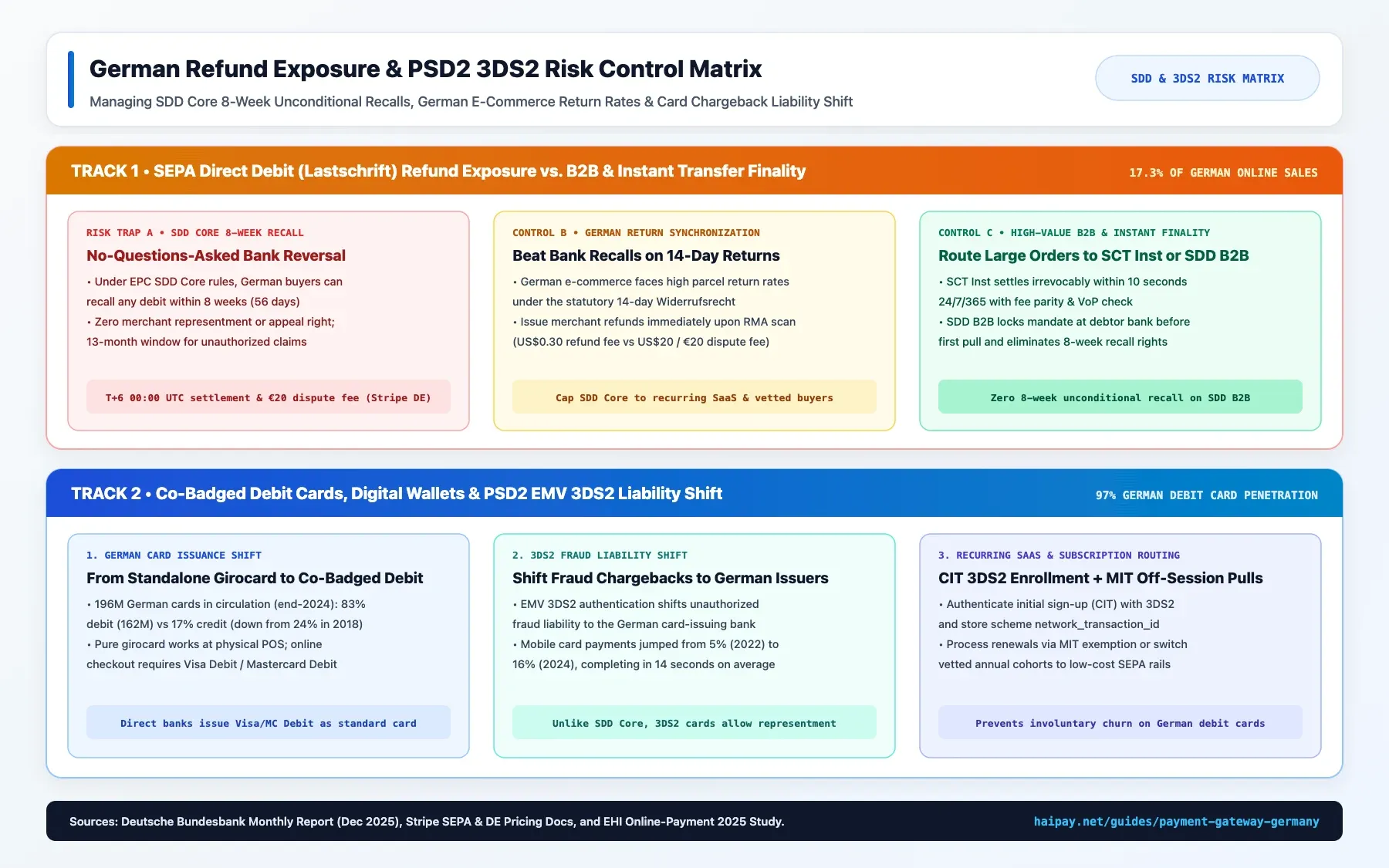
SEPA Direct Debit captures 17.3% of German online retail revenue and powers recurring subscriptions. Under EPC SDD Core rules, merchants must notify customers at least 14 calendar days before debiting the account. Mandates can shorten this window (up to 2 calendar days by default on Stripe). On Stripe, SDD Core caps single debits at 10,000 EUR, uses a 10:30 CET cutoff, and settles at T+6 at 00:00 UTC.
Crucially, SDD Core grants German payers an unconditional refund right for 8 weeks (56 days) after the debit, plus a 13-month window for unauthorized claims. The customer's bank honors an 8-week recall immediately with zero merchant appeal process. For high-ticket B2B sales, merchants should require SEPA Instant (SCT Inst) or SEPA Direct Debit B2B (SDD B2B). Under SDD B2B, corporate debtors confirm the mandate at their bank before the first debit and waive the 8-week unconditional refund right.
PSD2 Strong Customer Authentication (EMV 3DS2) and Return Synchronization
When German shoppers return goods under the 14-day withdrawal right, slow refunds often trigger bank-side SDD recalls or card chargebacks. Stripe Germany charges €20.00 per dispute received, whereas HaiPay charges US$0.30 per processed refund versus US$20 per dispute. Automating RMA webhooks to issue immediate gateway refunds prevents costly bank recalls.
For German card and wallet checkouts, merchants must enforce PSD2 Strong Customer Authentication via EMV 3DS2. Authenticating initial Customer-Initiated Transactions (CIT) with 3DS2 or native Apple Pay and Google Pay biometrics shifts fraud chargeback liability to the German issuer. For recurring renewals, pass the initial scheme network transaction ID to process off-session Merchant-Initiated Transactions (MIT) without step-up friction.
Risk Dimension | SDD Core | SDD B2B / SCT Inst | Co-Badged Cards & Wallets (3DS2) |
|---|---|---|---|
Settlement Speed | T+6 at 00:00 UTC on Stripe (1–2d debit + 5d refusal). | SCT Inst: <=10s 24/7/365; SDD B2B: 1–3 business days. | Instant auth; fastest cross-border settlement T+5. |
Refund Window | 8-week unconditional recall + 13m unauthorized claim. | Zero 8-week unconditional refund for authorized debits. | Issuer chargeback rules (120d) with evidence review. |
Merchant Appeal | None during first 8 weeks; bank reverses immediately. | Irrevocable push (SCT Inst) or bank-locked B2B mandate. | Full representment; 3DS2 shifts fraud liability to issuer. |
Best German Use Case | Recurring consumer SaaS and vetted repeat buyers. | High-value B2B wholesale invoices and instant release. | First-time e-commerce orders, digital goods, and apps. |
Source: Stripe SEPA Direct Debit docs (docs.stripe.com/payments/sepa-debit) and Stripe Germany pricing (stripe.com/en-de/pricing).
Payment Gateway Germany Fee Comparison: Domestic Schedules, Cross-Border Markups, and EUR Treasury
Evaluating a German payment gateway requires auditing cross-border surcharges, fixed platform fees, and settlement FX conversion. On Stripe Germany's domestic pricing page, standard EEA cards cost 1.5% + €0.25 and commercial EEA cards cost 2.8% + €0.25. UK cards cost 2.5% + €0.25, while international cards cost 3.15% + €0.25 plus 2% for currency conversion.
For bank and alternative rails on Stripe Germany, SEPA Direct Debit costs €0.35 per transaction (10,000 EUR cap, SDD Core only). Klarna domestic European transactions start at 2.99% + €0.35. For US entities collecting SEPA Direct Debit cross-border on Stripe, the fee is 0.8% + $0.30 (capped at $6.00) plus international and FX surcharges. Stripe also charges $10 in the US or €20.00 in Germany per dispute.
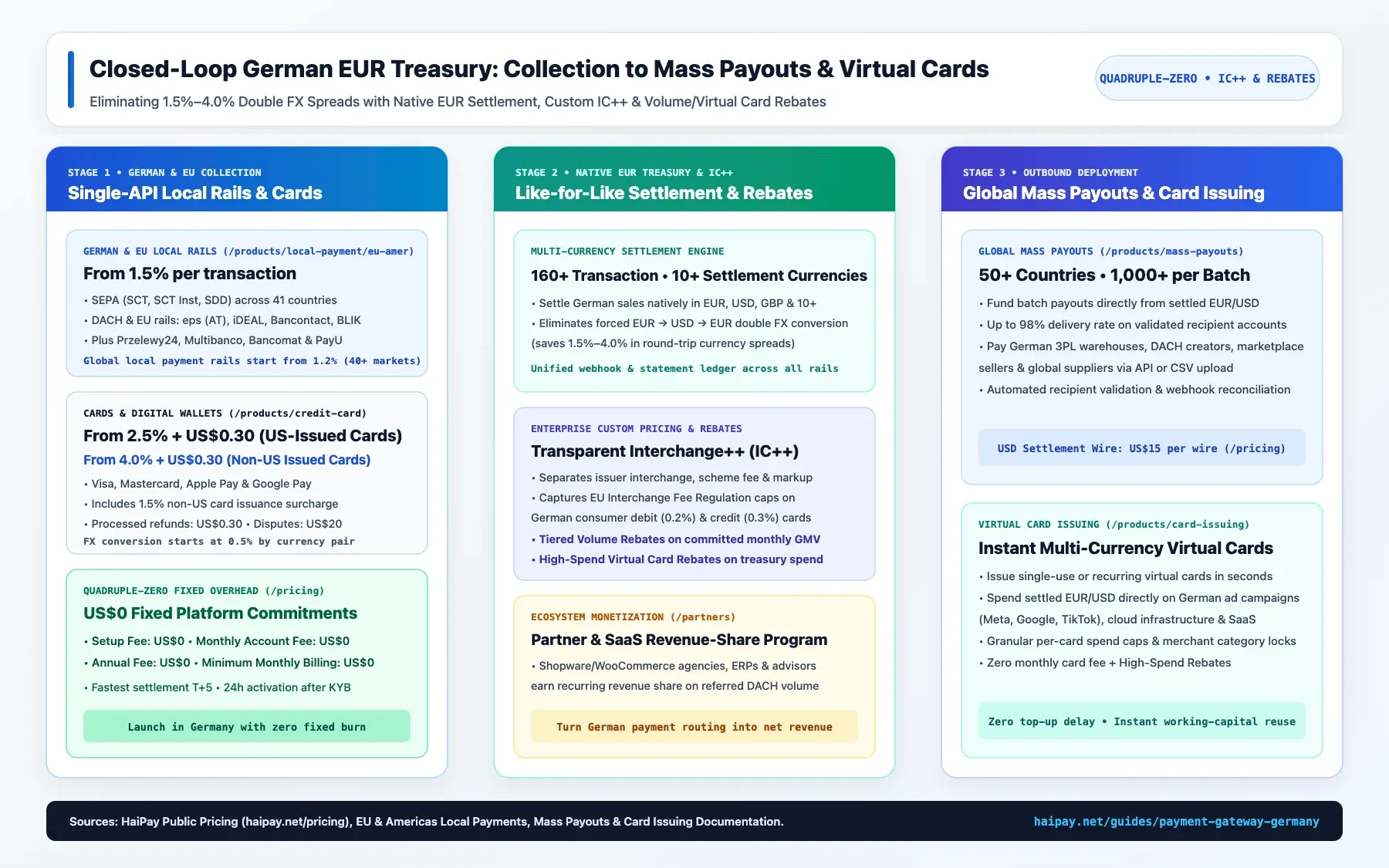
International merchants operating without a local German GmbH can unify German bank rails and card acceptance through HaiPay's Europe and Americas local payment infrastructure. A single API connects SEPA transfers with online credit and debit card acquiring across four operational layers:
- Unified SEPA & DACH Local Bank Rails (From 1.5%). Accept SEPA transfers alongside Austrian eps, iDEAL, Bancontact, BLIK, Przelewy24, and Multibanco from 1.5%. Regional local payment rails start from 1.2% across 40+ global markets.
- Co-Badged German Debit & Wallet Acquiring. Process German co-badged Visa Debit, Mastercard Debit, credit cards, Apple Pay, and Google Pay from 2.5% + US$0.30 for US cards via a US entity. Non-US cards start from 4.0% + US$0.30 (including a 1.5% non-US surcharge, FX from 0.5%, US$0.30 refunds, and US$20 disputes).
- Direct Overseas KYB & Zero Fixed Account Fees. Onboard qualified US, UK, Hong Kong, Singapore, and EU corporate entities within 24 hours of KYB approval without forming a local German GmbH. Accounts carry US$0 setup, US$0 monthly, US$0 annual, and US$0 minimum monthly billing fees.
- EEA Consumer Interchange Transparency (IC++). High-volume merchants can request unblended Interchange++ (IC++) pass-through pricing under EU Regulation (EU) 2015/751, capturing statutory 0.20% debit and 0.30% credit interchange caps.
Closing the treasury loop in native EUR protects an additional 1.5% to 4.0% of net margin. When a processor forces German EUR sales into USD at settlement, the merchant pays an immediate FX spread. Converting USD back into EUR later to pay German 3PL warehouses, DACH creators, or European ad platforms triggers a second FX loss. Read our multi-currency merchant account guide to structure native EUR, USD, and GBP settlement accounts without double conversion.
With HaiPay, merchants accept 160+ transaction currencies and settle natively in EUR, USD, GBP, and 10+ currencies on a T+5 card cycle. Supported local payment rails settle as fast as T+1, keeping German checkout proceeds in native EUR. Settled EUR balances route directly into Global Mass Payouts across 50+ countries (1,000+ recipients per batch with up to 98% delivery rates on validated supplier accounts).
Dimension | Stripe Germany (DE) | Stripe US Cross-Border | HaiPay Cross-Border & EU |
|---|---|---|---|
Entity Rule | Local German / EEA entity required. | US entity accepted; cross-border fees apply. | Qualified US, UK, HK, SG, or EU entity via KYB (no GmbH). |
SEPA & Local Rails | €0.35 SDD Core (10k EUR cap); Klarna from 2.99% + €0.35. | 0.8% + $0.30 ($6.00 cap) + intl & FX fees. | From 1.5% across SEPA, eps, iDEAL, Bancontact, BLIK, P24 & Multibanco on published pricing (global from 1.2%). |
Cards & Wallets | 1.5% + €0.25 (EEA), 2.8% + €0.25 (comm.), 2.5% + €0.25 (UK), 3.15% + €0.25 (intl) + 2% FX. | US rate + 1.5% intl card + 1% FX. | From 2.5% + US$0.30 (US cards); From 4.0% + US$0.30 (non-US); FX from 0.5%. |
Fixed Overhead | €0 pay-as-you-go fixed fees. | $0 pay-as-you-go fixed fees. | US$0 setup, US$0 monthly, US$0 annual & US$0 min. monthly. |
EUR Treasury | Local EUR payouts; custom IC+. | Forced USD unless multi-currency account. | Native EUR T+5 settlement; EUR routing to 50+ country mass payouts. |
Source: Stripe Germany pricing (stripe.com/en-de/pricing), Stripe SEPA Guide, and HaiPay Pricing (haipay.net/pricing), verified Nov 2026.
Downloadable Germany Payment Gateway Launch & EUR Reconciliation Checklist (CSV)
Launching in Germany requires Impressum disclosures, Giropay/SOFORT removal, VoP invoice alignment, and EUR ledger reconciliation. Compare local vs. cross-border acquiring, review cross-border acquiring fees and payment gateway reconciliation, and download the Germany Payment Gateway Launch & EUR Reconciliation Checklist (CSV).
Need to configure SEPA Direct Debit, co-badged Visa and Mastercard debit routing, and 14-day Widerrufsrecht refund workflows for German buyers without a local GmbH? Contact HaiPay's payment architects or review our published pricing schedule to evaluate cross-border KYB onboarding and native EUR settlement for your German checkout.
Sources
- EHI Retail Institute — Online-Payment 2025 (7 May 2025) — Accessed 8 Nov 2026.
- Deutsche Bundesbank — Payment Behaviour in Germany 2023 (1 Jul 2024) — Accessed 8 Nov 2026.
- Deutsche Bundesbank — Payments Ecosystem in Transition (16 Dec 2025) — Accessed 8 Nov 2026.
- Deutsche Bundesbank Monthly Report (Dec 2025) — German Card Market — Accessed 8 Nov 2026.
- VR Bank — Giropay Shutdown (31 Dec 2024) & Wero Notice — Accessed 8 Nov 2026.
- Stripe Docs — Giropay & SOFORT Removal (31 Mar 2025) — Accessed 8 Nov 2026.
- European Central Bank (ECB) — SEPA Overview (22 May 2025) — Accessed 8 Nov 2026.
- EUR-Lex — Regulation (EU) 2024/886 on Instant Credit Transfers — Published 19 Mar 2024; accessed 8 Nov 2026.
- Stripe Germany Pricing & SEPA Direct Debit Docs — Accessed 8 Nov 2026.
- HaiPay Pricing, Europe & Americas Local Payments & Mass Payouts — Accessed 8 Nov 2026.
FAQ
According to the EHI Retail Institute's Online-Payment 2025 study (surveying 153 retailers with 45.1 billion EUR in 2024 net online sales), PayPal is Germany's leading online payment method at 28.5%, followed by purchase on invoice (Kauf auf Rechnung) at 25.8%, SEPA Direct Debit (Lastschrift) at 17.3%, credit and international debit cards at 12.3%, and installment financing (Ratenkauf / BNPL) at 4.3%. In addition, 46.8% of surveyed German retailers plan to add Apple Pay and 36.2% plan to add Google Pay.
German banks and savings banks officially shut down the Giropay online banking payment system (including paydirekt) on 31 December 2024, after Stripe financial partners halted Giropay transactions after 30 June 2024. Standalone SOFORT was also discontinued on Stripe as of 31 March 2025 and merged into Klarna's pay-in-full option. Merchants should remove legacy Giropay and standalone SOFORT checkout buttons and route bank-preferring buyers to SEPA Instant (SCT Inst), SEPA Direct Debit, Klarna, or the European Payments Initiative's Wero wallet.
Yes. Qualified cross-border businesses incorporated in the United States, the United Kingdom, Hong Kong, Singapore, or any EU Member State do not need to incorporate a German GmbH to collect EUR from German customers. Through HaiPay's single API, overseas entities complete standard KYB verification and activate SEPA, European local rails (from 1.5%), and card/wallet acquiring (from 2.5% + US$0.30 for US cards via a US entity, or from 4.0% + US$0.30 for non-US cards) with US$0 setup, monthly, annual, and minimum monthly fees.
As confirmed in the Deutsche Bundesbank's December 2025 Monthly Report, Germany had 196 million payment cards in circulation at the end of 2024, of which 83% (162 million) were debit cards. While the domestic girocard network accounts for nearly 72% of German debit card turnover, a standalone girocard without an international co-badge works almost exclusively at physical point-of-sale terminals. For online purchases, German consumers use co-badged Visa Debit or Mastercard Debit cards, credit cards (17% of cards), Apple Pay, Google Pay, PayPal, or SEPA rails.
Under European Payments Council SDD Core rules, a German consumer can request a no-questions-asked unconditional refund within 8 weeks (56 days) of any SEPA Direct Debit charge, and can dispute unauthorized debits for up to 13 months. Because the payer's bank honors 8-week recalls immediately without any merchant representment process (and gateways like Stripe Germany charge €20.00 per dispute), merchants should synchronize 14-day statutory withdrawal refunds proactively and use SCT Inst or SDD B2B for high-value corporate orders.
Under Article 5c of Regulation (EU) 2024/886, eurozone bank payment service providers must verify the beneficiary's account name against the target IBAN free of charge before a payer authorizes a standard SCT or 10-second SCT Inst transfer starting 9 October 2025 (with EMIs and non-euro EU banks following in 2027). If a merchant's German invoice displays a marketing brand name while the receiving IBAN is registered under a different parent company or unlabeled PSP account, the buyer's bank displays a No-Match warning.
Double FX conversion occurs when a payment processor forces German EUR checkout proceeds into USD at settlement and the merchant later converts USD back into EUR to pay European suppliers or 3PL warehouses, losing 1.5% to 4.0% in currency spreads. With HaiPay, merchants collect in 160+ transaction currencies, settle natively in EUR, USD, GBP, and 10+ currencies, and deploy EUR balances directly into Global Mass Payouts across 50+ countries without forced currency conversion.

Related HaiPay surfaces
Explore the payment stack
Guide
SEPA Payments Guide: SCT, Instant & Direct Debit
Deep dive into SCT, 10-second SCT Inst, SDD Core 8-week refund rules, SDD B2B finality, and Regulation (EU) 2024/886 VoP across 41 countries.
Product
Europe & Americas Local Payment
Accept SEPA, eps, iDEAL, Bancontact, BLIK, Przelewy24, and Multibanco across Europe through one unified API integration.
Product
Credit & Debit Card Acquiring
Process Visa Debit, Mastercard Debit, credit cards, Apple Pay, and Google Pay in Germany with custom IC++ pricing and volume rebates.
Product
Global Mass Payouts
Route settled EUR and USD balances directly to DACH creators, suppliers, and partners across 50+ countries without double FX conversion.
Guide
Payment Gateway France Guide
Compare French Cartes Bancaires (CB) co-badging and wallet dominance against Germany's SEPA and invoice mix.
Guide
Cross-Border Payments Guide
Global payment rails, 5-layer cross-border cost breakdown, and native EUR/USD settlement architecture.

Need help mapping your payment stack?
Talk to HaiPay about acquiring, orchestration, local methods, and payout workflows.
Contact us