
Direct Answer
A multi-currency merchant account lets a business charge buyers in local currencies, hold separate currency balances, and settle funds without forced conversion. It separates checkout presentment currency (what the buyer pays) from settlement currency (what your treasury receives).
On single-currency setups, processors automatically convert foreign sales at capture, charging a 1.00% to 4.00% FX spread on top of cross-border card fees (+1.50% to +2.00%). Converting those funds again to pay overseas suppliers or USD ad networks creates a 2% to 6% Double FX Trap. Like-for-like settlement and direct payout or virtual-card routing eliminate that second conversion.
Commercial disclosure & scope note: This guide is published by HaiPay and benchmarks multi-currency acquiring, FX conversion, and settlement terms against public documentation from Stripe, PayPal, Adyen, Checkout.com, and Airwallex (reviewed November 8, 2026). For provider selection across regions, see our international payment gateway guide. For card scheme cross-border assessments, read cross-border acquiring fees explained.
How a Multi-Currency Merchant Account Works: Presentment vs. Settlement vs. Like-for-Like
Many payment gateways advertise support for over 130 currencies at checkout. However, accepting a currency on your checkout page is completely different from settling and holding that currency in your treasury.
Every international transaction moves through three distinct currency layers. Understanding where currency conversion happens across these layers is essential before signing an acquiring contract. See our cross-border payments and global clearing rails guide for how messaging, FX, and settlement rails interact.
- Layer 1 — Customer funding currency. This is the billing currency of the buyer's credit card, debit card, or local digital wallet. If the checkout currency differs from the card's funding currency, the buyer's issuing bank performs the conversion.
- Layer 2 — Presentment (transaction) currency. This is the currency displayed at checkout and submitted in the authorization request. Stripe supports 135+ presentment currencies, while HaiPay supports 160+ transaction currencies across global cards and 40+ local payment method markets.
- Layer 3 — Settlement (payout) currency. This is the currency in which your payment processor credits your merchant balance or wires funds to your bank. When presentment currency and settlement currency match, the transaction achieves like-for-like (L4L) settlement with zero processor FX conversion.
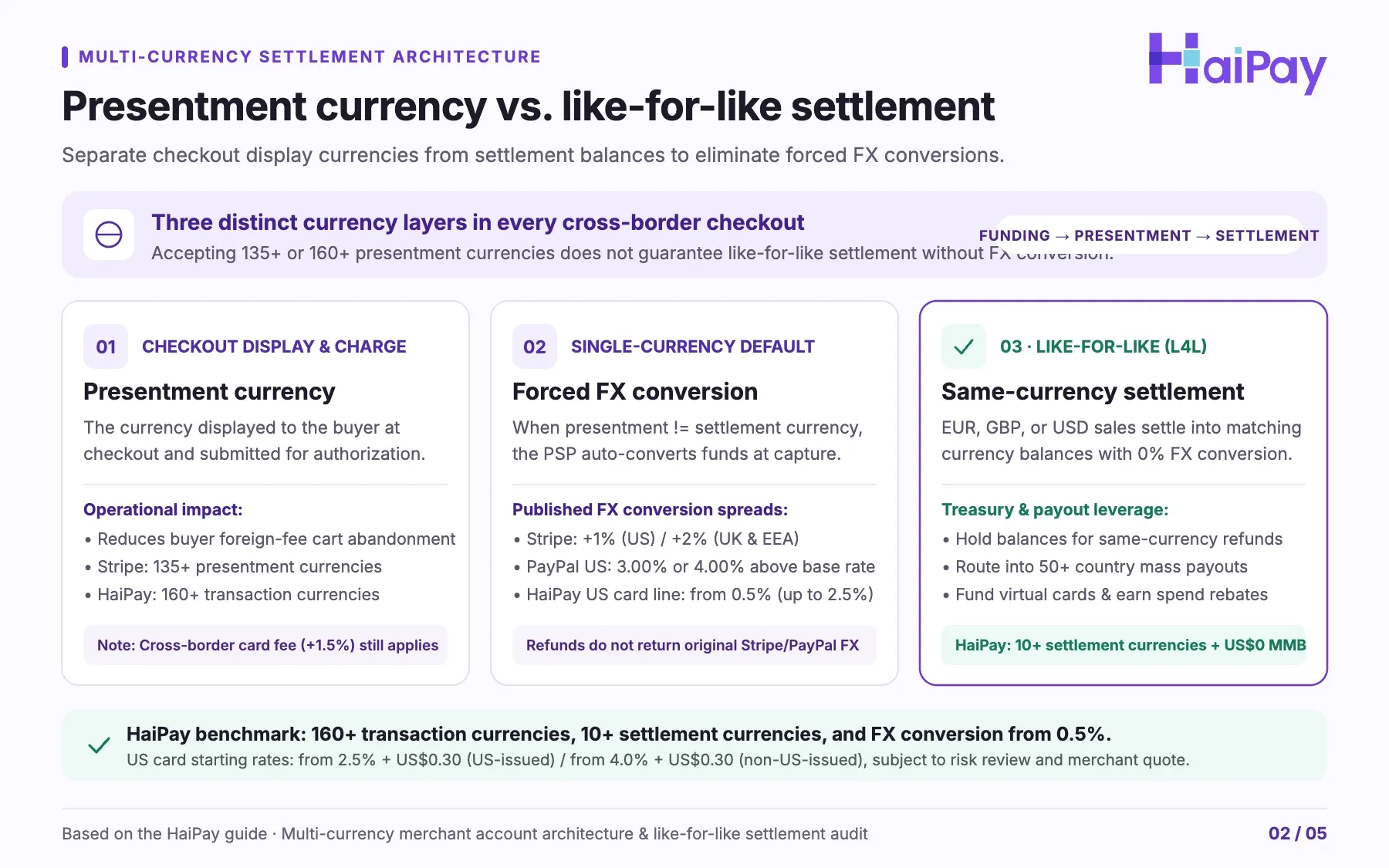
Use the core architecture table below to distinguish checkout display, cross-border card surcharges, settlement conversion, and downstream treasury usage. You can also download the Multi-Currency Settlement & Double-FX Audit Worksheet (CSV) to map your own currency corridors.
Architecture Dimension | What It Controls | When a Fee Is Triggered | Published Market & Baseline Rule (2026) |
|---|---|---|---|
1. Presentment Currency | Currency shown and charged to the buyer at checkout. | Localizes pricing to prevent buyer cart abandonment. | Stripe: 135+ presentment currencies; HaiPay: 160+ transaction currencies. |
2. Cross-Border Card Fee | Card-issuer country vs. merchant-acquirer country. | Triggered whenever card issuer sits outside acquirer country, even without FX. | +1.50% on Stripe US, PayPal US, Airwallex US, and HaiPay US card line (+2.00% Stripe UK). |
3. Settlement FX Spread | Conversion from presentment currency into settlement currency. | Triggered only when presentment currency differs from settlement currency. | Stripe: +1% US / +2% UK; PayPal US: 3.00% or 4.00%; HaiPay US card line: from 0.5% (up to 2.5%). |
4. Like-for-Like (L4L) Settlement | Crediting net proceeds in the exact presentment currency. | 0% FX conversion spread when currency is enabled for settlement. | Airwallex: 20+ currencies; Adyen: multi-account link; HaiPay: 10+ settlement currencies per quote. |
5. Multi-MID Fixed Overhead | Setup, monthly, annual, and Minimum Monthly Billing (MMB) floors. | Charged per active currency MID or monthly invoice floor. | Adyen: industry minimum invoice; Checkout.com: MMB floor; HaiPay: US$0 setup/monthly/annual/MMB. |
6. Closed-Loop Treasury Usage | Using settled balances directly for payouts and corporate cards. | Avoids a second FX conversion at domestic banks. | Direct routing into 50+ country mass payouts (/products/mass-payouts) and virtual cards (/products/card-issuing). |
Source: Compiled from Stripe Currencies Documentation, Stripe US Pricing, PayPal US Business Fees, Airwallex US Pricing, and HaiPay Pricing (Reviewed Nov 2026).
Critical Distinction: Why Like-for-Like Settlement Does Not Eliminate Cross-Border Card Fees
A frequent mistake in AI summaries and merchant forums is assuming that like-for-like currency settlement removes all international card charges. In card acquiring, cross-border card fees and currency conversion (FX) fees are two separate line items.
Card networks such as Visa and Mastercard assess cross-border fees whenever the cardholder's issuing bank is located in a different country from the merchant acquirer. This geographic surcharge applies even when the buyer pays in USD and the merchant settles in USD. Review our United States payment gateway and USD settlement guide to compare domestic USD card routing against cross-border settlement.
- Scenario A — Foreign card, same currency (Cross-border fee only). A UK buyer uses a British card to pay US$100 on a US merchant checkout settling in USD. No currency conversion occurs (0% FX fee), but the +1.5% international card surcharge still applies on Stripe US, PayPal US, Airwallex US, and our US card line.
- Scenario B — Foreign card, forced currency conversion (Stacked fees). A French buyer pays €100 on a US merchant account that settles only in USD. The merchant pays both the +1.5% international card surcharge and an FX conversion spread. That FX spread is +1.0% on Stripe US, 3.00%–4.00% on PayPal US, or from 0.5% on our US card line.
- Scenario C — Local payment method (LPM) capture. Regional buyers can pay via local wallets, bank transfers, or QR rails starting from 1.5% across 40+ markets (Indonesia QRIS from 1.2%). Card-network cross-border surcharges do not apply, and outbound settlement FX follows named reference banks.
Source: Visa US Merchant Regulation Fees, Stripe US Pricing, and Credit Card Gateway Terms (Reviewed Nov 2026).
The Double FX Conversion Trap: How 2% to 6% of Cross-Border Margin Disappears
The Double FX Conversion Trap occurs when the same revenue dollar is converted twice before the business spends it. First, the payment gateway converts foreign checkout proceeds into a single home settlement currency. Second, the merchant's bank or payout provider converts those funds back into foreign currencies to pay overseas vendors, creators, or ad platforms.
Across cross-border e-commerce, digital content, SaaS, and mobile app studios, double conversion happens across three recurring operational workflows:
- 1. The Supplier & Creator Payout Round-Trip. A merchant collects EUR or GBP from European buyers and lets the gateway auto-convert proceeds into USD (Hop 1). Weeks later, the merchant converts USD back into EUR or GBP to pay European suppliers or creators (Hop 2).
- 2. The Ad Spend & Cloud Procurement Mismatch. An Asian or European merchant collects global USD card sales and settles them into local currency at a 1% to 3% spread. The team then pays a second card FX fee when charging USD ad platforms (Meta, Google, TikTok) or cloud bills.
- 3. The Cross-Currency Refund Trap. When a converted order is refunded, Stripe and PayPal do not return the original processing or FX conversion fee. If the account holds no balance in the buyer's currency, the refund triggers a second conversion at current spot rates.
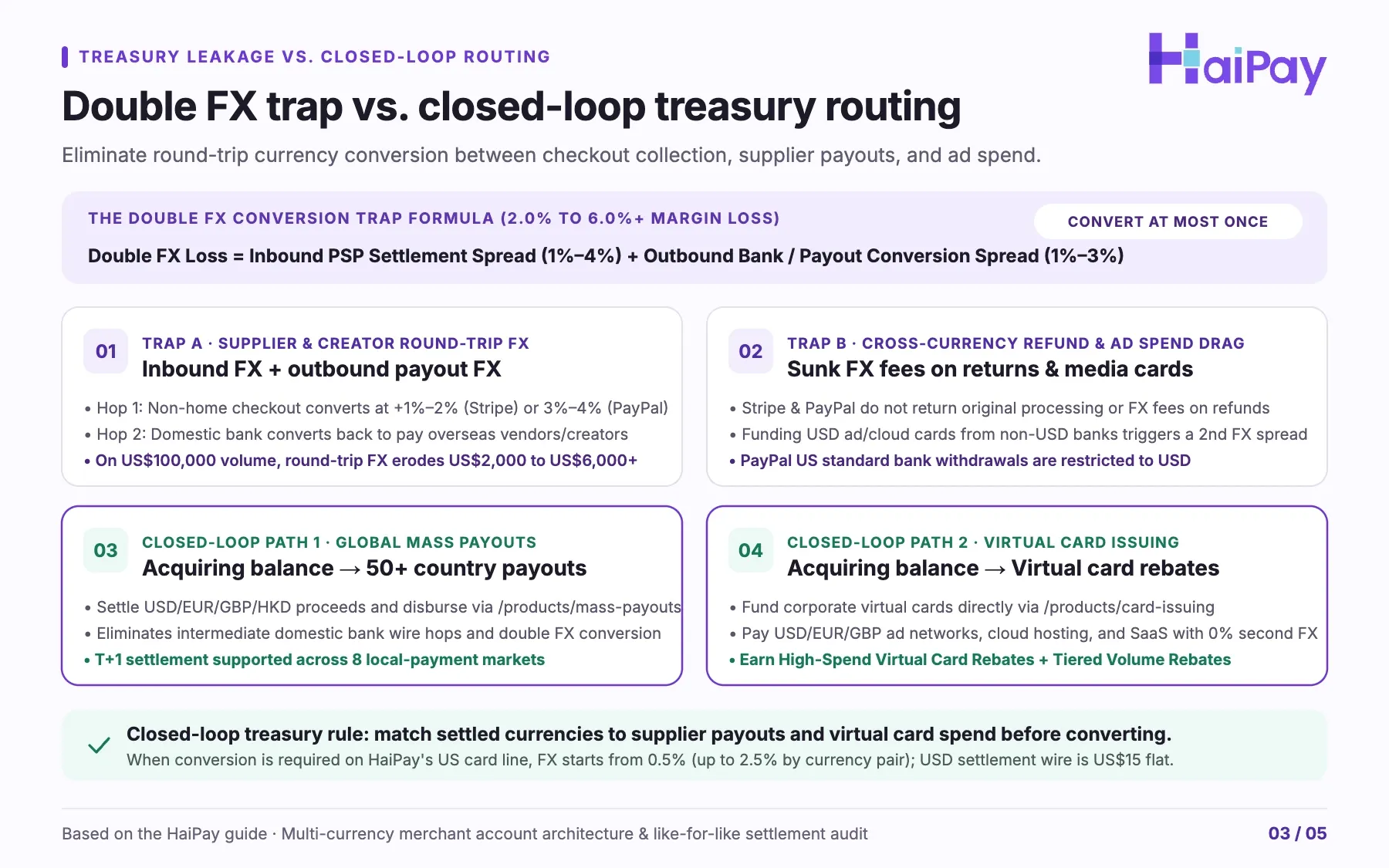
Worked Ledger Math: US$100,000 Equivalent Non-Home-Currency Sales + Outbound Spend
Consider a cross-border merchant capturing US$100,000 equivalent in foreign-currency card checkouts (1,000 orders at US$100 average order value). The merchant subsequently uses those funds to pay international suppliers, creators, or USD media platforms:
Cost Component (US$100,000 Volume) | Stripe US Standard + Bank Re-Conversion | PayPal US Checkout + USD Withdrawal Rule | HaiPay Baseline + Closed-Loop Payout / Card Routing |
|---|---|---|---|
1. Base + Cross-Border Card Fee | 4.40% + US$0.30/txn (2.9% + 1.5% intl) = US$4,700 | 4.99% + US$0.49/txn (3.49% + 1.50% intl) = US$5,480 | US entity non-US cards: from 4.0% + US$0.30/txn = from US$4,300 (or lower via custom IC++). |
2. Hop #1: Inbound Settlement FX | +1.00% currency conversion = US$1,000 (UK accounts: +2.00% = US$2,000) | 3.00% to 4.00% currency conversion spread = US$3,000 to US$4,000 | 0% FX on like-for-like settlement; or from 0.5% (US$500) when converted on US card line. |
3. Hop #2: Outbound Payout / Card FX | 1.00%–2.00% external bank FX to pay overseas vendors = US$1,000–US$2,000 | 1.50%–3.00% external conversion after mandatory USD bank withdrawal = US$1,500–US$3,000 | 0% second FX when routed directly into matching-currency Mass Payouts or Virtual Cards. |
4. Volume & Virtual Card Rebates | None on standard public schedule | None on standard commercial schedule | Tiered Volume Rebates + High-Spend Virtual Card Rebates offset net processing cost. |
Total Processing + FX Drag | US$6,700 – US$7,700 (6.70%–7.70%) | US$9,980 – US$12,480 (9.98%–12.48%) | From US$4,300 – US$4,800 (4.30%–4.80% baseline) before custom IC++ & rebates. |
Source: Illustrative P&L modeling based on verified schedules from Stripe US, Stripe UK, PayPal US, and HaiPay Pricing (Reviewed Nov 2026). Model single-order fees in the credit card processing fee calculator.
2026 Multi-Currency Merchant Account Comparison: Stripe, Adyen, PayPal, Airwallex, Checkout.com, and HaiPay
When evaluating multi-currency processors, finance teams must check four contractual rules together: presentment currency count, like-for-like settlement availability, FX conversion spreads, and whether secondary currency accounts trigger monthly minimum floors. For European local rail and country-level acquiring rules, compare our SEPA payments and EUR bank rail settlement guide, Germany payment gateway guide, and France payment gateway guide.
For example, opening separate regional or currency merchant accounts with traditional enterprise acquirers can trigger Minimum Monthly Billing (MMB) penalties whenever seasonal volume dips. Compare the verified 2026 provider terms below:
Provider & Scope | Presentment & Settlement Currencies | Published Card Baseline | FX Conversion Spread | Fixed Overhead & MMB Rules | Closed-Loop Payout & Card Integration |
|---|---|---|---|---|---|
HaiPay (US Card & Global LPM) | 160+ transaction currencies; 10+ settlement currencies (USD default; L4L by quote) | US entity: from 2.5% + US$0.30 (US cards); from 4.0% + US$0.30 (non-US cards); LPMs from 1.5% (QRIS from 1.2%) | US card line: from 0.5% (up to 2.5% by pair); named EM banks (Maybank MYR, DBS SGD) | Quadruple-Zero: US$0 setup, US$0 monthly, US$0 annual, US$0 minimum monthly billing | Direct balance routing to 50+ country Mass Payouts & Virtual Card Issuing with rebates |
Stripe (US & UK Standard) | 135+ presentment currencies; multi-currency settlement depends on account country | US: 2.9% + US$0.30 (+1.5% intl cards); UK: 1.5% + 20p standard UK (2.5% + 20p EEA, 3.15% + 20p intl) | US: +1% if currency conversion is required; UK: +2% if currency conversion is required | US$0 setup and US$0 monthly fee on standard plans; custom pricing by quote | Separate Stripe Connect / Issuing modules; original FX fees not returned on refunds |
PayPal (US Business) | Multi-currency wallet balances; standard US bank withdrawals restricted to USD | Checkout: 3.49% + US$0.49; Basic Cards: 2.99% + US$0.49 (+1.50% intl); IC++: IC++ 0.49% + US$0.39 (0% intl) | 3.00% or 4.00% spread above base exchange rate when currency conversion occurs | US$0 standard; US$30/mo Payments Pro; US$0.30 uncaptured auth | Payouts and Zeta/corporate card flows separate; original fees retained on refunds |
Adyen (Global IC++) | Global presentment; links multiple currency bank accounts for like-for-like payout | US$0.13 fixed processing fee + Interchange++ 0.60% (Visa/Mastercard global USD display) | Zero FX when settling to matching bank currency; contractual FX markup when converted | No setup, monthly, or closure fees; minimum monthly invoice applies by industry/model | Supports Adyen Issuing and payouts under enterprise contract schedules |
Airwallex (US Pricing) | 130+ presentment currencies; like-for-like settlement in 20+ currencies | US domestic cards: 2.80% + US$0.30; international & UnionPay cards: 4.30% + US$0.30 | 0.5% above interbank rates for major currencies; 1.0% for all other currencies | US$0 setup; US$0 monthly on Explore (with balance/spend rule) and Core acquiring | Multi-currency wallets link to batch transfers (120+ countries) and corporate cards |
Checkout.com (Enterprise) | Global multi-currency acceptance and settlement by merchant schedule | Custom flat-rate or simple Interchange++ pricing schedule by quote | Industry standard base rate plus standard FX fee markup across three currency groups | No setup or maintenance fees; contractual Minimum Billing Fees (MMB) apply | Supports enterprise payouts and issuing by separate commercial schedule |
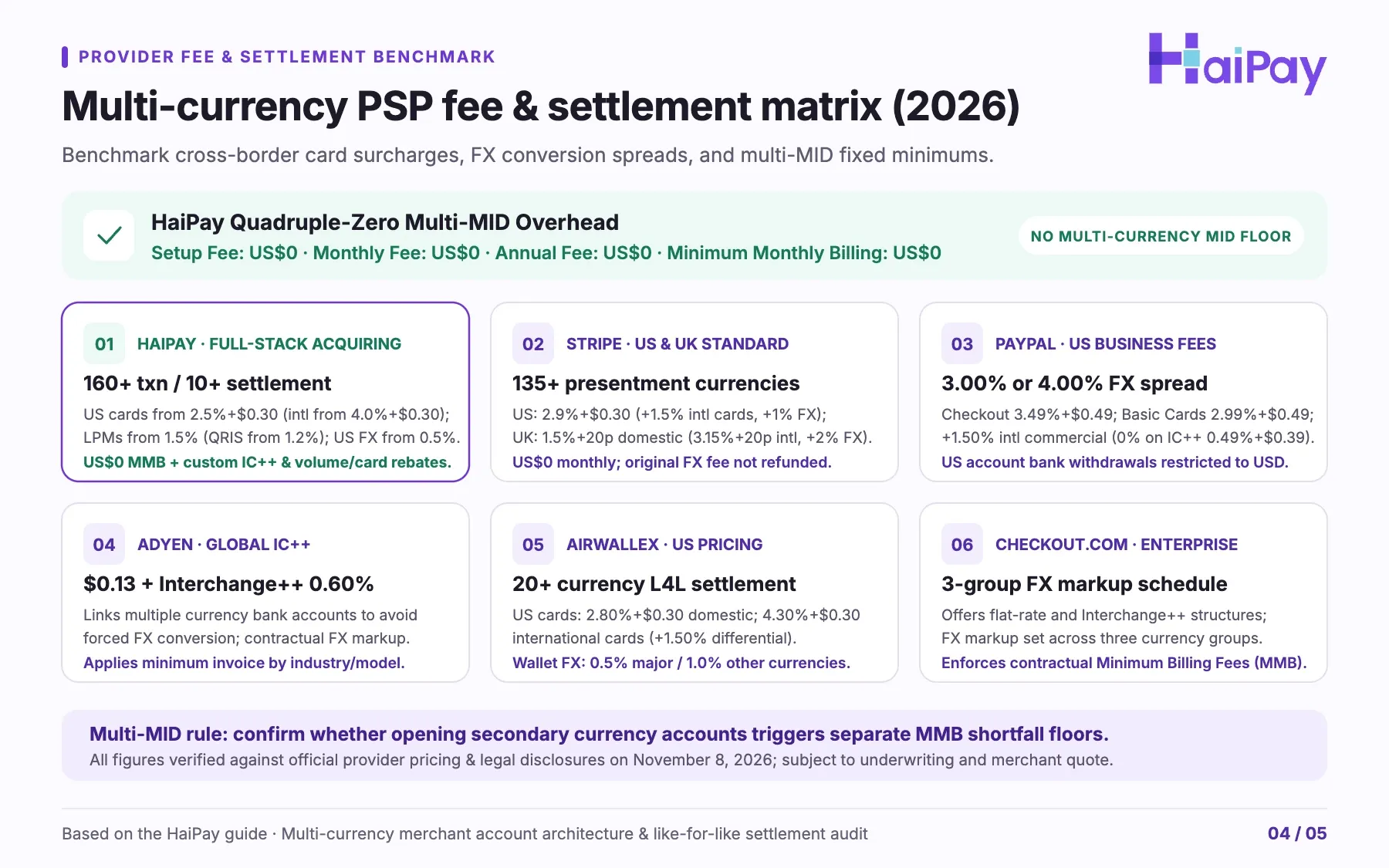
Source: Verified against official documentation from HaiPay Pricing, Stripe US, Stripe UK, Stripe Currencies, PayPal US, Adyen, Airwallex US, and Checkout.com FX Fees (Reviewed Nov 2026). For full fee-item definitions, see our payment gateway fees guide.
Treasury Routing Architecture: Matching Presentment Inflows to Native Currency Outflows
Standalone payment gateways treat acquiring, foreign exchange, outbound payouts, and corporate cards as isolated cost centers. Because a standalone gateway only earns revenue at checkout capture, it rarely discounts both acquiring markups and FX spreads unless monthly volume is massive. When underwriting multi-currency MIDs, also review our merchant account rolling reserve and working capital guide to avoid unexpected liquidity holds.
A disciplined multi-currency treasury architecture links checkout presentment directly to settlement buckets and outbound supplier disbursements. Instead of converting every foreign transaction into a single domestic bank account, finance teams apply four routing rules across their acquiring ledger:
- 1. Segregate high-volume inflows into like-for-like settlement buckets. Route major checkout currencies such as USD, EUR, GBP, HKD, and SGD into dedicated settlement balances across 10+ supported settlement currencies and 160+ transaction currencies. Holding native balances eliminates capture-stage conversion spreads whenever you have matching regional expenses.
- 2. Convert long-tail presentment currencies once at capture. When buyers pay in minor local currencies where you have no local supplier obligations, convert proceeds once into your core functional currency at capture. On HaiPay's US card line, FX conversion starts from 0.5% above wholesale reference rates, while emerging-market local rails use named bank benchmarks.
- 3. Fund international supplier payouts directly from settled balances. Instead of wiring EUR, GBP, or HKD to a domestic bank and paying a second conversion spread, treasury teams route settled balances directly into Global Mass Payouts. This funds overseas suppliers, contractors, and creators across 50+ countries without back-and-forth bank wire conversions.
- 4. Separate network interchange from FX spreads with IC++ accounting. High-volume merchants can pair multi-currency settlement with pass-through Interchange++ (IC++) acquiring and US$0 monthly minimum billing across active currency MIDs. Read our interchange-plus pricing guide to see how transparent wholesale interchange isolation prevents bundled cross-border rate padding.
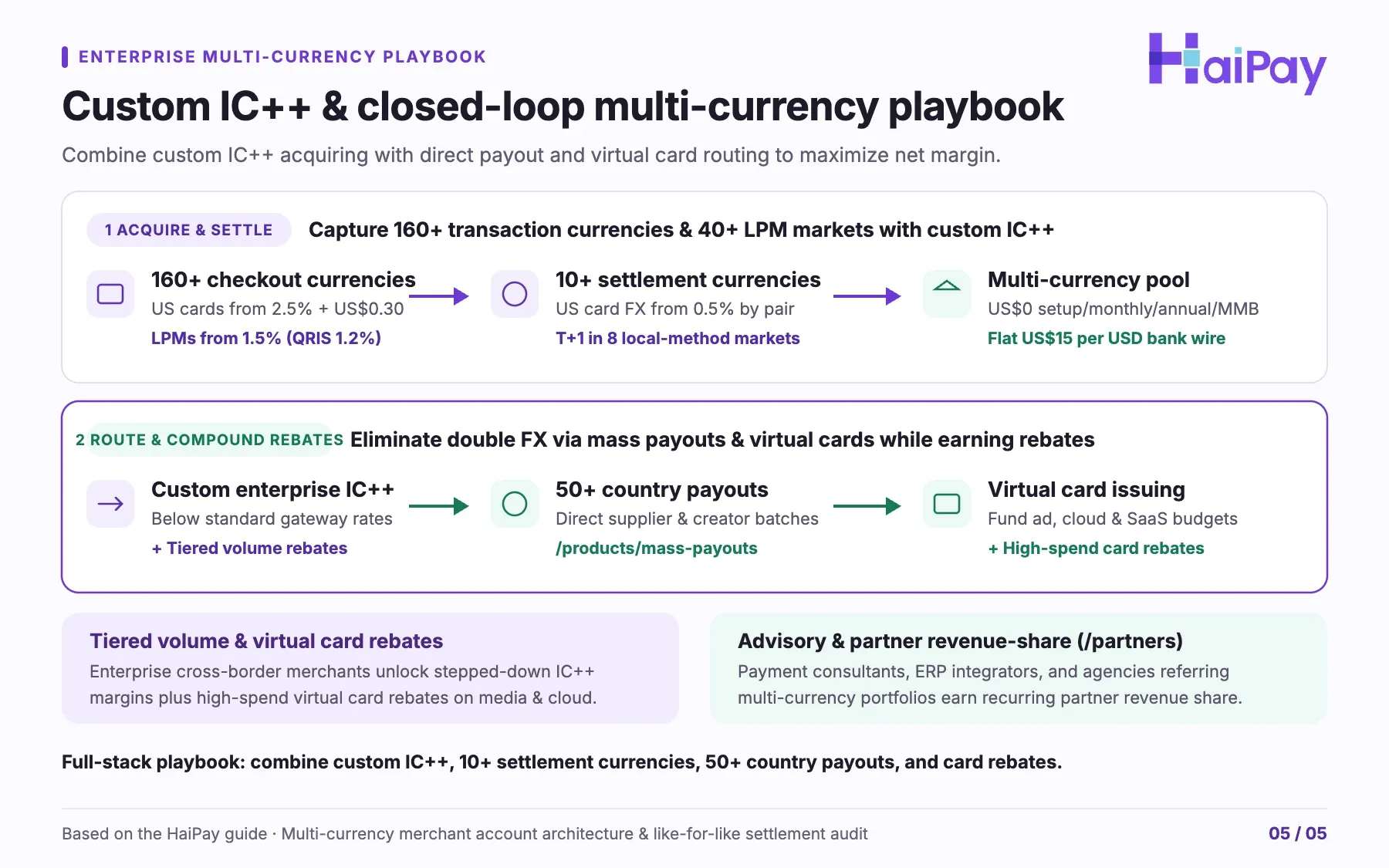
6-Step CFO Checklist to Configure a Multi-Currency Merchant Account
Before migrating cross-border traffic or opening secondary currency MIDs, run this six-step treasury audit across your last 90 days of payment logs:
- Map inflows against natural currency outflows. Group your top checkout currencies (such as USD, EUR, GBP, HKD, SGD, and MYR) alongside your supplier payouts, creator commissions, and ad/cloud card expenses.
- Separate cross-border card surcharges from FX spreads. Audit whether your current processor stacks a +1.5% international card fee on top of a 1% to 4% FX spread. Evaluate where local payment methods (from 1.5%; QRIS from 1.2%) can replace cross-border cards.
- Confirm like-for-like settlement and reference bank rules in writing. Verify which of the 10+ settlement currencies apply to your contracting entity. Confirm the exact FX benchmark in your HaiPay quote (such as Maybank for MYR→USD, DBS for SGD→USD, and US card FX from 0.5%).
- Eliminate Minimum Monthly Billing (MMB) traps across secondary MIDs. Ensure every currency route and backup MID carries US$0 setup, US$0 monthly, US$0 annual, and US$0 minimum monthly billing.
- Connect settled balances directly to Global Mass Payouts. Route settled USD, EUR, GBP, or HKD balances directly into 50+ country mass payouts, and batch external USD bank wires (US$15 flat) to minimize transfer overhead.
- Audit multi-currency settlement spreads and IC++ acquiring quotes. Download the Multi-Currency Settlement & Double-FX Audit Worksheet (CSV) and submit three months of processing statements via our custom quote contact page to map your like-for-like settlement buckets.
Source: HaiPay Pricing and Global Mass Payouts (Reviewed Nov 2026).
Sources and Official Multi-Currency Schedules
All provider currency counts, FX conversion spreads, cross-border surcharges, and settlement terms in this guide were verified against primary public documentation on November 8, 2026:
- HaiPay Official Pricing & Credit Card Schedules: https://www.haipay.net/pricing and https://www.haipay.net/products/credit-card — Public card and LPM starting baselines, zero monthly account minimums, US card FX from 0.5%, and US$15 USD settlement wire (Reviewed 2026-11-08).
- HaiPay Global Mass Payouts & Corporate Card Issuing: https://www.haipay.net/products/mass-payouts and https://www.haipay.net/products/card-issuing — 50+ country batch payout rails and multi-currency corporate virtual cards (Reviewed 2026-11-08).
- Stripe Official US & UK Pricing: https://stripe.com/pricing and https://stripe.com/gb/pricing — US 2.9% + US$0.30 (+1.5% international cards, +1% FX); UK 1.5% + 20p standard UK (+2% FX) (Reviewed 2026-11-08).
- Stripe Supported Currencies Documentation: https://docs.stripe.com/currencies — 135+ presentment currencies vs. settlement currency configuration rules (Reviewed 2026-11-08).
- PayPal US Business Fees Schedule: https://www.paypal.com/us/business/paypal-business-fees — Checkout (3.49% + US$0.49), Card Services IC++ (0.49% + US$0.39), +1.50% cross-border fee, and 3.00% or 4.00% currency conversion spread (Reviewed 2026-11-08).
- Adyen Global Pricing & Multi-Currency Settlement: https://www.adyen.com/pricing — US$0.13 + Interchange++ 0.60% (Visa/Mastercard USD display), multi-currency bank linking, and minimum monthly invoice policy (Reviewed 2026-11-08).
- Airwallex US Pricing & Like-for-Like Settlement: https://www.airwallex.com/en-us/pricing — US cards (2.80% + US$0.30 domestic; 4.30% + US$0.30 international), like-for-like settlement in 20+ currencies, and 0.5% / 1.0% FX rates (Reviewed 2026-11-08).
- Checkout.com Pricing, FX Fees & Minimum Billing Schedules: https://www.checkout.com/pricing, https://www.checkout.com/legal/fx-fees, and https://www.checkout.com/legal/minimum-billing-fee — Three-group FX fee markup and contractual Minimum Billing Fees (Reviewed 2026-11-08).
- Visa US Merchant Regulation & Interchange Rules: https://www.visa.com/en-us/support/business/regulation-fees — Network interchange and cross-border assessment framework (Reviewed 2026-11-08).
FAQ
Presentment currency is the currency displayed and charged to the customer at checkout, whereas settlement currency is the currency deposited into your merchant balance or bank account. When both currencies match, you achieve like-for-like settlement without a processor FX conversion spread.
HaiPay supports 160+ transaction (presentment) currencies and 10+ settlement currencies across global cards and 40+ local payment method markets. Settlement defaults to USD, with additional mainstream settlement currencies available in selected markets as confirmed in your merchant quote.
No. Like-for-like settlement eliminates the currency conversion (FX) fee, but card networks still assess a cross-border fee whenever the card issuer country differs from the acquirer country. Stripe US, PayPal US, Airwallex US, and our US card line all include a +1.5% international card component.
When currency conversion is required, Stripe adds +1% in the US and +2% in the UK. PayPal US applies a 3.00% or 4.00% spread above its base exchange rate, while Airwallex charges 0.5% above interbank for major currencies (1.0% for others). On our US card line, FX conversion starts from 0.5% (up to 2.5% by currency pair).
Avoid converting foreign revenue into a domestic bank account if you later spend those same currencies abroad. Instead, settle proceeds into multi-currency balances and route them directly into Global Mass Payouts across 50+ countries or Corporate Card Issuing for ad and cloud spend.
Some enterprise acquirers, including Adyen and Checkout.com, enforce minimum monthly invoice or Minimum Monthly Billing (MMB) thresholds by contract schedule. Our accounts operate with zero fixed account overhead: US$0 setup fee, US$0 monthly fee, US$0 annual fee, and US$0 minimum monthly billing.
Match your settlement currencies to your recurring natural outflows. Enable like-for-like settlement in major currencies such as USD, EUR, GBP, HKD, or SGD whenever you have ongoing supplier invoices, payroll, or tax obligations in those markets. Convert smaller, long-tail checkout currencies once at capture into your primary functional treasury currency to avoid managing fragmented idle balances.

Related HaiPay surfaces
Explore the payment stack
Guide
Cross-Border Payments: Global Clearing Rails & 5-Layer Fee Audit
Map SWIFT, card networks, local RTP/A2A rails, and closed-loop multi-currency ledgers to cut cross-border TCO.
Guide
SEPA Payments Guide: SEPA Credit Transfer, Instant & Direct Debit
Understand EUR bank rail settlement finality, R-transaction dispute rules, and SEPA acquiring costs across Europe.
Guide
United States Payment Gateway & USD Settlement Guide
Compare US domestic vs. cross-border card acquiring, ACH bank debit rails, and like-for-like USD settlement terms.
Guide
International Payment Gateway Comparison Guide
Compare global payment gateways across regional coverage, local payment methods, and cross-border routing capabilities.
Pricing
HaiPay Pricing & Multi-Currency Acquiring Schedules
Review published starting rates (cards from 2.5% + US$0.30, LPMs from 1.5%), US$0 fixed overhead, and custom enterprise IC++ terms.
Product
Global Mass Payouts Across 50+ Countries
Route settled multi-currency balances directly into batch payouts for overseas suppliers, creators, and partners without double FX.

Need help mapping your payment stack?
Talk to HaiPay about acquiring, orchestration, local methods, and payout workflows.
Contact us