
Direct Answer
Choosing a payment gateway in the United States requires matching your checkout rail mix—credit and debit cards, Apple Pay, Google Pay, and Nacha ACH bank debits—to your contracting entity structure, domestic or cross-border acquiring route, AVS and 3DS2 fraud controls, and net USD settlement workflow before signing a merchant agreement.
Selecting a payment gateway in the United States takes more than comparing headline card rates. Domestic and international merchants must evaluate four core operational mechanics before signing a contract. You need to confirm entity eligibility, checkout rail routing, card-not-present fraud controls, and net USD treasury settlement.
This guide examines US payment infrastructure using official Federal Reserve, Nacha, card scheme, and provider documentation. It covers both Delaware subsidiaries and overseas headquarters in Hong Kong, Singapore, the UK, or Europe. Use the benchmarks and checklists below to structure your US payment gateway setup before integration.
How the US Payment Landscape Works: Cards, Wallets, and Bank Rails
Unlike single-rail markets, the United States divides payment volume across two distinct architectures. Card networks carry most consumer retail and software purchases. Meanwhile, the Automated Clearing House (ACH) network—governed by Nacha (National Automated Clearing House Association)—drives B2B invoicing and recurring bank debits.
The Federal Reserve Payments Study reports that US core noncash payments reached 213.1 billion transactions in 2023. Total value across cards, ACH, and checks hit $128.5 trillion. Card payments accounted for 150.2 billion transactions, or 70.5% of noncash volume, while ACH transfers carried 78.6% of noncash value.
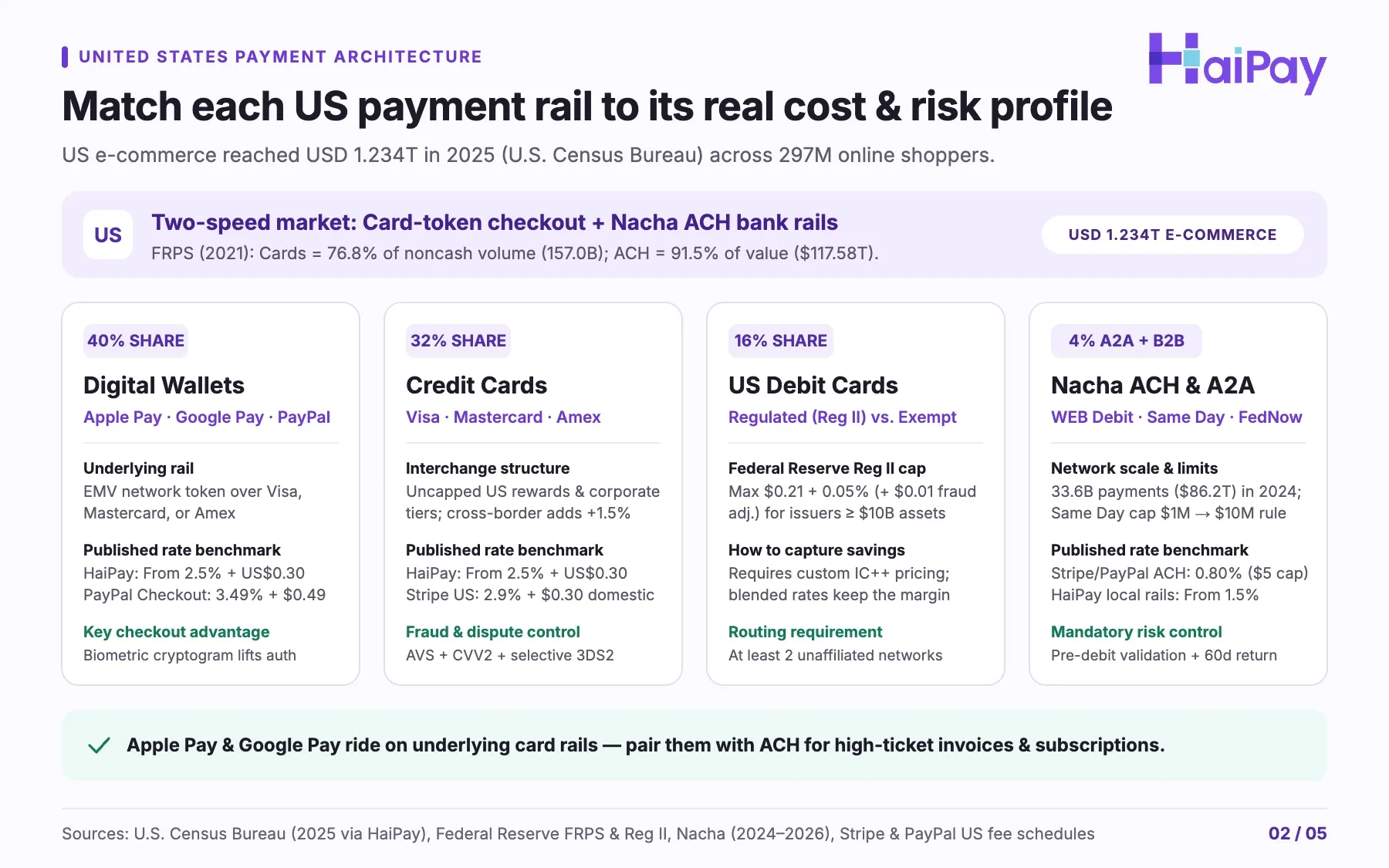
US Payment Rail | Primary Buyer & Checkout Use Case | Authorization & Settlement Speed | Reversal & Dispute Window |
|---|---|---|---|
Credit & Debit Cards (Visa, Mastercard, Amex, Discover) | Primary checkout rail for US e-commerce, SaaS subscriptions, and digital goods via online card acquiring. | Real-time authorization in seconds; net merchant settlement typically runs T+2 to T+5 by provider. | Cardholder disputes and chargebacks generally remain open for up to 120 days. |
Digital Wallets (Apple Pay, Google Pay, PayPal, Cash App Pay) | Mobile web, in-app, and accelerated one-tap checkout where buyers skip manual card entry. | Real-time tokenized authorization riding card or wallet balances; follows card or wallet settlement. | Follows underlying card network dispute rules; biometric device tokens lower unauthorized fraud. |
Nacha ACH Debit & Same Day ACH | Recurring B2B invoices, high-ticket subscriptions, and bank checkout via instant verification. | Standard ACH clears in 1 to 2 business days; Same Day ACH settles up to $1,000,000 per payment. | Administrative returns (such as R01 Insufficient Funds) take 2 banking days; unauthorized consumer returns (R10) allow 60 calendar days. |
Instant Bank Rails (FedNow & The Clearing House RTP) | Real-time treasury disbursements, instant payroll, wallet cash-outs, and B2B liquidity transfers. | Immediate 24x7x365 gross settlement between participating US financial institutions within seconds. | Credit-push final settlement; transfers are irrevocable once settled, though retail checkout adoption remains early. |
Source: Federal Reserve Payments Study (published 11 July 2025, 2023 data) and Nacha ACH Network statistics (32.1 billion payments totaling $98.4 trillion in 2025, including 1.4 billion Same Day ACH payments worth $3.9 trillion).
Why Instant Bank Rails Rarely Replace Cards at US Retail Checkout
Founders expanding from Brazil or India often expect FedNow or the RTP network to work like PIX or UPI. In reality, both US instant rails operate primarily as credit-push conduits between banks. FedNow raised its default transaction limit to $10,000,000 in November 2025, and RTP also supports up to $10,000,000 across 1,000+ financial institutions.
Despite those high limits, US retail and SaaS checkouts still rely on cards, Apple Pay, Google Pay, and ACH debits. Prioritize card acceptance, wallet tokenization, and verified ACH debits for incoming customer collections. Treat instant bank rails primarily as outbound payout and treasury infrastructure.
Contracting Entity Architecture: US Subsidiary vs. Direct Overseas Onboarding
Corporate underwriting is the most common bottleneck for international merchants entering the US market. Domestic US aggregators design automated onboarding around local US entities. They typically require a US LLC or C-Corporation, an IRS Employer Identification Number (EIN), a US physical address, and a domestic US bank account.
Many domestic providers also ask for a US-resident representative with a Social Security Number (SSN) or Individual Taxpayer Identification Number (ITIN). Forming a Delaware entity solely to test US demand adds legal fees, annual franchise taxes, and cross-entity accounting work. Mismatched entity structures can also trigger post-launch reserve holds. See our merchant account rolling reserve and 0% standard KYB policy guide to compare reserve holdbacks against zero-reserve underwriting.
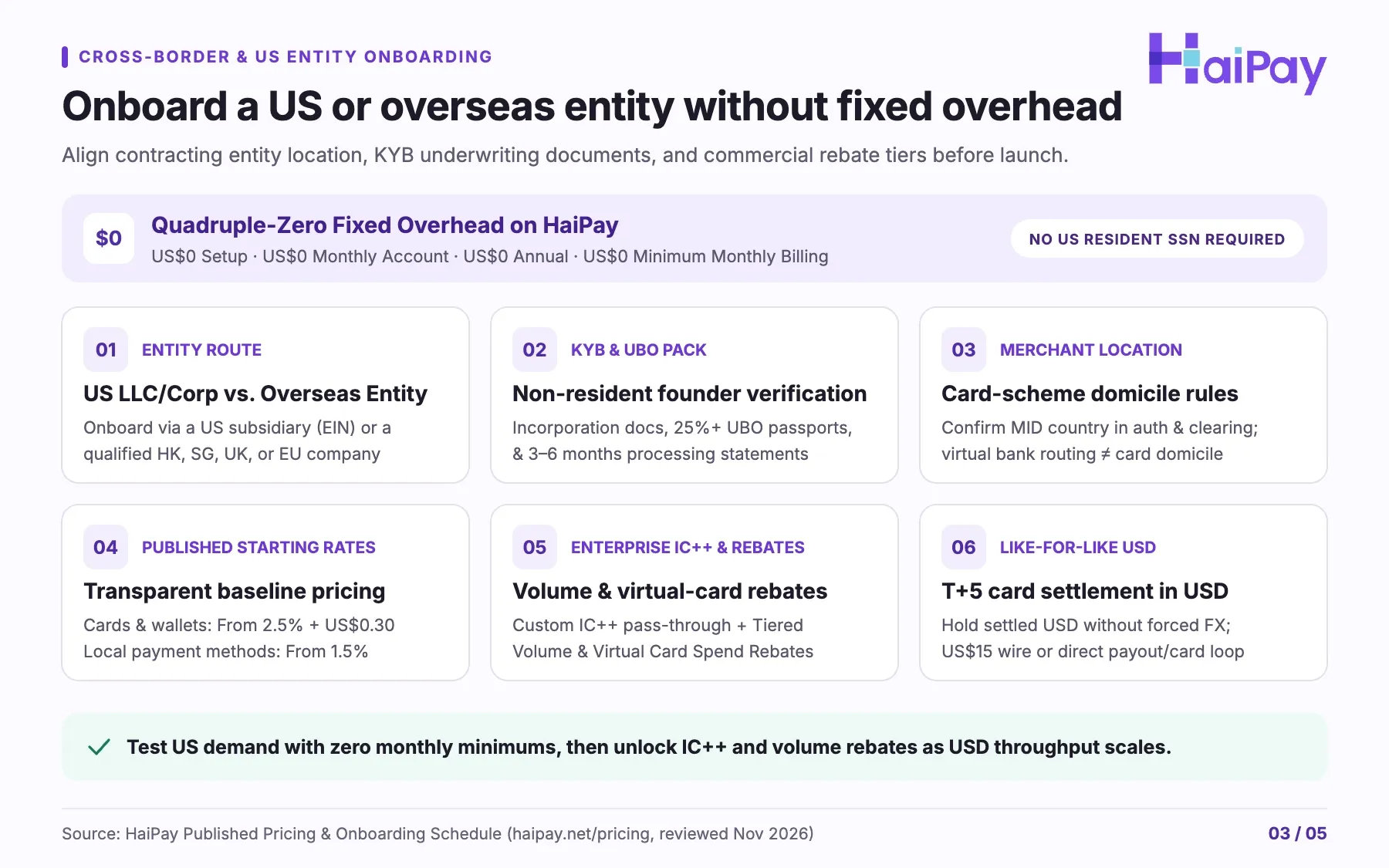
Cross-border payment gateways remove this obstacle by underwriting qualified non-US corporate entities directly. Through Europe and Americas local payment infrastructure, companies registered in Hong Kong, Singapore, the UK, and the EU can onboard with existing corporate documents. Merchants submit home-country registration records, Ultimate Beneficial Owner (UBO) disclosures, and corporate bank proofs.
Onboarding Dimension | Domestic US Aggregator Path (US Entity Required) | Cross-Border Gateway Path (Overseas Entity Accepted) |
|---|---|---|
Contracting Legal Entity | Requires a US LLC or C-Corp formed in a US state (such as Delaware or Wyoming). | Accepts qualified non-US corporate entities (Hong Kong, Singapore, UK, EU, and approved regions) or US subsidiaries. |
Tax & Representative ID | Requires an IRS EIN plus a US-resident SSN or non-resident ITIN verification. | Uses home-country corporate registration numbers, director passports, and UBO records without requiring a US SSN. |
Acquiring & Presentment | Domestic US card acquiring with native USD presentment and local ACH debit access. | Native USD checkout presentment with local or cross-border acquiring routes matched to merchant volume. |
Settlement Bank Account | Requires a domestic US checking account enabled for Nacha ACH settlement. | Settles in USD by default to approved corporate USD accounts or unified treasury balances. |
Source: Stripe US Atlas/onboarding documentation and HaiPay merchant underwriting guidelines, reviewed November 2026. Final approval depends on KYB verification and business model review.
US Payment Gateway Pricing, Hidden Fees, and Enterprise Economics
Headline card rates in the United States rarely reflect total processing cost. Finance teams must separate domestic card fees from international card surcharges, currency conversion spreads, fixed monthly fees, and dispute penalties. Review our merchant account fees and IC++ statement audit guide to benchmark interchange-plus pass-through pricing against blended processor rates.
Stripe's published US schedule charges 2.9% + $0.30 per domestic card or wallet charge. It adds +1.5% for international cards, adds +1% for currency conversion, and charges 0.8% capped at $5.00 for ACH Direct Debit. PayPal's US commercial schedule charges 3.49% + $0.49 for PayPal Checkout and Venmo, 2.99% + $0.49 for standard cards, and +1.50% for cross-border USD transactions.
Fee & Settlement Item | Stripe US Published Schedule | PayPal US Published Schedule | HaiPay Published US & Cross-Border Schedule |
|---|---|---|---|
US Domestic Cards & Wallets | 2.9% + $0.30 per successful card or wallet charge. | 2.99% + $0.49 (standard cards); 3.49% + $0.49 (PayPal Checkout, Pay Later, Venmo). | From 2.5% + US$0.30 per transaction for US-issued cards via US entity (after review) on the published pricing schedule. |
Non-US / International Cards | +1.5% international card fee (+1% if currency conversion applies). | +1.50% cross-border fee for USD transactions (3.00% to 4.00% if currency conversion applies). | From 4.0% + US$0.30 for non-US-issued cards (includes +1.5% international surcharge; FX starts at 0.5%). |
Local Payment Methods & Bank Rails | 0.8% (capped at $5.00) for ACH Direct Debit ($4.00 per failed or disputed ACH return). | Alternative payment method rates vary by rail and checkout setup. | From 1.5% for US local payment methods (regional local payment methods globally start from 1.2%). |
Fixed Account Overhead (Setup / Monthly / Annual / Minimum) | $0 setup and $0 monthly fee on standard pay-as-you-go plans. | $0 setup on standard checkout; advanced gateway plans may add monthly fees. | US$0 setup, US$0 monthly, US$0 annual, and US$0 minimum monthly fee. |
Refunds, Disputes & USD Settlement | $15.00 dispute fee ($15.00 counter-fee if contested and lost); processing fees not returned on refunds. | $20.00 standard chargeback fee ($15.00 with Dispute Automation); processing fees not returned on refunds. | US$0.30 per processed refund (original fee not returned); US$20 per dispute; T+5 card settlement; US$15 per USD wire. |
Source: Stripe US Pricing (stripe.com/us/pricing), PayPal US Merchant Fees (paypal.com/us/business/paypal-business-fees), and HaiPay Pricing (haipay.net/pricing), verified 7 November 2026.
How to Audit Regulated vs. Unregulated US Card Routing and Statement Costs
Blended flat-rate pricing simplifies early testing, but high-volume merchants often overpay as US card volume grows. Federal Reserve Regulation II (the Durbin Amendment) caps US Regulated Debit interchange at 21 cents plus 0.05% of the transaction value, plus a 1-cent fraud-prevention adjustment. Paying a flat 2.9% blended rate on debit-heavy US checkouts leaves substantial margin behind.
When auditing monthly US merchant statements or migrating from flat-rate aggregators to Interchange++ (IC++) contracts, finance teams should verify three cost lines:
- Regulated vs. unregulated US debit pass-through. Confirm your processor separates Federal Reserve Regulation II (Durbin) capped debit cards ($0.21 + 0.05% plus $0.01 fraud adjustment) from unregulated issuer tiers. Routing eligible US debit transactions at true pass-through rates prevents overpaying blended 2.9% retail card margins.
- Card scheme assessments and cross-border surcharges. Audit Visa and Mastercard network assessment pass-through (0.13% to 0.15%) alongside +1.5% international card surcharges and currency conversion spreads on non-USD transactions. Separating scheme fees from processor markups exposes hidden cross-border padding on monthly statements.
- Zero monthly minimum billing penalties. Avoid legacy US processors that enforce monthly minimum fees during seasonal troughs by verifying US$0 setup and US$0 monthly fees on the published pricing schedule.
US Card Risk Controls: Balancing AVS, 3DS2, and Visa VAMP Ratios
A common mistake among overseas merchants entering the United States is forcing mandatory 3-D Secure (3DS2) challenges on every card order. Unlike Europe under PSD2 Strong Customer Authentication, the United States is a non-mandated market. Unexpected 3DS challenge screens on routine domestic purchases often cause US cardholders to abandon checkout.
Instead of blanket challenges, high-converting US checkouts apply a three-layer risk matrix. They combine pre-authorization postal verification with selective EMV 3DS 2.2.0 step-up rules.
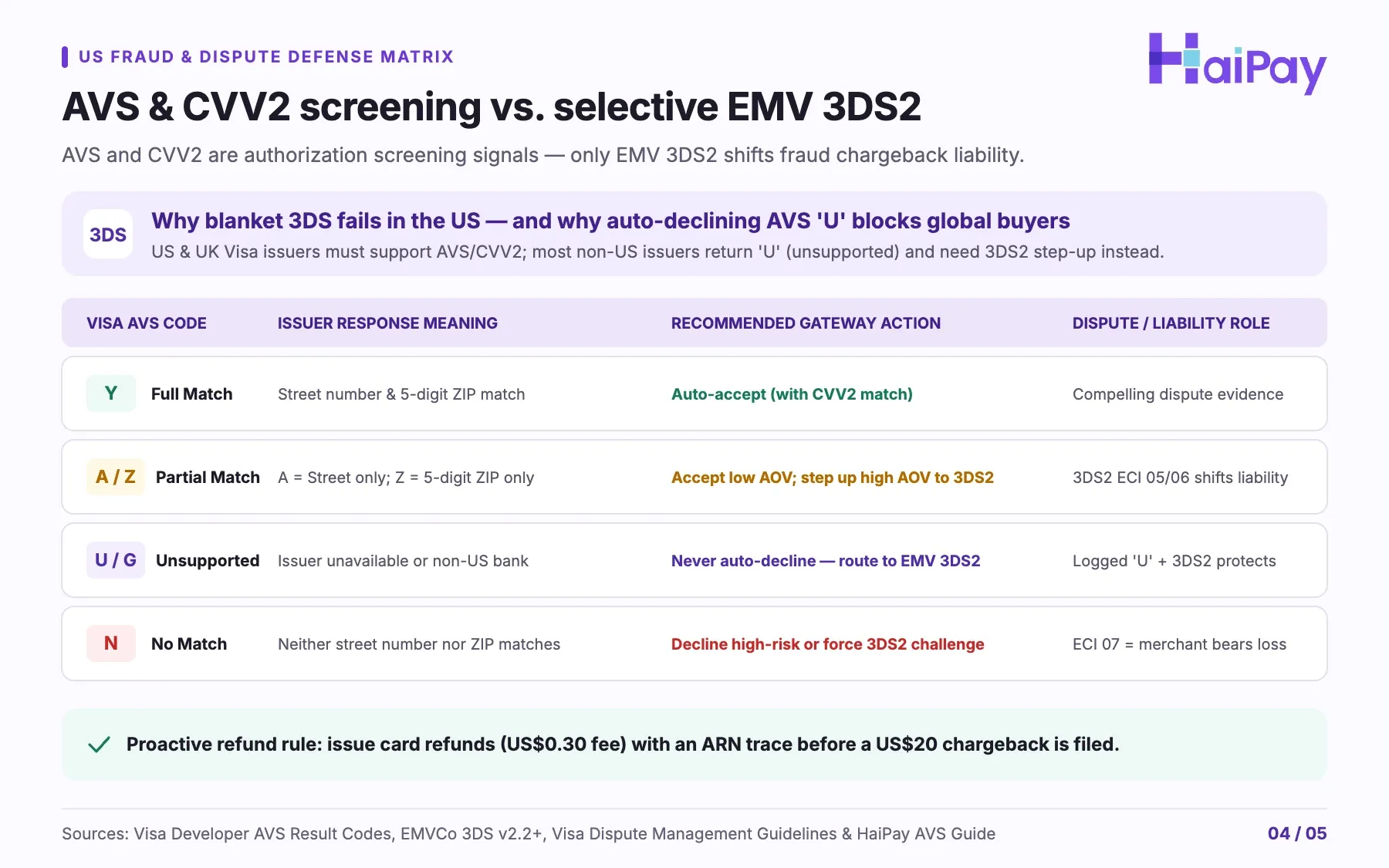
- Layer 1 — Address Verification System (AVS) and CVV checks: US issuers compare numeric street addresses and 5-digit or 9-digit ZIP codes against billing records. Enforcing Address Verification System (AVS) rules and CVV checks blocks card-testing bots before capture.
- Layer 2 — Selective EMV 3DS 2.2.0 and RDR pre-dispute deflection: Send full device and browser telemetry so low-risk orders qualify for frictionless 3DS2 approval. Trigger active 3DS2 challenges only on high-ticket or mismatched orders, and use Visa Verifi RDR and Mastercard Ethoca alerts.
- Layer 3 — Visa Acquirer Monitoring Program (VAMP) compliance: Effective 1 April 2025, Visa merged its fraud (VFMP) and dispute (VDMP) trackers into the Visa Acquirer Monitoring Program (VAMP). VAMP measures non-fraud disputes (TC15) plus fraud reports (TC40) over settled Visa card-not-present transactions. Enforcement requires a 1,500-incident monthly minimum. Merchants hit the Excessive tier at 2.2% (220 bps) from 1 October 2025 and 1.5% (150 bps) from 1 April 2026.
Source: EMVCo 3-D Secure Specification and Stripe/Visa VAMP compliance updates (effective April 2025 – April 2026), verified 7 November 2026.
Closed-Loop USD Treasury: From T+5 Settlement to Corporate Wires and Batch Payouts
For cross-border e-commerce brands, gaming publishers, and digital platforms, collecting US dollars is only half of the treasury workflow. Some gateways force USD sales to convert into HKD, EUR, or GBP at settlement. When merchants convert funds back into USD days later to pay ad networks or suppliers, double FX spreads can erode 2% to 4% of revenue. Compare global clearing routes in our cross-border payment rails and FX settlement guide to eliminate forced currency conversion losses.
A closed-loop USD architecture keeps funds in native USD from checkout capture through outbound deployment. Under HaiPay's standard schedule, card transactions settle at T+5 into a unified USD balance. Explore our multi-currency merchant account settlement guide to manage native USD, EUR, and GBP balances alongside global payouts. Finance teams can then deploy and reconcile settled USD across three workflows without forced double FX conversion:
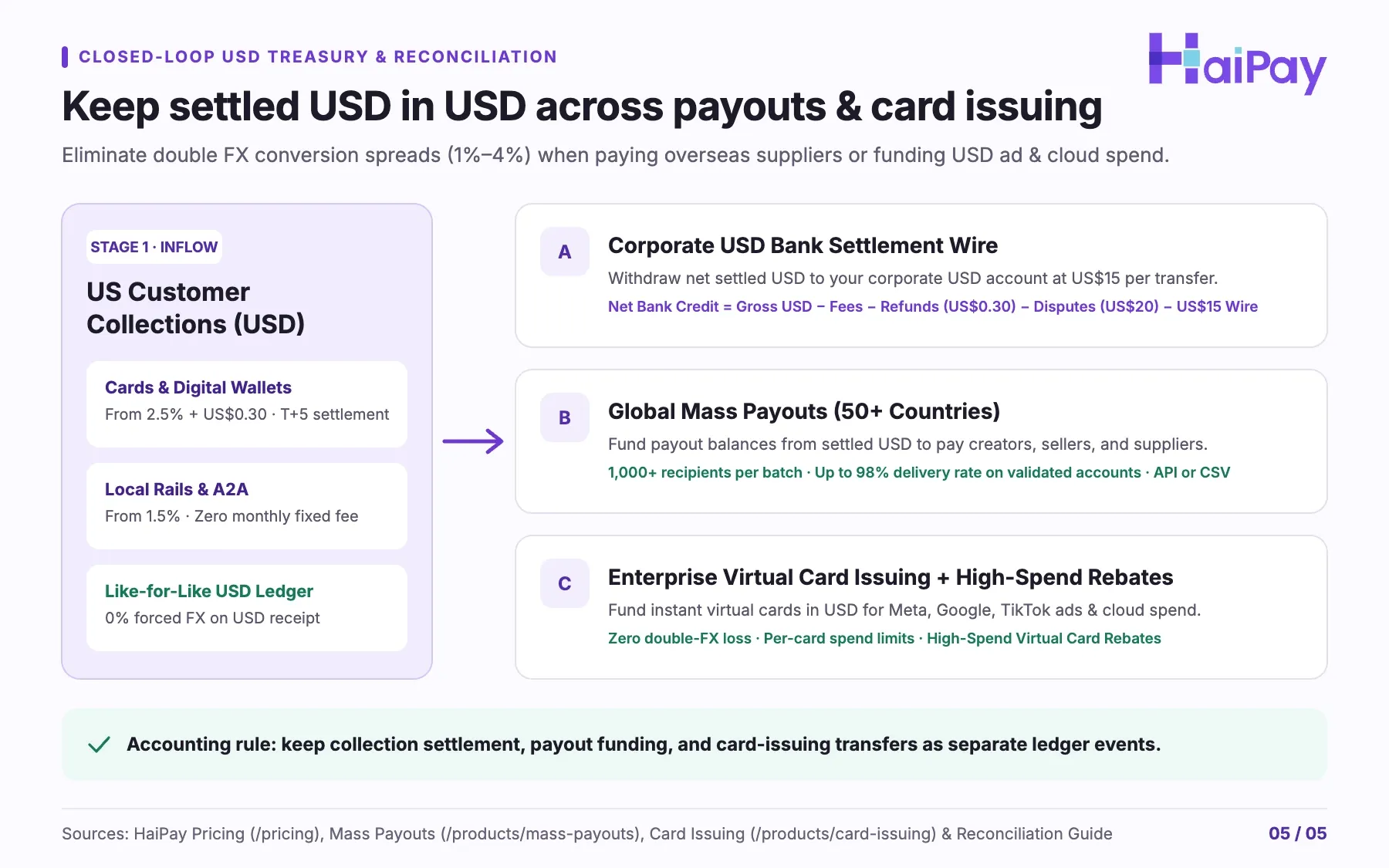
- Corporate USD bank wire settlement. Transfer net T+5 USD settlement batches to your corporate USD bank account at a published fee of US$15 per USD wire.
- Global Mass Payouts across 50+ countries. Fund supplier, creator, and logistics disbursements directly from settled USD via batch and API mass payouts. The payout engine supports 1,000+ recipients per batch with up to 98% delivery rates on validated accounts.
- Batch cutoff and statement descriptor alignment. Match T+5 card settlement batch IDs against Nacha ACH T+1 to T+2 clearing files while formatting clear soft descriptors to reduce friendly-fraud inquiries.
Download the US Payment Gateway Launch & Reconciliation Checklist
Preventing gaps between checkout webhooks, rolling reserves, refunds, and bank statements requires a standardized ledger. Read our payment gateway reconciliation guide and download the US Payment Gateway Launch & Reconciliation Checklist (CSV) to audit your entity documents, AVS rules, Nacha return codes, and T+5 net USD settlement formulas.
Need to accept US credit and debit cards, Apple Pay, Google Pay, and Nacha ACH debits through a US LLC or a qualified overseas entity? Contact the HaiPay payment architecture team to review your corporate KYB documents, US card routing rules, and T+5 USD settlement workflow.
Sources
- Federal Reserve Board — The Federal Reserve Payments Study (2023 Data Release) — Published 11 July 2025; accessed 7 November 2026.
- Nacha — ACH Network Volume and Value Statistics (2025 Full-Year Benchmark) — Published 2026; accessed 7 November 2026.
- Nacha — Same Day ACH Resource Center ($1,000,000 Per-Payment Limit) — Reviewed 7 November 2026.
- Federal Reserve Financial Services — FedNow Service Transaction Limit Increase to $10,000,000 — Published 27 August 2025 (effective November 2025); accessed 7 November 2026.
- The Clearing House — Real-Time Payments (RTP) Network Overview — Reviewed 7 November 2026.
- Federal Reserve Board — Regulation II (Debit Card Interchange Fees and Routing) — Reviewed 7 November 2026.
- Stripe — United States Pricing & Fee Schedule — Reviewed 7 November 2026.
- PayPal — United States Business Merchant Fees — Reviewed 7 November 2026.
- HaiPay — Published Pricing, Settlement, and Europe & Americas Payment Coverage — Reviewed 7 November 2026.
FAQ
Yes. While many domestic US aggregators require a US entity, EIN, and US-resident SSN, cross-border gateways such as HaiPay onboard qualified non-US companies directly. Corporations in Hong Kong, Singapore, the UK, and the EU can complete corporate KYB and collect USD from US buyers.
Standard US blended card rates range from 2.5% to 3.49% plus $0.30 to $0.49 per transaction. Stripe publishes 2.9% + $0.30 for domestic cards (+1.5% for international cards) and 0.8% capped at $5.00 for ACH Direct Debit. PayPal publishes 2.99% + $0.49 for standard cards and 3.49% + $0.49 for PayPal Checkout. HaiPay offers US card and wallet acquiring from 2.5% + US$0.30 and local payment methods from 1.5%, with US$0 setup, monthly, annual, and minimum monthly fees.
No. Unlike Europe under PSD2, the United States does not mandate 3DS2 on all card-not-present transactions. Forcing step-up challenges on every domestic US order often reduces checkout conversion. Instead, enforce Address Verification System (AVS) and CVV checks on all orders, pass EMV 3DS 2.2.0 data for frictionless approval, and trigger active 3DS2 challenges selectively on high-risk transactions.
Nacha ACH debits pull funds directly from a buyer's US bank account at a lower cost than credit cards, making ACH ideal for B2B invoices and subscriptions. However, ACH does not confirm final funds at checkout. Standard ACH clears in 1 to 2 business days, administrative returns (such as R01 Insufficient Funds) take 2 banking days, and unauthorized consumer returns (R10) allow up to 60 calendar days.
Effective 1 April 2025, Visa combined its fraud (TC40) and non-fraud dispute (TC15) tracking into the Visa Acquirer Monitoring Program (VAMP). Subject to a minimum threshold of 1,500 combined monthly fraud and dispute events, merchants enter the VAMP Excessive tier at 2.2% (220 bps) from 1 October 2025. That threshold tightens to 1.5% (150 bps) from 1 April 2026.
Merchants scaling past introductory volume should transition from blended pricing to Interchange++ (IC++) pricing. IC++ passes through actual card interchange—including US Regulated Debit rates capped at $0.21 + 0.05% plus $0.01 fraud adjustment under Regulation II—plus a transparent markup. Finance teams should also audit Visa and Mastercard network assessment pass-through (0.13% to 0.15%) and eliminate monthly minimum billing fees.
Double FX loss occurs when a gateway forces USD sales into a local currency at settlement and the merchant later converts funds back into USD. A closed-loop USD setup with HaiPay settles card volume at T+5 in native USD. Merchants can then route USD directly into corporate wires (US$15 per transfer) or global mass payouts across 50+ countries without forced currency conversion.

Related HaiPay surfaces
Explore the payment stack
Product
Europe & Americas Local Payment
Explore USD and regional payment acceptance across the United States, Europe, and the Americas through one integration.
Product
Credit & Debit Card Acquiring
Accept Visa, Mastercard, American Express, and Discover payments online with configurable AVS and 3DS2 risk controls.
Product
Global Mass Payouts
Route settled USD balances directly to supplier, creator, and partner payouts across 50+ countries without double FX conversion.
Guide
Local Acquiring vs Cross-Border Acquiring
Compare how local and cross-border acquiring routes affect US card authorization rates, interchange costs, and settlement speed.
Guide
Merchant Account Fees & IC++ Audit
Line-by-line statement audit, interchange-plus math, and quadruple-zero fixed fee benchmarks.
Guide
Cross-Border Payments Guide (2026)
Compare global clearing rails, 5-layer FX and acquiring costs, and local vs cross-border settlement.

Need help mapping your payment stack?
Talk to HaiPay about acquiring, orchestration, local methods, and payout workflows.
Contact us