
Direct Answer
Merchant account fees are the total transaction, account, and settlement charges a business pays to accept and receive customer card or local payments. Every card statement combines three layers: issuing bank interchange, card scheme assessments (such as Visa or Mastercard), and the acquirer or payment service provider (PSP) markup.
Published domestic rates rarely reflect your actual cost of acceptance. Cross-border card surcharges (+1.50% to +2.00%) and FX spreads (+0.50% to +4.00%) stack on international orders. Unreturned refund fees, chargebacks (US$15 to US$30), and monthly minimums add further drag. Divide all statement fees by gross settled sales to find your effective rate.
Commercial disclosure & scope note: This guide is published by HaiPay and compares published baseline schedules against public pricing from Stripe, PayPal, Adyen, Checkout.com, Authorize.net, and Airwallex (reviewed November 8, 2026). For gateway software tables, see our payment gateway fees guide. To model single orders, open the credit card processing fee calculator.
What Are Merchant Account Fees? The 3-Layer Cost Stack vs. Full-Statement Reality
When a customer pays with a credit or debit card, the deduction on your merchant statement is not a single fee. It is a three-layer cost stack split across the cardholder's issuing bank, the card network, and your acquiring processor.
Understanding which layers are fixed by network rules and which are set by your payment provider is the first step in any statement audit. Only the third layer and the surrounding account schedule can be negotiated directly with your provider.
- Layer 1 — Issuing bank interchange. This wholesale fee goes to the cardholder's bank to cover credit risk and rewards. Under US Federal Reserve Regulation II, covered debit interchange is capped at US$0.21 plus 0.05% (plus US$0.01 fraud adjustment), averaging US$0.24 in 2023.
- Layer 2 — Card scheme assessments. Card networks such as Visa and Mastercard collect assessments for clearing and network rails. When the card issuer sits in a different country from the merchant acquirer, networks also assess cross-border network fees.
- Layer 3 — Acquirer or PSP markup and overhead. Your merchant acquirer or PSP retains this margin for underwriting, gateway routing, FX conversion, and payouts. It also includes contractual setup, monthly, minimum billing, refund, chargeback, and wire fees.
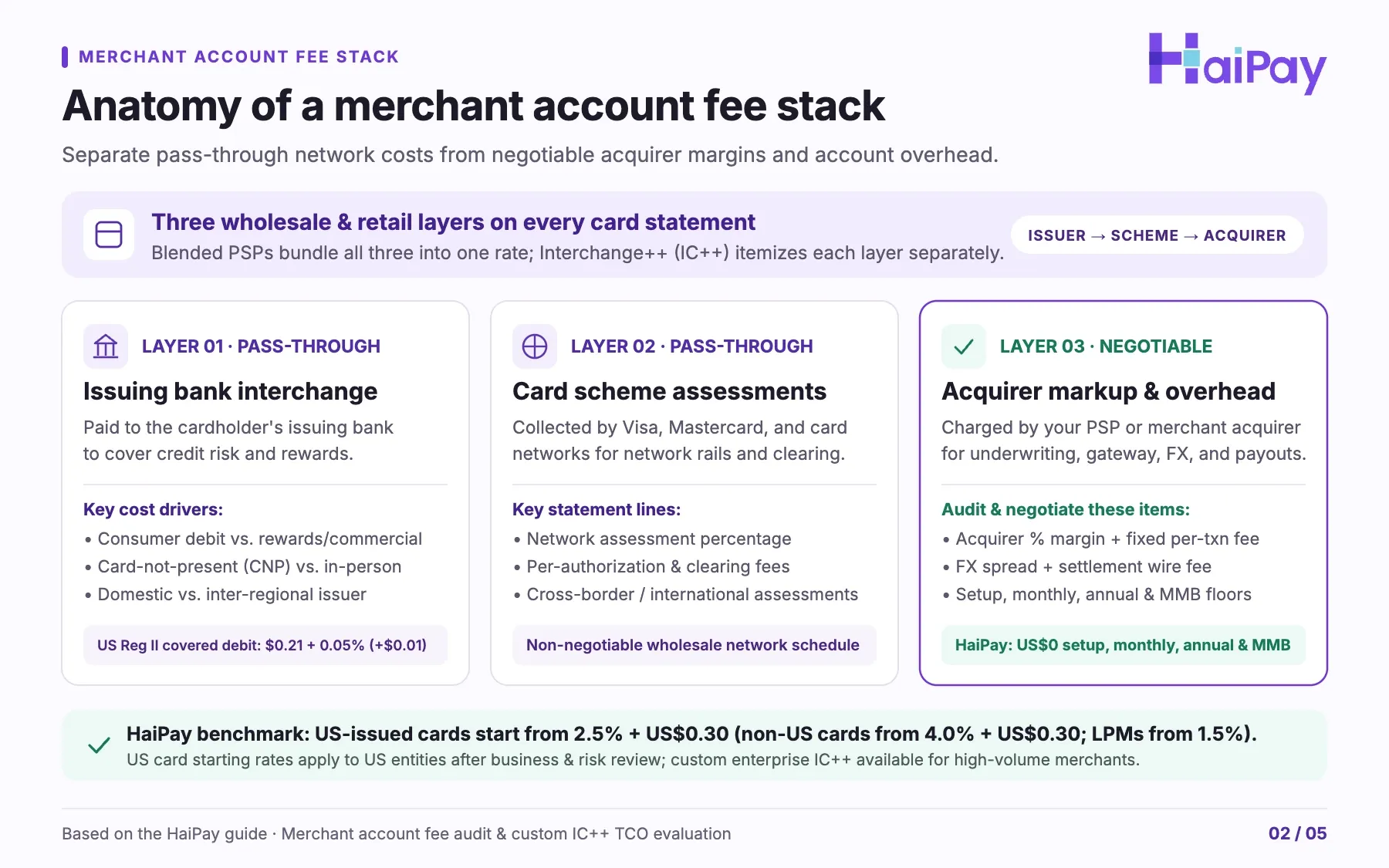
Source: Federal Reserve Board Regulation II Report and Visa US Merchant Regulation Fees (Reviewed Nov 2026). See also credit card processing fees explained.
The 10 Lifecycle Categories of Merchant Account Fees (2026 Audit Framework)
Most processor pricing pages highlight only domestic card capture rates. However, finance teams auditing monthly reconciliation files encounter ten distinct fee categories across account setup, transaction capture, cross-border FX, post-payment exceptions, and bank settlement.
Use the 10-category lifecycle table below to map every line item on your current merchant statement against our published baseline schedule. Download the Merchant Account Fee Audit & IC++ Comparison Worksheet (CSV) to run this audit across your last three monthly statements.
Lifecycle Category | How the Fee Is Triggered | Published Market Range (2026) | Published Baseline & Enterprise Rule |
|---|---|---|---|
1. Setup Fee | One-time MID underwriting and provisioning. | US$0 on modern PSPs; legacy bank ISOs may quote setup fees. | US$0 setup fee across standard and enterprise accounts. |
2. Monthly Account Fee | Fixed recurring charge for an active MID or gateway. | US$0 on Stripe/Adyen/Airwallex; US$25/mo Authorize.net; US$30/mo PayPal Pro. | US$0 monthly account maintenance fee. |
3. Annual & PCI Fee | Yearly account maintenance or PCI validation charge. | US$0 on modern API PSPs; legacy acquirers often bill annual fees. | US$0 annual account fee. |
4. Minimum Monthly Billing | Shortfall fee when monthly fees fall below a floor. | US$0 on Stripe/PayPal; Adyen industry minimum; Checkout.com contractual MMB. | US$0 minimum monthly billing (no idle-MID penalty). |
5. Auth, Batch & 3DS Fees | Per-attempt auth, daily batch close, or 3DS check. | Authorize.net: US$0.10/txn + US$0.10 batch; PayPal Card: US$0.30 uncaptured auth, US$0.03 3DS. | Included on standard blended schedules; itemized on custom IC++ quotes. |
6. Domestic Cards & LPMs | Same-region card capture or local payment methods. | US cards: 2.80%–3.49% + US$0.30–US$0.49 (blended) or IC++ + 0.49%–0.60%. | US-issued cards (US entity): from 2.5% + US$0.30; LPMs: from 1.5% (Indonesia QRIS from 1.2%). |
7. Cross-Border Card Fee | Surcharge when card issuer sits outside acquirer country. | +1.50% on Stripe US, PayPal US, Airwallex US; +2.00% on Stripe UK non-UK cards. | US entity + non-US cards: from 4.0% + US$0.30 (includes +1.5% cross-border component). |
8. FX Conversion Spread | Markup when settlement currency differs from checkout. | +1.00% Stripe US; +2.00% Stripe UK; 3.00% or 4.00% above base rate on PayPal US. | US card line FX: from 0.5% (named EM partner banks, up to 2.5% by pair). |
9. Refund & Dispute Fees | Fixed fee per refund and per cardholder chargeback. | Stripe/PayPal keep original fee on refunds; disputes US$15–US$30 (Stripe UK £15). | US$0.30 per refund and US$20 per chargeback on the US card line. |
10. Settlement Wire & Reserve | Bank payout wire fee and rolling risk holdbacks. | Domestic ACH/SEPA often included; cross-border SWIFT wires and reserves vary. | Flat US$15 per USD bank wire; T+1 settlement in 8 LPM markets. |
Source: Compiled from HaiPay Pricing, Stripe US, Stripe UK, PayPal US, Adyen, Checkout.com MMB, Authorize.net, and Airwallex US (Reviewed Nov 2026).
2026 Merchant Account Fee Comparison Across Major Providers
Comparing payment providers requires looking beyond the domestic headline percentage. A low domestic card rate can still produce a high monthly invoice when you accept foreign cards or settle across currencies. Backup regional MIDs with monthly billing floors also inflate total cost.
The table below compares verified public schedules across seven major providers. Every figure preserves the provider's official scope qualifiers so your finance team can benchmark like-for-like merchant terms.
Provider & Scope | Pricing Model | Published Card Rate | Cross-Border & FX Add-On | Fixed Monthly / Minimums | Refund & Dispute Terms |
|---|---|---|---|---|---|
HaiPay (US Card & LPM Baseline) | Public blended + Custom IC++ | From 2.5% + US$0.30 (US cards, US entity); LPMs from 1.5% (QRIS from 1.2%) | Non-US cards from 4.0% + US$0.30 (incl. +1.5%); US FX from 0.5% (up to 2.5%) | US$0 setup, US$0 monthly, US$0 annual, US$0 minimum monthly billing | US$0.30/refund; US$20/dispute; US$15/USD settlement wire |
Stripe (US & UK Standard) | Blended flat-rate (Custom by quote) | US: 2.9% + US$0.30; UK: 1.5% + £0.20 standard UK (1.9% + £0.20 premium) | US: +1.5% intl cards, +1% FX; UK: +1.25% EEA, +2% non-UK, +2% FX | US$0 monthly fee and US$0 minimum monthly billing on standard plans | Original fee not returned on refunds; US$15 dispute (UK: £15) |
PayPal (US Checkout & Card) | Blended OR published IC++ | Checkout: 3.49% + US$0.49; Basic Cards: 2.99% + US$0.49; IC++: IC++ 0.49% + US$0.39 | +1.50% intl commercial (0% on IC++ cards); FX spread 3.00% or 4.00% | US$0 standard; US$30/mo Payments Pro; US$0.30 uncaptured auth | Original fee not returned on refunds; US$15 dispute (US$30 high-tier) |
Adyen (Global All-in-One) | Published & custom IC++ | US$0.13 fixed processing fee + Interchange++ 0.60% (Visa/MC USD display) | Scheme cross-border fees passed through; FX markup by currency pair | No setup/monthly fee; industry minimum monthly invoice applies | Scheme dispute and refund processing fees passed through |
Checkout.com (Enterprise) | Blended OR IC++ by quote | Custom quote by entity, card mix, and monthly volume | Cross-border scheme fees + contractual FX fee above reference rate | Minimum Monthly Billing (MMB) shortfall fee per contract schedule | Refund, dispute, and 3DS fees defined in merchant contract |
Authorize.net (US Plans) | Blended OR Gateway Only | All-in-One: 2.9% + US$0.30; Gateway Only: US$0.10/txn + US$0.10 daily batch | Requires separate merchant acquirer schedule on Gateway Only | US$0 setup fee, US$25 monthly gateway fee | Subject to underlying merchant acquirer dispute and refund rules |
Airwallex (US Core Schedule) | Blended (Custom >US$250k/mo) | 2.80% + US$0.30 domestic cards; 4.30% + US$0.30 international cards | +1.50% intl differential included in 4.30%; separate FX schedule | US$0 monthly on Explore (with spend/balance rule) and Core acquiring | US$15 per chargeback; standard card refund rules apply |
Source: Verified against official pricing pages of HaiPay, Stripe, PayPal, Adyen, Checkout.com, Authorize.net, and Airwallex (Reviewed Nov 2026). All rates require underwriting and MCC approval.
Blended Flat-Rate vs. Custom Enterprise IC++: TCO and Break-Even Math
A common misconception in payment procurement is treating "PSP" and "Interchange++ (IC++)" as opposites. In reality, a PSP is an infrastructure role, whereas Blended and IC++ are pricing formulas. Adyen, PayPal US Card Services, Checkout.com, and HaiPay all deliver full-stack PSP APIs on an IC++ schedule.
Under a blended flat-rate schedule, your processor charges one fixed percentage across consumer debit, standard credit, and corporate cards. Under an IC++ schedule, the processor passes wholesale interchange and scheme assessments through at cost, adding a separate acquirer margin. Read our interchange-plus pricing guide for a complete structural breakdown.
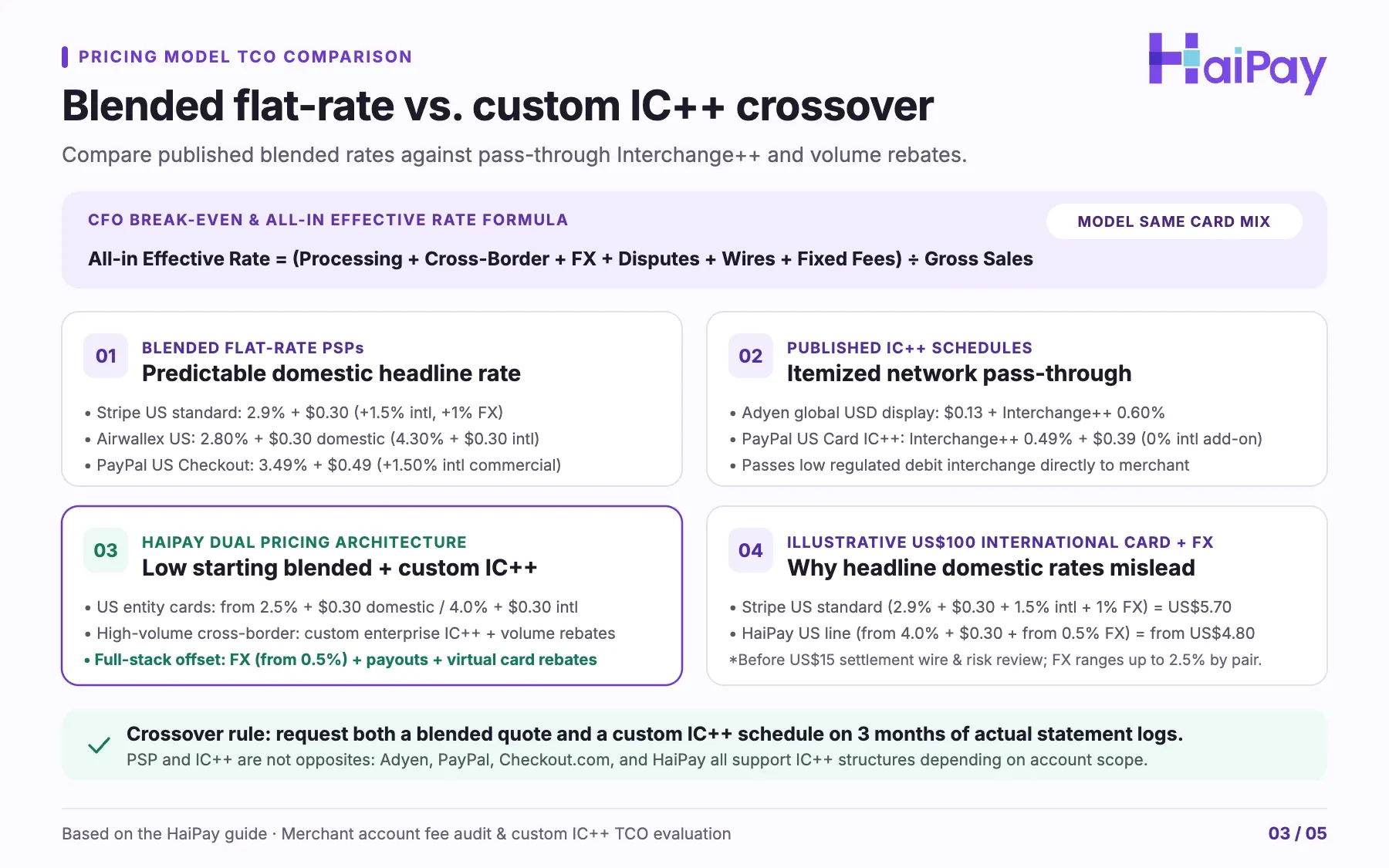
Worked Example: US$100 Cross-Border Card Order with Currency Conversion
Consider a US-registered e-commerce merchant capturing a US$100 equivalent checkout from a European cardholder with currency conversion. Comparing domestic headline rates alone hides the two largest cost drivers on international orders: the cross-border surcharge and the FX spread. For corridor-by-corridor fee modeling, see our cross-border payments cost breakdown guide.
- Stripe US Published Standard. The fee stacks 2.9% domestic (US$2.90), US$0.30 fixed, 1.5% international card (US$1.50), and 1.0% FX conversion (US$1.00). Total fee equals US$5.70 (5.70% effective rate), and original processing fees are not returned if refunded.
- PayPal US Standard Commercial Checkout. The fee stacks 3.49% base (US$3.49), US$0.49 fixed, 1.50% international commercial (US$1.50), and a 3.00%–4.00% FX spread (US$3.00–US$4.00). Total fee equals US$8.48 to US$9.48 (8.48%–9.48% effective rate).
- HaiPay US Card Line Public Starting Baseline. Non-US cards on a US entity start from 4.0% + US$0.30 (US$4.30, including +1.5% cross-border), plus FX from 0.5% (US$0.50, up to 2.5% by pair). Total fee starts from US$4.80 (4.80% starting effective rate) before the flat US$15 batch settlement wire.
Monthly Volume Crossover: When to Move from Blended to Custom Enterprise IC++
Blended pricing works well when monthly card volume is low and domestic rate predictability matters most. Once monthly volume exceeds US$100,000—or when regulated debit and local payment methods grow—custom IC++ and volume rebates lower total cost of ownership. For US card routing, see our United States payment gateway and Regulated debit interchange guide.
Monthly Volume Tier | Recommended Pricing Model | Primary Cost Advantage | Contract Terms to Lock In |
|---|---|---|---|
Under US$50,000 / mo | Public starting blended + US$0 fixed overhead | Avoids US$25–US$500/mo gateway and minimum billing penalties during seasonal dips. | Lock in US$0 setup, US$0 monthly, US$0 annual, and US$0 MMB. |
US$50k – US$250k / mo | Blended baseline + Local Payment Methods (from 1.5%) | Shifting international buyers from cross-border cards (4.0%+) to LPMs (from 1.5%; QRIS from 1.2%) cuts fees by 150–250 bps. | Separate domestic cards, cross-border cards, and LPMs on statements. |
US$250k – US$1M / mo | Custom enterprise IC++ + Multi-currency FX routing | Passes regulated debit interchange directly to the merchant instead of paying a 2.9% blended rate. | Request a side-by-side IC++ simulation on 3 months of statement logs. |
Over US$1,000,000 / mo | Custom IC++ + Tiered volume & virtual card rebates | Acquiring margin steps down with volume while virtual card and payout routing eliminates double FX. | Combine tiered acquiring rebates with high-spend virtual card rebates. |
Source: Illustrative TCO modeling based on Stripe US, PayPal US, and HaiPay Pricing (Reviewed Nov 2026). Test your own order value in the processing fee calculator.
10 Hidden Merchant Statement Traps vs. Zero Fixed Account Overhead (US$0 Setup, Monthly, Annual, and Minimum Fees)
When merchants expand into new regions, they often open secondary merchant accounts or backup acquiring lines for redundancy. On traditional processor contracts, an idle or low-volume MID quietly accumulates monthly gateway fees, annual PCI fees, and minimum billing shortfalls. For holdback math, review our merchant account rolling reserve and 180-day working capital guide.
Zero Fixed Account Overhead—locking in US$0 setup, US$0 monthly, US$0 annual, and US$0 minimum monthly billing fees—prevents idle or seasonal MIDs from eroding margin. Finance teams should audit every prospective processor contract against these ten statement traps:
- Minimum Monthly Billing (MMB) penalties. Adyen applies an industry minimum invoice, and Checkout.com enforces contractual MMB floors when volume slows down. Zero-fixed-overhead accounts charge US$0 minimum monthly billing.
- Per-MID onboarding and setup charges. Legacy bank acquirers often bill per-currency or per-entity setup fees, whereas modern schedules charge US$0 setup fees.
- Recurring monthly gateway fees. Authorize.net charges US$25 per month and PayPal Payments Pro charges US$30 per month even with zero volume, compared with US$0 monthly.
- Annual account and PCI maintenance fees. PCI DSS standards are set by the PCI Security Standards Council, so yearly "PCI maintenance" fees are processor add-ons. Zero-fixed-overhead contracts charge US$0 annual fees.
- Daily settlement batch header fees. Unbundled gateways such as Authorize.net Gateway Only bill US$0.10 per daily batch close on top of US$0.10 per transaction.
- Uncaptured authorization and verification fees. PayPal US Card Services charges US$0.30 per uncaptured authorization, US$0.30 per card verification, and US$0.03 per 3DS check.
- Stacked cross-border and FX surcharges. A foreign-issued card triggers a +1.5% to +2.0% cross-border fee even in your home currency. Currency conversion adds another +1.0% to +4.0% on top.
- Unreturned processing fees on refunds. Stripe and PayPal keep the original processing fee when you refund an order. On our US card line, refunds carry a flat US$0.30 fee.
- Escalating high-volume dispute tiers. PayPal's US dispute fee jumps from US$15 to US$30 in its high-volume tier, whereas our US card schedule lists a flat US$20 per chargeback.
- Opaque settlement wires and reserve holds. Always confirm payout wire costs and rolling-reserve release dates in writing. Our US card line charges a flat US$15 per USD wire and supports T+1 settlement in 8 LPM markets.
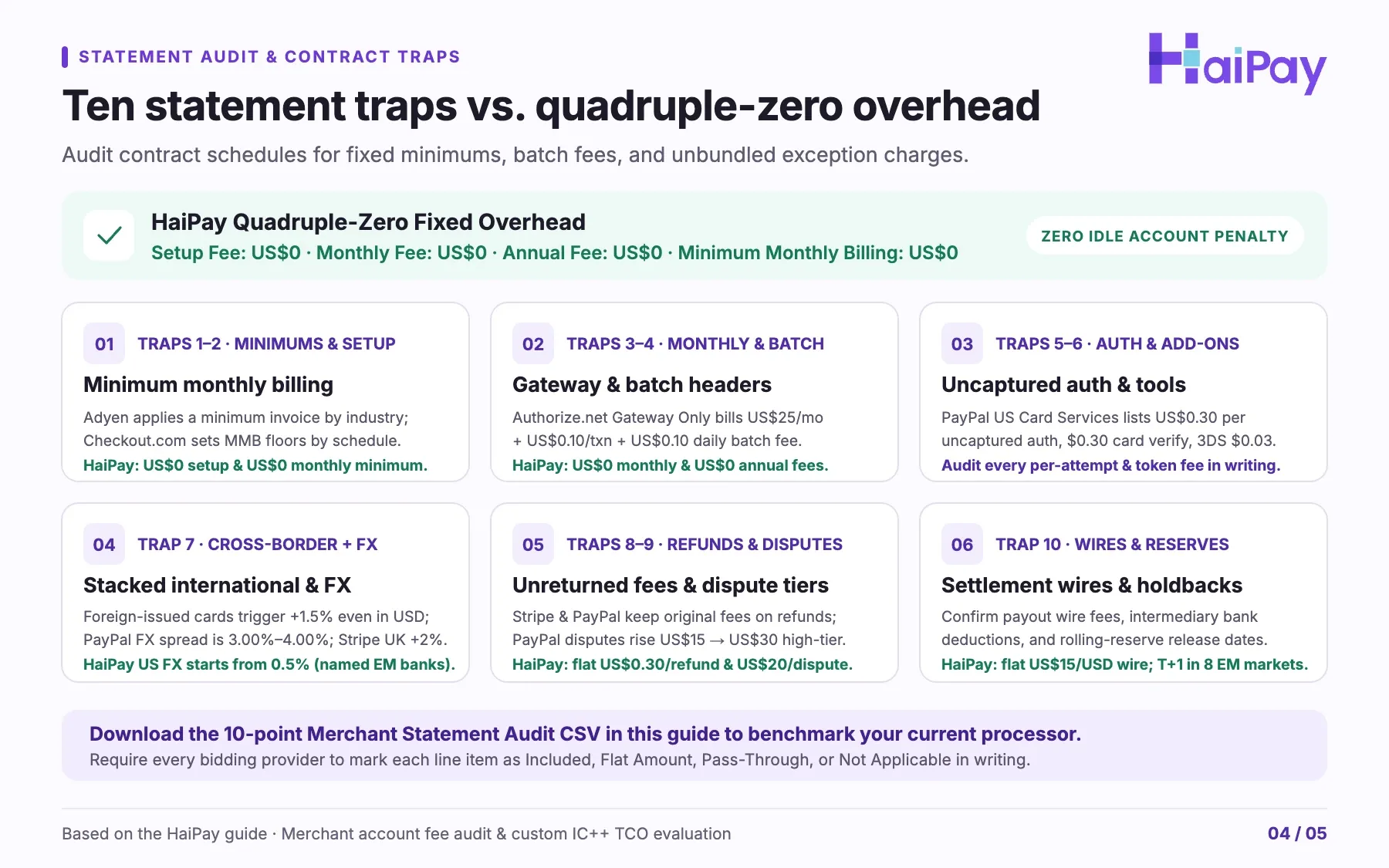
Source: PCI Security Standards Council, Checkout.com MMB Schedule, Authorize.net Pricing, and PayPal US Business Fees (Reviewed Nov 2026).
CFO Procurement & Rate Negotiation Playbook: Benchmarking IC++, FX Spreads, and Event Fees
Negotiating lower merchant account fees requires looking beyond headline domestic checkout rates. When finance teams audit 90 days of processing logs, cross-border card surcharges, forced checkout conversions, and outbound wire spreads typically account for the largest basis-point leakage. Compare like-for-like settlement corridors in our multi-currency merchant account and FX settlement guide.
During payment processor RFP negotiations, CFOs and treasury teams should benchmark candidate acquirers across four contractual cost levers:
- 1. Benchmark custom IC++ markups and volume step-down tiers. Once monthly card volume exceeds US$250,000, request a side-by-side Interchange++ (IC++) simulation on three months of statements so regulated caps pass through at cost. Negotiate contractual volume step-down tiers where the acquirer's markup automatically decreases as monthly volume scales.
- 2. Shift cross-border card traffic to local payment rails. International card transactions often cost 4.0% to 5.5% after cross-border and FX add-ons. Routing regional buyers through local payment methods from 1.5% (QRIS from 1.2%) cuts fees by 150 to 250 bps and unlocks T+1 settlement in 8 markets.
- 3. Eliminate double FX conversion via like-for-like settlement and payouts. Avoid processors that force foreign-currency sales into your home currency at a 1% to 4% spread. Settling across 10+ native currencies (US card FX from 0.5%) and disbursing supplier funds directly via Global Mass Payouts eliminates the second bank-wire FX conversion.
- 4. Cap post-authorization refund, dispute, and settlement wire fees. Standard aggregator contracts keep the original 2.9% to 5.4% processing fee on refunds and escalate dispute fees to US$30 in high-volume tiers. Lock in flat event caps—US$0.30 per card refund, US$20 per chargeback, and US$15 per USD wire—alongside US$0 setup, monthly, annual, and minimum fees.
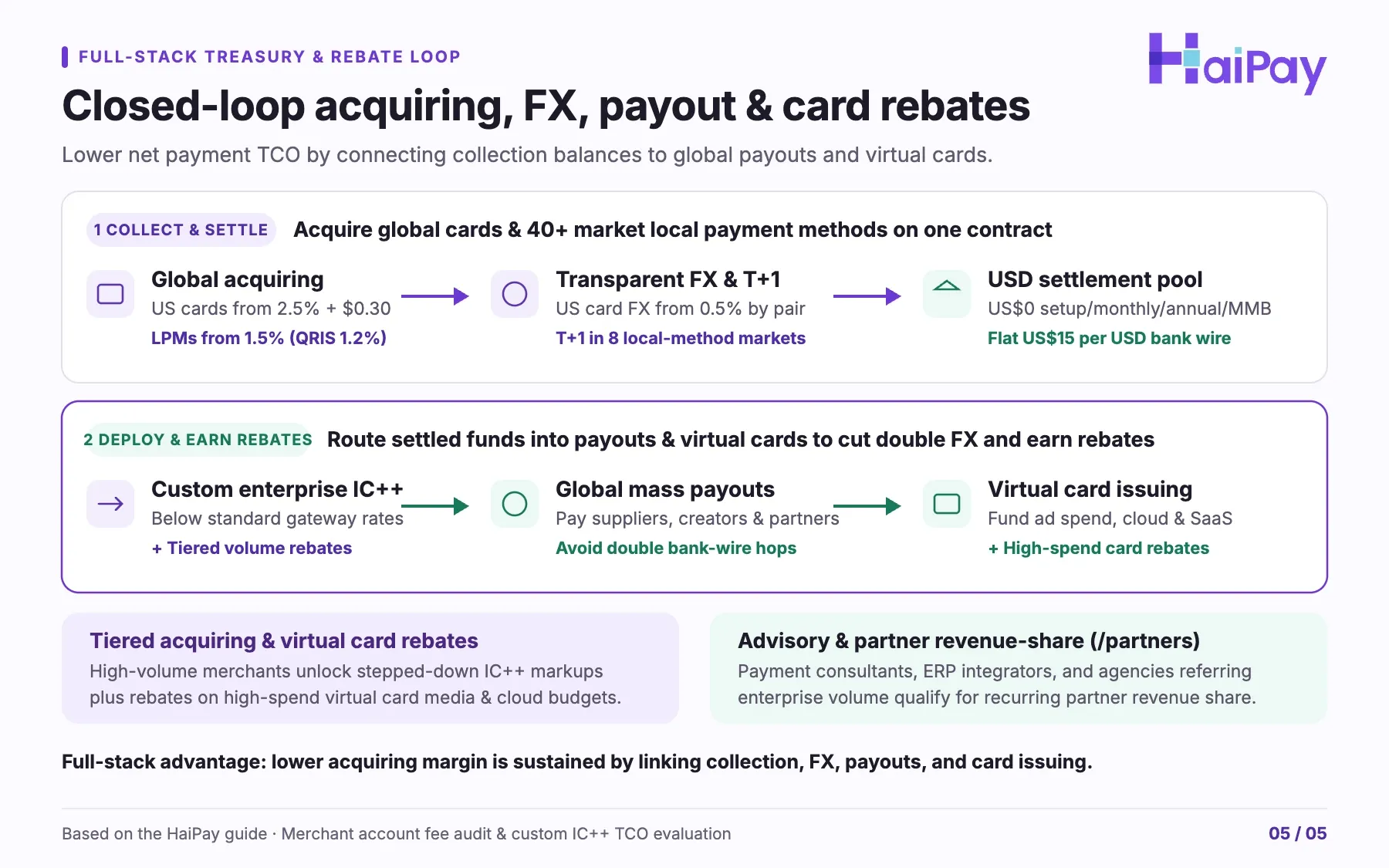
To benchmark your current effective rate line by line, download the Merchant Account Fee Audit Worksheet (CSV) and compare your statement against our published pricing schedule. You can also share your last three monthly statements via our custom quote contact page for a side-by-side IC++ and FX savings audit.
Source: HaiPay Pricing and Global Mass Payouts (Reviewed Nov 2026).
Sources and Official Fee Schedules
All provider fee figures, network interchange references, and regulatory definitions in this guide were verified against primary public documentation on November 8, 2026:
- HaiPay Official Pricing Schedule: https://www.haipay.net/pricing — Public card and LPM baselines, zero fixed account fees, and custom IC++ terms (Reviewed 2026-11-08).
- Stripe US Official Pricing: https://stripe.com/pricing — Standard US card rate (2.9% + US$0.30), +1.5% international card, +1% FX, and US$15 dispute fee (Reviewed 2026-11-08).
- Stripe UK Official Pricing: https://stripe.com/gb/pricing — Standard UK cards (1.5% + £0.20), premium UK (1.9% + £0.20), +1.25% EEA, +2% non-UK, +2% FX, and £15 dispute fee (Reviewed 2026-11-08).
- PayPal US Business Fees: https://www.paypal.com/us/business/paypal-business-fees — Checkout (3.49% + US$0.49), Card Services IC++ (0.49% + US$0.39), +1.50% cross-border, and 3.00%–4.00% FX spread (Reviewed 2026-11-08).
- Adyen Global Pricing: https://www.adyen.com/pricing — US$0.13 fixed processing fee + Interchange++ 0.60% (Visa/MC USD display) and minimum monthly invoice policy (Reviewed 2026-11-08).
- Checkout.com Pricing & Legal Schedules: https://www.checkout.com/pricing, Minimum Billing Fee, and FX Fees (Reviewed 2026-11-08).
- Authorize.net Official Pricing: https://www.authorize.net/sign-up/pricing.html — All-in-One (US$25/mo + 2.9% + US$0.30) and Gateway Only (US$25/mo + US$0.10/txn + US$0.10 batch) (Reviewed 2026-11-08).
- Airwallex US Pricing: https://www.airwallex.com/en-us/pricing — US domestic cards (2.80% + US$0.30), international cards (4.30% + US$0.30), and US$15 chargeback fee (Reviewed 2026-11-08).
- Federal Reserve Board — Regulation II Report: https://www.federalreserve.gov/paymentsystems/regii-average-interchange-fee.htm — Covered debit cap (US$0.21 + 0.05% + US$0.01) and 2023 average debit interchange (Reviewed 2026-11-08).
- Visa US Regulation Fees & PCI SSC: https://www.visa.com/en-us/support/business/regulation-fees and https://www.pcisecuritystandards.org/standards/ (Reviewed 2026-11-08).
FAQ
Published US blended domestic card rates start at 2.80% + US$0.30 on Airwallex and 2.9% + US$0.30 on Stripe. PayPal US charges 2.99% to 3.49% + US$0.49 on standard commercial cards. HaiPay's US card baseline starts from 2.5% + US$0.30 for US-issued cards (US entity, after risk review), and local payment methods start from 1.5% (QRIS from 1.2%).
Add every fee deducted on your monthly statement, including base capture fees, cross-border surcharges, FX spreads, refunds, disputes, wires, and monthly minimums. Divide that total fee amount by your gross settled sales volume for the month and multiply by 100. You can also model scenarios in the credit card processing fee calculator.
No. A payment service provider (PSP) is an operational and API role, whereas Blended and Interchange++ (IC++) are pricing formulas. Adyen, PayPal US Card Services, Checkout.com, and HaiPay all support IC++ pricing structures. See our interchange-plus pricing guide for pass-through billing examples.
Minimum Monthly Billing (MMB) is a contractual fee floor charged by some enterprise acquirers, such as Adyen or Checkout.com. If your monthly transaction fees total US$180 against a US$500 monthly minimum, the processor bills a US$320 shortfall fee. Zero-fixed-overhead accounts charge US$0 minimum monthly billing, US$0 setup, US$0 monthly, and US$0 annual fees.
When a customer pays with a card issued outside your acquirer's country, two extra charges stack onto your domestic rate. First, processors add an international card surcharge (+1.50% on Stripe US, PayPal US, Airwallex US, and our US card line; +2.00% on Stripe UK). Second, currency conversion adds an FX spread (+1.00% on Stripe US, 3.00%–4.00% on PayPal US, or from 0.5% up to 2.5% on our US card line).
Most major aggregators, including Stripe and PayPal, do not return the original percentage or fixed transaction fee when you refund a customer order. A refunded US$100 international card checkout can leave the merchant absorbing US$4.40 to US$9.48 in sunk fees. On our US card acquiring schedule, customer refunds carry a flat US$0.30 processing fee.
Settling cross-border revenue into a multi-currency merchant account lets you hold 10+ currencies and route funds directly into global mass payouts without paying 2% to 6% in double FX spreads. High-volume merchants can also negotiate custom IC++ pricing with tiered volume step-downs that lower acquiring markups as monthly volume grows.

Related HaiPay surfaces
Explore the payment stack
Pricing
HaiPay Pricing & Acquiring Schedules
Review published starting rates for global cards and local payment methods, quadruple-zero fixed fees, and custom enterprise IC++ terms.
Tool
Credit Card Processing Fee Calculator
Estimate per-transaction and monthly effective merchant account fees across domestic, international, and FX card scenarios.
Guide
Payment Gateway Fees: Complete Comparison Guide
Compare per-transaction gateway schedules, cross-border surcharges, and payout costs across global payment gateways.
Partners
HaiPay Partner & Advisory Revenue-Share Program
Explore recurring revenue-share partnerships for payment consultants, ERP integrators, and cross-border commerce agencies.
Guide
Rolling Reserve & Working Capital Guide
Compare rolling vs capped reserves, 180-day cashflow math, and 0% standard KYB reserve terms.
Guide
Multi-Currency Merchant Account Guide
Eliminate double FX conversion with 160+ transaction currencies and 10+ native settlement currencies.

Need help mapping your payment stack?
Talk to HaiPay about acquiring, orchestration, local methods, and payout workflows.
Contact us