
Direct Answer
Cross-border payments are financial transactions where the payer and the merchant or beneficiary are located in different countries. Regulated institutions settle these transactions by adjusting ledger balances across four primary clearing rails.
Those four rails are SWIFT correspondent wires, global card switches, domestic local payment methods (such as SEPA, PIX, UPI, and QRIS), and closed-loop multi-currency ledgers. To protect net margin, merchants must separate checkout authorization speed from usable settlement finality and eliminate 2% to 6% double FX conversion.
Commercial disclosure & cluster scope note. This pillar guide is published by HaiPay and benchmarks cross-border clearing rails, FSB/BIS standards, and published fee schedules from Stripe, PayPal, Adyen, Checkout.com, and Airwallex (reviewed November 8, 2026). For commercial deployment, visit our cross-border payment solutions page. For authorization-rate comparisons between domestic and foreign acquirers, see local acquiring vs. cross-border acquiring, and for card scheme assessment rules read cross-border acquiring fees explained.
How Cross-Border Payments Work: The Four Global Clearing Rails Explained
Cross-border payments do not run on a single universal pipeline. Every international purchase or supplier payout combines messaging, foreign exchange (FX), compliance screening, and settlement across four distinct infrastructure rails.
The critical operational metric for finance teams is the gap between message or authorization speed and usable settlement finality. A checkout payment can appear approved in two seconds while actual cash takes days to reach your bank. Compare domestic US clearing timelines in our United States payment gateway and ACH/card acquiring guide.
- Rail 1 — SWIFT Correspondent Banking (ISO 20022 & Nostro/Vostro Accounts). SWIFT is an interbank messaging network rather than a settlement bank. When banks lack a direct account relationship, funds hop across intermediary correspondent banks holding pre-funded Nostro and Vostro ledgers.
- Rail 2 — Global Card Networks (Visa, Mastercard, American Express). Card schemes operate a four-party switch linking the cardholder, issuing bank, merchant acquirer, and merchant. Authorization happens in milliseconds, but batch clearing, network FX conversion, and merchant payout settle days later.
- Rail 3 — Local Payment Methods (LPMs) & Account-to-Account (A2A) Rails. Domestic rails such as SEPA in Europe, PIX in Brazil, UPI in India, and QRIS in Indonesia clear locally in the buyer's currency. A global payment processor collects funds locally and either settles like-for-like or repatriates aggregated batches.
- Rail 4 — Closed-Loop Collection-to-Payout & Card-Issuing Treasury Platforms. Instead of wiring every foreign sale back to a single home bank account, multi-currency platforms hold settled balances across currencies. Merchants route those balances directly into outbound supplier payouts or corporate virtual cards via internal ledger netting.
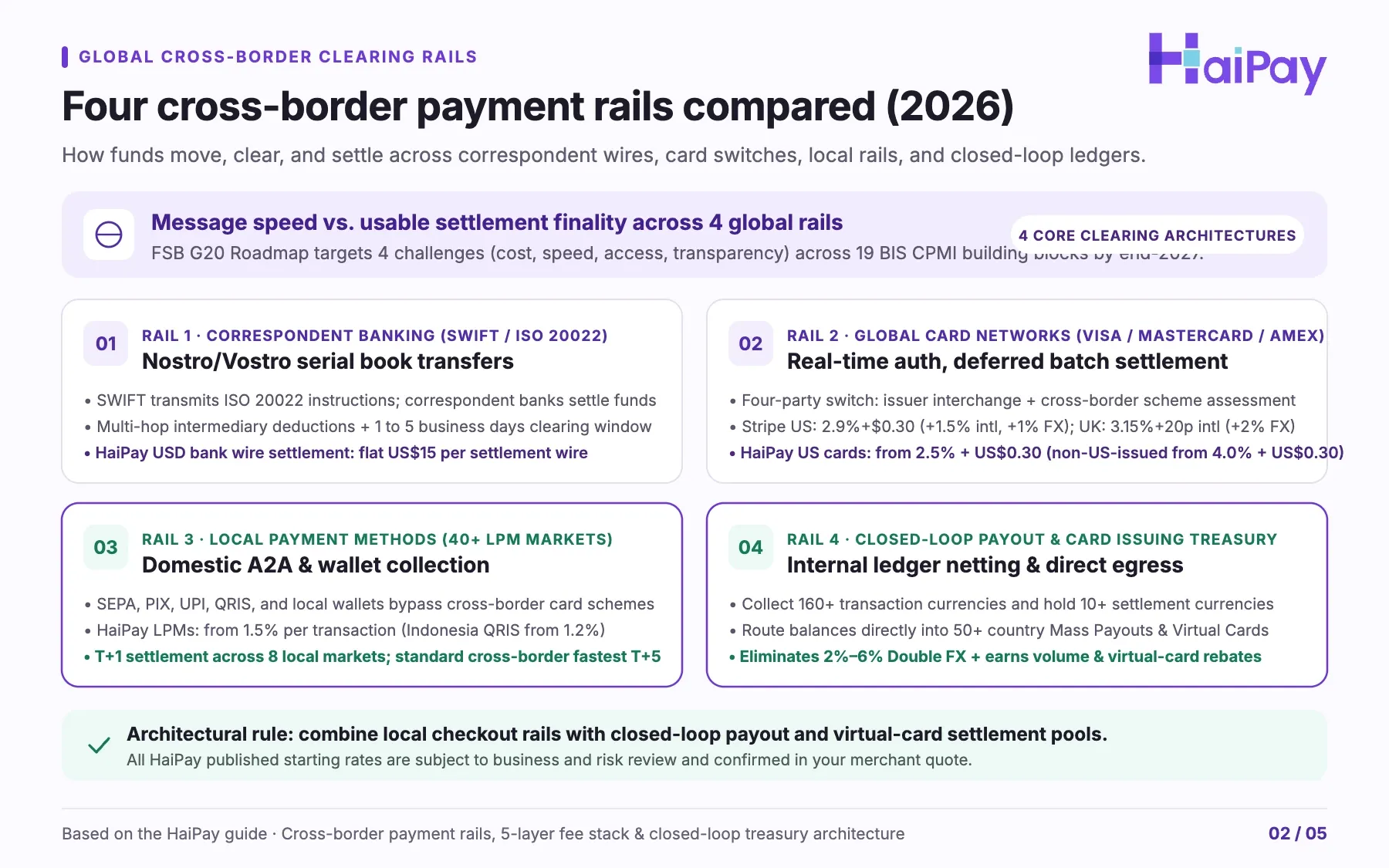
Compare the four cross-border payment rails across authorization speed, settlement finality, fee structure, and primary use cases below. You can also download the Cross-Border Payment Rails & 5-Layer TCO Audit Worksheet (CSV) to benchmark your own payment corridors.
Cross-Border Rail | Core Clearing Mechanism | Confirmation vs. Usable Cash Speed | Typical Fee & FX Structure | Primary Merchant Scenario |
|---|---|---|---|---|
1. SWIFT Correspondent Wire | ISO 20022 instructions paired with serial Nostro/Vostro book transfers across intermediary banks. | Message in minutes; bank credit in 1 to 5 business days. | Originating wire fee + intermediary deductions + receiving fee + bank FX spread; HaiPay USD settlement wire is US$15 flat. | High-value B2B invoice settlement and consolidated treasury sweeps. |
2. Global Card Networks | Four-party switch (Issuer, Network, Acquirer, Merchant) with real-time auth and deferred batch clearing. | 1–3 second authorization; T+2 to T+5 acquirer payout. | Stripe US: 2.9%+$0.30 (+1.5% intl, +1% FX); HaiPay US cards: from 2.5% + US$0.30 (non-US-issued from 4.0% + US$0.30). | Global e-commerce, SaaS subscriptions, and consumer digital checkout. |
3. Local Payment Methods (LPMs) | Domestic A2A transfers, QR switches, and e-wallets collected locally and aggregated by the PSP. | Instant buyer push confirmation; T+1 in 8 HaiPay local markets (fastest T+5 standard cross-border). | HaiPay 40+ LPM markets: from 1.5% per transaction (Indonesia QRIS from 1.2%); no card scheme cross-border surcharge. | Mobile-first and bank-transfer markets across Europe, Asia, and Latin America. |
4. Closed-Loop Treasury Ledger | Multi-currency collection pools linked directly to local payout rails and corporate virtual card issuing. | Instant internal balance allocation; same-day or T+1 local payout egress. | 0% second FX hop when settled USD/EUR/GBP/HKD funds route directly into 50+ country payouts or virtual cards. | Merchants paying overseas suppliers, creators, cloud bills, and ad platforms. |
Source: Compiled from BIS CPMI Cross-Border Payments Programme, Stripe US Pricing, HaiPay Pricing, and HaiPay Local Payment Methods (Reviewed Nov 2026).
Regulatory Benchmarks: FSB G20 2027 Roadmap Targets and BIS CPMI 19 Building Blocks
Why do international payments still cost far more than domestic transfers? The Financial Stability Board (FSB) and the BIS Committee on Payments and Market Infrastructures (CPMI) identify four core challenges: high costs, low speed, limited access, and insufficient transparency.
In 2020, the G20 launched the Roadmap for Enhancing Cross-Border Payments. In October 2021, G20 Leaders endorsed 11 global quantitative targets across three segments: wholesale payments, retail payments (B2B, P2B, B2P, and P2P), and remittances.
- End-2027 Common Target Date. The FSB set End-2027 as the common target date for wholesale and retail cross-border targets. Meanwhile, the remittance cost target aligns with the 2030 United Nations Sustainable Development Goal (UN SDG).
- Correspondent Banking Concentration Risk. Since November 2015, the FSB has tracked the global decline in correspondent banking relationships under its four-point action plan. Fewer correspondent banks mean longer chains and higher fees.
- BIS CPMI 19 Building Blocks & Five Focus Areas. The BIS CPMI roadmap identifies 19 building blocks across five focus areas. Areas A through D enhance the existing ecosystem, while area E explores new infrastructures.
- Three Priority Themes (Interlinking & ISO 20022). Delivery centers on three priority themes: payment system interoperability and extension, legal and regulatory frameworks, and cross-border data exchange. Harmonizing ISO 20022 standards cuts manual compliance holds.
For corporate treasurers, the takeaway from the BIS CPMI framework is straightforward. Harmonizing ISO 20022 messages improves automated sanctions screening, but it does not eliminate Nostro/Vostro liquidity costs. To cut fees today, merchants must combine local rails (such as SEPA payments in Europe) with closed-loop multi-currency ledgers. For market-specific European checkout routing, review our Germany payment gateway and SEPA Direct Debit guide and France payment gateway and Cartes Bancaires (CB) guide.
Source: FSB Cross-Border Payments Overview, FSB G20 Targets Final Report (Oct 2021), and BIS CPMI 19 Building Blocks Report (Reviewed Nov 2026).
The 5-Layer Cross-Border Fee Stack and US$100,000 Monthly TCO Audit
Most payment gateways quote a single domestic headline rate on their pricing page. However, when an overseas buyer pays or a merchant settles across currencies, total cost of ownership (TCO) compounds across five separate fee layers.
- Layer 1 — Issuing Bank Interchange or Local Scheme Fee. On card rails, interchange goes to the cardholder's issuing bank. Domestic UK and EEA consumer interchange is capped, whereas inter-regional and corporate cards carry much higher wholesale rates.
- Layer 2 — Card Network Cross-Border Assessment. Visa and Mastercard charge a cross-border scheme fee whenever the card issuer country differs from the merchant acquirer country. Stripe US, PayPal US, Airwallex US, and our US card line all reflect a +1.50% international card differential.
- Layer 3 — Acquirer or PSP Processing Markup. This covers processor margin and per-transaction fees. Adyen lists a US$0.13 processing fee plus Interchange++ 0.60% (Visa/Mastercard USD display), while PayPal US Advanced Card IC++ charges Interchange + 0.49% + US$0.39.
- Layer 4 — Inbound and Outbound FX Conversion Spreads. When currency conversion is required, Stripe adds +1% in the US and +2% in the UK. PayPal US applies a 3.00% or 4.00% spread above its base rate, and re-converting at a domestic bank creates a 2% to 6% Double FX Trap.
- Layer 5 — Fixed Account Overhead, Minimum Monthly Billing (MMB), and Exception Fees. Adyen and Checkout.com enforce contractual minimum monthly invoice or Minimum Billing Fee (MMB) thresholds. Exception costs include disputes (US$15 on Stripe US, £20 on Stripe UK, US$20 on HaiPay) and unrefunded original fees on Stripe and PayPal.
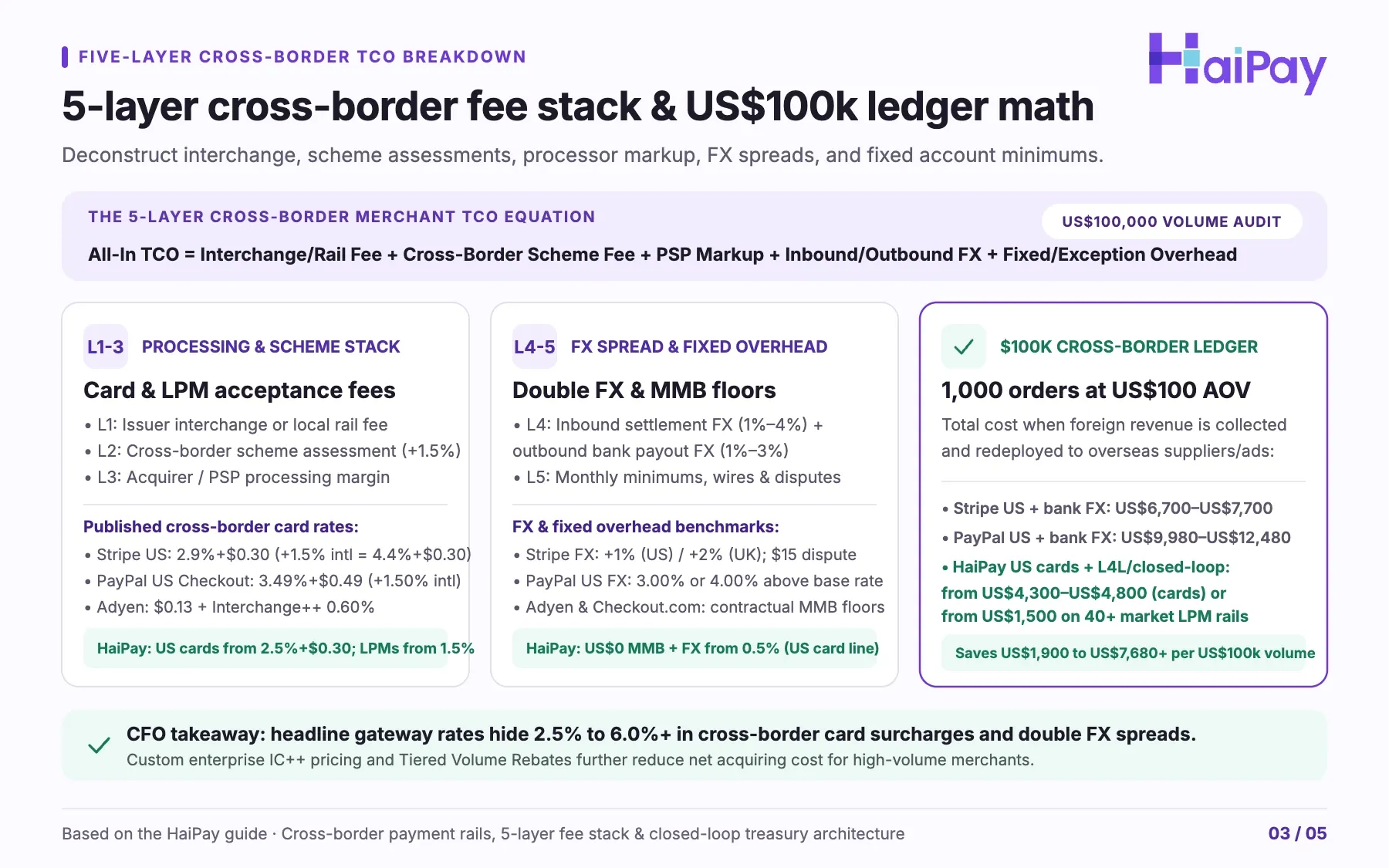
Worked Ledger Audit: US$100,000 Monthly Cross-Border Sales Redeployed to Global Spend
Consider a merchant processing US$100,000 per month across 1,000 international orders (US$100 average order value). The merchant then uses those funds to pay overseas suppliers or USD media platforms:
Fee Layer (US$100,000 Monthly Volume) | Stripe US Standard + Bank Payout FX | PayPal US Checkout + USD Withdrawal FX | HaiPay Card Baseline + Closed-Loop Routing | HaiPay 40+ Market LPM Baseline |
|---|---|---|---|---|
Layer 1–3: Base + Cross-Border Acceptance | 4.40% + US$0.30/txn (2.9% + 1.5% intl) = US$4,700 | 4.99% + US$0.49/txn (3.49% + 1.50% intl) = US$5,480 | From 4.0% + US$0.30/txn (non-US cards on US entity) = from US$4,300 (US-issued cards from 2.5% + US$0.30 = from US$2,800) | From 1.5% per transaction across 40+ LPM markets = from US$1,500 (Indonesia QRIS from 1.2% = from US$1,200) |
Layer 4A: Inbound Settlement FX | +1.00% currency conversion = US$1,000 (Stripe UK: +2.00% = US$2,000) | 3.00% or 4.00% conversion spread = US$3,000 to US$4,000 | 0% FX on like-for-like settlement; or from 0.5% (US$500) on US card line | Named reference bank rate when converted to USD (e.g., Maybank MYR→USD, DBS SGD→USD) |
Layer 4B: Outbound Supplier / Ad Card FX | 1.00%–2.00% domestic bank wire/card FX = US$1,000–US$2,000 | 1.50%–3.00% external FX after mandatory USD withdrawal = US$1,500–US$3,000 | 0% second FX when routed into matching-currency Mass Payouts or Virtual Cards | 0% second FX when USD settlement funds matching-currency payouts or virtual cards |
Layer 5: Monthly Minimums & Rebates | US$0 monthly; no standard volume or card rebates | US$0 standard (US$30/mo Pro); no standard rebates | US$0 setup/monthly/annual/MMB + Custom IC++ + Tiered Volume & Virtual Card Rebates | US$0 setup/monthly/annual/MMB + Tiered Volume & Virtual Card Rebates |
All-In Monthly Cost (Before Rebates) | US$6,700 – US$7,700 (6.70%–7.70%) | US$9,980 – US$12,480 (9.98%–12.48%) | From US$4,300 – US$4,800 (non-US cards) / From US$2,800 (US cards) | From US$1,200 – US$1,500 + reference bank FX |
Source: Calculated from verified public fee schedules at Stripe US Pricing, Stripe UK Pricing, PayPal US Business Fees, Visa Regulation Fees, and HaiPay Merchant Account Fees Guide (Reviewed Nov 2026).
Closed-Loop Treasury Architecture: Connecting 160+ Transaction Currencies to Mass Payouts and Virtual Cards
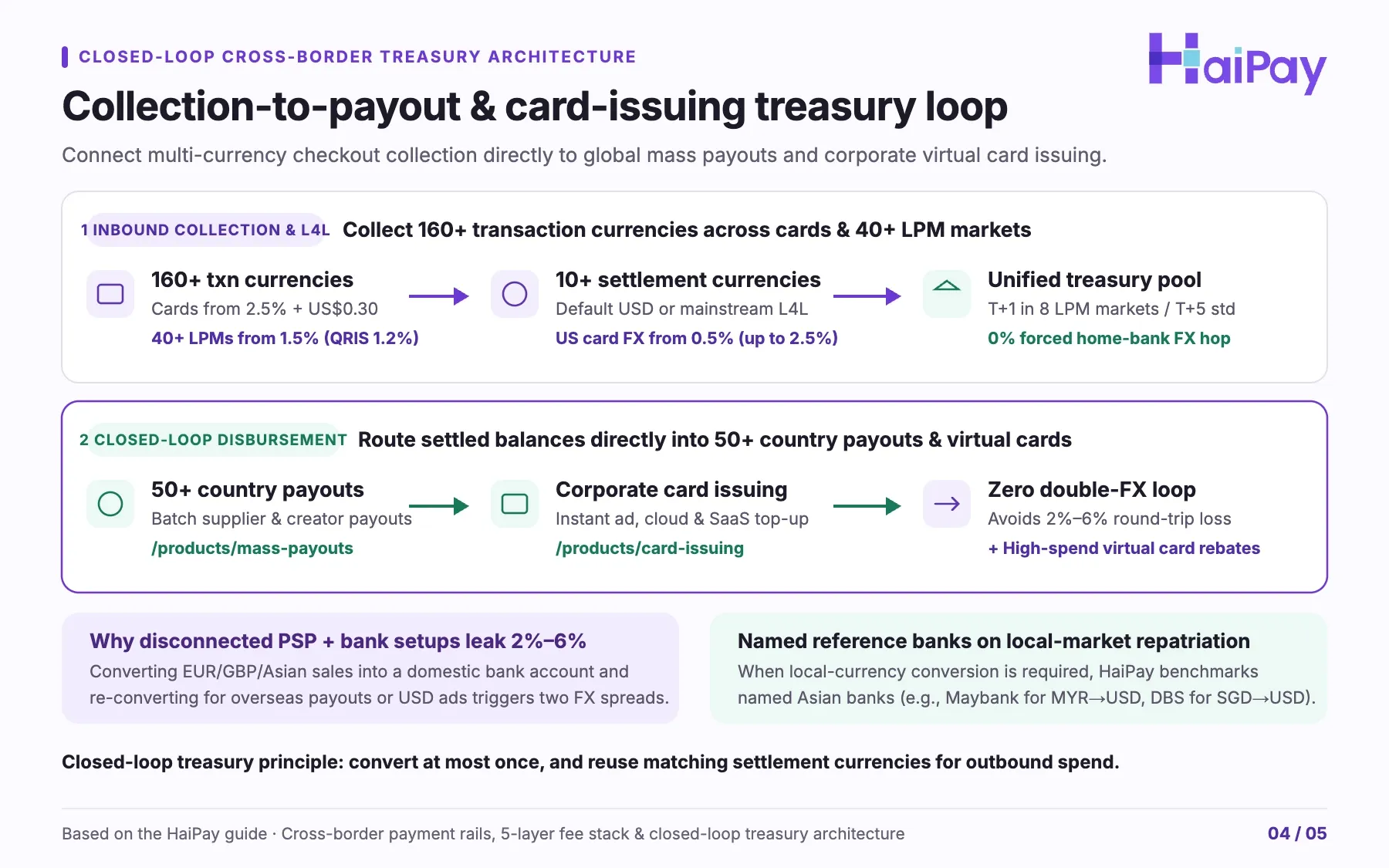
In a traditional cross-border setup, your checkout gateway and your corporate bank operate in separate silos. Force-converting foreign sales into a domestic bank and re-converting them for overseas vendors erodes 2% to 6% in round-trip FX spreads.
A closed-loop treasury architecture eliminates that second conversion by keeping multi-currency collection, settlement balances, batch disbursements, and corporate cards inside one unified ledger. For a deep dive into currency account setup, read our multi-currency merchant account guide.
- 160+ Transaction Currencies and 10+ Settlement Currencies. HaiPay supports 160+ transaction currencies across global cards and 40+ LPM markets, plus 10+ settlement currencies (USD default, with like-for-like currencies set by quote). When conversion is required on the US card line, FX starts from 0.5% above wholesale reference rates (up to 2.5% by pair).
- Fast Regional Settlement Windows (T+1 Local / T+5 Cross-Border). Across 8 local payment markets (ID, VN, TH, PH, IN, BR, MX-SPEI, and BD), settlement reaches as fast as T+1. Standard cross-border card and local-method corridors settle as fast as T+5.
- Direct Routing into 50+ Country Global Mass Payouts. Instead of wiring funds to a domestic bank first, merchants route settled USD, EUR, GBP, or HKD balances directly into Global Mass Payouts. This pays suppliers, creators, and contractors across 50+ countries without double FX.
- Direct Top-Up into Corporate Virtual Card Issuing. Treasury teams allocate settled acquiring balances directly into Corporate Card Issuing for digital ad networks (Meta, Google, TikTok), cloud hosting, and SaaS tools with zero second FX conversion.
When to Route Cross-Border Volume Through Cards vs. Local Payment Rails
Choosing between global card acquiring and domestic local payment methods (LPMs) is an engineering decision governed by local payment habits, average order value (AOV), and chargeback exposure. Because card schemes and local push rails carry different liquidity profiles, review our guide to merchant account rolling reserve and 0% standard KYB policy when sizing working capital across corridors.
Payment architects configure checkout routing rules across four operational dimensions—market card penetration, dispute finality, ticket size, and recurring billing structure:
- Route card-first markets through 3DS2-authenticated card acquiring. In credit-card-dominant markets such as the United States, the United Kingdom, and France, buyers expect instant card and Apple Pay or Google Pay checkout. Process US-issued cards starting from 2.5% + US$0.30 (non-US cards from 4.0% + US$0.30) with EMV 3-D Secure 2.2 liability shift.
- Prioritize local push rails in bank-transfer and wallet-first markets. In the Netherlands (iDEAL), Poland (BLIK), Brazil (PIX), and Indonesia (QRIS), domestic account-to-account and QR rails outperform cross-border cards on conversion. Local payment methods across 40+ markets start from 1.5% per transaction (Indonesia QRIS from 1.2%) and bypass the +1.5% international card assessment.
- Eliminate chargeback exposure on high-AOV orders with push transfers. Card transactions remain exposed to friendly fraud and US$15 to US$20 dispute fees for up to 120 days after fulfillment. Routing high-ticket B2B invoices and digital goods through authenticated push rails such as SEPA Instant, PIX, or SPEI provides immediate post-settlement finality with zero chargeback risk.
- Match settlement speed and recurring pull capabilities to cash flow. Use card network tokens or SEPA Direct Debit mandates for variable SaaS subscriptions that require merchant-initiated recurring pulls. For one-off e-commerce orders in supported Asian and Latin American corridors, local payment rails accelerate usable liquidity to T+1 compared with T+5 on standard cross-border settlements.
Provider & Verified Scope | Supported Rails & Currencies | Published Cross-Border Card & LPM Baseline | FX Conversion Spread | Fixed Overhead & Minimum Billing | Payout, Virtual Card & Rebate Loop |
|---|---|---|---|---|---|
HaiPay (Global Full-Stack) | Global cards, 40+ LPM markets, 160+ txn currencies, 10+ settlement currencies | US cards: from 2.5%+$0.30 (non-US cards from 4.0%+$0.30); LPMs from 1.5% (QRIS from 1.2%); Custom IC++ | US card line: from 0.5% (up to 2.5% by pair); named EM banks (Maybank MYR, DBS SGD) | Quadruple-Zero: US$0 setup, US$0 monthly, US$0 annual, US$0 MMB; US$15 USD wire | Direct balance routing to 50+ country Mass Payouts & Virtual Cards + Volume & Card Rebates |
Stripe (US & UK Standard) | Cards, wallets, local methods; 135+ presentment currencies | US: 2.9%+$0.30 (+1.5% intl cards); UK: 1.5%+20p domestic (2.5%+20p EEA, 3.15%+20p intl) | US: +1% if currency conversion is required; UK: +2% if currency conversion is required | US$0 setup and US$0 monthly fee on standard plans; US$15 / £20 dispute fee | Separate Connect and Issuing pricing; original FX fees not returned on refunds |
PayPal (US Business) | PayPal wallet, cards, alternative methods; multi-currency wallet | Checkout: 3.49%+$0.49; Basic Cards: 2.99%+$0.49 (+1.50% intl); IC++: IC++ 0.49%+$0.39 (0% intl) | 3.00% or 4.00% spread above base exchange rate when currency conversion occurs | US$0 standard; US$30/mo Payments Pro; US$0.30 uncaptured authorization | US bank withdrawals restricted to USD; original processing fees retained on refunds |
Adyen (Global IC++) | Global cards and local payment methods; multi-currency bank linking | US$0.13 fixed processing fee + Interchange++ 0.60% (Visa/Mastercard global USD display) | 0% FX when settling to matching currency bank account; contractual FX markup otherwise | No setup, monthly, or closure fees; minimum monthly invoice applies by industry/model | Enterprise payouts and issuing governed by separate contract schedules |
Airwallex (US Pricing) | Cards, local rails, multi-currency accounts; 20+ L4L settlement currencies | US domestic cards: 2.80%+$0.30; international & UnionPay cards: 4.30%+$0.30 | 0.5% above interbank rates for major currencies; 1.0% for all other currencies | US$0 setup; US$0 monthly on Explore (with balance/spend rule) and Core acquiring | Multi-currency wallets connect to global transfers and corporate cards |
Checkout.com (Enterprise) | Global cards and regional APMs; multi-currency settlement by schedule | Custom flat-rate or simple Interchange++ pricing schedule by merchant quote | Industry standard base rate plus standard FX fee markup across three currency groups | No setup or account maintenance fees; contractual Minimum Billing Fees (MMB) apply | Enterprise payouts and card issuing priced under separate commercial schedules |
Source: Verified against official schedules at HaiPay Pricing, Stripe US, Stripe UK, PayPal US, Adyen, Airwallex US, and Checkout.com Minimum Billing Fee (Reviewed Nov 2026). See our international payment gateway guide and payment gateway fees guide for further comparisons.
6-Step CFO & Payments Architect Checklist to Audit Your Cross-Border Stack
Use this six-step audit across your last three months of processor statements to identify hidden cross-border leakage and configure a closed-loop treasury workflow:
- Separate message speed from usable cash settlement. Track both checkout authorization rates and the exact business day (`T+1` vs. `T+5`) when net funds become usable for supplier payouts or media spend.
- Deconstruct your effective cross-border rate across all five fee layers. Separate issuing interchange, card scheme cross-border assessments (+1.5%), PSP markups, and FX conversion spreads using our credit card processing fee calculator.
- Shift high-decline card corridors to Local Payment Methods (LPMs). Add local A2A and wallet rails (SEPA, PIX, UPI, and QRIS from 1.2%–1.5%). This avoids cross-border card scheme assessments and cuts chargebacks.
- Align settlement currencies with outbound supplier and ad obligations. Hold settled USD, EUR, GBP, or HKD balances like-for-like and route them directly into 50+ country mass payouts and corporate virtual cards to eliminate 2% to 6% double FX conversion.
- Verify zero fixed account minimums across every currency MID. Confirm in writing that your contract enforces US$0 setup, US$0 monthly, US$0 annual, and US$0 minimum monthly billing across all active and backup MIDs.
- Run a side-by-side 5-layer TCO and routing simulation. Download the Cross-Border Payment Rails & 5-Layer TCO Audit Worksheet (CSV) and submit three months of statements via our merchant contact page to benchmark card vs. local-rail routing.
Sources and Official Regulatory & Provider Schedules
All regulatory roadmap targets, clearing rail rules, and provider fee schedules cited in this guide were verified against primary official documentation on November 8, 2026:
- Financial Stability Board (FSB) G20 Cross-Border Payments Roadmap & Targets: https://www.fsb.org/work-of-the-fsb/financial-innovation-and-structural-change/cross-border-payments/ and https://www.fsb.org/2021/10/targets-for-addressing-the-four-challenges-of-cross-border-payments-final-report/ — Four challenges (cost, speed, access, transparency), 11 global targets across wholesale/retail/remittances, and End-2027 target date (Reviewed 2026-11-08).
- Bank for International Settlements (BIS) CPMI Cross-Border Programme & 19 Building Blocks: https://www.bis.org/committees/cpmi/cross-border-payments/overview and https://www.bis.org/publications/enhancing-cross-border-payments-building-blocks-global-roadmap — 19 building blocks across 5 focus areas, payment system interoperability/extension, and ISO 20022 message harmonization (Reviewed 2026-11-08).
- HaiPay Official Pricing, Cross-Border Solutions, and Product Schedules: https://www.haipay.net/pricing, https://www.haipay.net/solutions/cross-border, https://www.haipay.net/products/credit-card, https://www.haipay.net/products/local-payment, https://www.haipay.net/products/mass-payouts, and https://www.haipay.net/products/card-issuing. Card starting rates (from 2.5% + US$0.30), 40+ LPM markets (from 1.5%; QRIS from 1.2%), 160+ transaction currencies, 10+ settlement currencies, FX from 0.5%, and 50+ country payouts (Reviewed 2026-11-08).
- Stripe Official US, UK & Currencies Documentation: https://stripe.com/pricing, https://stripe.com/gb/pricing, and https://docs.stripe.com/currencies — US 2.9% + US$0.30 (+1.5% international cards, +1% FX); UK 1.5% + 20p standard UK (+2% FX); 135+ presentment currencies (Reviewed 2026-11-08).
- PayPal US Business Fees Schedule: https://www.paypal.com/us/business/paypal-business-fees — Checkout (3.49% + US$0.49), Standard Cards (2.99% + US$0.49), Advanced IC++ (0.49% + US$0.39), +1.50% cross-border fee, and 3.00% or 4.00% currency conversion spread (Reviewed 2026-11-08).
- Adyen Global Pricing & Multi-Currency Settlement: https://www.adyen.com/pricing — US$0.13 + Interchange++ 0.60% (Visa/Mastercard global USD display), multi-currency bank account linking, and minimum monthly invoice rules (Reviewed 2026-11-08).
- Airwallex US Pricing & Checkout.com Legal Schedules: https://www.airwallex.com/en-us/pricing, https://www.checkout.com/pricing, https://www.checkout.com/legal/fx-fees, and https://www.checkout.com/legal/minimum-billing-fee — Airwallex US card & 0.5%/1.0% FX schedules; Checkout.com three-group FX markups and Minimum Billing Fees (Reviewed 2026-11-08).
- Visa US Merchant Regulation & Interchange Rules: https://www.visa.com/en-us/support/business/regulation-fees — Network interchange and cross-border assessment framework (Reviewed 2026-11-08).
FAQ
Cross-border payments move through four rails: SWIFT correspondent banking wires (ISO 20022 messages with Nostro/Vostro book transfers), global card networks, domestic local payment methods (LPMs), and closed-loop multi-currency ledgers. Rather than shipping cash across borders, regulated institutions adjust balances across pre-funded or bilateral settlement accounts.
Layers 1 to 3 cover issuing bank interchange (or local rail fees), card scheme cross-border assessments (+1.5%), and acquirer processing markups. Layers 4 and 5 add inbound/outbound FX conversion spreads (1% to 4%+) plus monthly minimums, wire fees, and dispute charges.
Endorsed by G20 Leaders in 2021, the FSB Roadmap establishes 11 global quantitative targets across wholesale, retail (B2B, P2B, B2P, P2P), and remittance segments. It addresses high costs, low speed, limited access, and insufficient transparency by an End-2027 target date (2030 UN SDG for remittances).
Published card acquiring starts from 2.5% + US$0.30 for US-issued cards and from 4.0% + US$0.30 for non-US-issued cards, subject to business and risk review. Local payment methods across 40+ markets start from 1.5% (Indonesia QRIS from 1.2%), with 160+ transaction currencies, 10+ settlement currencies, and US card FX from 0.5%.
Force-converting foreign sales into a domestic bank account and re-converting them for overseas suppliers or USD ads triggers two FX spreads (2% to 6% loss). Routing settled multi-currency balances directly into Global Mass Payouts across 50+ countries or Corporate Card Issuing removes that second conversion.
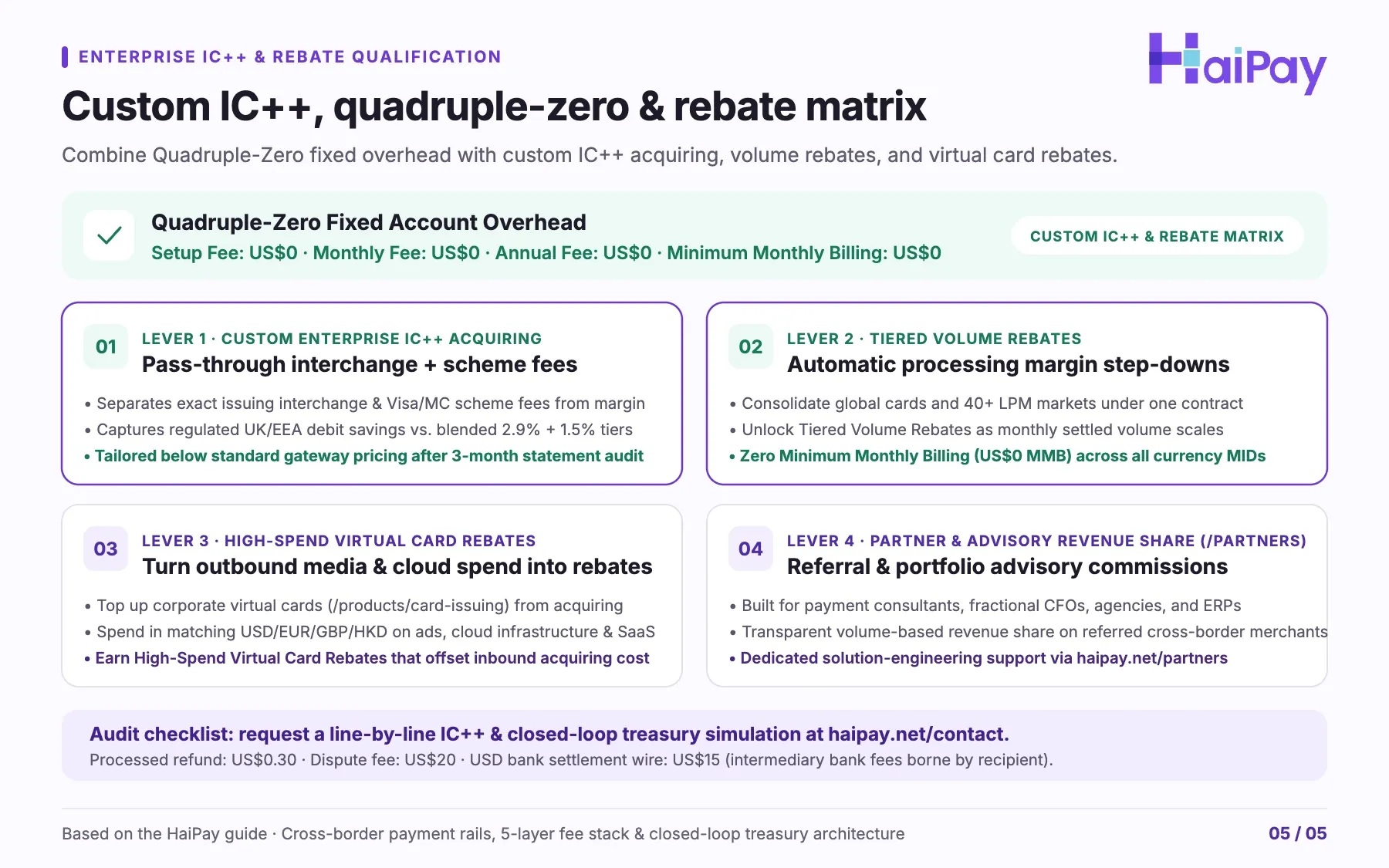
Some enterprise acquirers, such as Adyen and Checkout.com, apply contractual minimum monthly invoice or Minimum Billing Fee (MMB) thresholds. Our merchant accounts operate with zero fixed account overhead: US$0 setup fee, US$0 monthly fee, US$0 annual fee, and US$0 minimum monthly billing.
Deploy local payment methods (from 1.5%, or 1.2% for Indonesia QRIS) in bank-transfer and wallet-first markets like the Netherlands, Poland, Brazil, and Indonesia. Because buyer-initiated push transfers eliminate chargeback risk and +1.5% cross-border card assessments, they also suit high-ticket orders. Use 3DS2-authenticated cards (from 2.5% + US$0.30 US / 4.0% + US$0.30 non-US) for card-first markets and recurring subscriptions.

Related HaiPay surfaces
Explore the payment stack
Solution
Cross-Border Payment Solutions for Global Digital Businesses
Explore unified cross-border card acquiring, 40+ local payment method markets, multi-currency settlement, and global payout orchestration.
Guide
Multi-Currency Merchant Account: Presentment vs. Like-for-Like Settlement
Compare presentment currency vs. like-for-like settlement, audit 1%–4% FX spreads, and model closed-loop treasury math.
Guide
United States Payment Gateway & ACH/Card Acquiring Guide
Compare US card acquiring, ACH bank debits, cross-border card surcharges, and USD like-for-like settlement rules.
Guide
Germany Payment Gateway & SEPA Direct Debit Guide
Evaluate German checkout methods, SEPA Direct Debit R-transaction risk, Girocard co-badging, and EUR settlement.
Guide
France Payment Gateway & Cartes Bancaires (CB) Guide
Review Cartes Bancaires co-badged routing, PSD2 SCA exemptions, SEPA rails, and French merchant acquiring terms.
Guide
Merchant Account Rolling Reserve & Working Capital Guide
Understand 5%–15% rolling reserve mechanics, cash-flow valley math, and HaiPay's 0% standard KYB reserve policy.

Need help mapping your payment stack?
Talk to HaiPay about acquiring, orchestration, local methods, and payout workflows.
Contact us