
Direct Answer
SEPA (Single Euro Payments Area) harmonizes cashless euro bank payments across 41 European countries, including all 27 EU Member States, the UK, Switzerland, and Norway (ECB, May 2025). The European Payments Council governs four core schemes: SEPA Credit Transfer (SCT, settling in 1 business day), SEPA Instant Credit Transfer (SCT Inst, settling within 10 seconds 24/7/365), SEPA Direct Debit Core (SDD Core, carrying an 8-week unconditional refund right and 13-month unauthorized claim window), and SEPA Direct Debit B2B (offering post-settlement finality for corporate payers). Under Regulation (EU) 2024/886, eurozone bank PSPs enforce instant fee parity and free Verification of Payee (VoP) in 2025, with EMIs and non-euro EU PSPs following in 2027.
Accepting euro bank payments across Europe takes more than displaying an IBAN on a checkout page. Merchants must select the right Single Euro Payments Area (SEPA) scheme for each revenue model. That choice determines settlement speed, mandate compliance, refund exposure, and net EUR treasury margin.
The European Central Bank (ECB) confirms that SEPA covers 41 European countries as of 22 May 2025. The European Payments Council (EPC) governs four core retail payment schemes across this zone. Meanwhile, EU Instant Payments Regulation (EU) 2024/886 enforces 10-second transfers, fee parity, and Verification of Payee (VoP).
How SEPA Works for Merchants: 41 Countries, EPC Rulebooks, and the Four Core Schemes
SEPA harmonizes cashless euro payments across 41 European countries under unified technical standards. This scope includes all 27 European Union Member States plus non-EU and non-eurozone jurisdictions. Participating markets include the United Kingdom, Switzerland, Norway, Iceland, Liechtenstein, Monaco, San Marino, Andorra, and Vatican City State.
Every SEPA transfer uses an International Bank Account Number (IBAN) and ISO 20022 XML messaging. Under Regulation (EU) No 260/2012, cross-border euro transfers within SEPA carry the same bank charges as domestic transfers. However, payers in non-euro countries like the UK or Switzerland still face bank currency conversion spreads. Read our cross-border payments and multi-rail settlement guide to compare SEPA clearing against global card and local bank rails.
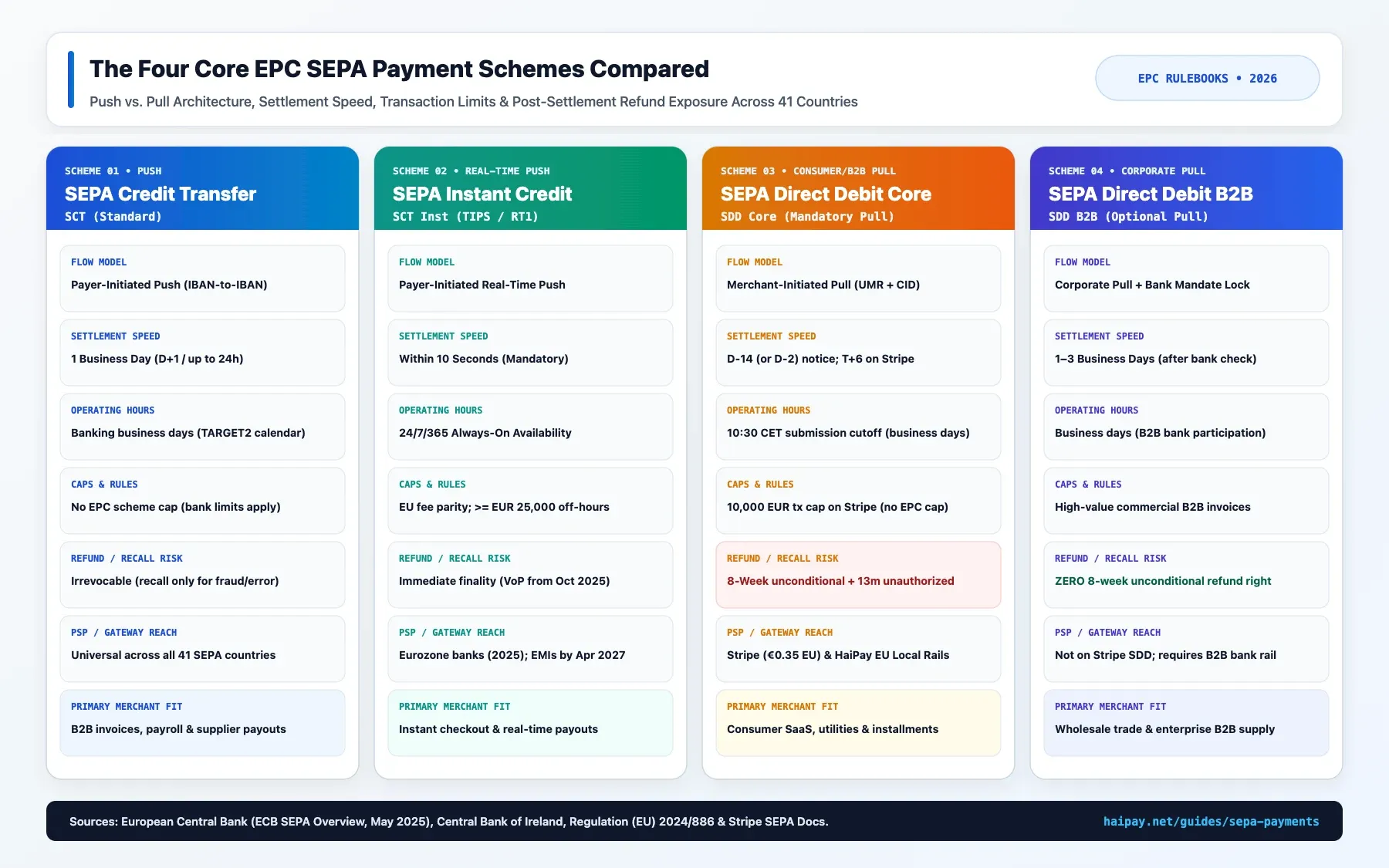
EPC Scheme | Flow Model & Settlement Speed | Limits & Gateway Rules | Post-Settlement Refund Exposure |
|---|---|---|---|
SEPA Credit Transfer (SCT) | Push transfer; settles in 1 business day (D+1, up to 24h). | No EPC scheme cap; bank corporate limits apply. | Irrevocable once settled; recall limited to fraud or error. |
SEPA Instant (SCT Inst) | Real-time push; settles within 10 seconds, 24/7/365. | Mandatory EU fee parity; non-euro off-hours >= EUR 25,000. | Immediate finality; free VoP check from October 2025. |
SEPA Direct Debit Core (SDD Core) | Pull via mandate (UMR + CID); settles T+6 (00:00 UTC) on Stripe. | 10,000 EUR tx cap on Stripe; D-14 default (or D-2) notice. | 8-week unconditional refund + 13-month unauthorized claim. |
SEPA Direct Debit B2B (SDD B2B) | Corporate pull with bank mandate check; 1 to 3 business days. | Commercial mandate limits; not supported on Stripe SDD. | Zero 8-week unconditional refund right for authorized debits. |
Source: European Central Bank SEPA Overview (status: 22 May 2025), European Commission SEPA policy documentation, and Central Bank of Ireland scheme rules.
SEPA Credit Transfer (SCT) vs. SEPA Instant Credit Transfer (SCT Inst)
Standard SEPA Credit Transfers (SCT) clear in batches across pan-European Automated Clearing Houses such as STEP2-T. According to the Central Bank of Ireland, a standard credit transfer can take upwards of 24 hours to complete. Orders submitted after a bank's daily cutoff or on weekends wait until the next TARGET2 business day.
That one-day settlement gap creates risk for instant digital delivery and B2B order fulfillment. If a merchant ships goods against an unconfirmed bank transfer screenshot, the buyer can still cancel a queued transfer. Finance teams must wait for actual ledger settlement before releasing high-value inventory.
- 24/7/365 real-time settlement via TIPS and RT1: Launched in November 2017, SCT Inst settles continuously across the Eurosystem's TARGET Instant Payment Settlement (TIPS) service and EBA Clearing's RT1 system within 10 seconds.
- Non-euro EU off-hours liquidity rule: Under Regulation (EU) 2024/886, PSPs in non-euro EU Member States may apply off-hours transaction limits, but those limits cannot be set lower than EUR 25,000.
- Immediate checkout finality: Once an SCT Inst transfer settles onto the payee account, the credit is irrevocable and eliminates card chargeback exposure.
SEPA Direct Debit Core (SDD Core) vs. B2B (SDD B2B): Mandate Governance and Refund Exposure
SEPA Direct Debit (SDD) is the primary recurring bank pull rail in Europe. European Payments Council data cited by Stripe shows 11.3 billion eurozone direct debits in the first half of 2025. Despite its scale, SDD requires strict mandate governance to prevent unrecoverable revenue reversals. See our Germany payment gateway and SEPA Direct Debit guide for Lastschrift checkout shares and German return risk controls.
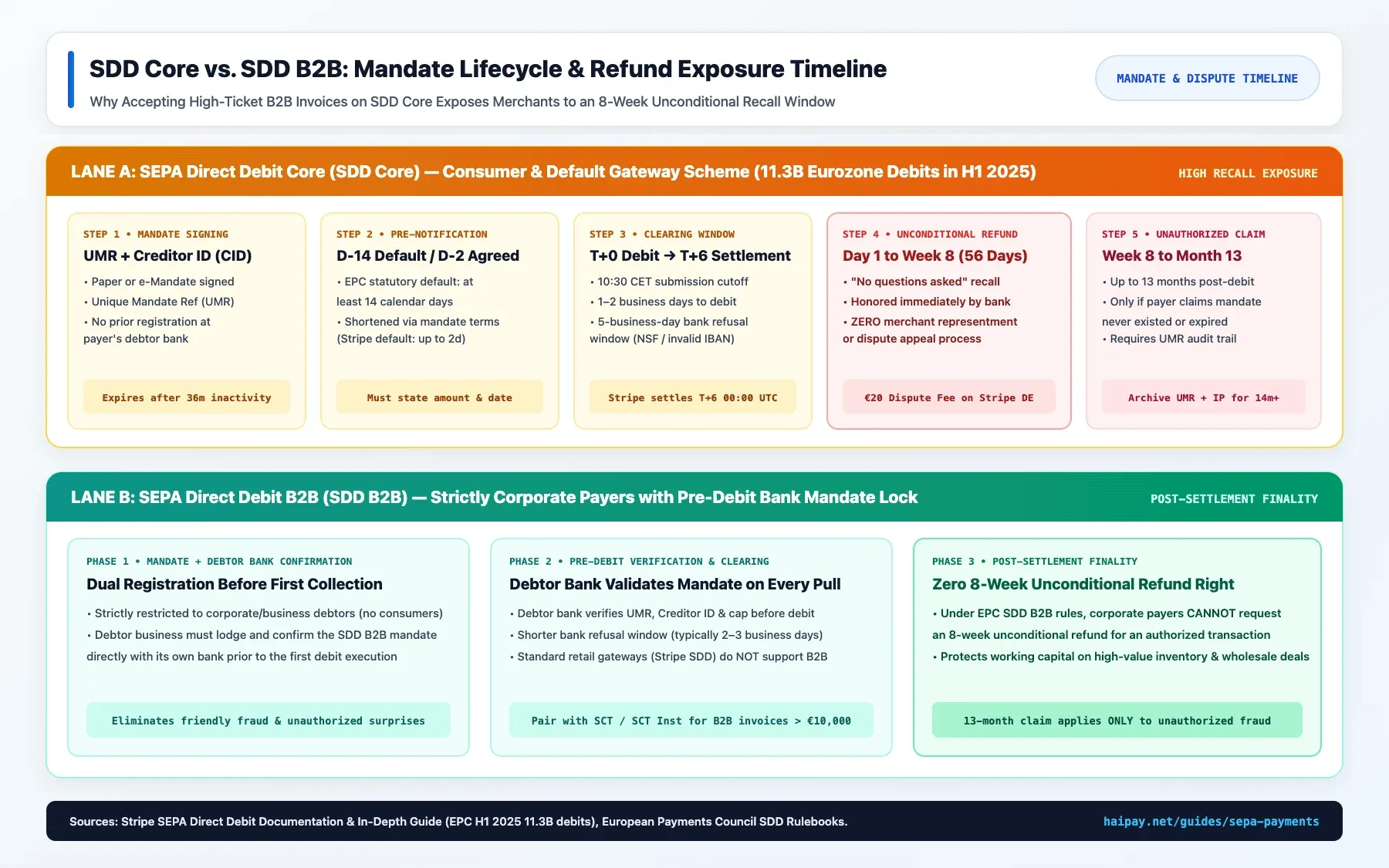
Mandate Lifecycle, Pre-Notification, and T+6 Clearing Rules
Before pulling funds under SDD Core or SDD B2B, the merchant must collect a signed paper or electronic mandate. Every valid mandate contains the creditor's legal name, a Creditor Identifier (CID), and a Unique Mandate Reference (UMR). A SEPA Direct Debit mandate expires automatically after 36 months of non-use.
Under EPC rules, merchants must notify the customer at least 14 calendar days before debiting the account. Merchants and payers can agree to a shorter notice window in the mandate terms (up to 2 calendar days by default on Stripe). On Stripe, SDD Core follows a 10:30 CET business-day cutoff and settles at T+6 at 00:00 UTC after the 5-business-day bank refusal window.
The 8-Week Unconditional Refund Trap vs. SDD B2B Finality
The largest risk in European recurring billing is confusing SDD Core with SDD B2B. Under SDD Core rules, a customer can request a refund for any debit within 8 weeks of the charge. The customer's bank honors this no-questions-asked refund immediately with zero merchant representment or appeal process. After 8 weeks, payers can still dispute unauthorized debits for up to 13 months.
SDD B2B solves this risk for corporate transactions. Available strictly to businesses, SDD B2B requires the debtor company to confirm the mandate directly with its bank before the first debit. Once an authorized SDD B2B debit settles, the corporate payer has zero 8-week unconditional refund right.
Governance Dimension | SEPA Direct Debit Core (SDD Core) | SEPA Direct Debit B2B (SDD B2B) |
|---|---|---|
Eligible Payers & Bank Reach | Mandatory for SEPA SDD banks; open to consumers and businesses. | Optional for banks; strictly restricted to corporate payers. |
Debtor Bank Mandate Lock | Not required; merchant or PSP stores signed UMR and CID. | Mandatory; debtor business confirms mandate with its bank before first pull. |
Authorized Refund Right | 8-week unconditional no-questions-asked refund with zero appeal. | Zero unconditional refund right once an authorized B2B debit settles. |
Unauthorized Claim & Gateway Cap | 13 months for unauthorized pulls; supported on Stripe (10,000 EUR cap). | 13 months for unauthorized fraud; not supported on standard Stripe SDD. |
Source: Stripe SEPA Direct Debit documentation (docs.stripe.com/payments/sepa-debit) and Stripe SEPA Guide (EPC H1 2025 11.3B debits).
EU Instant Payments Regulation (EU) 2024/886 and Verification of Payee (VoP): 2025–2027 Deadlines
Adopted on 13 March 2024 and effective from 8 April 2024, Regulation (EU) 2024/886 makes instant euro transfers mandatory. The regulation amends the SEPA Regulation (EU) No 260/2012 across four operational pillars:
- Article 5a — Mandatory 10-Second Execution (24/7/365): PSPs offering standard euro credit transfers must process incoming and outgoing instant euro transfers within 10 seconds at all hours.
- Article 5b — Equality of Charges (Fee Parity): Charges applied by a PSP on payers and payees for instant euro credit transfers cannot exceed charges for standard euro credit transfers.
- Article 5c — Free Verification of Payee (VoP): PSPs must verify the beneficiary's account name against the target IBAN before payer authorization, free of charge, for SCT and SCT Inst.
- Article 5d — Simplified Daily Sanctions Screening: Per-transaction instant sanctions screening is replaced by at least daily customer database checks against EU sanctions lists.
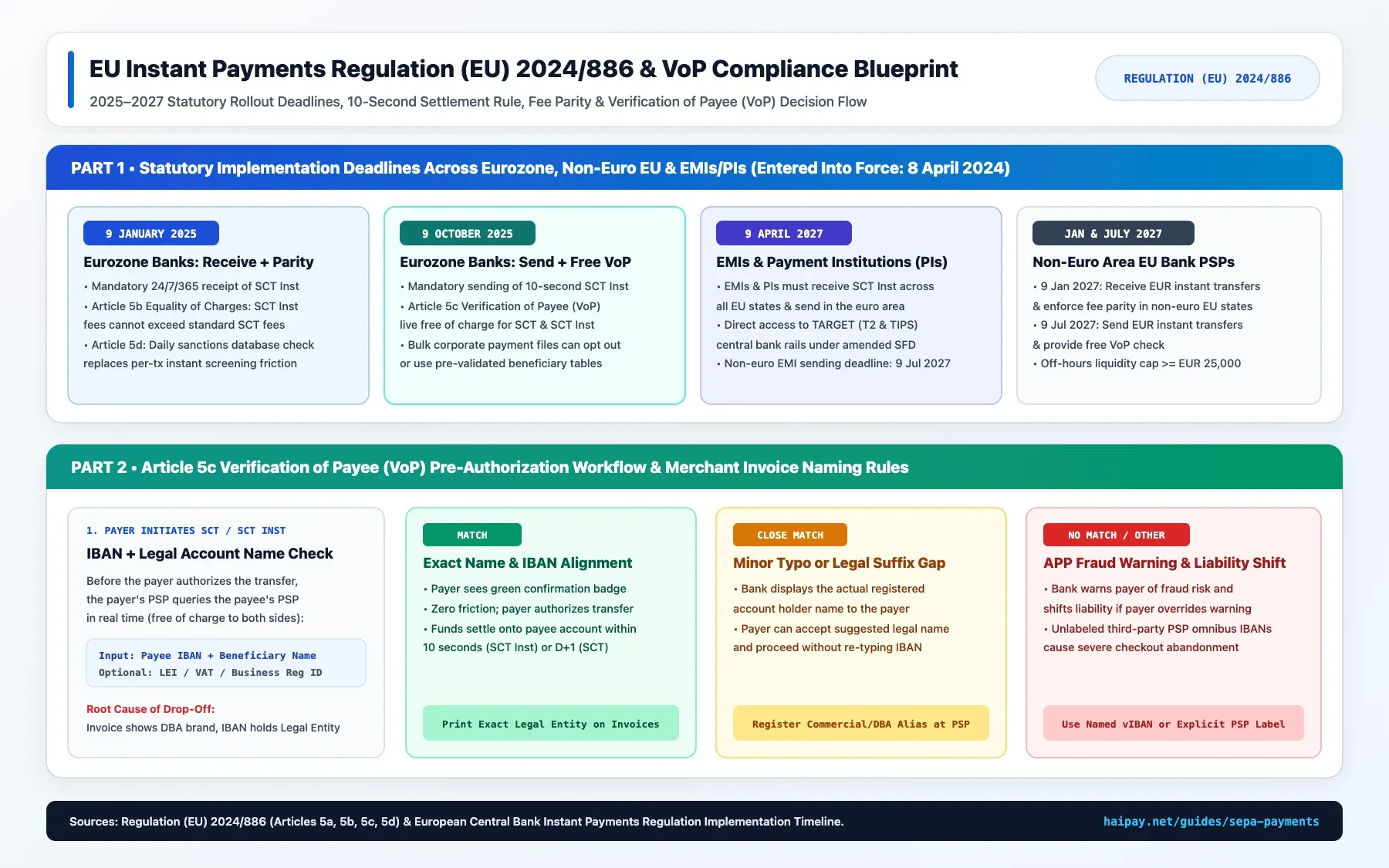
Statutory Deadline | Regulated Scope | Mandatory Obligations under Regulation (EU) 2024/886 |
|---|---|---|
9 January 2025 | Euro area bank PSPs | 24/7/365 receipt of SCT Inst (Art. 5a), fee parity with SCT (Art. 5b), and daily sanctions checks (Art. 5d). |
9 October 2025 | Euro area bank PSPs | Sending of 10-second SCT Inst transfers and free Verification of Payee (VoP) pre-checks (Art. 5c). |
9 January 2027 | Non-euro EU bank PSPs | Receipt of instant euro credit transfers and fee parity with standard euro credit transfers. |
9 April 2027 | EMIs & Payment Institutions | Receipt of SCT Inst across all EU states and sending in the euro area, plus TARGET (T2/TIPS) access. |
9 July 2027 | Non-euro EU banks & EMIs/PIs | Sending of instant euro credit transfers in non-euro EU Member States and full VoP rollout. |
Article 5c Verification of Payee directly affects checkout conversion. When a buyer enters an IBAN and beneficiary name, the bank returns match, close match (showing the registered legal name), no match, or other. If an invoice shows a marketing brand name (DBA) while the IBAN belongs to a parent legal entity or unlabeled PSP omnibus account, the bank displays a no-match warning.
To prevent checkout drop-off, merchants must print the exact registered legal account holder name on every invoice or provision dedicated named virtual IBANs (vIBANs). Under Article 5c, corporate users submitting bulk payment files can also opt out of VoP checks.
Source: European Central Bank Instant Payments Regulation timeline and EUR-Lex Regulation (EU) 2024/886 official text.
Cross-Border SEPA Economics: Orchestrating European Local Rails, Cards, and EUR Treasury
For international merchants selling into Europe, total cost of ownership depends on checkout channel mix and settlement currency routing. On Stripe Germany and Stripe Ireland domestic pricing pages, SEPA Direct Debit costs €0.35 per transaction and standard EEA cards cost 1.5% + €0.25 (2.8% + €0.25 for premium EEA cards). UK cards cost 2.5% + €0.25, while international cards cost 3.15% to 3.25% + €0.25 plus 2% for currency conversion.
When a US entity processes SEPA Direct Debit cross-border on Stripe, the published fee is 0.8% + $0.30 (capped at $6.00) plus international and FX surcharges. Stripe also charges a $10 failed or disputed debit fee in the US and €20.00 per dispute received in Germany and Ireland. Relying solely on raw IBAN transfers also misses European buyers who prefer national bank-redirect wallets. Compare French co-badged card routing in our France Cartes Bancaires (CB) and SEPA payment gateway guide.
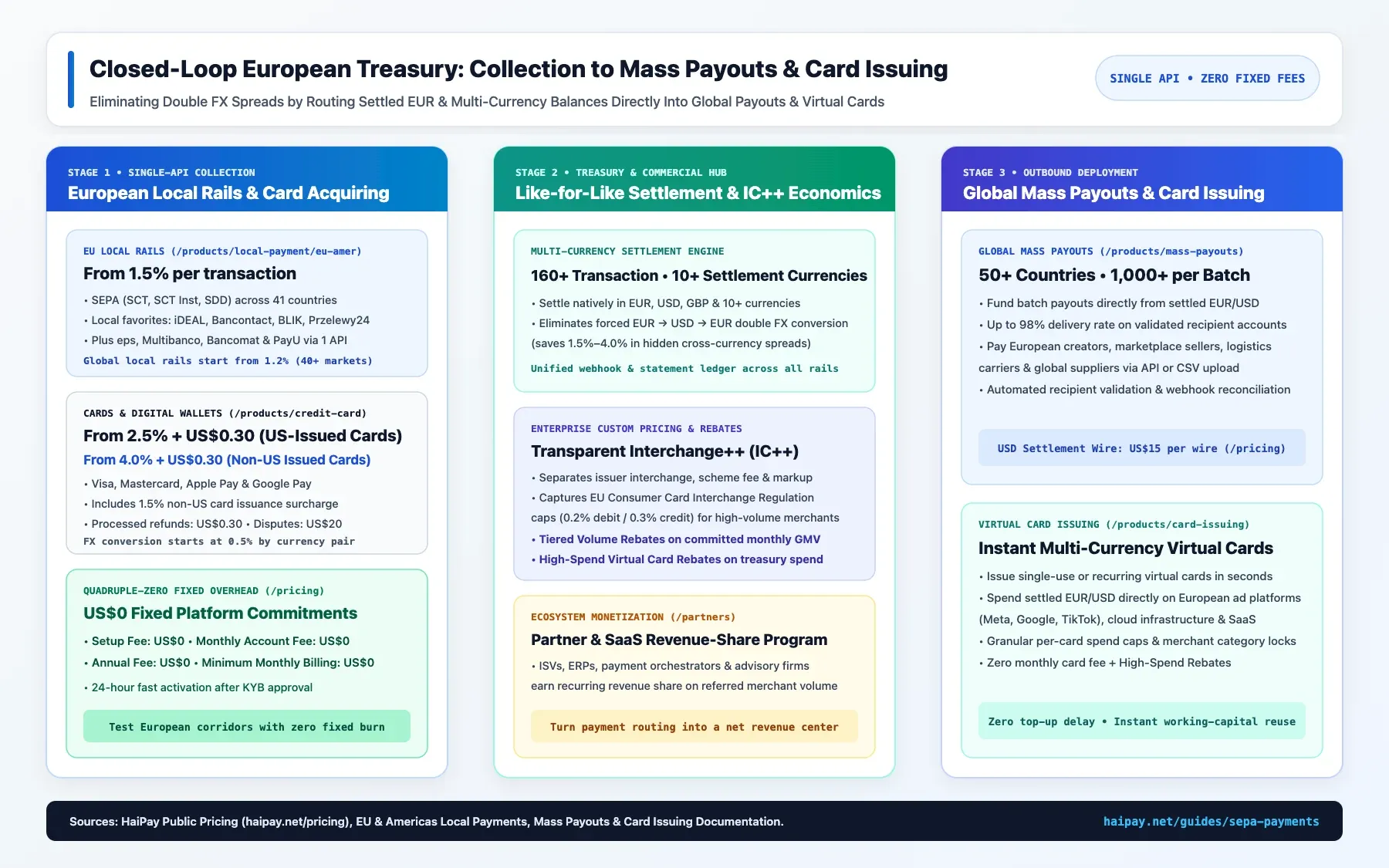
To execute SEPA collections at scale, HaiPay's Europe and Americas local payment infrastructure combines SEPA bank transfers with national European payment methods and online credit and debit card acquiring. Merchants manage mandate lifecycles, webhook reconciliation, and euro settlement through one unified integration:
- SEPA Schemes Paired with National European Rails (From 1.5%). Accept SEPA Credit Transfer, SEPA Instant, and SDD workflows alongside iDEAL, Bancontact, BLIK, Przelewy24, eps, and Multibanco starting from 1.5% per transaction. Global regional local methods start from 1.2% across 40+ markets.
- Automated Webhook Reconciliation via endToEndId and mandateId. Map asynchronous SEPA Credit Transfer, SCT Inst, and SDD settlement webhooks directly to ERP invoice ledgers using ISO 20022 endToEndId and signed UMR mandateId tags. Automated status matching prevents unallocated euro cash and duplicate debit retries.
- 3DS2 Card Fallback & Transparent Acquiring Baselines. Pair bank-transfer checkout with Visa, Mastercard, Apple Pay, and Google Pay starting from 2.5% + US$0.30 for US-issued cards via a US entity. Non-US cards start from 4.0% + US$0.30, with FX from 0.5% and US$0 monthly minimums.
- Predictable Settlement Windows (T+1 Local / T+5 Cross-Border). Supported local payment corridors settle as fast as T+1, while standard cross-border card and local-method transactions settle on a T+5 cycle. Zero setup, monthly, or annual account fees apply when enabling additional European checkout rails.
Eliminating double currency conversion after settlement is equally important. Many cross-border gateways force EUR sales into USD at settlement. Converting USD back into EUR later to pay European suppliers or ad platforms erodes 1.5% to 4.0% in round-trip FX spreads. Explore how a multi-currency merchant account for EUR, GBP, and USD treasury keeps European collections in native euro balances.
Through HaiPay, merchants accept 160+ transaction currencies and settle natively in 10+ currencies, including EUR, USD, and GBP. Treasury teams route settled euro balances directly into Global Mass Payouts across 50+ countries to pay European suppliers and VAT obligations without forced USD conversion. Batch payout pipelines support 1,000+ recipients per file with up to 98% delivery rates on validated IBAN accounts.
Commercial Dimension | Stripe Europe Domestic (DE / IE) | Stripe US Cross-Border SEPA | HaiPay Unified Single-API Schedule |
|---|---|---|---|
SEPA & EU Local Rails | €0.35 per SEPA Direct Debit (SDD Core only; 10,000 EUR cap). | 0.8% + $0.30 (capped at $6.00) + international & FX fees. | From 1.5% across SEPA, iDEAL, Bancontact, BLIK, Przelewy24, eps, and Multibanco on the published pricing schedule (global local rails from 1.2%). |
Cards & Digital Wallets | 1.5% + €0.25 (EEA), 2.5% + €0.25 (UK), 3.15%–3.25% + €0.25 (intl) + 2% FX. | Standard US card rate + 1.5% international card fee + 1% FX. | From 2.5% + US$0.30 (US cards via US entity); From 4.0% + US$0.30 (non-US cards, incl. 1.5% surcharge); FX from 0.5%. |
Fixed Account Overhead | €0 standard pay-as-you-go account fees. | $0 standard pay-as-you-go account fees. | Quadruple-Zero: US$0 Setup, US$0 Monthly, US$0 Annual, and US$0 Minimum Monthly Billing. |
Enterprise & Treasury Loop | Custom IC+ for enterprise volume; local bank payouts. | Forced USD conversion unless multi-currency account held. | Custom IC++ + Volume & Virtual Card Rebates; 10+ settlement currencies (EUR/USD/GBP) to 50+ country payouts. |
Source: Stripe Germany and Ireland pricing (stripe.com/en-de/pricing, stripe.com/ie/pricing) and HaiPay Pricing (haipay.net/pricing), verified November 2026.
Downloadable SEPA Scheme Selection, Mandate & Reconciliation Checklist (CSV)
Preventing mandate defects, VoP mismatches, and settlement discrepancies requires a standardized ledger workflow. Compare local vs. cross-border acquiring routes, review our cross-border acquiring fees breakdown and payment gateway reconciliation guide, and download the SEPA Scheme Selection, Mandate & Reconciliation Checklist (CSV).
Need to align your checkout with EU Verification of Payee (VoP) rules and settle SEPA inflows into a native EUR treasury? Review our published European local payment and card pricing or contact HaiPay's payment architects to configure your SEPA and multi-currency settlement workflow.
Sources
- European Central Bank (ECB) — Single Euro Payments Area (SEPA) Overview (22 May 2025) — Accessed 8 November 2026.
- European Central Bank (ECB) — Instant Payments Regulation Timeline — Accessed 8 November 2026.
- EUR-Lex — Regulation (EU) 2024/886 on Instant Credit Transfers in Euro — Published 19 March 2024; accessed 8 November 2026.
- EUR-Lex — Regulation (EU) No 260/2012 on SEPA Credit Transfers and Direct Debits — Accessed 8 November 2026.
- European Commission — Single Euro Payments Area (SEPA) Policy — Accessed 8 November 2026.
- Central Bank of Ireland — Single Euro Payments Overview — Accessed 8 November 2026.
- Stripe Documentation — SEPA Direct Debit Payments — Accessed 8 November 2026.
- Stripe Resources — SEPA Direct Debit In-Depth Guide (EPC H1 2025) — Accessed 8 November 2026.
- Stripe Germany & Ireland Pricing Schedule — Accessed 8 November 2026.
- HaiPay Pricing, EU & Americas Local Payments & Mass Payouts — Accessed 8 November 2026.
FAQ
The European Payments Council (EPC) administers four primary retail SEPA schemes. SEPA Credit Transfer (SCT) handles standard one-business-day (D+1) push transfers. SEPA Instant Credit Transfer (SCT Inst) processes 24/7/365 real-time euro push transfers within 10 seconds. SEPA Direct Debit Core (SDD Core) supports recurring consumer and business pull collections, while SEPA Direct Debit B2B (SDD B2B) covers corporate pull payments with post-settlement finality.
According to the European Central Bank (status as of 22 May 2025), SEPA comprises 41 European countries. This includes all 27 European Union Member States plus non-EU and non-euro area countries including the United Kingdom, Switzerland, Norway, Iceland, Liechtenstein, Monaco, San Marino, Andorra, Vatican City State, and recently acceded European jurisdictions.
Under SDD Core rules, a payer can demand a no-questions-asked unconditional refund within 8 weeks of the debit, which the payer's bank honors immediately without any merchant appeal process. Both SDD Core and SDD B2B also allow claims up to 13 months for unauthorized debits. Under SDD B2B, the corporate payer confirms the mandate directly with its bank before the first debit and has zero unconditional refund right once an authorized payment settles.
Under Article 5c of Regulation (EU) 2024/886, payment service providers must verify the beneficiary's account name against the target IBAN before the payer authorizes a standard SCT or instant SCT Inst transfer, free of charge. The service returns match, close match (showing the registered legal name), no match, or other. Eurozone bank PSPs must provide VoP by 9 October 2025, while EMIs, payment institutions, and non-euro EU PSPs follow in 2027.
SEPA Instant Credit Transfer (SCT Inst) is a push rail that settles euro funds onto the payee's account within 10 seconds, 24/7/365. By contrast, SEPA Direct Debit (SDD Core) is a pull rail requiring pre-notification (14 calendar days by default, or up to 2 calendar days when agreed in the mandate on Stripe). On Stripe, SDD Core settles at T+6 at 00:00 UTC due to the 1-to-2-business-day debit cycle and 5-business-day bank refusal window.
Yes. Through HaiPay's cross-border payment infrastructure, merchants incorporated in the United States, the United Kingdom, Hong Kong, Singapore, or the European Union can accept SEPA payments alongside European local methods (iDEAL, Bancontact, BLIK, Przelewy24, eps, and Multibanco) starting from 1.5% per transaction with US$0 setup, monthly, annual, and minimum billing fees. Merchants can settle natively in EUR, USD, GBP, and 10+ settlement currencies.
Double FX conversion happens when a gateway forces EUR checkout proceeds into USD at settlement and the merchant later converts USD back into EUR to pay European suppliers, losing 1.5% to 4.0% in currency spreads. By settling SEPA and local European payments natively in EUR with HaiPay, merchants can route settled balances directly into Global Mass Payouts across 50+ countries to pay European suppliers without forced currency conversion.

Related HaiPay surfaces
Explore the payment stack
Product
Europe & Americas Local Payment
Accept SEPA, iDEAL, Bancontact, BLIK, Przelewy24, eps, and Multibanco across Europe through one unified API integration.
Product
Credit & Debit Card Acquiring
Process Visa, Mastercard, Apple Pay, and Google Pay alongside local European bank rails with transparent IC++ pricing options.
Product
Global Mass Payouts
Route settled EUR and USD balances directly to supplier, creator, and partner payouts across 50+ countries without double FX conversion.
Guide
Local Acquiring vs Cross-Border Acquiring
Compare how local and cross-border acquiring routes impact European authorization rates, interchange fees, and settlement speed.
Guide
Payment Gateway Germany Guide
Post-Giropay payment mix, SEPA Direct Debit return risk controls, and EUR settlement in Germany.
Guide
Payment Gateway France Guide
Cartes Bancaires (CB) co-badged routing, digital wallets, SEPA rails, and Banque de France benchmarks.

Need help mapping your payment stack?
Talk to HaiPay about acquiring, orchestration, local methods, and payout workflows.
Contact us