
Direct Answer
A merchant account rolling reserve withholds 5% to 15% of each settlement for 30 to 180 days as non-interest-bearing dispute collateral. On US$100,000 in monthly card sales, a 10% 180-day rolling reserve locks US$60,000 in steady-state working capital.
If Month 6 volume jumps to US$300,000, cumulative locked cash reaches US$80,000 before Day 181 releases begin. Merchants can protect liquidity by negotiating a dollar-capped reserve, shifting checkout mix to local push payment methods, or passing pre-launch KYB underwriting for a 0% standard rolling reserve.
Few events disrupt a scaling business faster than an unexpected reserve notice. You double monthly checkout volume during a campaign and suddenly receive an automated hold.
That notice typically withholds 10% to 25% of settlements for 90 to 180 days. A merchant account rolling reserve is not a permanent processing fee. It is non-interest-bearing collateral held by a processor or acquiring bank to cover refunds, chargebacks, and network fines.
For a Chief Financial Officer (CFO), a 180-day freeze acts like a heavy tax on growth. Below, we compare rolling, fixed-date, capped, and upfront reserves, model 6-month cashflow math, and review 2025–2026 Visa VAMP and Mastercard ECM rules. We also show how qualified compliant merchants secure a 0% standard rolling reserve via pre-launch underwriting.
How a Merchant Account Rolling Reserve Works (and What Varies by Processor)
In card acquiring, authorization takes milliseconds and settlement occurs within days. However, Visa and Mastercard give cardholders 45 to 120 days—and up to 540 days for future-delivery orders—to file a dispute.
If a merchant stops shipping orders after withdrawing settled funds, the acquiring bank or payment facilitator (PayFac) remains liable to reimburse the issuer. To cover that post-settlement exposure, processors hold back a share of daily settlements.
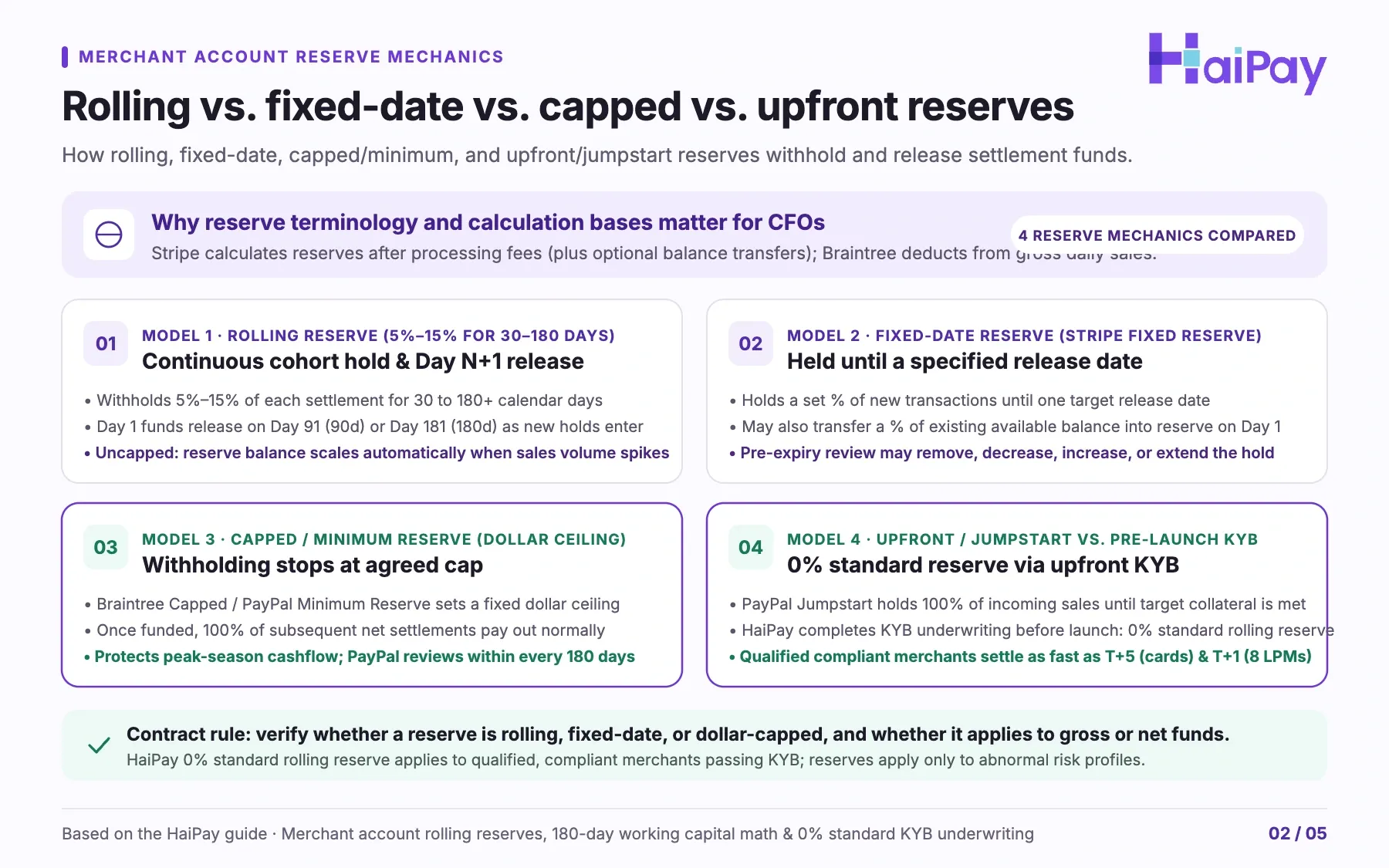
Under a rolling reserve, the processor withholds 5% to 15% of each sale for 90 or 180 calendar days. Day 1 holds release on Day 91 (for 90-day holds) or Day 181 (for 180-day holds) as new daily holds continue.
Three Contract Mechanics Most Merchants Overlook
When we audited five AI search engines against official processor docs, three contract rules were frequently misstated:
- 1. Gross Sales vs. Net-of-Fee Base. Braintree's reserve guide withholds 1% to 20% (default 5%) of gross daily sales for 30, 60, 90, or 120 calendar days. Conversely, Stripe's reserve examples calculate reserves on the net remainder after fees. On a US$100 sale with a US$3.20 fee (2.9% + US$0.30), a 25% Stripe reserve holds US$24.20 from the US$96.80 remainder.
- 2. Fixed-Date vs. Capped (Minimum) Reserve Labels. On Stripe, a fixed reserve holds a percentage of each new sale until one specified release date, rather than setting a dollar cap. Stripe may also transfer part of your available balance into reserves on Day 1. On Braintree and PayPal, a dollar ceiling is called a capped reserve or minimum reserve, where withholding stops once the cap is funded.
- 3. Refunds and Disputes Draw From Reserved Funds. Stripe's Reserves FAQ confirms that when a reserved sale is refunded or disputed, its corresponding reserve releases immediately to cover that liability.
Reserve Structure | Withholding Base & Typical Range | Release Schedule & Review Rule | Working-Capital Impact During Growth | Documented Provider Examples |
|---|---|---|---|---|
Uncapped Rolling Reserve | 5%–15% of each transaction (Braintree: 1%–20% of gross daily sales, default 5%; Stripe: % of net remainder after processing fees) | Held 30, 60, 90, 120, or 180+ calendar days; Day 1 cohort releases on Day 91 (90d) or Day 181 (180d) as new holds enter | No dollar ceiling; withheld balance scales up automatically when monthly sales accelerate | |
Fixed-Date Reserve (Stripe Fixed Reserve) | Set % of each new transaction (after processing fees) + optional transfer of a % of existing available balance on Day 1 | All withheld cohorts accumulate until one specified release date; pre-expiry credit review a few days prior | Locks all withheld cash until the target date; pre-expiry review may remove, decrease, increase, or extend the hold | |
Capped Reserve / Minimum Reserve | Set % of daily settlements (or one-time transfer) until a predetermined dollar ceiling (e.g., US$30,000) is reached | Withholding stops once the cap is funded (resumes only if balance drops below cap); PayPal reviews within every 180 days | Predictable maximum cash lock-up; 100% of net settlements above the cap pay out on schedule | PayPal Account Reserves (Minimum); Braintree Reserves (Capped) |
Upfront Reserve / Jumpstart Reserve | 100% of incoming payouts withheld (or upfront cash deposit / letter of credit) until target collateral balance is met | Normal payouts resume only after the full upfront target is funded; reviewed periodically (within every 180 days on PayPal) | Severe day-one liquidity freeze; blocks early operating cash flow until the full target is funded | PayPal Account Reserves (Jumpstart); Stripe Rolling Reserves 101 |
Pre-Launch KYB Dedicated Acquiring (Compliant Profile) | 0% standard rolling reserve for qualified, compliant merchants passing pre-launch KYB and maintaining healthy dispute ratios | Fastest T+5 cross-border card settlement; fastest T+1 settlement across 8 local payment markets; reserves apply only to abnormal risk profiles | US$0 rolling reserve drag; 100% of net settled funds available for payouts, ad spend, or supplier wires | HaiPay Pricing & Credit Card Acquiring (subject to KYB & ongoing risk review) |
Source: Stripe Rolling Reserves 101 (2026); Stripe Reserves FAQ (2026); PayPal Account Reserves (2026); Braintree Reserves (2026); and HaiPay terms (November 2026).
The 180-Day Working Capital Trap: US$100,000 Steady-State vs. Month 6 Hyper-Growth Math
Because a rolling reserve releases old batches after the hold window expires, founders often assume their cash crunch ends after six months. Treasury math proves otherwise.
Steady-State Reserve Lock-Up Formula. Cumulative Locked Working Capital ≈ Reserve % × Daily Eligible Volume × Hold Period (Days). Under a 10% 180-day rolling reserve, steady-state frozen cash equals 60% of one month's revenue.
Suppose a business processes US$100,000 per 30-day month under a 10% 180-day rolling reserve (modeled before fees). From Month 1 through Month 6, the processor holds US$10,000 per month, locking US$60,000 by Day 180.
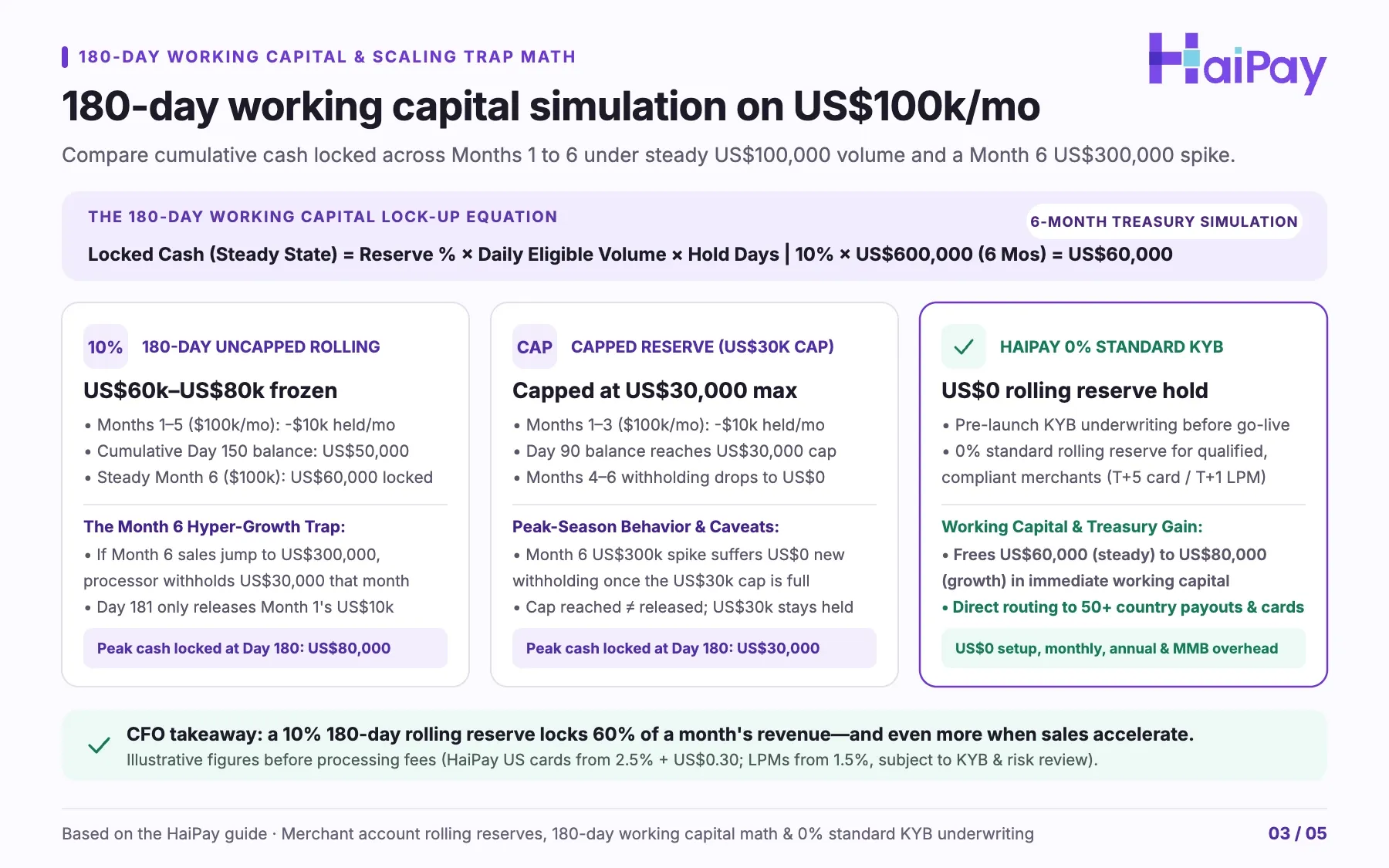
On Day 181 (Month 7), the US$10,000 held in Month 1 begins releasing while the processor holds US$10,000 from Month 7 sales. Monthly cash flow reaches equilibrium in Month 7, but the initial US$60,000 capital hole stays frozen until the reserve ends.
Why Rapid Growth Turns a Rolling Reserve into a Liquidity Crisis
An uncapped rolling reserve tightens further when sales accelerate. New withholdings scale with today's higher volume, while daily releases reflect smaller cohorts from 180 days earlier.
- Scenario A — Steady US$100,000 Volume (Months 1–6). Withholding US$10,000 per month locks US$60,000 by Day 180.
- Scenario B — Peak-Season Jump to US$300,000 in Month 6. After five months at US$100,000 (US$50,000 held), Month 6 volume jumps to US$300,000. An uncapped 10% reserve holds US$30,000 in Month 6 while releasing US$0 before Day 181, locking US$80,000 when you must pay suppliers.
- Scenario C — Capped Reserve (10% up to a US$30,000 Ceiling). Withholding reaches US$30,000 at Day 90 and drops to US$0 in Months 4 to 6. Reaching the cap does not release the US$30,000; it caps maximum exposure.
- Scenario D — HaiPay Pre-Launch KYB Profile (0% Standard Rolling Reserve). Qualified, compliant merchants passing pre-launch KYB and maintaining healthy dispute ratios receive a 0% standard rolling reserve. Cross-border cards settle as fast as T+5 (and T+1 across 8 local markets), keeping all US$60,000 to US$80,000 in working capital.
Timeline (30-Day Periods) | Scenario Volume (Steady vs. Month 6 Peak) | 10% / 180-Day Uncapped Rolling Reserve (Cumulative Locked) | 10% Capped Reserve with US$30,000 Ceiling (Cumulative Locked) | HaiPay 0% Standard Compliant KYB Profile (T+5 / T+1) |
|---|---|---|---|---|
Month 1 (Days 1–30) | US$100,000 gross card volume | US$10,000 withheld · US$0 released · US$10,000 locked | US$10,000 withheld · US$0 released · US$10,000 locked | US$0 reserve held · Full net settlement on T+5 (cards) / T+1 (8 LPMs) |
Month 2 (Days 31–60) | US$100,000 gross card volume | US$10,000 withheld · US$0 released · US$20,000 locked | US$10,000 withheld · US$0 released · US$20,000 locked | US$0 reserve held · US$20,000 cumulative liquidity advantage |
Month 3 (Days 61–90) | US$100,000 gross card volume | US$10,000 withheld · US$0 released · US$30,000 locked | US$10,000 withheld · US$30,000 cap reached (collection stops) | US$0 reserve held · US$30,000 cumulative liquidity advantage |
Month 4 (Days 91–120) | US$100,000 gross card volume | US$10,000 withheld · US$0 released · US$40,000 locked | US$0 withheld · US$0 released · US$30,000 locked | US$0 reserve held · US$40,000 advantage vs. rolling reserve |
Month 5 (Days 121–150) | US$100,000 gross card volume | US$10,000 withheld · US$0 released · US$50,000 locked | US$0 withheld · US$0 released · US$30,000 locked | US$0 reserve held · US$50,000 advantage vs. rolling reserve |
Month 6A · Steady State (Days 151–180) | US$100,000 steady card volume | US$10,000 withheld · US$0 released · US$60,000 locked | US$0 withheld · US$0 released · US$30,000 locked | US$0 reserve held · US$60,000 working capital freed |
Month 6B · Peak Scaling Trap (Days 151–180) | US$300,000 peak season volume | US$30,000 withheld · US$0 released until Day 181 · US$80,000 locked | US$0 withheld (cap already met) · US$30,000 locked | US$0 reserve held · US$80,000 working capital freed |
Month 7+ (Days 181–210, Steady US$100k) | US$100,000 steady card volume | US$10,000 withheld · Month 1 US$10,000 released · US$60,000 stays locked | US$30,000 remains held until periodic review or account closure | US$0 reserve held · US$0 setup, monthly, annual & MMB fees |
Download the editable Rolling Reserve 180-Day Working-Capital Calculator & Release Checklist (CSV) to model your volume, margin, and release timeline.
Why Stripe and PayPal Trigger Sudden Post-Onboarding Reserves (and 2025–2026 VAMP / ECM Thresholds)
Merchants are often surprised when a smooth account is hit with a 15% or 25% reserve overnight. The root cause lies in how self-serve payment facilitators sequence underwriting.
Aggregators like Stripe and PayPal optimize for instant signup and rely on automated post-onboarding risk models. When live sales trip a rule, the system places a reserve before an analyst reviews your fulfillment model.
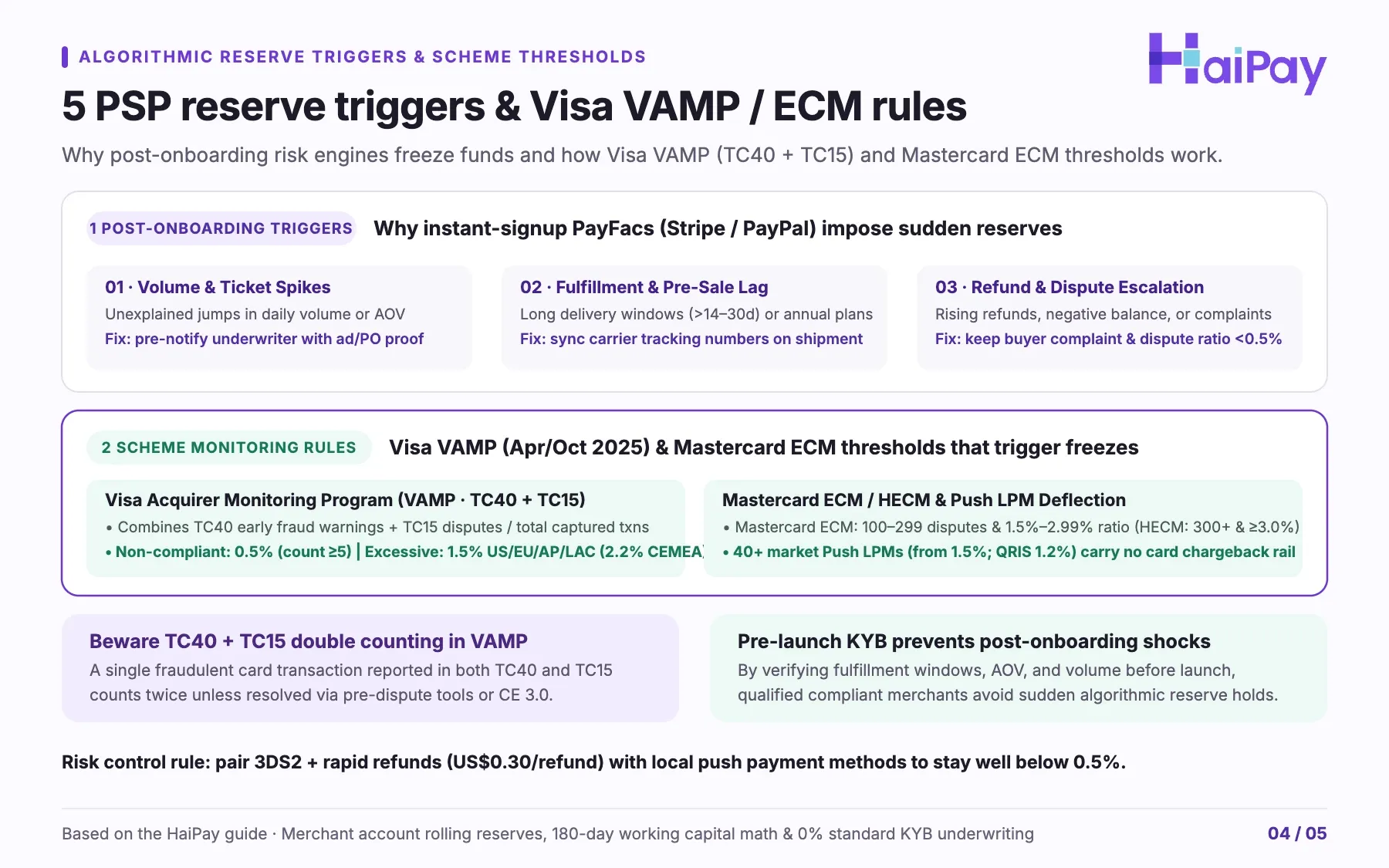
The Five Documented Triggers Behind Sudden Reserve Holds
- Elevated Dispute and Fraud Ratios (Visa VAMP & Mastercard ECM). Effective April 1, 2025 (enforced from October 1, 2025), Visa launched the Visa Acquirer Monitoring Program (VAMP). Per Stripe's Dispute Monitoring guide and our chargeback process guide, VAMP combines early fraud warnings (TC40) and disputes (TC15) divided by captured Visa count. Unexempted fraud in both TC40 and TC15 counts twice. Stripe lists a Non-compliant VAMP threshold of 0.5% (count ≥5). The Excessive threshold is 1.5% in the US, EU, UK, CA, AP, and LAC (count ≥1,500), or 2.2% in CEMEA (count ≥150). Mastercard's Excessive Chargeback Merchant (ECM) triggers at 100–299 disputes and a 1.5%–2.99% ratio (fines US$1,000 to US$100,000). Mastercard HECM triggers at 300+ disputes and a 3.0%+ ratio.
- Unexplained Spikes in Volume or Ticket Size. Both Stripe and PayPal flag sudden jumps in volume or average order value (AOV). Without pre-submitted purchase orders, algorithms treat 3x growth as potential fulfillment failure.
- Longer-Than-Average Delivery Windows. Charging buyers weeks or months before shipping goods or delivering memberships creates unfulfilled delivery exposure.
- Rising Refund Rates and Buyer Complaints. Even when proactive refunds prevent chargebacks (see chargeback vs. refund), rising refund velocity signals supply-chain friction. PayPal advises keeping buyer complaints below 1% of sales.
- Permanent Risk Surcharges Alongside Reserve Holds. Separate temporary reserves from permanent risk fees in your merchant account fees. PayPal's US Business Fees list an Additional Risk Factors fee of up to 5.00% per transaction. PayPal also charges US$15.00 standard dispute fees, US$30.00 high-volume dispute fees, and US$20.00 card chargeback fees.
Provider / Card Scheme | Published Reserve / Monitoring Structure | Published Card & LPM Baseline Rates | Dispute / Chargeback & Risk Surcharges | Fixed Overhead & Settlement Cadence |
|---|---|---|---|---|
Stripe (US / UK Standard) | Fixed-date reserve or rolling reserve (typically 30–90+ days) calculated on funds after processing fees; optional Day-1 available balance transfer | US cards: 2.9% + US$0.30 (+1.5% international, +1% FX); UK standard cards: 1.5% + 20p (international 3.15% + 20p, +2% FX) | US$15.00 dispute received / US$15.00 countered (UK: £20.00); customer refunds/disputes pulled from reserved balance | US$0 setup/monthly fee; standard payouts T+2 (US) / T+3 (UK) business days |
PayPal (US Business) | Three reserve types: Rolling reserves (e.g., 10% for 90 days), Minimum reserves (capped floor), and Jumpstart reserves (100% hold until target); reviewed within every 180 days | PayPal Checkout: 3.49% + US$0.49; Standard cards: 2.99% + US$0.49; IC++ cards: Interchange + 0.49% + US$0.39; +1.50% intl; 3.00% or 4.00% FX | Additional Risk Factors fee: up to 5.00% per transaction; Dispute fee: US$15.00 standard / US$30.00 high-volume; Card chargeback: US$20.00 | US$0 monthly on standard checkout; original processing fee not returned on refunds |
Braintree (A PayPal Service) | Rolling reserve (1%–20% of gross daily sales, default 5%, held 30/60/90/120 calendar days), Capped (risk) reserve, or Upfront reserve | Published under PayPal / Braintree commercial schedules by region | If a capped reserve falls below the cap due to deductions, daily collection resumes until the cap is restored | Calendar-day holding queues released to settlement bank after hold window |
Adyen & Checkout.com | Enterprise underwriting with contractual reserve or collateral clauses by risk profile and fulfillment exposure | Adyen global USD display: US$0.13 + Interchange++ 0.60%; Checkout.com: custom flat-rate or Interchange++ | Scheme chargeback fees + network monitoring fines passed through per merchant agreement | US$0 setup/monthly fee, but Adyen applies a minimum invoice and Checkout.com enforces Minimum Billing Fees (MMB) |
Visa VAMP & Mastercard ECM | Visa VAMP (launched Apr 1, 2025; enforced Oct 1, 2025) combines TC40 fraud + TC15 disputes; Mastercard ECM tracks monthly dispute count & ratio | VAMP Non-compliant: 0.5% (count ≥5); VAMP Excessive: 1.5% US/EU/AP/LAC (count ≥1,500) or 2.2% CEMEA (count ≥150); MC ECM: 100–299 disputes & 1.5%–2.99% | Double counting applies if the same fraud transaction appears in both Visa TC40 and TC15 unless exempted via pre-dispute or CE 3.0 | Mastercard ECM fines start at US$1,000 in month 2 up to US$100,000 in month 19+ (HECM ≥3.0% up to US$200,000) |
HaiPay (Pre-Launch KYB Acquiring) | 0% standard rolling reserve for qualified, compliant merchants passing pre-launch KYB and maintaining healthy dispute ratios (reserves apply only to abnormal risk profiles) | US cards from 2.5% + US$0.30 (non-US-issued from 4.0% + US$0.30); 40+ market LPMs from 1.5% (Indonesia QRIS from 1.2%); US card FX from 0.5%; custom IC++ | Flat US$20 per dispute; US$0.30 per processed refund; push LPMs carry no standard card chargeback rail | US$0 setup, US$0 monthly, US$0 annual, US$0 MMB; fastest T+5 card & T+1 LPM (8 markets); US$15 per USD settlement wire |
Source: Stripe Dispute Monitoring (2026); Stripe US Pricing (2026); Stripe UK Pricing (2026); PayPal US Business Fees (2026); Adyen Pricing (2026); Checkout.com MMB (2026); and HaiPay Pricing (2026).
How to Negotiate a Reserve Step-Down or Release: The 6-Step CFO Playbook
Reserve percentages and hold windows are processor underwriting terms—not statutory Visa or Mastercard rules. Follow this six-step escalation workflow:
- Separate Three Formal Requests. Specify whether you want (a) scheduled maturity verification on Day 181+ cohorts, or (b) early release of existing reserves. Alternatively, request (c) a prospective step-down to 5%/90 days or a dollar cap.
- Audit Your Pre-Expiry Review Date. Stripe's Reserves FAQ notes its credit team reviews accounts days before expiry to remove, reduce, increase, or extend holds. PayPal reviews reserves within every 180 days. Submit your packet 14 to 21 days early.
- Prove Zero Unfulfilled Delivery Tail. Export a 90-day order ledger matched with carrier confirmations (DHL, FedEx, UPS, or USPS) showing 98%+ completed delivery.
- Document Sub-0.50% Dispute Ratios. Provide 3 to 6 months of statements showing dispute ratios below the 0.50% Visa VAMP threshold. Highlight 3DS2, AVS/CVV rules, and rapid refund workflows (see chargeback reason codes).
- Demonstrate Operating Bank Liquidity. Attach 3 months of bank statements proving cash balances comfortably exceed monthly refund and dispute volume.
- Propose a Step-Down or Parallel Pre-Underwritten MID. If full removal is declined, propose a US$30,000 cap or 5% for 90 days while onboarding a pre-underwritten account.
Structural Alternative: Pre-Launch KYB for 0% Standard Rolling Reserve, Push LPMs, and Dispute Prevention
The most reliable way to eliminate reserve cash drag is to combine upfront KYB underwriting with low-dispute checkout routing and automated refund rules. HaiPay structures merchant accounts around four reserve-prevention safeguards:
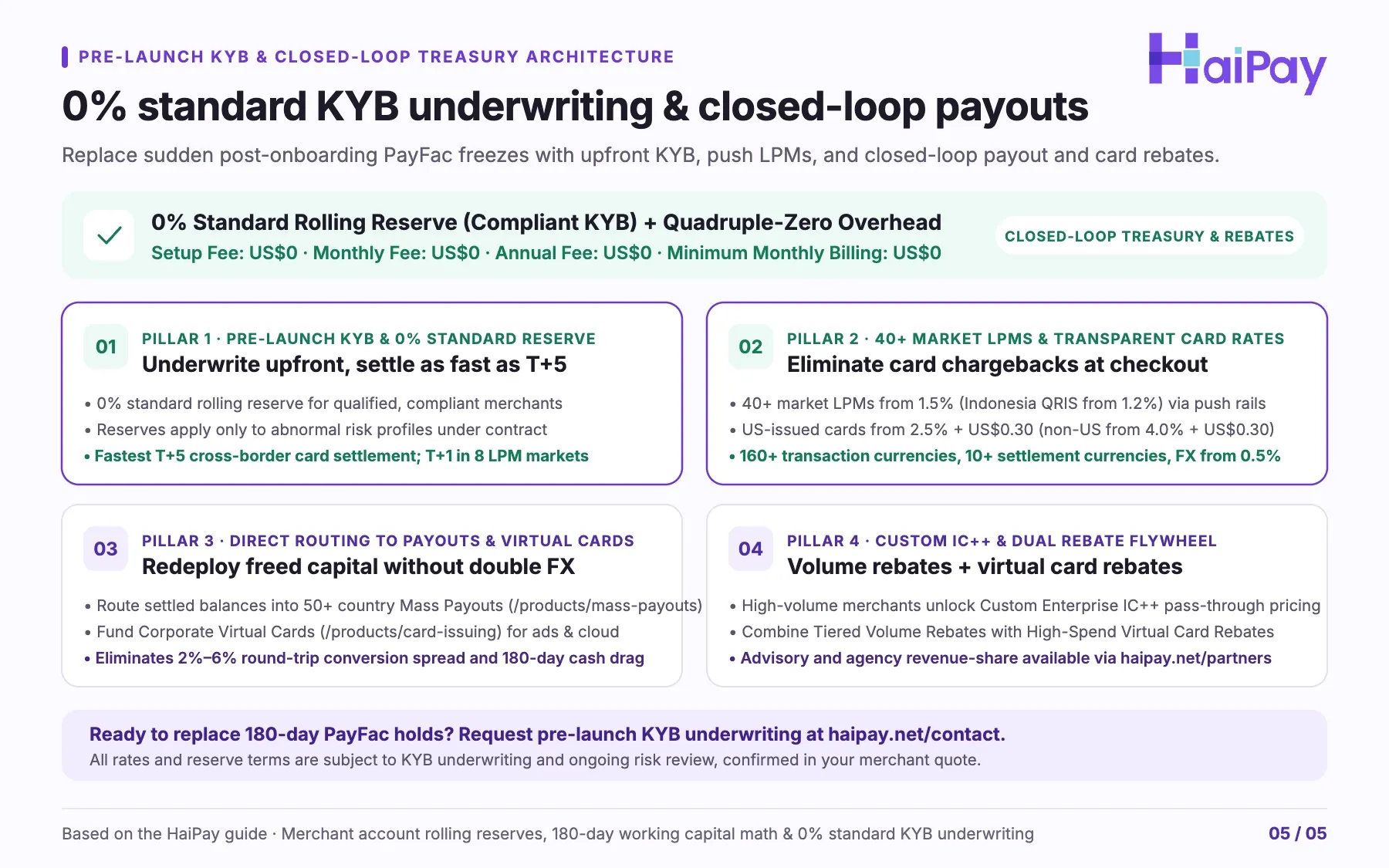
- 1. Pre-Launch KYB Underwriting & 0% Standard Rolling Reserve. HaiPay completes Know Your Business (KYB) and fulfillment underwriting before go-live. Qualified, compliant merchants passing pre-launch KYB and maintaining healthy dispute ratios receive a 0% standard rolling reserve. Contractual reserves apply only to abnormal risk profiles, subject to KYB underwriting and ongoing risk review. Cross-border cards settle as fast as T+5, and 8 local payment markets (ID, VN, TH, PH, IN, BR, MX SPEI, and BD) settle as fast as T+1.
- 2. Root-Cause Chargeback Reduction via 40+ Market Push LPMs. Cards carry 120-day dispute exposure, whereas irrevocable push rails like QRIS, PIX, PromptPay, and SEPA Credit Transfer carry no standard card chargeback rail. Shifting high-ticket checkout traffic to Local Payment Methods across 40+ markets (from 1.5%, with Indonesia QRIS from 1.2%) directly lowers Visa VAMP dispute ratios. Via Credit Card Acquiring, US cards start from 2.5% + US$0.30 (US entity) and non-US-issued cards start from 4.0% + US$0.30.
- 3. Automated Billing Descriptor Clarity, Pre-Dispute Refunds & Tracking Sync. Friendly fraud often starts when buyers do not recognize a generic legal name on their card statement. Configuring dynamic brand billing descriptors alongside carrier shipment tracking synchronization prevents unrecognized-transaction claims before they become TC15 disputes. Issuing an automated pre-dispute refund costs a flat US$0.30 refund fee on our US card line, avoiding US$15 to US$20 chargeback fees and protecting VAMP thresholds.
- 4. Predictable T+5 Settlement Cashflow into Native Currency Accounts. Instead of trapping working capital in rolling reserves or Minimum Monthly Billing (MMB) penalties, accounts carry US$0 setup, monthly, annual, and minimum fees. Merchants collect across 160+ transaction currencies and settle into 10+ native currencies via a unified multi-currency merchant account and cross-border payment solution. Treasury teams then disburse unlocked T+5 card and T+1 local funds directly through Global Mass Payouts across 50+ countries without double FX conversion.
Ready to replace a 180-day rolling reserve with pre-launch KYB underwriting? Download the Rolling Reserve 180-Day Working-Capital Calculator & Release Checklist (CSV) or contact our underwriting team with 3 months of statements for a pre-launch KYB and 0% standard reserve assessment.
Sources & Official References
- Stripe Support — Reserves: Frequently Asked Questions (Triggers, Pre-Expiry Review & Refund/Dispute Coverage, accessed November 2026)
- Stripe Support — Reserves Topic Guide: Fixed Reserves, Rolling Reserves, Net-of-Fee Examples & Balance Transfers (accessed November 2026)
- Stripe Resources — Rolling Reserves 101: What They Are, Capped vs. Up-Front Reserves, and How They Work (accessed November 2026)
- Stripe Documentation — Dispute and Fraud Card Monitoring Programs: Visa Acquirer Monitoring Program (VAMP) & Mastercard ECM/HECM Thresholds (accessed November 2026)
- PayPal Business Resource Center — The Why and What of Account Reserves: Rolling, Minimum, and Jumpstart Reserves & 180-Day Reviews (accessed November 2026)
- PayPal Developer / Braintree Support — Underwriting Reserves: Rolling (1%–20% Gross Daily Sales), Capped, and Upfront Reserves (accessed November 2026)
- Visa Official Support — Dispute Resolution & Chargeback Management Rules for Merchants (accessed November 2026) & Visa Interchange and Regulation Fees (accessed November 2026)
- Published PSP Fee & Minimum Billing Schedules. Stripe US Pricing, Stripe UK Pricing, PayPal US Business Fees, Adyen Global Pricing, Checkout.com Pricing & Checkout.com Minimum Billing Fee, and Airwallex US Pricing (all accessed November 2026).
- HaiPay Official Documentation. HaiPay Pricing & Zero Fixed Overhead Terms, Chargeback Process & VAMP Guide, Merchant Account Fees Guide, Local Payment Methods (40+ Markets), and Global Mass Payouts (50+ Countries) (accessed November 2026).
FAQ
The processor holds 10% of each settlement for 180 calendar days to cover refunds or chargebacks. Day 1 holds release on Day 181 as new daily holds continue, locking US$60,000 on US$100,000 in steady monthly volume.
A rolling reserve holds a percentage of sales and releases each batch after 90 or 180 days. A Stripe fixed reserve holds funds until one release date, whereas a capped (or PayPal minimum) reserve stops withholding once a dollar ceiling is funded.
Self-serve payment facilitators approve accounts rapidly at signup and run automated post-onboarding risk models. Spikes in volume or ticket size, long delivery windows, rising refunds, or approaching Visa VAMP (0.5% / 1.5%) or Mastercard ECM thresholds trigger holds.
No. Reaching Day 91 or Day 181 only releases the oldest daily cohort while new sales continue to be withheld. Removing the reserve term requires passing a credit review (days before expiry on Stripe, or within every 180 days on PayPal).
HaiPay completes Know Your Business (KYB), fulfillment, and dispute underwriting before go-live. Qualified, compliant merchants passing pre-launch KYB and maintaining healthy dispute ratios receive a 0% standard rolling reserve (fastest T+5 card and T+1 LPM settlement in 8 markets).
Rolling reserves cover 120-day card chargeback exposure. Routing buyers to push-based local payment methods across 40+ markets (from 1.5%, with Indonesia QRIS from 1.2%) eliminates standard card chargebacks on those orders.
Unlocked balances across 10+ native settlement currencies can be held in a multi-currency merchant account and routed directly into Global Mass Payouts across 50+ countries without 2%–6% double FX conversion. Combined with US$0 setup, monthly, annual, and minimum monthly billing fees, predictable T+5 card and T+1 local settlements keep working capital liquid for supplier disbursements.

Related HaiPay surfaces
Explore the payment stack
Guide
Chargeback Process: Dispute Lifecycle, Visa VAMP & Representment
Master the end-to-end chargeback lifecycle, Visa VAMP (TC40 + TC15) monitoring thresholds, and evidence packets that keep dispute ratios below 0.5%.
Guide
Merchant Account Fees: Full 10-Category Statement Audit & IC++ Math
Audit all 10 fee categories on a merchant statement, compare flat-rate PSPs against custom IC++, and eliminate Minimum Monthly Billing penalties.
Pricing
HaiPay Pricing, 0% Standard KYB Reserve & Quadruple-Zero Terms
Review published starting rates (US cards from 2.5% + US$0.30, 40+ market LPMs from 1.5%), US$0 fixed overhead, and custom IC++ quotes.
Product
Local Payment Methods Across 40+ Markets (From 1.5%)
Accept push-based local wallets, QR rails, and instant bank transfers (Indonesia QRIS from 1.2%, T+1 in 8 markets) with no card chargeback exposure.
Product
Global Mass Payouts Across 50+ Countries
Route settled multi-currency acquiring balances directly into 50+ country supplier, creator, and contractor payouts without double FX conversion.
Product
Corporate Virtual Card Issuing & High-Spend Rebates
Deploy freed settlement funds directly into multi-currency virtual cards for ad spend, cloud hosting, and SaaS with High-Spend Virtual Card Rebates.

Need help mapping your payment stack?
Talk to HaiPay about acquiring, orchestration, local methods, and payout workflows.
Contact us