


Chargeback Reason Codes: Every Current Visa Dispute Condition
Reviewed by WeiJun Tang










Last updated: September 9th, 2026
Chargeback Code Insights
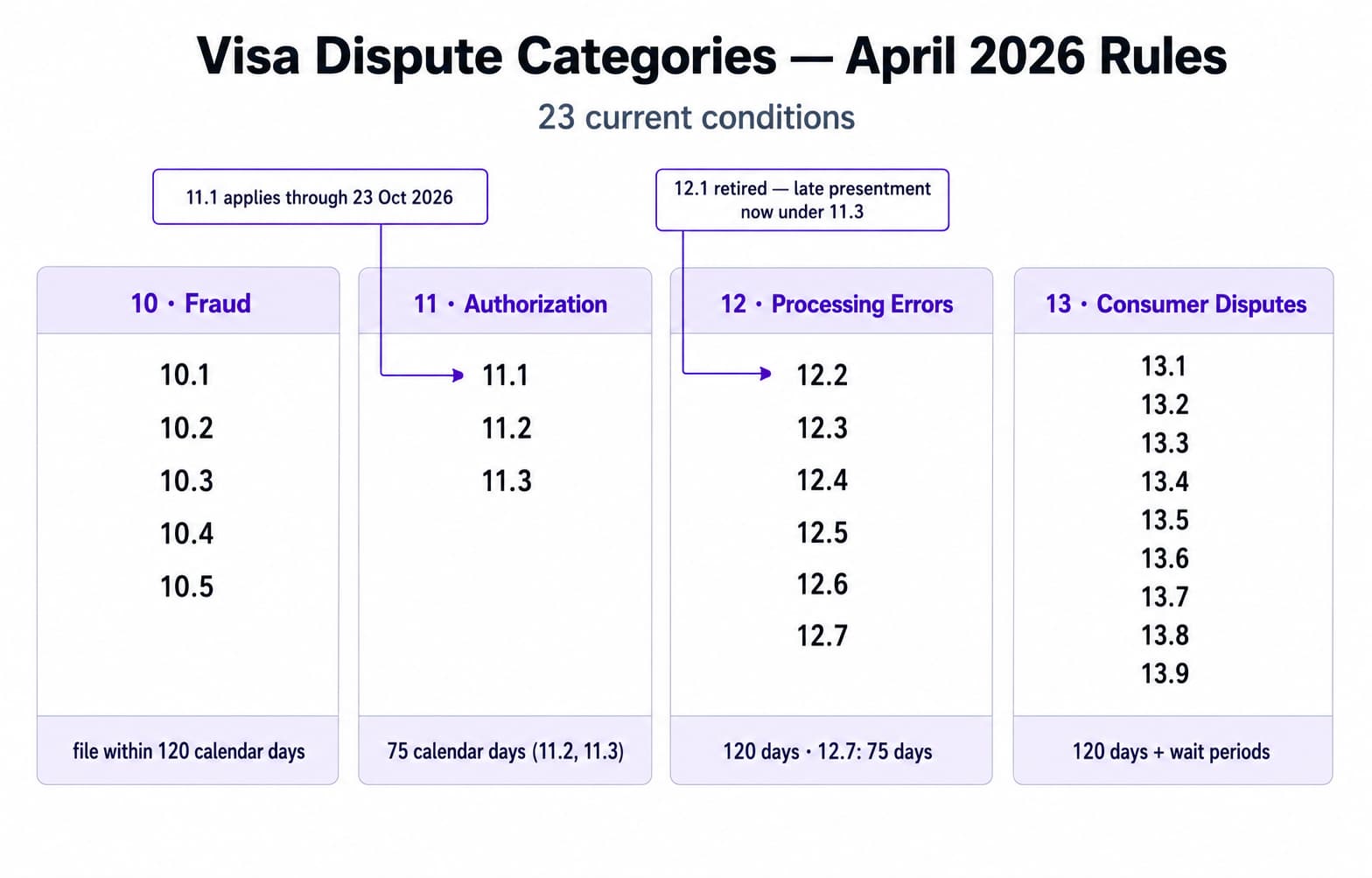
Visa’s April 2026 rules contain 23 current dispute conditions across four categories: fraud, authorization, processing errors, and consumer disputes.
Condition 12.1 is no longer current. Late presentment is now handled under condition 11.3.
Condition 11.1 applies only through 23 October 2026 and should be treated as end-of-life in internal reference tables.
A reason code describes the issuer’s claim, not the final outcome. Use the category to identify which transaction records and evidence to review first.
A chargeback reason code tells you why the cardholder’s bank pulled your money back — and, when read against the card network’s rules, what you are allowed to do about it.
The issuing bank assigns the code from a fixed list published by the card network. Each entry carries its own filing window, requirements, and limits. This guide lists all 23 current Visa dispute conditions in the 18 April 2026 edition of the Visa rules, explains what each code claims, and shows how long the issuer had to file it.
It also explains what happened to retired codes such as Visa 12.1 and code 53, why some Mastercard codes are not reproduced here, and how merchants can move from a reason code to the right records and response workflow.
Who assigns the chargeback reason code?
Three parties touch a reason code before it reaches the merchant.
The card network publishes the list. For Visa, the list appears in Chapter 11 of the Visa Core Rules and Visa Product and Service Rules. Each “dispute condition” has a number, definition, filing window, requirements, and corresponding rule tables.
The issuing bank selects the condition when it files the dispute. The issuer cannot invent a reason code, but it determines which published condition fits the cardholder’s claim.
The payment provider then displays the result to the merchant. Some platforms translate the network code into an internal label, which can make it harder to compare the dispute with the original network rules.
HaiPay passes the network’s original condition code through unchanged. The code shown in the dashboard can therefore be checked directly against the tables below.
An authorization decline is different from a dispute. If the transaction never completed and no settled payment was reversed, refer instead to HaiPay’s credit card decline codes guide.
The most important distinction is that a reason code describes the claim, not the truth. Visa condition 10.4 means that the issuer filed the transaction as card-absent fraud; it does not establish that fraud actually occurred.
Whether the claim succeeds depends on the evidence submitted during the dispute process. The stages, response windows, and evidence workflow are covered separately in HaiPay’s chargeback process guide.
The current Visa chargeback reason code list
Visa organizes its dispute conditions into four categories:
10 — Fraud
11 — Authorization
12 — Processing Errors
13 — Consumer Disputes
The number before the decimal point identifies the category. The number after it identifies the specific dispute condition.
The following list is based on the Visa Core Rules and Visa Product and Service Rules, Edition 18 April 2026, verified on 25 August 2026. The filing windows shown below are the issuer’s deadlines to initiate the dispute and are measured in calendar days.
Category 10 — Fraud
Category 10 covers claims that the cardholder did not authorize the transaction. All five current conditions generally carry a 120-calendar-day filing window.
The issuer must also report the transaction through Visa’s fraud-reporting system before initiating the dispute.
Code | Official name | What is being claimed | Filing window |
|---|---|---|---|
10.1 | EMV Liability Shift Counterfeit Fraud | A counterfeit chip card was used at a terminal that did not process it as a chip transaction | 120 calendar days |
10.2 | EMV Liability Shift – Non-Counterfeit Fraud | A lost, stolen, or never-received chip card was used and liability shifted to the acquiring side | 120 calendar days |
10.3 | Other Fraud – Card-Present Environment | Unauthorized use occurred in a card-present transaction outside the EMV liability-shift conditions | 120 calendar days |
10.4 | Other Fraud – Card-Absent Environment | Unauthorized use occurred in an online, telephone, or mail transaction | 120 calendar days |
10.5 | Visa Fraud Monitoring Program | Visa’s monitoring program identified the transaction and notified the issuer, which then disputed it | 120 calendar days |
Source: Visa Core Rules and Visa Product and Service Rules, Edition 18 April 2026, Chapter 11. The 10.4 dispute time limit is set out in Section 11.7.5.4, Table 11-29. Verified 9 September 2026.
For digital-goods and online merchants, 10.4 — Other Fraud, Card-Absent Environment is usually the most relevant condition in this category.
Patterns connected to card-absent fraud may appear in authorization data before disputes arrive, including repeated attempts after declines and mismatched verification results. Related authorization signals are covered in the credit card decline codes guide.
Category 11 — Authorization
Category 11 does not necessarily claim that the cardholder never made the purchase. It claims that the merchant completed the transaction without the authorization required by the network rules.
Two of the three current conditions carry a shorter 75-calendar-day filing window.
Code | Official name | What is being claimed | Filing window |
|---|---|---|---|
11.1 | Card Recovery Bulletin | The transaction was below the merchant’s floor limit, no authorization was obtained, and the account number appeared in the Card Recovery Bulletin | Special conditions apply |
11.2 | Declined Authorization | The authorization request received a decline or pickup response, but the merchant completed the transaction anyway | 75 calendar days |
11.3 | No Authorization/Late Presentment | No valid authorization was obtained, or the transaction was submitted for clearing later than the rules allow | 75 calendar days |
Source: Visa Core Rules and Visa Product and Service Rules, Edition 18 April 2026. The 11.2 dispute time limit is set out in Section 11.8.2.4, Table 11-43; the 11.3 dispute time limit in Section 11.8.3.4, Table 11-49; and the 11.1 dispute reasons in Section 11.8.1.1, Table 11-36. Verified 9 September 2026.
Important change to condition 11.1: the current rules state that condition 11.1 applies to disputes processed through 23 October 2026.
The Card Recovery Bulletin is a legacy mechanism, and Visa is retiring the dispute condition built around it. Merchants maintaining internal reason-code tables should treat 11.1 as end-of-life.
Another important change concerns late presentment.
Late presentment is now handled under condition 11.3. Older chargeback reason code lists may show Late Presentment as condition 12.1, but the April 2026 Visa rules contain no current 12.1 condition.
Category 12 — Processing Errors
Category 12 covers cases in which something about the transaction data or processing was incorrect. The amount, currency, account number, transaction type, or clearing data may be wrong even though the cardholder willingly made the purchase.
Code | Official name | What is being claimed | Filing window |
|---|---|---|---|
12.2 | Incorrect Transaction Code | The wrong transaction type was processed, such as a debit where a credit was due | 120 calendar days |
12.3 | Incorrect Currency | The transaction currency differed from what was transmitted, or dynamic currency conversion was applied without agreement | 120 calendar days |
12.4 | Incorrect Account Number | The transaction was processed using a payment credential that did not match the credential authorized by the cardholder | 120 calendar days |
12.5 | Incorrect Amount | The transaction amount was incorrect because of an addition, transposition, or ATM dispensing error | 120 calendar days |
12.6 | Duplicate Processing/Paid by Other Means | One transaction was processed more than once, or the purchase was paid by another method and also charged to the card | 120 calendar days |
12.7 | Invalid Data | Authorization was obtained using invalid or inaccurate data in defined transaction fields | 75 calendar days |
Source: Visa Core Rules and Visa Product and Service Rules, Edition 18 April 2026, Chapter 11 dispute-condition tables for category 12. Verified 25 August 2026.
There is deliberately no 12.1 row in this table. It is not an omission. Late Presentment has been consolidated into 11.3 — No Authorization/Late Presentment.
Category 13 — Consumer Disputes
Category 13 applies when the cardholder acknowledges the transaction but disputes what happened afterwards.
Examples include goods that never arrived, recurring charges processed after cancellation, defective merchandise, and a promised credit that was never completed.
Several category 13 conditions require the issuer to wait before filing, giving the merchant time to deliver the goods, complete a refund, or resolve the complaint.
Code | Official name | What is being claimed | Filing window |
|---|---|---|---|
13.1 | Merchandise/Services Not Received | The goods or services were not received. The window runs from the transaction processing date or the last expected delivery date | 120 calendar days, after a 15-day wait |
13.2 | Cancelled Recurring Transaction | The cardholder withdrew permission to charge the credential, but another recurring charge was processed | 120 calendar days |
13.3 | Not as Described or Defective Merchandise/Services | The goods or services did not match the description or were defective | 120 calendar days, generally after a 15-day wait |
13.4 | Counterfeit Merchandise | The merchandise was identified as counterfeit by an IP owner, customs authority, or qualified expert | 120 calendar days |
13.5 | Misrepresentation | The cardholder claims that the merchant misrepresented the terms of sale | 120 calendar days |
13.6 | Credit Not Processed | The cardholder has a credit or void receipt, but the credit was not processed | 120 calendar days, after a 15-day wait |
13.7 | Cancelled Merchandise/Services | The purchase was cancelled under the merchant’s policy or applicable rules but was still charged | 120 calendar days |
13.8 | Original Credit Transaction Not Accepted | An original credit transaction, meaning a push payment to the cardholder, was not accepted | 120 calendar days |
13.9 | Non-Receipt of Cash at an ATM | The cardholder received no cash or only part of the requested amount from an ATM | 120 calendar days |
Source: Visa Core Rules and Visa Product and Service Rules, Edition 18 April 2026. The 13.1 dispute time limit is set out in Section 11.10.2.4, Table 11-92; the 13.2 dispute time limit in Section 11.10.3.4, Table 11-99; and the 13.6 dispute time limit in Section 11.10.7.4, Table 11-125. Verified 9 September 2026.
Waiting periods may be waived when waiting would cause the dispute to exceed its filing deadline. Several category 13 conditions also carry an outer limit of 540 calendar days from the transaction processing date.
Three conditions deserve particular attention:
13.1 — Merchandise/Services Not Received
13.3 — Not as Described or Defective Merchandise/Services
13.6 — Credit Not Processed
These conditions generally include a 15-calendar-day waiting period. The waiting period gives the merchant time to deliver, replace, cancel, refund, or credit the transaction before the issuer files a dispute.
A fast and documented response to the customer’s original complaint can therefore prevent some disputes from becoming eligible for filing. If the complaint involves a promised, pending, or completed credit, see when to refund, accept, or challenge a chargeback before moving money again.
Visa also applies a minimum dispute amount of USD 25 to defined travel-and-entertainment transactions under several category 13 conditions. Merchants should not rely on this threshold as a dispute strategy, because it applies only to specific transaction types and conditions.
What happened to Visa condition 12.1?
Many chargeback reason code lists still include 12.1 — Late Presentment.
Those lists reflect an older edition of the Visa rules. The underlying issue still exists, but the current code does not. Under the April 2026 rules, late presentment is handled by:
11.3 — No Authorization/Late Presentment
If a processor dashboard or an older internal runbook still displays 12.1, use the dispute description to confirm the issue and check it against the current 11.3 requirements before responding.
Are two-digit Visa codes such as 37 and 53 still valid?
Two-digit Visa reason codes such as 30, 53, 75, and 83 belong to the system used before Visa Claims Resolution was introduced in April 2018.
They are not current Visa dispute conditions.
These codes may still appear in older processor exports, internal documentation, contracts, forum discussions, and outdated online reference tables. This explains why merchants continue to search for terms such as “chargeback reason code 37” and “chargeback reason code 53.”
There is no current official one-to-one conversion table covering every old code.
The reliable method is to read the description of the dispute, rather than relying only on the legacy number, and match that description to the current Visa condition list.
For example, the old Visa code 53 described claims involving merchandise or services that were not as described or were defective. The comparable claim is now filed under:
13.3 — Not as Described or Defective Merchandise/Services
The general test for any chargeback code list is to check the network-rules edition it cites and the date on which it was verified.
This guide uses the 18 April 2026 edition of the Visa rules and was verified on 25 August 2026. Visa updates its rules regularly, so merchants should confirm the current edition before relying on a specific provision.
Mastercard chargeback reason codes
Mastercard’s merchant-facing documentation groups chargebacks into four categories:
Fraud-related
Authorization-related
Point-of-Interaction Error
Cardholder Disputes
The structure resembles Visa’s four-category system, but the contents and terminology are different.
Mastercard’s Point-of-Interaction Error category includes issues such as duplicate charges, incorrect amounts, currency-conversion complaints, and improper surcharges.
The Cardholder Disputes category includes claims involving goods or services not as described, services not provided, counterfeit goods, no-show hotel charges, timeshares, recurring transactions, and certain low-value digital-goods purchases.
Each Mastercard chargeback subcategory has three main components:
A chargeback condition
A time frame for initiating the chargeback
Supporting-documentation requirements
Mastercard also uses different names for parts of its dispute process. What Visa describes as a dispute and response is generally handled by Mastercard as a first chargeback followed by the acquirer’s second presentment, with pre-arbitration and arbitration available in later stages.
Mastercard’s public Chargeback Guide — Merchant Edition, dated 13 May 2025, sets out message reason codes and the detailed conditions attached to them. The examples below are checked against that edition; confirm the latest applicable requirements with your acquirer.
For example:
4808/08 covers authorization-related chargebacks.
4853/53/4850/4854 are used within the Cardholder Dispute Chargeback family.
These numbers identify broader message-reason-code families rather than functioning as direct one-to-one equivalents of Visa’s individual dispute conditions. The precise claim must be read together with the applicable Mastercard chargeback condition.
Merchants can review the numeric codes and conditions in the cited edition in Mastercard’s Chargeback Guide — Merchant Edition.
Mastercard’s shorter Chargebacks Made Simple Guide provides a more accessible overview of the categories, required documentation, and dispute-cycle structure.
Amex and Discover chargeback codes
American Express and Discover operate their own dispute systems and use their own code sets. American Express reason codes are generally alphanumeric, with letter prefixes indicating categories.
A complete current code list from either network was not available through a verifiable public primary source suitable for reproducing as a table in this article. This guide therefore does not copy Amex or Discover code tables from secondary websites.
American Express publishes merchant policies and dispute-management guidance through its Merchant Regulations and Disputes Support Center.
For an Amex or Discover dispute, the authoritative reference should be the network documentation and case information supplied through the merchant’s acquiring relationship.
The same verification standard applies throughout this guide: where a table is published, every row should be traceable to a named rules edition or primary-source document.
From the chargeback code to the next action
The reason-code category tells the merchant which type of record to examine first.
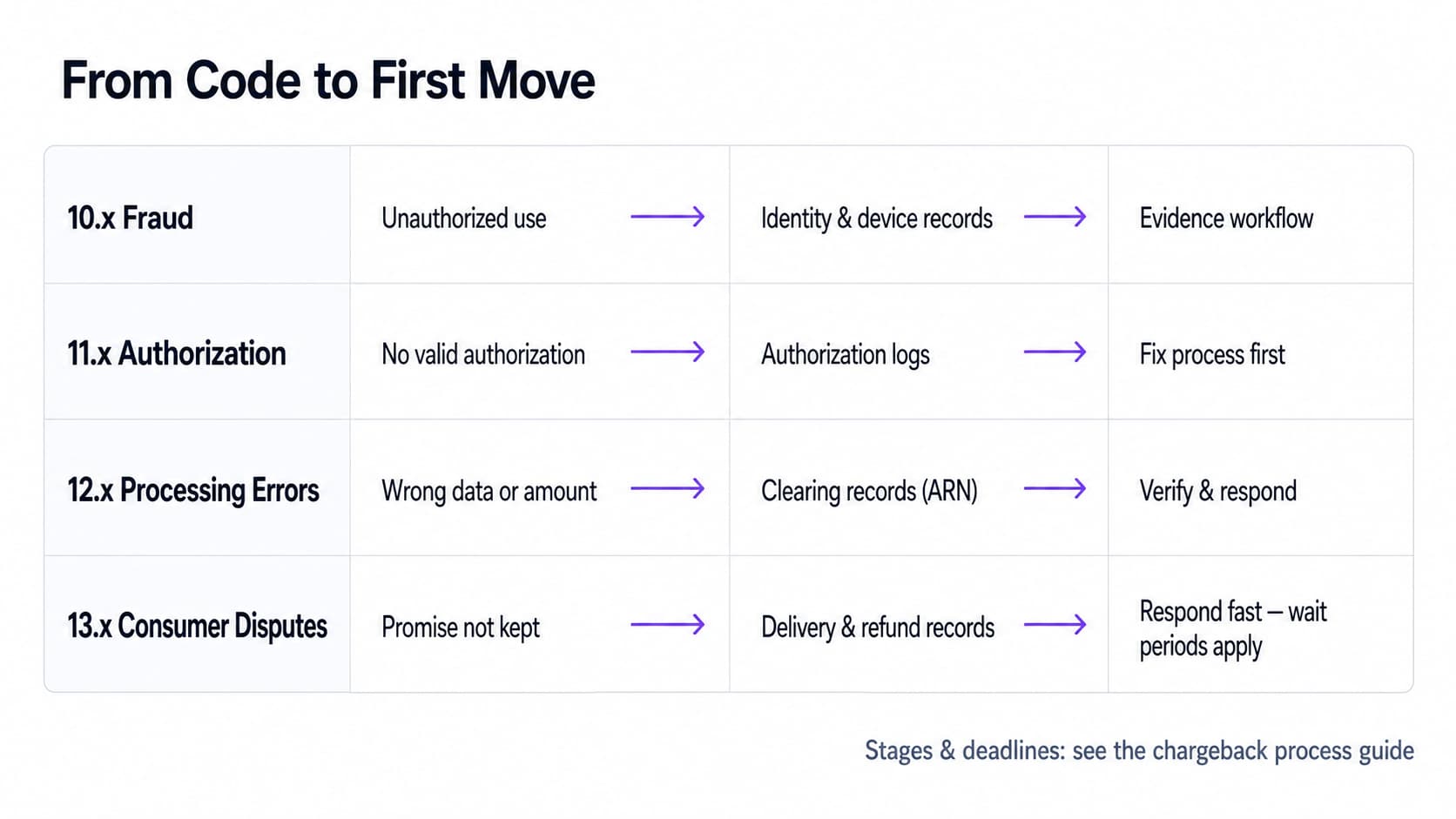
Category 10 — Fraud
The claim concerns who completed the transaction. Start by collecting identity, authentication, account, device, IP, login, and usage records.
Category 11 — Authorization
The claim concerns whether valid authorization existed. Start with the authorization request and response logs. If an 11.2 dispute arrives, determine why a transaction completed after the issuer returned a decline or pickup response.
Category 12 — Processing Errors
The claim concerns transaction data, clearing, currency, duplication, or amount. Start with the authorization and clearing records and confirm the amount and transaction identifiers.
Pull the acquirer reference number (ARN) early when tracing a settled card transaction.
Category 13 — Consumer Disputes
The claim concerns what happened after the purchase. Start with delivery records, cancellation requests, customer communications, refund records, credit receipts, and evidence of the goods or services supplied.
The complete response workflow, including dispute stages, deadlines, and the first-72-hours checklist, is covered in the chargeback process guide.
Two operational rules apply across all four categories.
First, do not try to dispute the reason code itself. The merchant generally responds to the condition filed by the issuer; it does not reclassify the dispute.
Second, do not submit the same generic evidence package for every category. Fraud, authorization, processing-error, and consumer-dispute conditions ask different questions. Evidence that answers the wrong question is unlikely to resolve the claim.
For merchants accepting card payments through HaiPay, the dispute record contains the network’s original condition code. Merchants can use that code to identify the claim and begin collecting the corresponding records.
More information about HaiPay’s card acceptance capabilities is available on the credit card processing product page.
Sources
- Visa Core Rules and Visa Product and Service Rules, Edition 18 April 2026
Visa. Chapter 11, “Dispute Resolution.” Used to verify the 23 current Visa dispute conditions, filing windows, waiting periods, rule-section and table references, the consolidation of condition 12.1 into 11.3, and the scheduled retirement of condition 11.1. Accessed 25 August 2026.
Read the official Visa rules - Visa Dispute Resolution Guidelines for Merchants
Visa. Used for the merchant dispute workflow, transaction-record review, response guidance, and dispute-prevention practices. Accessed 25 August 2026.
Read Visa’s merchant dispute guidance - Chargeback Guide — Merchant Edition, 13 May 2025
Mastercard. Used to verify Mastercard message reason codes, including 4808, 4850, 4853 and 4854; chargeback conditions; supporting-documentation requirements; second presentment; pre-arbitration; and arbitration procedures. Accessed 9 September 2026.
Read the official Mastercard Chargeback Guide - Chargebacks Made Simple Guide
Mastercard. Used for Mastercard’s chargeback categories, merchant-facing explanations, documentation requirements, and general dispute-cycle structure. Accessed 25 August 2026.
Read Mastercard’s Chargebacks Made Simple Guide - Merchant Regulations — U.S.
American Express. Official merchant policies covering card acceptance, transaction processing, and dispute management. The complete regulations may require merchant-account access. Accessed 25 August 2026.
View American Express Merchant Regulations - Disputes Support Center for Merchants
American Express. Official guidance for reviewing dispute cases, responding to Card Member claims, submitting documentation, and managing disputes through the merchant portal. Accessed 25 August 2026.
Visit the American Express Disputes Support Center
Card-network rules are written, published, and interpreted by the card networks themselves. The categories, condition names, filing windows, and rule references above are provided so readers can verify the information against the cited primary documents.
Network rules change regularly. Confirm the current edition before relying on a specific provision, and expect the issuer’s implementation to determine how a rule is applied to an individual dispute.
FAQ
Valid chargeback reasons are the dispute conditions published by the relevant card network.
Visa currently groups its 23 conditions into four categories: fraud, authorization, processing errors, and consumer disputes. An issuer must file the dispute under one of the published conditions and meet that condition’s requirements.
Code 37 is not a current Visa dispute condition. The April 2026 edition defines conditions from 10.1 through 13.9 and does not contain condition 37.
A two-digit code may come from a pre-2018 Visa system, another card network, or an internal processor label. If a report displays code 37, use the accompanying dispute description to identify the corresponding current condition.
Visa condition 13.3 — Not as Described or Defective Merchandise/Services means the cardholder claims that the goods or services did not match what was described at the time of purchase or were defective.
The issuer must generally wait 15 calendar days after the cardholder attempted to return the merchandise or cancel the services. The dispute must generally be processed within 120 calendar days of the applicable starting point.
Code 53 was the pre-2018 Visa reason code for merchandise or services that were not as described or were defective.
It was retired when Visa Claims Resolution replaced the old two-digit system in April 2018. The comparable claim is now filed under condition 13.3.
If current tooling still displays code 53, it is presenting a legacy label.
Mastercard 4853 is part of the Cardholder Dispute Chargeback family. It can cover multiple underlying conditions, including goods or services not provided, goods not as described or defective, recurring-transaction disputes, and other cardholder claims.
The exact meaning cannot be determined from “4853” alone. Merchants should review the accompanying condition and documentation requirements in Mastercard’s Chargeback Guide (13 May 2025). Confirm the latest applicable requirements with your acquirer.
Yes. Visa publishes the Visa Core Rules and Visa Product and Service Rules as a publicly accessible PDF. Chapter 11 contains the current dispute conditions, definitions, requirements, and filing windows.
Mastercard also publishes a public Chargeback Guide — Merchant Edition (the linked edition is dated 13 May 2025) containing message reason codes, chargeback conditions, documentation requirements, and dispute-cycle procedures.
