


Chargeback vs Refund: When Merchants Should Use Each
Reviewed by WeiJun Tang










Last updated: September 9th, 2026
Refund or Chargeback?
Identify the transaction state before taking action.
- No formal dispute: Issue a refund when the customer is entitled to one.
- Refund already submitted: Verify its status and preserve proof of the amount, date, and transaction reference.
- Formal dispute open: Accept a valid claim or challenge it with reason-specific evidence through the dispute workflow.
Never issue an unlinked second refund after a chargeback has opened. Reconcile the original payment, refund, and dispute in one shared record to prevent duplicate payouts.
A refund is a merchant decision; a chargeback is a bank-led dispute process.
Before a formal dispute opens, a refund can resolve a valid complaint directly. After a dispute opens, the merchant should work inside the dispute process: accept it when the claim is valid, or challenge it with relevant evidence. If a refund was already submitted, treat that credit as evidence. Do not automatically send the customer the money a second time.
That timing distinction matters more than a generic “refunds are better” rule. The right action depends on the transaction’s current state, what the customer is entitled to receive, and what your records can prove.
Chargeback vs refund: the practical difference
A refund reverses all or part of a completed payment at the merchant’s instruction. The merchant approves the remedy and submits the credit through its payment provider.
A chargeback, also called a card dispute, starts when the cardholder asks the issuing bank—the bank that issued the card—to contest a transaction. The issuer sends the dispute through the card network to the acquiring side. The acquirer is the institution that provides card acceptance to the merchant.
Question | Refund | Chargeback |
|---|---|---|
Who starts it? | The merchant | The cardholder’s issuer |
Where is it handled? | The merchant’s payment/refund workflow | The provider, acquirer, and card-network dispute workflow |
What does the merchant decide? | Whether and how much to refund, subject to policy and law | Whether to accept the dispute or submit a supported response |
What should happen to evidence? | Keep the refund record and customer confirmation | Submit evidence relevant to the reason code and current case status |
What is the main operational risk? | A late, failed, or unmatched credit | Missing the response deadline or sending irrelevant evidence |
What if the other process already started? | Stop and verify the dispute state before sending money | Show a prior refund or reversal as evidence instead of paying twice |
What does it cost at HaiPay? | US$0.30 per merchant-initiated refund (published list price; the fees that apply to your account are confirmed in your quote) | Chargeback-related fees are confirmed in the merchant’s quote |
Source: Visa, “Dispute Management Guidelines for Visa Merchants” (merchant dispute process), published June 2024 and accessed 31 August 2026; HaiPay, “Chargeback Process: Step-by-Step Guide for Merchants” (first-party fee scope), accessed 31 August 2026.
For the full sequence from notification to response and possible escalation, use the chargeback process guide. This article stays with the choice between refunding, accepting, and challenging.
The decision changes across three transaction states
The same complaint can require a different action one day later. Start by identifying the transaction state before discussing cost or evidence.
State | What has happened | Default operating action | Main control |
|---|---|---|---|
1. Complaint, no formal dispute | The customer contacted the merchant; no dispute case exists | Decide whether a refund is due and process it promptly if approved | Record the refund against the original transaction |
2. Refund submitted or processed | A full or partial credit exists; a dispute may still arrive | Verify refund status and preserve proof of amount and date | Do not create an unlinked second credit |
3. Formal dispute open | A dispute ID, reason, amount, and response route exist | Accept a valid claim or challenge through the dispute workflow | Freeze ordinary refund handling until the dispute owner decides |
Source: Visa, “Dispute Management Guidelines for Visa Merchants” (response and prior-credit evidence), published June 2024 and accessed 31 August 2026; Stripe, “Responding to Disputes” (Stripe-platform workflow), accessed 31 August 2026.
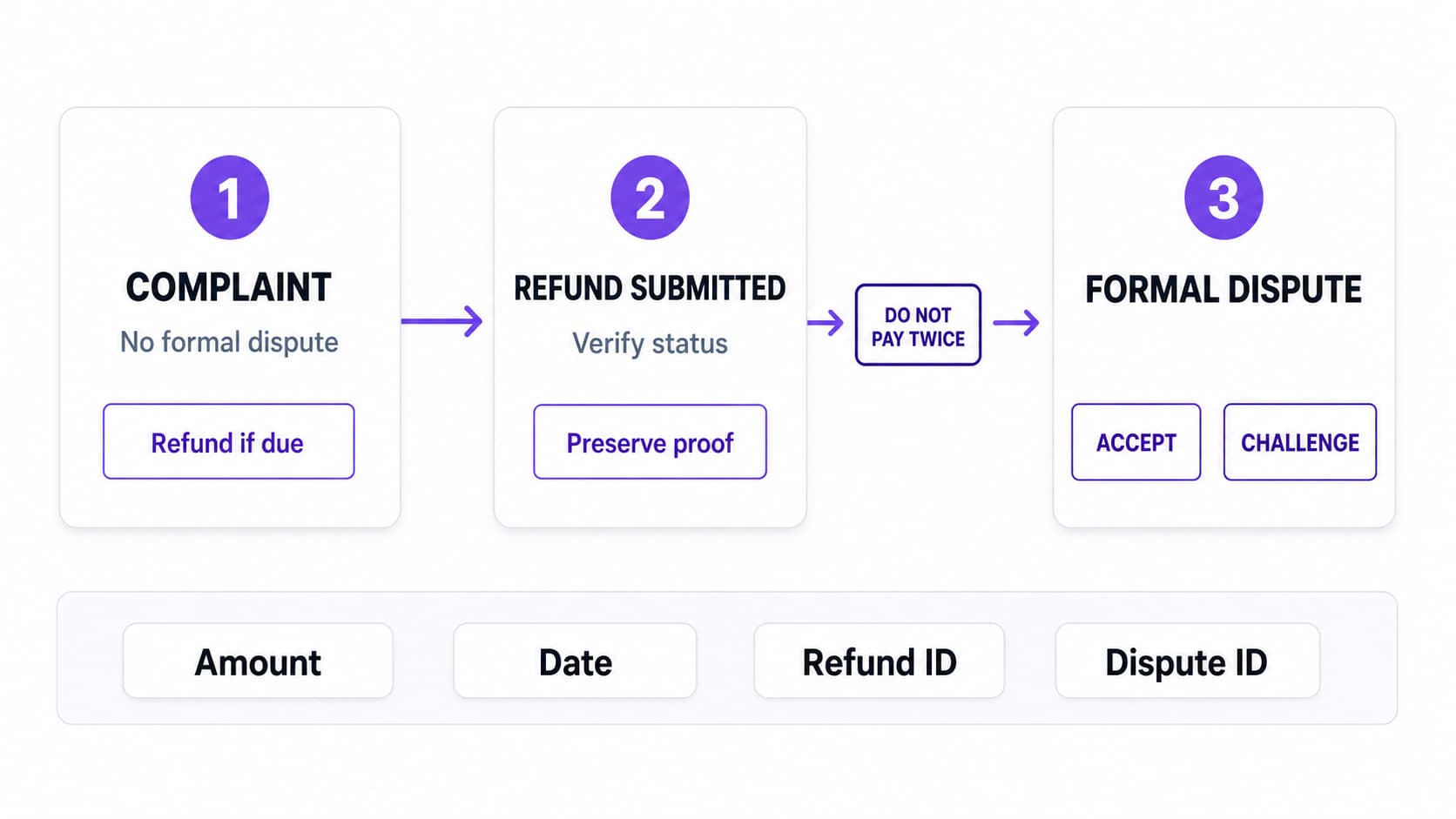
This model is a control framework, not a network rule. Your provider may expose different statuses or block certain actions automatically. Confirm the live case status before support promises a refund.
State 1: when to issue a refund before a chargeback
Refund before a dispute when the customer is entitled to the money and no formal dispute has opened. Common examples include a duplicate merchant-side charge, a cancellation covered by the disclosed policy, an undelivered service, or an amount error that your records confirm.
Use four checks:
- Entitlement: Does the contract, return policy, service record, or applicable law support the customer’s request?
- Dispute status: Has the provider created a formal dispute case for the same transaction?
- Amount: Is the remedy full or partial, and does it match the agreed resolution?
- Traceability: Can the team connect the credit to the original transaction and later prove its date, amount, and status?
Do not turn this into a universal value threshold. A small payment with weak evidence may not justify staff time, but a pattern of suspicious refund requests may require a fraud review. The decision combines customer entitlement, evidence strength, operational cost, and abuse risk.
Visa’s merchant guidance recommends acting promptly when a cardholder with a valid complaint contacts the merchant. It also recommends telling the cardholder that a credit is coming. That communication does not replace the refund record; it reduces uncertainty while the credit is being processed.
Source: Visa, “Dispute Management Guidelines for Visa Merchants” (merchant response to a valid complaint), published June 2024 and accessed 31 August 2026.
State 2: what to do when a refund already exists
A refund does not make a later dispute notification impossible. The customer may have contacted the issuer before the credit appeared. The refund may be partial. The issuer may not have matched the credit to the original sale. A processing error may also have left the credit incomplete.
Your first task is reconciliation, not another payout. Confirm:
- the original transaction ID and disputed amount;
- the refund ID, amount, currency, and processing timestamp;
- whether the refund is pending, succeeded, failed, or reversed;
- the payment credential or masked-account reference used for both entries;
- the Acquirer Reference Number (ARN), when available;
- the customer message that confirms the agreed remedy.
An ARN is a network tracking reference used to trace a card transaction. If the customer says the credit has not appeared, the ARN guide explains what to request and how it helps the issuer locate the movement.
Visa’s merchant guide says that evidence of a prior credit should include the amount and the date it was processed. Its current rules for Condition 13.6, Credit Not Processed, also allow a response when a credit or reversal was already issued and the issuer did not account for it.
Source: Visa, “Dispute Management Guidelines for Visa Merchants” (Condition 13.6 response evidence), published June 2024 and accessed 31 August 2026; Visa Core Rules and Visa Product and Service Rules, Edition 18 April 2026, tables 11-126 and 11-127 (public rules document), verified 31 August 2026.
State 3: when to accept a chargeback
Accepting a chargeback means you will not try to recover the disputed funds through an evidence response. It is appropriate when your records show that the customer’s claim is valid, the refund was due but never processed, or the transaction cannot be supported under the filed reason.
Visa’s Condition 13.6 guidance is direct: when the transaction is due for a refund but the refund has not been processed, accept the dispute. The same guide notes that contesting a dispute with no available remedy can add time and expense without changing the outcome.
Source: Visa, “Dispute Management Guidelines for Visa Merchants” (Condition 13.6 and response economics), published June 2024 and accessed 31 August 2026.
Do not ask the customer to withdraw a valid dispute merely so the merchant can send an ordinary refund. A Visa operational bulletin says that if the issuer has already processed a valid dispute, the merchant should accept the dispute and not issue a separate credit. Treat that as a strong control against duplicate compensation, while following your own provider and acquirer instructions.
Source: Visa, “Managing Disputes Through COVID-19” (Visa dispute/credit operations), published April 2021 and accessed 31 August 2026.
When to challenge a chargeback
Challenge only when your evidence addresses the actual dispute reason. A prior refund is one example. Others may include proof that the service was delivered, the customer used the product, the recurring charge was properly disclosed, or the transaction data contradicts the issuer’s claim.
The reason code is the filing category, not a conclusion that the claim is true. Use the chargeback reason codes reference to identify what the issuer alleges. Then build the response around the elements that matter to that condition.
For a refund-related dispute, a useful evidence pack may contain:
- the original transaction record;
- the refund or reversal record;
- amount, currency, and processing date for both entries;
- refund status and reference numbers;
- the return, cancellation, or service policy accepted at purchase;
- customer communications showing what was agreed;
- a short cover note that maps each file to the filed reason.
More evidence is not automatically better. Irrelevant screenshots can bury the one record that proves the credit was processed. Make the amount, date, and relationship to the original transaction visible.
Partial refunds need their own control
A partial refund creates two balances: the amount already returned and the amount still in dispute. Those numbers must remain separate throughout the response.
Stripe documents a platform-specific case in which a customer can dispute the full original payment after receiving a partial refund. Its guidance tells merchants to respond with proof of the partial refund, including the amount and date. It also identifies a Cartes Bancaires exception where merchants cannot contest these disputes through Stripe.
Source: Stripe, “Dispute Best Practices” (Stripe and named-network scope), accessed 31 August 2026.
Do not generalize Stripe’s outcome mechanics to every provider or card network. The safe cross-provider rule is narrower: preserve the partial-credit proof, identify the remaining amount, and follow the dispute route shown by your provider.
The double-payout prevention ledger
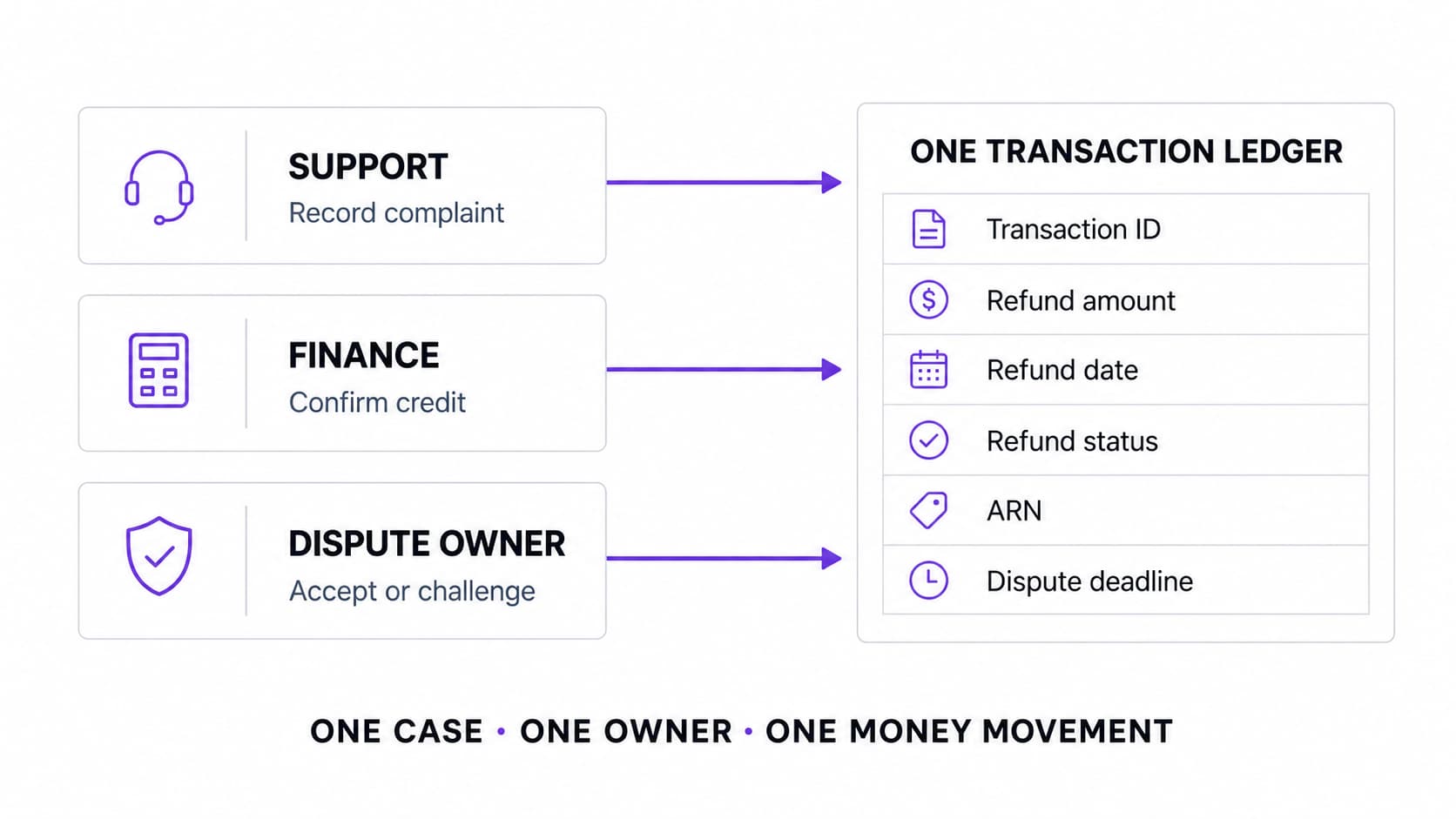
Most refund-versus-chargeback failures are ownership failures. Support approves a refund, finance sees a dispute debit, and the dispute team responds without sharing one transaction record.
Use one ledger row for every complaint that could become a dispute:
Field | Why it exists | Owner |
|---|---|---|
Original transaction ID | Joins every event to the sale | Payments/engineering |
Customer and order ID | Connects payment evidence to fulfilment | Support/operations |
Complaint received at | Establishes the sequence | Support |
Refund decision and approver | Prevents duplicate approval | Support lead |
Refund ID, amount, currency, status | Proves what was actually submitted | Finance/payments |
Refund processed at | Supports a prior-credit response | Finance/payments |
ARN or provider reference | Helps trace the credit | Payments |
Dispute ID, reason, amount, deadline | Controls the formal case | Dispute owner |
Case action: accept or challenge | Creates one accountable decision | Dispute owner |
Evidence submitted at | Confirms the response was completed | Dispute owner |
This ledger is an original operating template, not a network-mandated form. Adapt the owner names and identifiers to your provider’s data model.
Refund, accept, or challenge: the final decision matrix
Situation | Refund | Accept chargeback | Challenge chargeback | Do not do |
|---|---|---|---|---|
Valid complaint; no formal dispute | Usually | No open case | Not applicable | Delay without recording the decision |
Refund due but never processed; dispute open | No separate refund | Usually | Only if the dispute is factually invalid | Pay outside the open dispute workflow |
Full refund already processed; dispute open | No | Not before reviewing proof | Usually submit prior-credit evidence | Send the full amount again |
Partial refund processed; full amount disputed | No automatic second credit | Possibly for the unresolved portion, provider permitting | Submit partial-refund proof | Treat the original and remaining balances as equal |
Claim conflicts with reliable fulfilment/payment records | Not by default | Only if recovery is not worth pursuing | Consider a reason-specific response | Submit a generic evidence dump |
Dispute deadline passed | Provider-specific | Provider-specific | Often unavailable | Invent a workaround or promise recovery |
Source: Decision synthesis based on Visa merchant guidance, Visa Condition 13.6, and scoped Stripe dispute documentation, all accessed or verified 31 August 2026. The matrix is operational guidance, not a substitute for the merchant agreement, provider instructions, or legal advice.
Build the prevention path before the next complaint
A good refund policy is only useful if operations can execute it before the issue becomes a dispute. Make the policy visible at purchase, give support authority limits, record every credit against the original payment, and route formal dispute notifications to one owner.
For fees, use current account terms rather than a generic internet benchmark. HaiPay’s published list price is US$0.30 per merchant-initiated refund; chargeback and other refund-related fees are quote-specific. These are published list figures; the rates, fees and minimums that apply to your account are confirmed in your quote. Processing terms and fees can be reviewed on the card processing page and pricing page.
Source: HaiPay, “Chargeback Process: Step-by-Step Guide for Merchants” (first-party pricing scope), accessed 31 August 2026.
The operational rule is simple: identify the state first. Refund before a dispute when the customer is entitled to a remedy. Once a formal dispute opens, accept or challenge it through that process. If money was already returned, prove it—do not return it twice.
Sources
- Visa, Dispute Management Guidelines for Visa Merchants — dispute lifecycle, prior-credit evidence, Condition 13.6 and merchant response guidance; published June 2024, accessed 31 August 2026.
- Visa, Visa Core Rules and Visa Product and Service Rules, Edition 18 April 2026 — Condition 13.6 tables 11-126 and 11-127; verified 31 August 2026.
- Visa, Managing Disputes Through COVID-19 — valid-dispute and duplicate-credit control; published April 2021, accessed 31 August 2026.
- Stripe, Responding to Disputes — Stripe-scoped formal-dispute workflow; accessed 31 August 2026.
- Stripe, Dispute Best Practices — Stripe-scoped partial-refund guidance and limitations; accessed 31 August 2026.
- HaiPay, Chargeback Process: Step-by-Step Guide for Merchants — first-party refund and quote-specific fee statements; accessed 31 August 2026.
Disclosure: HaiPay publishes this article and provides payment services. Product and pricing references are first-party. The rules belong to the card networks, not to the publisher, and workflows can vary by network, region, provider, acquirer, and merchant agreement. This content is operational information, not legal, financial, or investment advice.
FAQ
A dispute may still arrive if the refund was partial, had not posted when the customer contacted the issuer, or was not matched to the original payment. Do not issue a second refund automatically. Confirm the dispute status and submit proof of the prior credit through your provider’s dispute workflow.
Once a formal dispute is open, handle the case through the dispute process. Visa guidance says that when a valid dispute has already been processed, the merchant should accept the dispute rather than issue a separate credit. Your provider or acquirer may impose additional steps.
Often, but there is no universal threshold. Compare the refund cost with the disputed amount, provider fees, staff time, evidence quality, and the risk of duplicate compensation. HaiPay’s published list price is US$0.30 per merchant-initiated refund; chargeback-related fees are quote-specific. These are published list figures; the rates, fees and minimums that apply to your account are confirmed in your quote.
Do not assume so. Monitoring rules and provider reporting can count received disputes even when the merchant later wins. Confirm the applicable network program, region, provider, and merchant agreement.
Keep the original transaction ID, refund ID, amount, currency, processing date, status, payment credential reference, Acquirer Reference Number when available, and the customer confirmation. The exact evidence fields accepted depend on the provider and dispute reason.
Separate the amount already refunded from the remaining disputed balance. Do not automatically issue another credit. Keep proof of the partial refund, including its amount, date, status, and transaction reference, then respond through the provider’s dispute workflow. The available response options can vary by provider and card network.
