
Direct Answer
A payment facilitator (PayFac) is a company that lets other businesses accept card payments under its own master merchant account, taking on onboarding, underwriting, funds flow, risk monitoring, and compliance for those businesses as sub-merchants. Platforms choose the model to onboard sellers in minutes instead of weeks — and inherit the acquirer's responsibilities in exchange.
The model is common in platform payments, marketplace payments, vertical SaaS, embedded finance, and merchant aggregation. It can help businesses onboard sellers faster, but it also moves more responsibility onto the PayFac.
For cross-border merchants, the most important question is often different: do you actually need to become a registered PayFac, or do you need a provider that already supports local payment methods, local acquiring, settlement, risk controls, and reconciliation across markets?
This guide explains the PayFac model, how it differs from ISOs, acquirers, processors, and sub-merchants, and how to decide which path fits your business.
What is a payment facilitator?
A payment facilitator is a company that helps other businesses accept payments by onboarding them under a master merchant account.
Instead of every small merchant applying directly for its own merchant account, the PayFac signs up those businesses as sub-merchants. The PayFac handles the front-line work: merchant onboarding, KYC/KYB checks, risk review, transaction monitoring, settlement coordination, dispute handling, and ongoing reporting.
This creates a faster onboarding experience for merchants, but it also means the PayFac carries more responsibility than a simple referral partner or software provider.
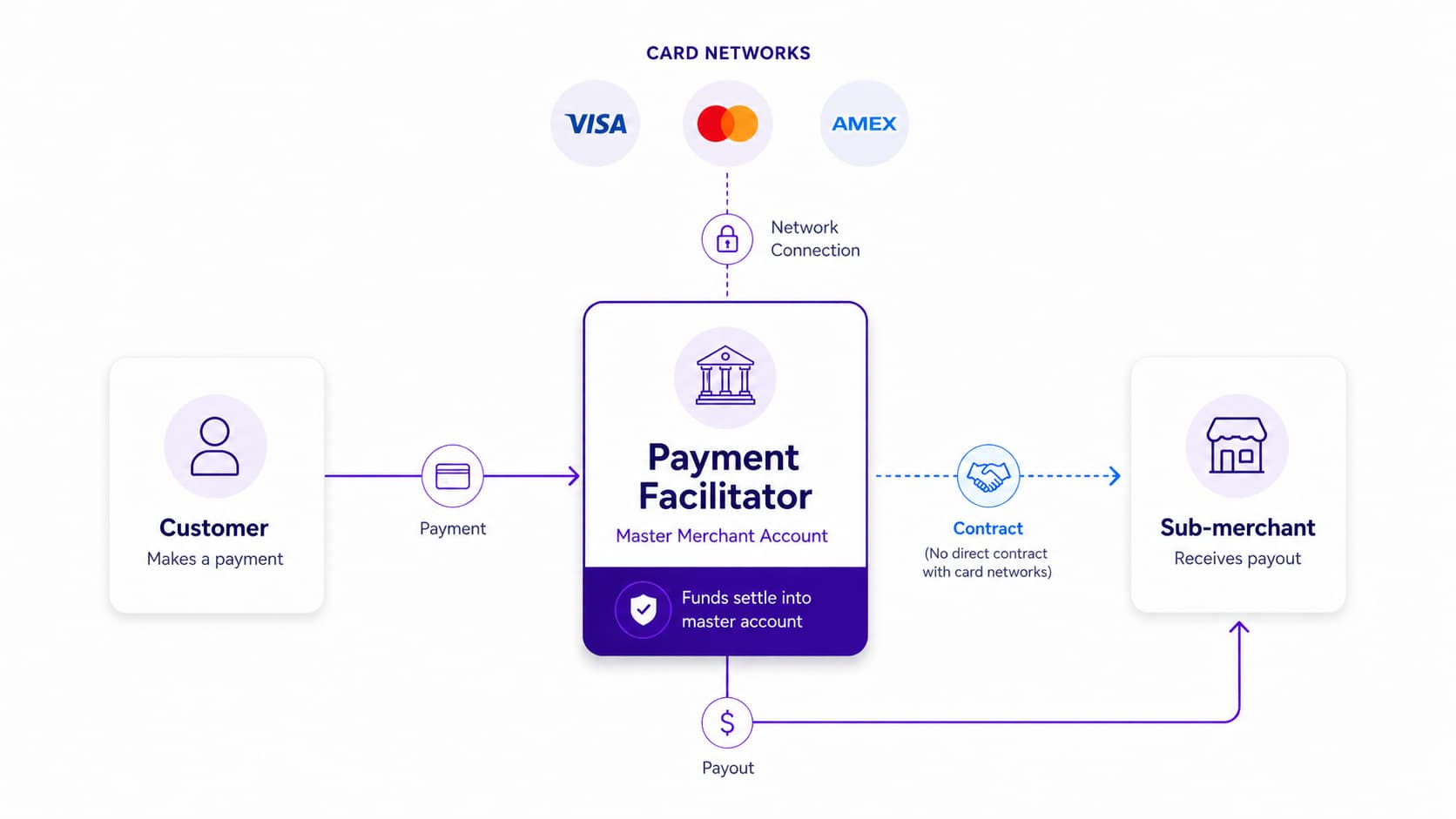
In practice, a PayFac model is usually built around four relationships:
- The customer pays.
- The sub-merchant sells the product or service.
- The PayFac aggregates and manages many sub-merchants.
- The acquirer and payment processor connect the PayFac to card networks and payment rails.
What is a sub-merchant?
A sub-merchant is a business that accepts payments under a PayFac's master merchant account instead of holding its own direct merchant account.
The sub-merchant usually signs a contract with the PayFac, not directly with the card networks. The PayFac then manages onboarding, risk rules, monitoring, settlement logic, and reporting obligations.
This arrangement can be useful for smaller merchants, platform sellers, creators, service providers, and marketplace participants that need to start accepting payments quickly. It also means the sub-merchant has less direct control over underwriting rules, reserves, payout timing, dispute handling, and certain payment method decisions.
Full breakdown: What is a sub-merchant?
PayFac vs ISO vs merchant acquirer vs processor
The PayFac model is often confused with ISOs, merchant acquirers, and payment processors. They all sit near the payment chain, but they do different jobs.
The simplest way to separate them is to ask four questions:
- Who signs the merchant relationship?
- Who touches the funds?
- Who carries underwriting and chargeback risk?
- Who owns compliance and monitoring obligations?
Payment facilitator (PayFac) | ISO (Independent Sales Organization) | Merchant acquirer | Payment processor | |
|---|---|---|---|---|
Who signs the merchant relationship? | The PayFac — merchants onboard as sub-merchants under its master merchant account | The acquirer — the ISO refers and manages the commercial relationship | The acquirer signs merchants directly | No one — processors are not merchant-facing |
Who touches the funds? | Often sits in the funds flow, settling to sub-merchants | Typically does not sit in the funds flow | Yes — receives settlement from the card networks | Moves payment messages, not merchant funds |
Who carries underwriting and chargeback risk? | Day-to-day risk on sub-merchants sits with the PayFac | Little to none — risk stays with the acquirer | Ultimate liability for its merchants and its PayFacs | None toward merchants |
Who owns compliance and monitoring obligations? | Must vet sub-merchants and ensure they meet PCI DSS and scheme rules | Limited — sales and servicing obligations | Responsible to the card networks for everything below it (Visa Core Rules 5.3.1.2; Mastercard Rules 7.6.5) | Operates under the members it serves |
How fast can a merchant go live? | Fastest — onboarding under an existing master account | Depends on the acquirer's underwriting | Full per-merchant underwriting — typically the slowest path | Not applicable |
Card-network registration? | Yes — registered by its sponsoring acquirer before processing | Yes — registered by its sponsoring acquirer as a service provider | Is the licensed card-network member | Acts as a registered service provider to members |
Best fit | Platforms and marketplaces embedding payments for many small sellers | Sales organizations that don't want funds-flow or risk obligations | Institutions built to carry merchant risk at scale | Infrastructure behind acquirers and PayFacs |
In short: an ISO (Independent Sales Organization) refers merchants to an acquirer under direct merchant agreements and never sits in the settlement flow or aggregates sub-merchant funds, whereas a payment facilitator vs merchant acquirer comparison hinges on who holds the card-network membership: the merchant acquirer is the licensed financial institution connected to Visa and Mastercard that sponsors the PayFac's master MID, while the PayFac signs, underwrites, monitors, and settles sub-merchants beneath that sponsor relationship. See also our merchant acquiring guide for how direct acquiring accounts work.
Comparing a PayFac usually means untangling a few neighboring roles too. These break down where each one sits in the payment stack:
- Payment service provider (PSP)
- Merchant acquirer vs payment processor
- Payment gateway vs payment processor
- Merchant account vs payment gateway
Why companies choose the PayFac model
Companies usually consider the PayFac model when they want to embed payments into a platform experience.
For example, a vertical SaaS platform may serve thousands of small businesses. A marketplace may need to onboard sellers quickly. A creator platform may want to let users receive money without sending each user through a long merchant-account process.
The PayFac model can make sense when payments are part of the product experience, not just a checkout tool. It allows the platform to control more of the merchant lifecycle, including onboarding, pricing, risk rules, settlement logic, and support workflows.
The trade-off is responsibility. Once a company becomes a PayFac, it is no longer only providing software. It also takes on payment operations, risk ownership, compliance obligations, dispute processes, monitoring, and reporting.
What the PayFac model means for SMEs and small businesses
Most PayFac guides are written for platforms deciding whether to become one. If you are a small merchant deciding whether to sell through one, the trade-offs look different.
How onboarding differs. Under a PayFac, you sign with the facilitator and start processing under its master merchant account — often within hours or days. Opening your own merchant account means full underwriting by an acquirer, which typically takes longer and requires more documentation.
What you give up. Three things, mainly. You price off the PayFac's rate card rather than negotiating directly with an acquirer. Your account lives inside the PayFac's portfolio, so its risk decisions can affect you. And under Mastercard Rules 7.8.1.1, your agreement terminates automatically if the PayFac is deregistered or its acquirer loses its license — a dependency merchants with their own accounts don't carry.
When you outgrow the umbrella. There is a concrete line: under Visa Core Rules 5.3.1.4, once a sponsored merchant exceeds USD 1 million in annual Visa transaction volume, the acquirer must generally sign a direct merchant agreement with it — before processing for new merchants, or within two years for existing ones. The PayFac can keep providing payment services after that, and exceptions exist for long-standing, well-reported relationships and certain merchant categories. But past that threshold, a direct acquirer relationship stops being optional in most cases.
Selling cross-border. If most of your volume is international, the PayFac model may not be the right umbrella at all — see the cross-border section below.
For suppliers invoicing business buyers, the PayFac route also has a ceiling: once a sponsored merchant passes USD 1 million in annual Visa volume, the acquirer must generally sign a direct merchant agreement. See B2B payment acceptance for what that threshold changes on the receiving side.
What a PayFac is responsible for
A registered PayFac typically needs to manage several areas at once. This is formalized in Visa's own Payment Facilitator Model, which sets minimum equity and risk-rating standards for any company operating as a PayFac.
First, it must understand the card-network and acquirer requirements that apply to its model. The PayFac operates within a broader acquiring relationship and must follow the rules set by its sponsor bank, acquirer, processor, card networks, and applicable local regulations.
Second, it must perform merchant due diligence. This usually includes KYC, KYB, sanctions screening, business model review, prohibited-activity checks, ownership verification, and risk classification.
Third, it must monitor transaction behavior. A PayFac needs to watch fraud patterns, refunds, chargebacks, sudden volume changes, abnormal ticket sizes, and suspicious merchant behavior. Card-network risk tools sit alongside this monitoring — for example, address verification (AVS) checks the billing address a cardholder provides against issuer records to screen higher-risk transactions.
Fourth, it must manage funds flow. This includes settlement timing, reserves, payout rules, refunds, disputes, and reconciliation between customer transactions and sub-merchant payouts.
Fifth, it must maintain documentation. Underwriting policies, monitoring procedures, risk decisions, merchant agreements, compliance records, and operational controls all need to be clear enough for review.
Simplified checklist below; full version: Payment facilitator compliance checklist.
PayFac compliance checklist
A PayFac compliance program is not one document. It is a set of controls across onboarding, transaction monitoring, risk operations, data security, funds movement, and reporting. For the full picture, see Visa's Payment Facilitator and Marketplace Risk Guide, which covers underwriting, monitoring, and risk obligations in detail.
At a minimum, companies evaluating the PayFac path should review:
- Card-network registration and sponsor/acquirer requirements
- PCI DSS scope and service-provider obligations
- KYC, KYB, AML, and sanctions screening
- Local licensing and money movement rules
- Sub-merchant underwriting policies
- Funds flow, payout logic, reserves, and reconciliation
- Chargeback, refund, and dispute operations
- Ongoing monitoring and merchant reporting
- Documentation, audit trail, and policy ownership
- Whether PayFac-as-a-Service is enough before becoming a registered PayFac
Compliance Pillar | Core PayFac Obligation | Operational Control & Escalation Trigger |
|---|---|---|
1. Acquirer sponsorship & scheme registration | Register with card networks (e.g., Visa Payment Facilitator / Mastercard PF) through a licensed sponsoring acquirer. | Annual scheme renewal, sponsor bank audit readiness, and operating rules adherence. |
2. Sub-merchant KYC/KYB & sanctions screening | Verify legal entity, beneficial owners (UBO), tax ID, bank account ownership, MCC, and OFAC/sanctions lists before activation. | Automated KYB checks plus manual underwriting escalation for restricted verticals or high-ticket profiles. |
3. Scheme volume thresholds & direct agreements | Track sub-merchant annual card volume against network thresholds requiring direct acquirer merchant agreements. | Automated volume alerts as large sub-merchants approach network high-volume transition thresholds. |
4. PCI DSS service-provider scope & risk monitoring | Maintain PCI DSS Level 1 compliance and monitor sub-merchant authorization, refund, and dispute ratios continuously. | Real-time velocity rules, fraud rules, and early intervention before chargeback ratios breach scheme thresholds. |
5. Segregated settlement flows & reserve governance | Keep sub-merchant settlement funds segregated per sponsor bank rules and maintain clear reconciliation and reserve ledgers. | Daily gross-to-net sub-merchant ledger reconciliation, hold/reserve policies, and audit trails. |
For a step-by-step audit worksheet covering underwriting files, monitoring rules, and sponsor-bank reviews, see our payment facilitator compliance checklist and chargeback process guide.
The point is not only whether a company can technically process payments. The real question is whether it is ready to own the operational and compliance layer that comes with aggregating merchants.
When PayFac-as-a-Service may be enough
Not every company that wants embedded payments needs to become a registered PayFac immediately.
PayFac-as-a-Service can be a middle path. In this model, a provider gives platforms some of the merchant onboarding, payment acceptance, risk, and settlement capabilities of a PayFac structure, while reducing the amount of compliance infrastructure the platform needs to build from zero.
This can work well for platforms that want embedded payments but are still testing volume, markets, merchant categories, or risk exposure.
It may not be enough for companies that want full control over underwriting, pricing, reserves, funds flow, payment operations, and merchant lifecycle management. At that stage, the business may need to evaluate a deeper PayFac setup or direct acquiring relationships.
How to decide which path fits
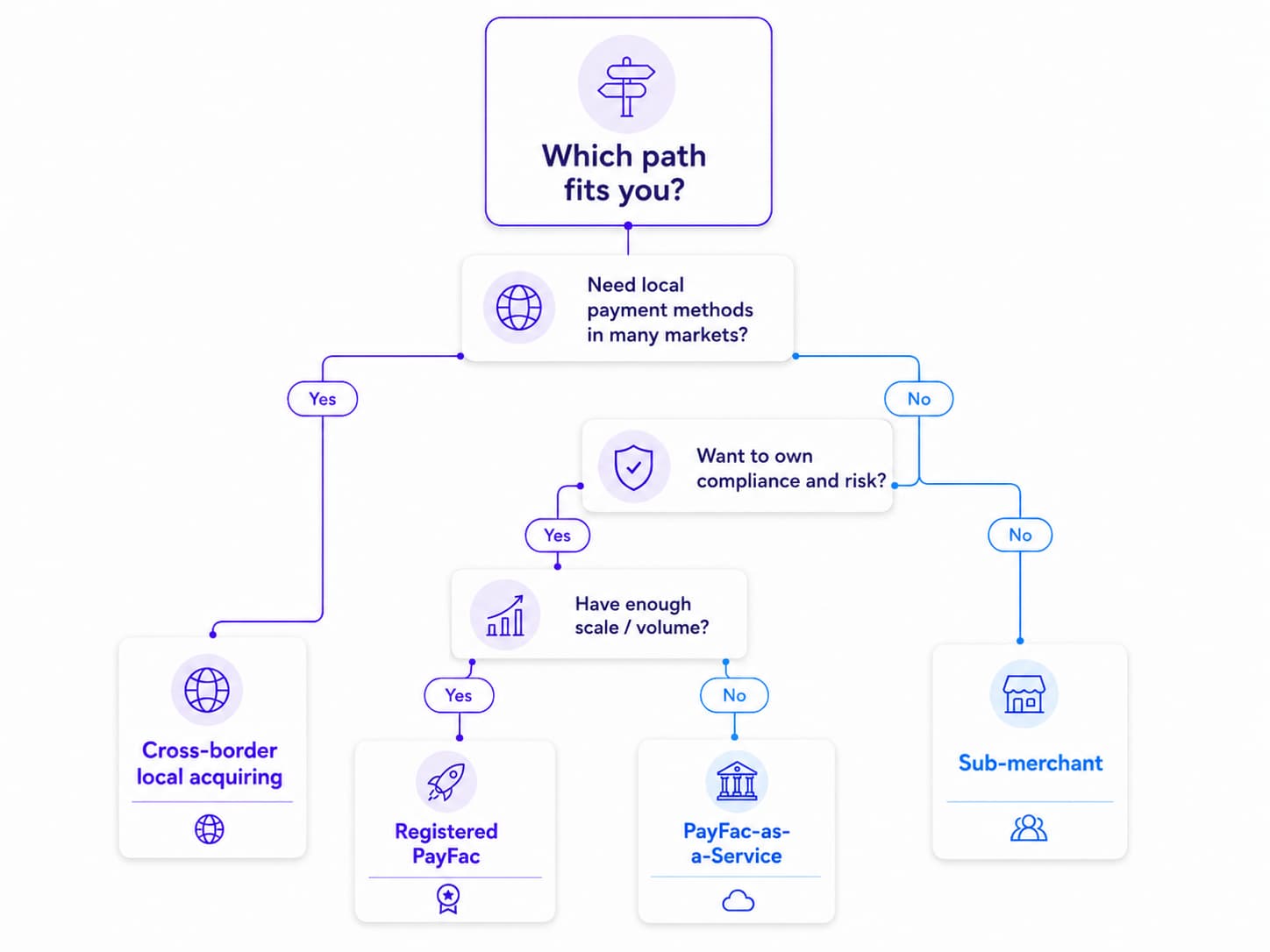
The right model depends on business volume, geography, risk appetite, compliance readiness, and how much of the payment experience the company needs to control.
A company should consider staying a sub-merchant when it mainly needs to accept payments quickly and does not want to own payment compliance.
It should consider PayFac-as-a-Service when embedded payments are important to the product, but the company is not ready to build the full registration, risk, and compliance stack.
It should consider becoming a registered PayFac when payment onboarding, merchant control, pricing, risk policy, and settlement operations are central to the business model.
It should consider cross-border local acquiring when the main challenge is not merchant aggregation, but accepting local payment methods, improving authorization routes, settling across currencies, and managing payment operations in multiple markets.
Cross-border reality: PayFac is not always the answer
Many international merchants use the word “PayFac” when they are really describing a different need.
They do not necessarily want to aggregate many sub-merchants. They want to sell into more markets, accept the payment methods local users trust, reduce payment friction, manage settlement, and keep finance operations clear across currencies and entities.
That is a cross-border acquiring and local payment infrastructure problem.
For example, a gaming company expanding into Latin America may need Pix, local cards, bank transfer options, fraud controls, and local payout or settlement support. An AI SaaS company may need subscription payments, failed-payment recovery, multi-currency settlement, and cleaner reconciliation. A content platform may need a checkout experience that supports local wallets, card payments, and payment-status synchronization.
In those cases, becoming a PayFac may be unnecessary. The stronger question is whether the provider can support local methods, local acquiring paths, settlement, reporting, risk controls, and API integration across target markets.
Where HaiPay fits
For most cross-border merchants, the practical need is more direct: they need to accept payments from overseas users through local methods and reliable acquiring paths, then manage settlement, reconciliation, and risk across markets.
HaiPay processes and settles payments through licensed acquiring institutions and regulated regional payment partners across key global markets, including the Philippines, Indonesia, the United States, and Canada; specific contracting entities and regulatory disclosures are provided in your merchant agreement. Through this unified acquiring and partner infrastructure, HaiPay supports cross-border and local acquiring, local payment methods, multi-currency settlement, payment API integration, order status synchronization, and localized risk-control capabilities — so businesses can run a multi-market payment stack without taking on PayFac registration and sub-merchant underwriting obligations.
This is especially relevant when a company is expanding from one market into several markets. At that stage, payment work often shifts from “can we collect money?” to “can we collect through the right local methods, settle clearly, manage risk, and avoid rebuilding the payment stack in every market?”
- Built for developers. A REST/JSON API with signed requests covers pay-in (collect) and pay-out (pay); for example, the Brazil integration supports Pix for collection (QR) and payouts to CPF, phone, or email. See the HaiPay developer docs.
- Built for operators and finance teams. Payment status, settlement records, refund handling, and reconciliation data need to be understandable outside the engineering team.
- Built for cross-border growth. Local acquiring and local payment methods matter most when users are paying from markets where international cards are not always the preferred path.
Next steps: explore HaiPay cross-border payment solutions, international card acquiring, local payment methods, and payment API integration, review our published pricing and developer documentation, or contact our team for an architecture review.
Sources
The card-network and data-security references below provide context for the responsibilities and controls discussed in this guide.
Visa — Payment Facilitator Model. An overview of the Visa payment facilitator model and its participation requirements. Accessed 9 September 2026.
Visa — Payment Facilitator and Marketplace Risk Guide. Guidance on underwriting, monitoring, and risk management for payment facilitators and marketplaces. Accessed 9 September 2026.
PCI Security Standards Council — PCI Data Security Standard. The official overview of PCI DSS and resources for understanding payment-data security requirements. Accessed 9 September 2026.
Visa — Visa Core Rules and Visa Product and Service Rules, 18 April 2026. Sections 5.3.1.2 and 5.3.1.4 cover acquirer responsibility and sponsored-merchant agreement requirements. Accessed 9 September 2026.
Mastercard — Mastercard Rules, 2 June 2026. Sections 7.6.5 and 7.8.1.1 cover acquirer responsibilities and sponsored-merchant agreement terms. Accessed 9 September 2026.
The rules belong to the card networks and the PCI SSC. We describe them and point you at the primary text; where our reading and your acquirer's differ, your acquirer's governs your account.
FAQ
A payment facilitator, or PayFac, is a payment model where a platform uses a master merchant account sponsored by an acquiring bank to onboard businesses as sub-merchants.
No. An acquirer is the registered card-network member behind the payment stack. A PayFac operates under an acquirer and manages sub-merchants.
A sub-merchant is a business that accepts payments under a PayFac's master merchant account instead of holding its own direct merchant account.
No. An ISO or MSP mainly refers merchants to an acquirer or processor. A PayFac onboards sub-merchants, touches funds, and carries more risk and compliance responsibility.
No. Some platforms use PayFac-as-a-Service, work with an ISO/MSP, contract with an acquirer, or use a cross-border local acquiring provider depending on their business model.
Through a sponsoring acquirer, in four broad steps: contract with an acquirer willing to sponsor you, complete card-network registration through that acquirer, stand up sub-merchant underwriting and PCI DSS compliance, and build settlement and reporting flows. The full requirements are in our payment facilitator compliance checklist.
Yes — Stripe, PayPal and Square all operate payment-facilitator models, onboarding sellers as sub-merchants under their own master accounts. HaiPay takes a different route: it works as an acquiring and gateway partner with local acquiring in the markets it supports, rather than aggregating merchants under one master account.
Under Visa Core Rules 5.3.1.4, when a sponsored merchant's annual Visa volume exceeds USD 1 million, the acquirer must generally sign a direct merchant agreement — before processing for a new merchant, or within two years for an existing one. Limited exceptions apply for long-standing, well-reported relationships and certain merchant categories.

Related HaiPay surfaces
Explore the payment stack
PayFac / Compliance
Payment Facilitator Compliance Checklist
A practical checklist for PayFac compliance, covering registration, PCI DSS, KYC/KYB, AML, underwriting, chargebacks, and ongoing monitoring.
PayFac / Roles
What Is a Sub-Merchant?
Learn how sub-merchants operate under a payment facilitator's master merchant account and what responsibilities still remain with the business.
PayFac / Comparison
PayFac vs ISO
Compare payment facilitators and ISOs across merchant onboarding, funds flow, risk, compliance, and merchant relationships.
PayFac / Acquiring
Payment Facilitator vs Merchant Acquirer
Understand how PayFacs and merchant acquirers work together in the payment stack, and why a PayFac operates under an acquirer.
Acquiring / Pay-ins
Pay-ins Acquiring
Accept local payment methods, card payments, and multi-market pay-ins through HaiPay's cross-border local acquiring capabilities.
Terms in this guide
Glossary terms covered
Payment Facilitator (PayFac)
A Payment Facilitator (PayFac) is an entity that contracts with an acquirer to onboard sponsored merchants and process payments on their behalf, with identifier, settlement, and compliance obligations governed by card network rules.

Need help mapping your payment stack?
Talk to HaiPay about acquiring, orchestration, local methods, and payout workflows.
Contact us