PayFac vs ISO: What's the Difference?










Last updated: September 9th, 2026
Choose by Responsibility
The key difference is responsibility: a PayFac manages sub-merchant onboarding and payment risk, while an ISO refers merchants to an acquirer. Choose the model around who signs the agreement, handles funds and owns compliance—not just how quickly you want to launch.
The short version: a payment facilitator (PayFac) onboards businesses as sub-merchants under its own master merchant account, touches the funds, and carries the risk. An ISO (Independent Sales Organization) refers merchants to an acquirer, does not touch the funds, and does not carry the underwriting or chargeback risk. Both sit between merchants and the payment system — they just take on very different amounts of responsibility.
This is part of our payment facilitator series. For the full model, see the guide.
What is a payment facilitator (PayFac)?
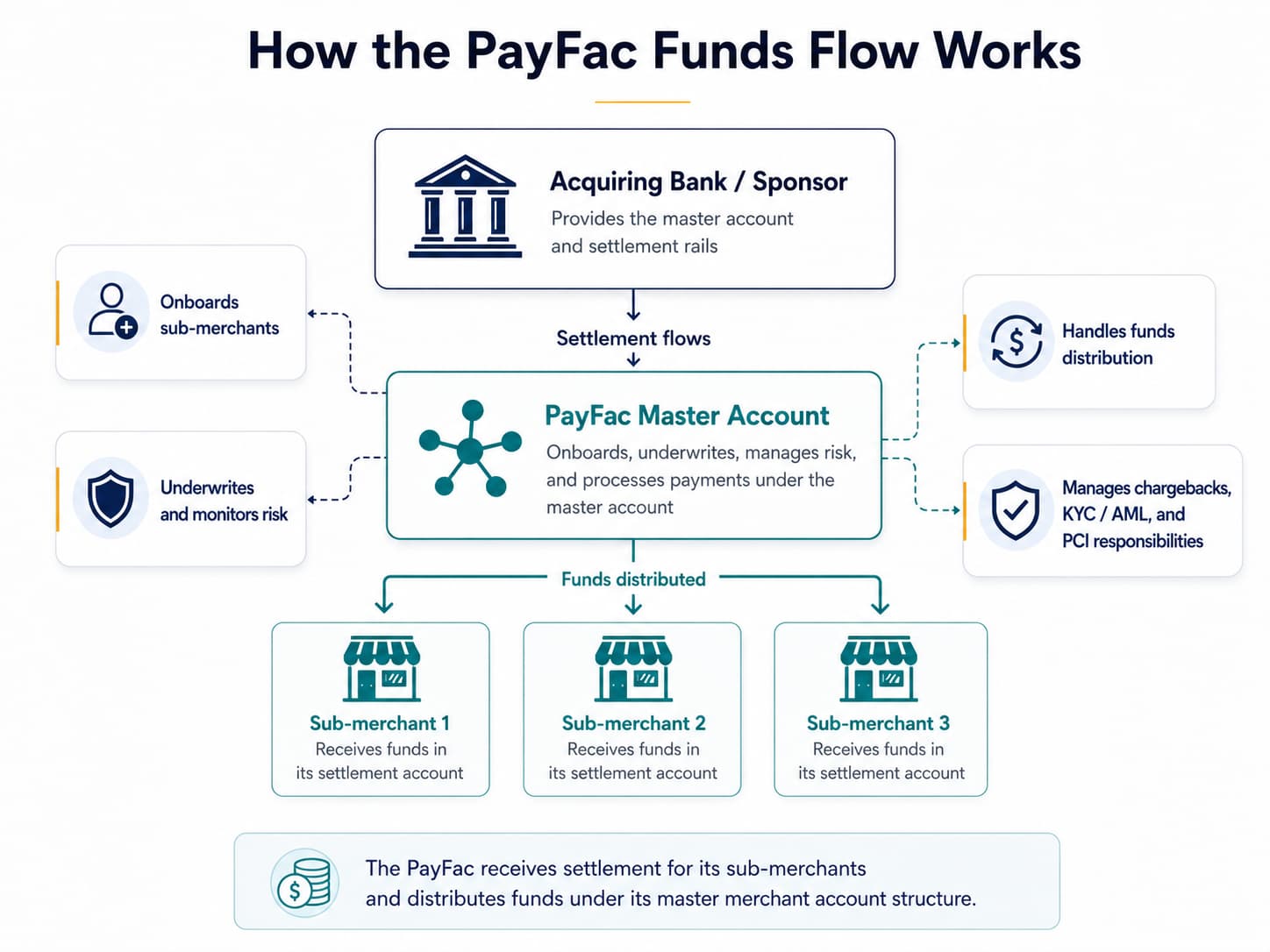
A PayFac holds a master merchant account and MID with an acquiring bank, and signs up businesses as sub-merchants underneath it. It underwrites those sub-merchants, sits in the funds flow, and is responsible for their risk and compliance. Stripe, Square, and PayPal are commonly cited examples, though the exact role can vary by product and region.
Read the full Payment Facilitator guide: Payment Facilitator Guide
What is an ISO (Independent Sales Organization)?
An ISO is a third-party sales channel that resells merchant accounts. It has relationships with acquirers and refers merchants to them, but — crucially — it is not allowed to touch the funds, and settlement goes directly from the sponsor to the merchant. Visa calls this role an ISO; Mastercard calls the equivalent an MSP. Most providers register with both.
PayFac vs ISO — head-to-head
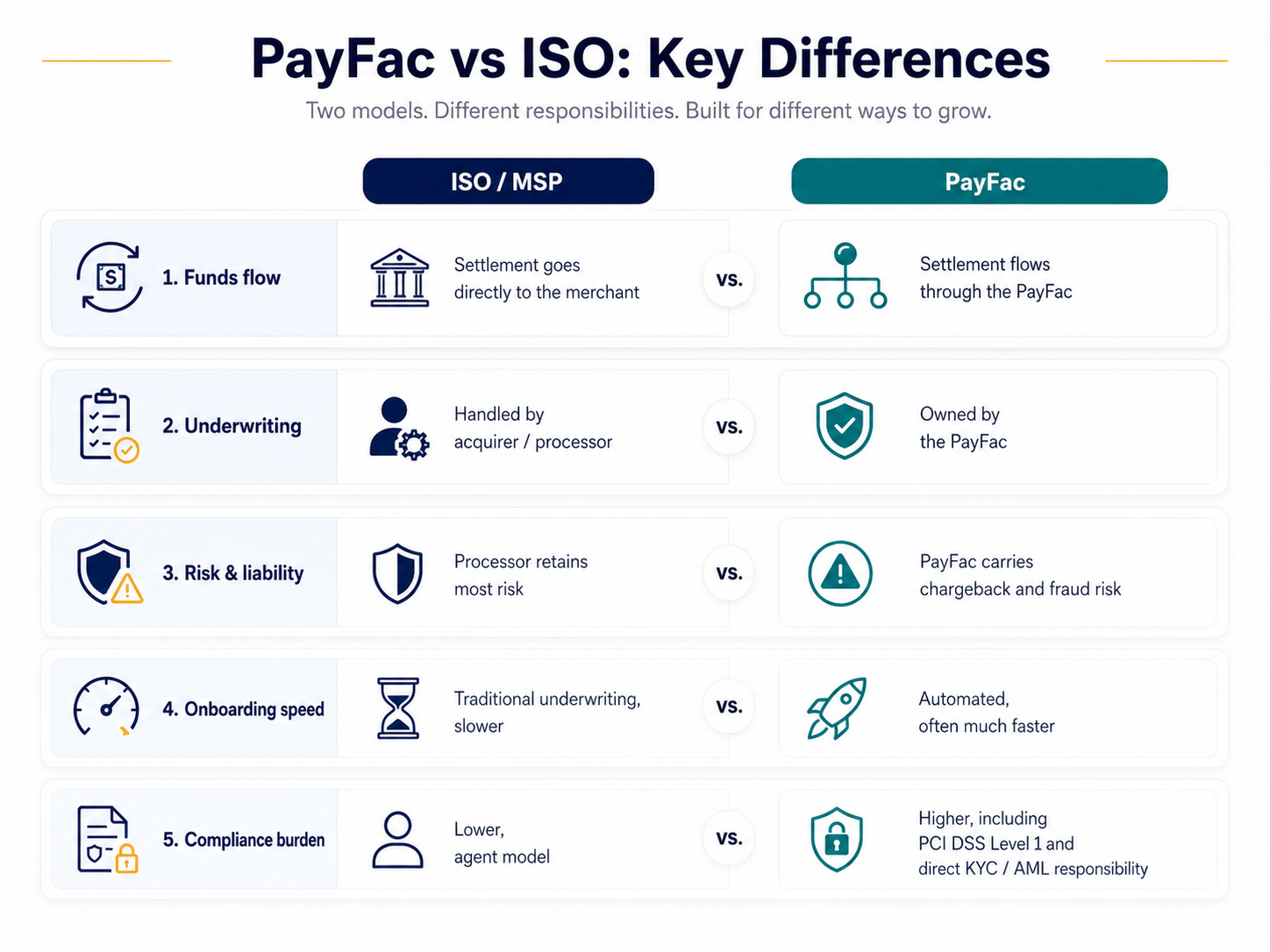
PayFac | ISO / MSP | |
|---|---|---|
Merchant relationship | Onboards sub-merchants under its master account | Refers merchants to an acquirer |
Touches funds | Yes | No |
Underwriting | Yes — owns it | Usually no — acquirer/processor does |
Risk & liability | Carries it, including chargebacks | Acquirer/processor retains it |
Contract | Merchant contracts with the PayFac | Merchant contracts with the processor/acquirer |
Onboarding speed | Fast, often hours and automated | Slower, usually traditional underwriting |
Compliance burden | High, including PCI Level 1 and direct KYC/AML responsibility | Lower, as an agent of the processor |
Revenue | Share of the processing economics | Commission / residual on referrals |
The acquiring bank sits underneath both of these roles — see payment facilitator vs merchant acquirer for how that layer fits.
Funds flow
The PayFac receives settlement for all its sub-merchants and distributes it. The ISO never holds the money — that's a defining line between the two.
Risk and liability
Because PayFacs onboard and process, they assume the risk of chargebacks and fraud and must comply directly with PCI DSS, KYC, and AML. ISOs, as agents of the processor, generally don't carry that risk.
Underwriting and onboarding
PayFacs underwrite each sub-merchant and can automate approvals down to minutes. ISOs sign a merchant up and hand off to the processor, which underwrites.
Compliance
Card networks treat a registered PayFac as a third-party agent (service provider) that must comply with PCI DSS; in practice it is generally validated at Level 1 — confirm the exact scope with your acquirer and QSA.
For more detail, see: Payment Facilitator Compliance Checklist
Which one fits your business?
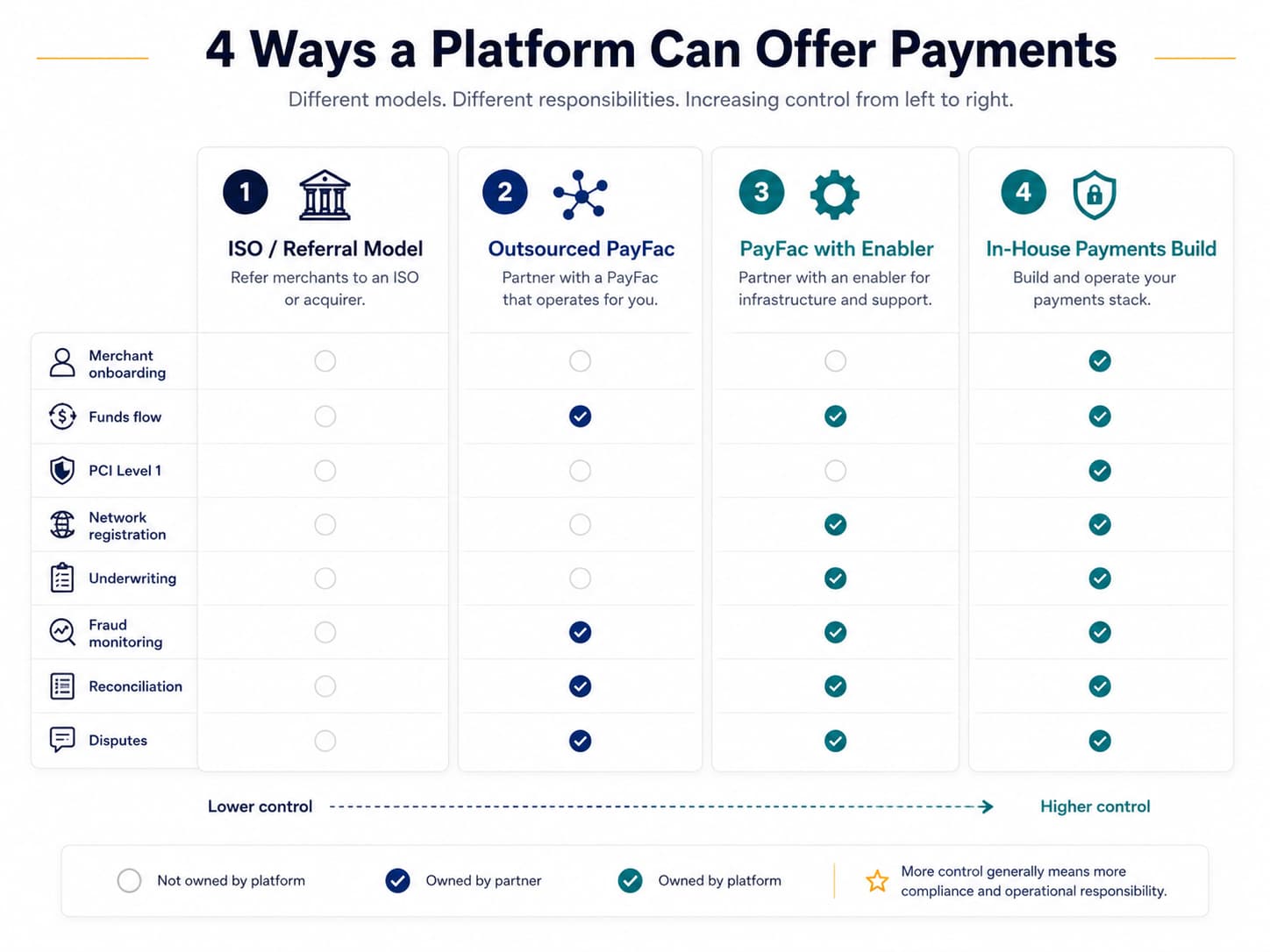
- Choose the PayFac direction if you're a SaaS platform, marketplace, or ISV that wants to embed payments, own the customer experience, and capture more of the economics — and you can take on the compliance, or use PayFac-as-a-Service to outsource most of it.
- Choose the ISO direction if you want to resell payment processing as a sales channel without touching funds, underwriting, or the associated risk.
Not sure which path you're on? The decision tree in the main guide walks you through it: Payment Facilitator Guide
Can a company be both?
Yes — some organizations operate hybrid models, acting as an ISO in some relationships and a PayFac in others. It's possible, but it multiplies the compliance and operational surface, so it's usually a deliberate, later-stage choice.
Where HaiPay fits
HaiPay is a licensed payment provider, regulated across the Philippines, Indonesia, the US, and Canada. It operates a payment-facilitation model that lets merchants accept local payment methods across many markets — Pix, GCash, UPI, Mada/STC Pay, and more.
See how cross-border local acquiring works: Pay-ins Acquiring
Last updated June 2026.
Sources
- Visa — Visa Core Rules and Visa Product and Service Rules (18 April 2026). Glossary definitions of Third Party Agent and Payment Facilitator, and Section 10.2.2, Member Requirements Related to Third Party Agents. Accessed 9 September 2026.
- Mastercard — Payment Facilitators (program & rules): mastercard.com/us/en/business/support/payment-facilitators.html
FAQ
Neither is "better" — they serve different goals. PayFacs suit platforms embedding payments and wanting more control and economics; ISOs suit sales-driven resellers who don't want to carry risk.
No. ISOs are not permitted to handle settlement funds; money flows directly from the sponsor to the merchant.
They're the same role under different card-network names — ISO is Visa's term, MSP is Mastercard's.
Stripe is commonly cited as a payment facilitator, onboarding businesses as sub-merchants — not as an ISO.
Yes. A company can act as an ISO in some relationships and as a payment facilitator in others. Each arrangement brings different contractual, operational and compliance responsibilities, so the model should be defined clearly with the sponsoring acquirer.
Start with who signs the merchant agreement, who handles settlement funds, and who is responsible for underwriting and disputes. Then assess whether payment onboarding and operations are central to your platform, and confirm compliance requirements with your acquirer and qualified advisers.
