What Is a Sub-Merchant? Definition, Rules, and What It Means for You










Last updated: July 21st, 2026
Insights
A sub-merchant accepts payments under a payment facilitator's master merchant account instead of holding its own. Learn how the relationship works, what responsibilities remain, and when a business may need its own merchant account.
A sub-merchant is a business that accepts card payments under a payment facilitator's (PayFac's) master merchant account, instead of holding its own merchant account. It signs a contract with the PayFac — not directly with Visa or Mastercard — and relies on the PayFac's banking and compliance relationships to process payments. In return, it can be onboarded in hours instead of the days or weeks a traditional merchant account can take.
If you've signed up with Stripe, Square, or a similar provider and started taking payments almost immediately, you were almost certainly onboarded as a sub-merchant.
This is part of our payment facilitator series. For the full model, see the guide.
How a sub-merchant relationship works
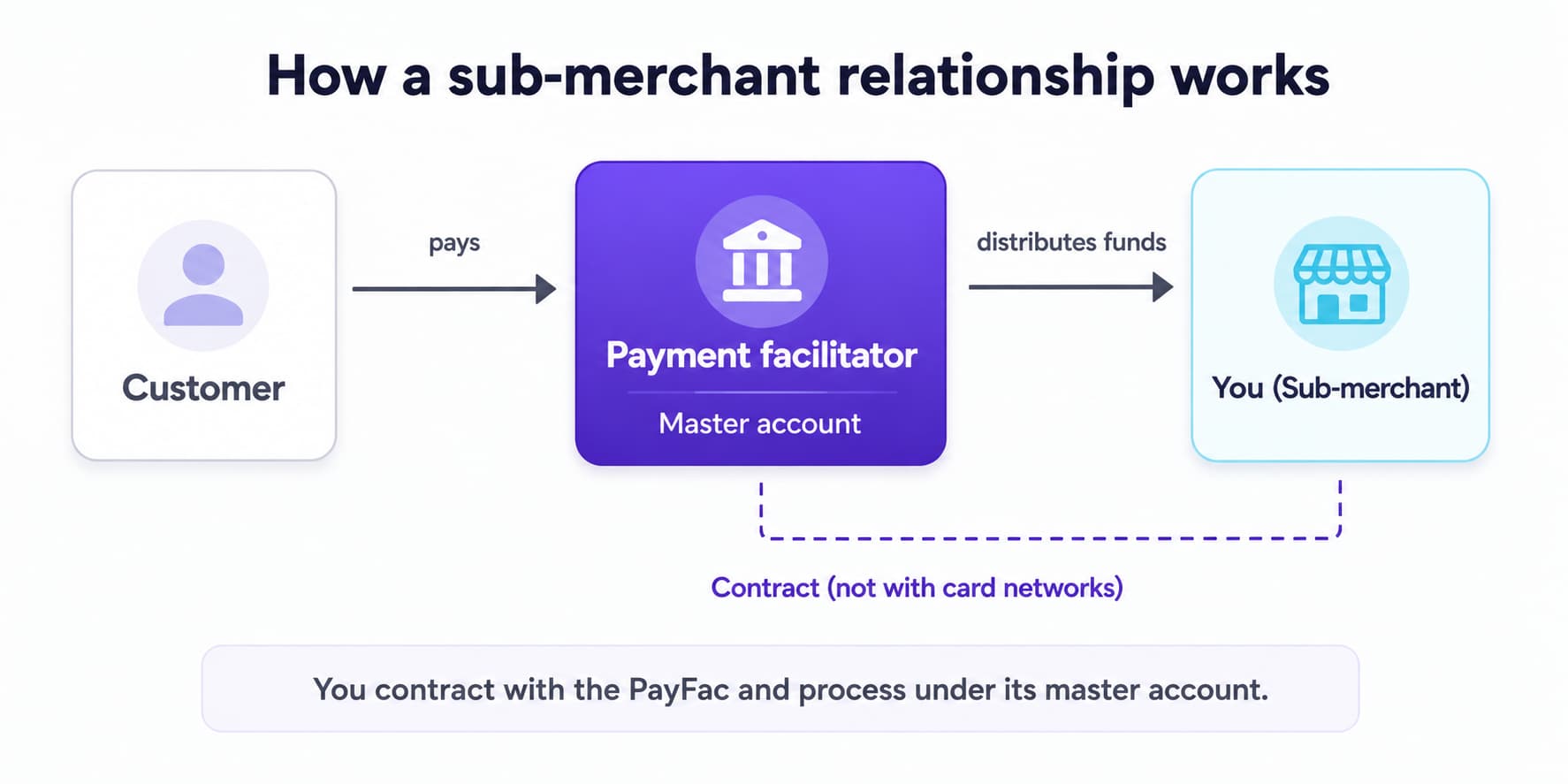
In the PayFac model, the payment facilitator holds one master merchant account and a single Merchant ID (MID) with an acquiring bank. Each business it signs up processes underneath that master account as a sub-merchant.
- Who you contract with: the PayFac, not the card networks or the bank directly.
- Whose infrastructure you use: the PayFac's MID, underwriting, and compliance posture.
- How money reaches you: funds settle into the PayFac's master account first, then are distributed to you.
That's why onboarding is fast — the PayFac already did the heavy lifting with the bank and card networks, and you inherit it.
Sub-merchant vs traditional merchant account
Sub-merchant (under a PayFac) | Traditional merchant account | |
|---|---|---|
Setup time | Hours to a day | Days to weeks |
Contract with | The PayFac | Acquirer / processor |
Your own MID | No, shares master MID | Yes |
Underwriting | Done by the PayFac | Done by the bank, on you |
Control & flexibility | Lower | Higher |
Best for | Fast start, smaller volume | Large or complex volume |
What sub-merchants are still responsible for
A common misconception is that the PayFac's compliance "covers" you completely. It doesn't.
- PCI DSS doesn't fully pass through. As a separate legal entity, a sub-merchant has its own PCI obligations. Where the PayFac's solution handles certain requirements for you, that should be documented — but you still need to understand and meet your own obligations. See the Payment Facilitator Compliance Checklist.
- Accurate information. You're responsible for giving truthful business and ownership details during onboarding, including KYC information.
- Your own disputes. When a customer disputes a charge, you typically handle the documentation and fight the chargeback — even though the PayFac processes the reversal.
The $1M rule: what changes at scale
You won't stay "just a sub-merchant" forever if you grow. Both Visa and Mastercard set a threshold — commonly USD 1,000,000 in annual card volume — above which a sub-merchant is generally expected to enter a more direct relationship with the acquiring bank. Mastercard frames this as a direct merchant agreement; Visa's approach is more flexible, with exceptions for established relationships and certain low-risk merchant categories.
Full detail on the threshold is in the main guide: Payment Facilitator Guide
Common pain points for sub-merchants
- Funding holds and reserves. PayFacs may hold reserves or delay funding to manage risk, which can affect cash flow.
- Policy changes. You operate under the PayFac's terms, which can change.
- Statement descriptor. In some setups your customers see the PayFac's prefix alongside your name on their statement.
Most of these trace back to one fact: the PayFac owns the risk, so it controls the levers that protect against it.
When to graduate to your own merchant account
Consider moving from sub-merchant to a dedicated merchant account when:
- You approach or exceed the USD 1,000,000 threshold.
- You need more control over funding timing, descriptors, or fees.
- You operate in complex or higher-risk verticals where aggregated models are restrictive.
Where cross-border fits
If you're selling internationally, "sub-merchant vs merchant account" may not be the real question — accepting local payment methods in each market is. A licensed payment provider like HaiPay — regulated across the Philippines, Indonesia, the US, and Canada — facilitates cross-border local acquiring, including Pix, GCash, GoPay, UPI, Mada/STC Pay, and more, so you can get paid the way local customers actually pay.
Explore cross-border local acquiring: Pay-ins Acquiring
Last updated June 2026.
Sources
- Mastercard — Payment Facilitators (sub-merchant definition & rules): mastercard.com/us/en/business/support/payment-facilitators.html
- PCI Security Standards Council: pcisecuritystandards.org — on sub-merchant PCI obligations. PCI does not "pass through."
FAQ
Functionally it accepts payments like a merchant, but it does so under a PayFac's master account rather than its own merchant account, and it contracts with the PayFac.
Yes. A sub-merchant is a separate legal entity with its own PCI DSS obligations, even when the PayFac handles some requirements on its behalf.
The sub-merchant usually does the dispute work; the PayFac processes the reversal and bears the ultimate loss if the sub-merchant can't fund it.
It's generally expected to enter a more direct agreement with the acquirer, though Visa allows exceptions for established, low-risk relationships.
