


Direct Answer
For international merchants, the strongest gateway is not the one with the longest logo list. It is the one that can onboard your contracting entity, accept the payment methods Singapore customers use, settle into the required currency, and document post-payment operations. For PayNow, verify three separate facts: the scheme exists in Singapore, the provider offers the exact route, and your merchant account is eligible to activate it.
That approach is more useful than a provider ranking. It also prevents a common error: treating a market payment method, a product feature and an approved merchant account as the same thing.
This guide provides a verification framework for international ecommerce, digital-service, gaming and SaaS merchants. It is particularly relevant to businesses processing small, frequent consumer payments.
What a payment gateway in Singapore needs to support
A payment gateway carries checkout information into a payment flow and returns a result that the merchant can use. That description is only the starting point. A launch-ready arrangement also needs an eligible merchant entity, an approved payment route, defined money flows and workable post-payment operations.
Evaluate the complete order lifecycle:
Decision area | What to verify before signing |
|---|---|
Contracting entity | The legal entity that signs, the countries it may be incorporated in, required registrations, settlement account and restricted business categories |
Customer payment methods | Exact card brands, PayNow route and any separate wallets enabled for the account |
Transaction model | Average transaction value, monthly volume, customer location, recurring or one-off payment, and refund frequency |
Currencies | Presentment currency, settlement currency, conversion point and the quoted foreign-exchange (FX) basis |
Settlement | The applicable T+N with an explicitly agreed starting event and day unit, cut-off, non-working-day treatment, reserves, reviews and transfer charges |
Integration | Hosted checkout, plugin or application programming interface (API) path, supported devices, redirects, notifications, query operations and production activation |
Post-payment work | Full and partial refunds, customer claims, disputes, reports, reconciliation identifiers and support escalation |
Total cost | Percentage and fixed charges, FX, transfers, refunds, disputes, tax treatment, reserves and internal operating effort |
The broader international payment gateway guide can help you define a multi-market shortlist. For Singapore, every shortlisted provider should then pass the country and account checks below.
Source: Integration Steps Guide, verified 2026-08-28; Payment Gateway Pricing & Fees, verified 2026-08-28.
Singapore’s payment landscape: cards, PayNow and SGQR
Cards and PayNow solve different customer journeys. Cards can support domestic and international cardholders, subject to the provider’s approved route. PayNow lets users of participating institutions make Singapore-dollar transfers through the Fast and Secure Transfers (FAST) infrastructure.
The Association of Banks in Singapore describes PayNow users as customers of participating banks and major payment institutions. Registered proxies include a mobile number, National Registration Identity Card (NRIC), Foreign Identification Number (FIN) and Unique Entity Number (UEN). A Virtual Payment Address is another supported proxy. PayNow Corporate links an eligible entity’s UEN to its Singapore bank or e-wallet account.
Those market facts do not establish which provider can serve your company. They also do not prove a provider’s fees, merchant settlement, refund process or technical implementation.
SGQR is another distinct layer. It is a standardised quick response (QR) label that can contain one or more payment schemes. A displayed SGQR label does not mean every bank, wallet or QR scheme will work. Check the scheme logo, provider configuration and customer flow for the account being launched.
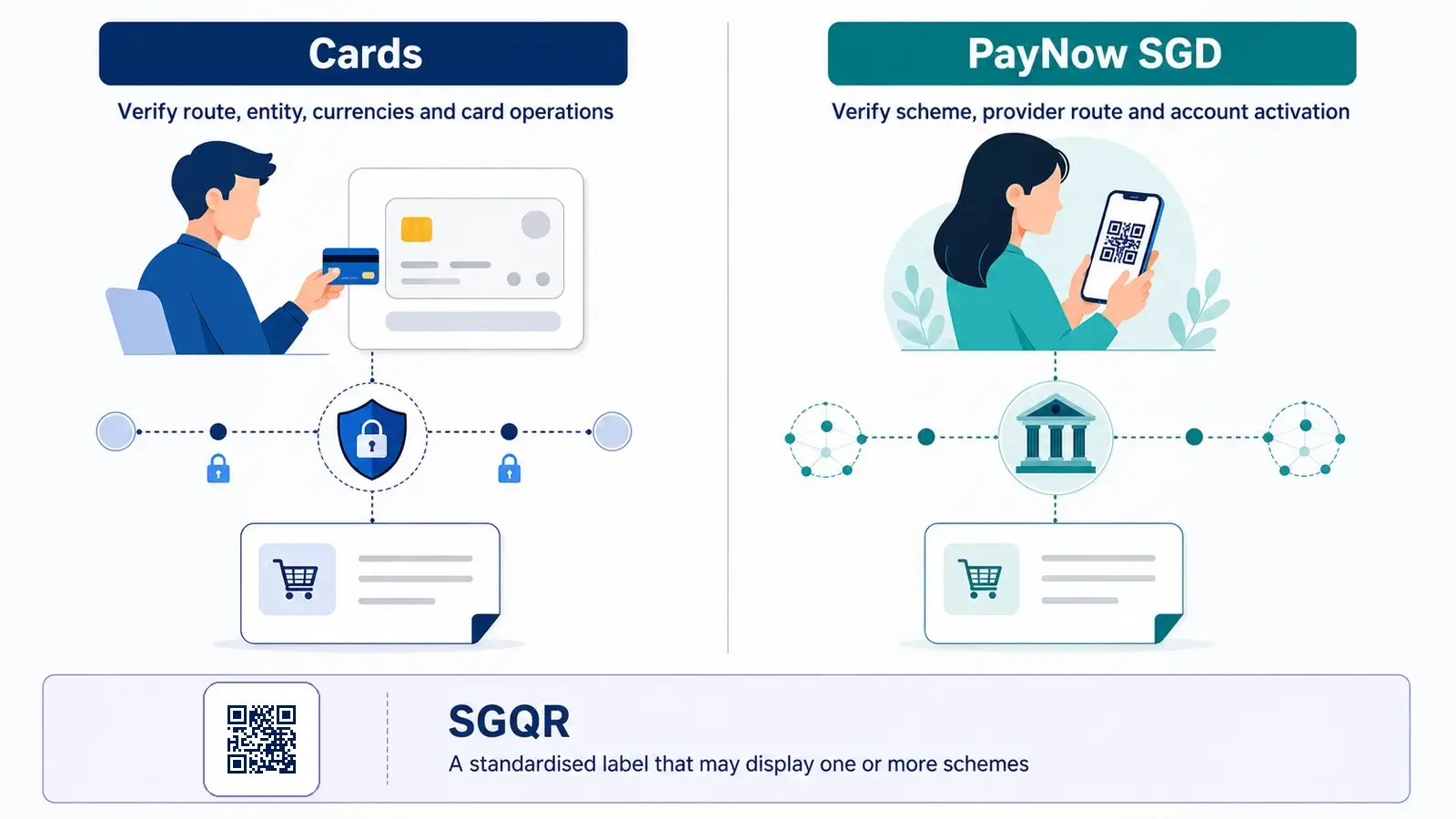
Source: PayNow Singapore, verified 2026-08-28; Singapore Quick Response Code factsheet, verified 2026-08-28.
Card payments for international merchants
Card evaluation starts with acquiring scope. Ask whether the transaction is locally or cross-border acquired, which merchant entity is accepted, and where funds settle. The local-acquiring and cross-border-acquiring guide explains why that distinction can affect routing, currency and commercial terms.
Next, test the card route against your operating model:
- Can the approved entity accept the required domestic and international cards?
- Which checkout route is available on your website, app or commerce platform?
- What authentication, fraud-review and decline-handling tools apply to that route?
- Can your team identify an order from payment through settlement and refund?
- Are partial refunds, card disputes and evidence deadlines documented?
- Which presentment and settlement currencies appear in the final quote?
For US merchants contracting through HaiPay’s US entity, US-issued cards start at 2.5% + US$0.30 per transaction; cards issued outside the US start at 4.0% + US$0.30. Actual rates follow a business and risk review. These are US card-product starting rates, not a Singapore-merchant or PayNow quote.
The current public USD international-card API documentation lists a route amount range of US$0.99 to US$1,000. Treat that as a route-specific technical limit, not a promise for every card account. It makes the documented route more relevant to small, frequent consumer payments than to large-ticket business-to-business (B2B) collection.
Read the current card product page, then obtain account-specific confirmation before designing checkout or forecasts around either statement.
Source: Payment Gateway Pricing & Fees, verified 2026-08-28; International credit-card API documentation, verified 2026-08-28.
Verify PayNow in three layers
The correct question is not simply, “Does Singapore have PayNow?” Run three separate tests.
Layer 1: market availability
PayNow exists as a Singapore-dollar funds-transfer service through FAST. The current ABS page names participating banks and major payment institutions without giving one dependable aggregate for every use case.
Institution categories matter. A bank, major payment institution and wallet brand are not interchangeable labels. Do not turn a provider’s separate bank-transfer and wallet fields into a PayNow participant count.
Layer 2: provider product evidence
HaiPay’s current public Singapore coverage table lists PayNow. Its versioned Singapore API documentation also lists a PAYNOW_SGD QR collection route, with a published amount range of S$1 to S$3,000. The documentation contains collection-application and query fields for orders, amounts and payment status.
That is evidence of a current public product route. It does not establish the commercial rate, contracting entity, settlement currency, refund method, dispute process or reconciliation access for a particular account.
Layer 3: merchant account eligibility
The merchant still needs written approval for the relevant entity, app configuration and production account. The quote and contract should name the enabled method, transaction limits, currencies, settlement schedule, fees and operational procedures.
Use this five-part activation check:
- Identify the contracting entity and settlement account.
- Obtain written confirmation that PayNow SGD is enabled for that entity and business model.
- Confirm the exact hosted, plugin or API route and its production configuration.
- Test payment status, failed and duplicate events, order matching and reports.
- Document refunds, customer claims, reconciliation and support escalation before launch.
Source: PayNow Singapore, verified 2026-08-28; Singapore API, V20260701, verified 2026-08-28; Payment Gateway Pricing & Fees, verified 2026-08-28.
Compare gateways with an evidence scorecard
A provider table can create false precision when sources use different entities, fee bases and product versions. Use an evidence scorecard instead.
Assign each criterion one of three values:
- 2 — confirmed: current official evidence exists and the provider has confirmed the field for your account.
- 1 — conditional: public provider evidence exists, but the quote, contract or configuration is still pending.
- 0 — not established: the field is absent, ambiguous or contradicted.
Do not total the score until every critical field has evidence. A high aggregate cannot compensate for an ineligible merchant entity or an unavailable required method.
Criterion | Priority | Evidence to request | Stop condition |
|---|---|---|---|
Contracting-entity eligibility | Critical | Named entity, accepted business model and settlement-account requirement | Provider cannot onboard the entity |
Cards and PayNow | Critical | Account method list, route and production entitlement | A required launch method is unavailable |
Presentment and settlement currencies | Critical | Currency fields in quote and contract | Treasury requirement is not met |
Total quoted cost | Critical | Percentage, fixed, FX, transfer, refund/dispute, reserve and tax terms | A material cost remains undefined |
Settlement and holds | Critical | T+N with an explicitly agreed starting event and day unit, cut-off, exceptions, review and reserve conditions | Cash-flow risk exceeds tolerance |
Refunds, disputes and reconciliation | Critical | Route-specific process, fees and report identifiers | Operations cannot close the order lifecycle |
Integration proof | Critical | Exact checkout/plugin/API path plus sandbox and production evidence | Required route cannot be launched |
Support and escalation | Important | Channels, response targets and funds-access escalation | Operational risk exceeds tolerance |
Regional expansion | Important | Country-by-method-by-entity matrix | Another provider is required for the next market |
Recurring, marketplace or in-person needs | Important | Account-specific product confirmation | Product does not match the business model |
This method deliberately avoids naming a universal winner. It asks whether a provider can prove fit for your entity and order lifecycle.
Payment gateway fees, GST, FX and settlement
Headline rates are incomplete. For small, frequent orders, a fixed charge can materially change the effective cost per order. Model percentage and fixed components separately:
estimated processing charge = processed value × percentage rate + transaction count × fixed charge
Then add only the charges supported by the quote: FX, settlement transfers, refunds, disputes, reserves, account fees and applicable tax treatment. Include internal work for manual payment matching or reconciliation.
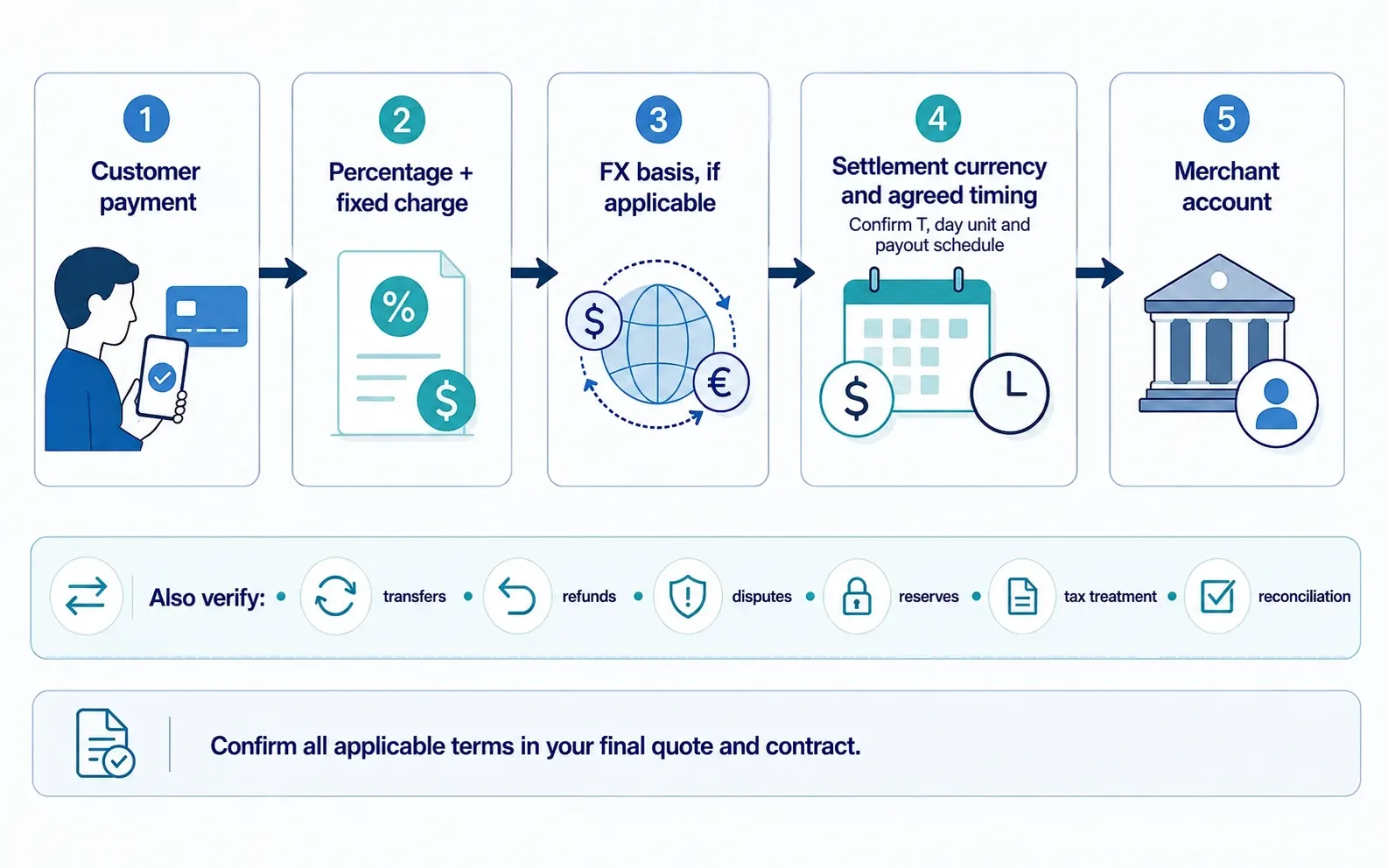
Current public platform starting points
Every item below is a general public platform term. None is a PayNow-specific or Singapore-account quote. For every item, actual pricing depends on the merchant entity, market, payment method, transaction volume, risk profile, contract and final quote.
Public term | Current published starting point | Scope boundary |
|---|---|---|
US card product | US-issued cards from 2.5% + US$0.30; non-US-issued cards from 4.0% + US$0.30 | US merchants contracting through HaiPay’s US entity; business and risk review required. Not a Singapore or PayNow quote. |
Local payment methods | From 1.2%, such as QRIS in Indonesia | Not a PayNow price. Confirm the method, FX and applicable taxes separately in the Singapore quote. |
Setup and annual fees | US$0 setup; US$0 annual fee | Confirm other account-specific charges in the quote. |
Monthly billing | No minimum monthly billing | This does not establish a US$0 monthly service fee. |
Processed refunds | US$0.30 per processed refund | Does not establish PayNow refund-route support or original-fee return rules. |
USD settlement wire | US$15 per wire | Intermediary bank fees are borne by the recipient; confirm the approved currency and payout arrangement. |
IC++ pricing | Request an itemized quote | Confirm eligibility and any processing-volume terms in writing. |
HaiPay’s public pricing page does not state a PayNow-specific rate, and it does not state the exact goods and services tax (GST) wording or percentage for a Singapore merchant quote. Request the tax line exactly as it will appear in the quote; do not add or infer a rate.
HaiPay’s public pricing page and Singapore API documentation do not state a Singapore-specific FX benchmark or outbound-FX range for this route. Ask which currency pair converts, when conversion occurs, which reference is used, and which spread or fee applies.
Settlement requires the same discipline. FAST-level transfer characteristics do not establish when a provider settles to a merchant. Require the final quote to state the settlement currency, T+N with an explicitly agreed starting event and day unit, cut-off, non-working-day treatment, transfer fee, reserve and review conditions.
See the current pricing page for public starting points. Use the integration planning guide to turn the commercial terms into test cases.
Source: Payment Gateway Pricing & Fees, verified 2026-08-28; FAST, verified 2026-08-28.
Merchant entity, underwriting and contract requirements
Payment-method availability begins with the legal entity, not the checkout logo. A global group may have several companies, but only the contracting merchant receives the approved account scope.
Prepare one underwriting pack for that entity. It may include incorporation records, beneficial-owner information, website and product details, fulfilment or service terms, refund policy, processing history and expected payment flows. The provider decides the actual requirements.
Ask these questions in writing:
- Which legal entity will contract with and invoice the merchant?
- Which merchant incorporation countries and settlement accounts are accepted for this Singapore route?
- Is a Singapore entity, UEN or local bank account required for the requested configuration?
- Which product categories, delivery models or transaction patterns require further review?
- Which payment methods will appear in the production account?
- Can the provider place a reserve, delay availability or request another review? Under which contract terms?
- How can the merchant challenge an onboarding or account decision?
- What happens to authorised, captured, refunded and unsettled transactions if access changes?
- Which support path handles a payment incident or funds-access issue?
For any regulatory claim, verify the exact legal entity and relevant activity in the MAS Financial Institutions Directory. A group brand, scheme participation or partner relationship should not be treated as a licence held by every entity.
Source: MAS Financial Institutions Directory, verified 2026-08-28; Payment Gateway Pricing & Fees, verified 2026-08-28.
Integration, refunds, disputes and reconciliation
Integration should be tested against the exact method and account. A provider may offer hosted checkout, plugins and APIs at platform level while exposing a narrower set for one configuration.
For PayNow, verify the full event chain:
- The merchant creates the order.
- The provider returns the approved customer payment flow.
- The customer completes or abandons the payment.
- The merchant receives and verifies the payment status.
- The merchant handles duplicate, delayed or failed events.
- The order and payment enter the reconciliation record.
The Singapore documentation publishes collection-application and query operations. The platform integration material also documents redirects, asynchronous notifications and reporting functions. However, the versioned Singapore API documentation and the SGD collection application API reference use conflicting PayNow request labels, and the general reporting material is not expressly PayNow-specific.
Engineering should therefore confirm the current request fields and test them in the approved environment. Do not build a production promise around a code sample until the provider reconciles the documentation.
Operational acceptance test
Scenario | Evidence to retain |
|---|---|
Successful payment | Provider reference, merchant order ID, amount, currency, verified status and time |
Customer abandonment | Final order state and retry behaviour |
Delayed or repeated notification | Idempotency result, retry sequence and final state |
Amount mismatch | Rejection or exception path and support owner |
Full or partial refund | Supported method, approval, fee, timing and resulting report entries |
Customer claim or dispute | Applicable process, evidence deadline, fee and escalation path |
Daily reconciliation | Report availability, field dictionary, time zone and exception handling |
Account review or hold | Contract basis, merchant notice, affected funds and escalation channel |
The Singapore API documentation and the SGD collection application API reference do not describe a PayNow-specific refund or dispute workflow. Treat both as contract and implementation questions. Platform-level reports may be useful, but confirm their fields and access for the approved Singapore route.
Source: Singapore API, V20260701, verified 2026-08-28; SGD collection application API reference, verified 2026-08-28; Integration Steps Guide, verified 2026-08-28; Common API, verified 2026-08-28.
Singapore PayNow Acceptance Evidence Matrix
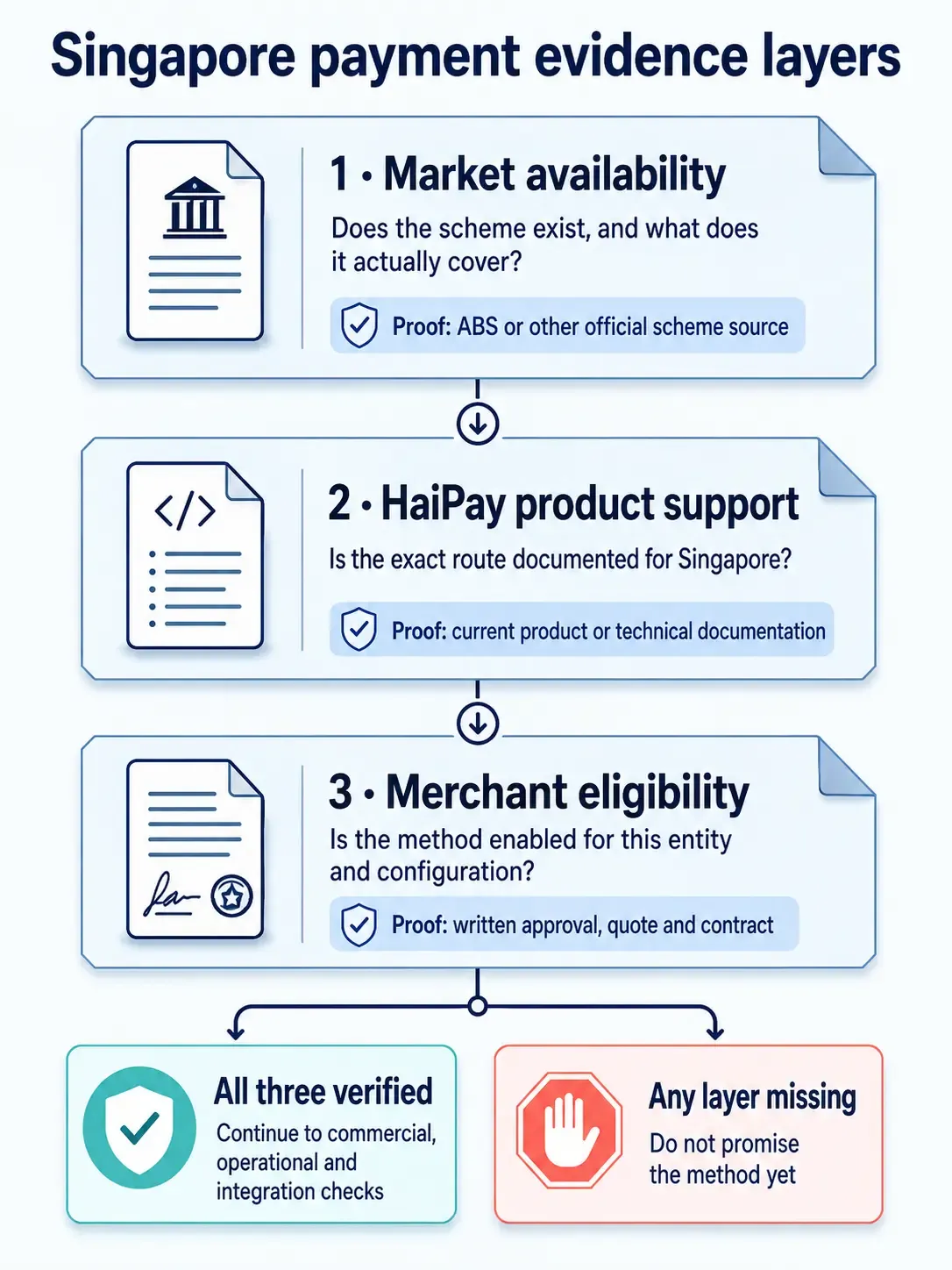
The matrix below records what each source layer proves. “Not established” means the public sources cited on this page do not support a merchant-facing promise.
Capability or decision criterion | Singapore market availability | Provider product evidence | Merchant eligibility requirement | Verified | Status |
|---|---|---|---|---|---|
Cards | Available through card providers, subject to provider scope | Public pricing page gives a card starting point | Eligible entity, card route, risk review and final quote | 2026-08-28 | Conditional |
PayNow | ABS documents an SGD service through FAST for participating institutions | Singapore pricing row and PAYNOW_SGD API route | Approved entity, app configuration and written activation | 2026-08-28 | Conditional |
Wallets | Separate payment methods; not proof of PayNow participation | Public Singapore table lists named wallets separately | Each wallet must be enabled in the approved account | 2026-08-28 | Conditional |
Bank-transfer coverage | PayNow has participating banks and major payment institutions | Public bank-transfer wording does not define a PayNow participant set | Written route and institution scope required | 2026-08-28 | Not established |
Presentment currency | PayNow market service is SGD | Public Singapore documentation lists an SGD route | Approved route, application identifier and amount limit | 2026-08-28 | Conditional |
Settlement currency | Not determined by scheme availability | The Singapore API documents SGD settlement for its SGD route and USD settlement for its USD route; your enabled route and settlement arrangement are confirmed in your quote. | Quote and contract must name currency and account | 2026-09-09 | Documented route currencies; account confirmation required |
FX benchmark | Not determined by PayNow | Not stated in public pricing or Singapore API documentation | Quote must name reference, pair, timing and charge | 2026-08-28 | Not established |
Settlement timing | FAST is infrastructure, not the provider-to-merchant schedule | Not stated in public pricing or Singapore API documentation; confirmed in your quote | Quote must state T+N with an explicitly agreed starting event and day unit and exceptions | 2026-08-28 | Not established |
Refund handling | Not defined by scheme existence | No PayNow-specific refund route established | Contract and route documentation required | 2026-08-28 | Not established |
Dispute handling | Card and PayNow processes are not interchangeable | No PayNow-specific process established | Contract must define claims, evidence and escalation | 2026-08-28 | Not established |
Integration | Provider-specific | Apply/query operations are public; platform notifications and reports exist | Conflicting request labels require engineering confirmation and testing | 2026-08-28 | Conditional |
Reconciliation | Provider-specific | Platform reports exist, but PayNow-specific fields were not established | Confirm identifiers, access, timing and exceptions | 2026-08-28 | Conditional |
Source: PayNow Singapore, verified 2026-08-28; Singapore API, V20260701, verified 2026-08-28; SGD collection application API reference, verified 2026-08-28; Common API, verified 2026-08-28; Payment Gateway Pricing & Fees, verified 2026-08-28.
Singapore Payment Gateway Selection Flow
Use this flow before requesting commercial terms. Keep each decision and its supporting evidence in the procurement record.
1. Which customers and channels must you serve?
- Online cards only: Verify cards, currencies and the checkout route.
- Singapore PayNow: Run the three-layer PayNow test.
- Wallets, in-person payments or several countries: Build a market-by-channel method matrix.
2. Does the required method pass all three layers?
- Document market availability.
- Document the provider route.
- Obtain written approval for the merchant account.
Stop condition: If any layer is missing, do not promise the payment method at launch.
3. Does the transaction model fit?
- Record volume, average transaction value and method mix.
- Model percentage and fixed charges separately.
- Check route limits and underwriting scope.
4. Do the money flows fit?
- Name the presentment and settlement currencies.
- Require the FX basis and complete quoted cost.
- Require the starting event and day-counting unit for T+N, plus reserve and hold terms.
5. Can operations close the order lifecycle?
- Confirm refund and customer-claim handling.
- Confirm status notifications and retry behaviour.
- Confirm reporting, reconciliation and escalation.
6. Can the exact integration be proven?
- Confirm the hosted, plugin or API route.
- Test the sandbox and production configuration.
- Resolve documentation conflicts before launch.
Decision
- Critical fields documented: Proceed to contract review and a controlled launch.
- Commercial fields missing: Request a written quote and account scope.
- Operational fields missing: Keep an alternative and delay the launch promise.
Where HaiPay may fit — and what still needs confirmation
The current public evidence makes HaiPay relevant to a Singapore shortlist where an international merchant needs cards and wants to assess PayNow SGD. The published technical ranges also point towards consumer-sized, frequent transactions rather than large-ticket B2B collection.
That is a shortlist conclusion, not an activation promise. Before selecting the service, obtain written confirmation for:
- the contracting entity and eligible business model;
- cards, PayNow and any separate wallets enabled for the account;
- presentment and settlement currencies;
- complete price, GST treatment and FX basis;
- settlement schedule, reserves and reviews;
- PayNow refund, customer-claim and reconciliation procedures;
- the exact integration route and resolved request fields;
- support and escalation ownership.
Review the local-payment product page and public pricing. Then request a Singapore acceptance review with your entity, payment mix, volume, average transaction value, currencies and operating requirements.
Source: Singapore API, V20260701, verified 2026-08-28; International credit-card API documentation, verified 2026-08-28; Payment Gateway Pricing & Fees, verified 2026-08-28.
Editorial disclosure
This guide is published by HaiPay and evaluates the company’s public product materials. It uses a requirement-led method, not a provider ranking. Sources and product data were checked on 28 August 2026. Availability and commercial terms remain subject to merchant approval and the final contract. This guide is general information, not legal, tax, financial or investment advice.
Sources
- PayNow Singapore. Association of Banks in Singapore. Accessed 28 August 2026. Supports the SGD/FAST description, proxy types, PayNow Corporate context and participating-institution terminology.
- Singapore Quick Response Code (SGQR) factsheet. Infocomm Media Development Authority. Accessed 28 August 2026. Supports the distinction between SGQR as a standardised label and the schemes it can display.
- Financial Institutions Directory — Payments. Monetary Authority of Singapore. Accessed 28 August 2026. Supports the instruction to verify a named legal entity and activity in the official directory; it does not establish a licence claim for the provider.
- Singapore API, V20260701. HaiPay. Accessed 28 August 2026. Supports the public PAYNOW_SGD route, SGD 1–3,000 range, and collection/query field description.
- Payment Gateway Pricing & Fees. HaiPay. Accessed 28 August 2026. Supports the public starting points and quote-dependent scope stated in the cost section.
- International credit-card API documentation. HaiPay. Accessed 28 August 2026. Supports the US$0.99–US$1,000 range for the documented USD international-card route only.
- HaiPay Integration Steps Guide. HaiPay. Accessed 28 August 2026. Supports the platform integration sequence and notification concepts, subject to route configuration.
- Common API. HaiPay. Accessed 28 August 2026. Supports the existence of platform reporting and reconciliation functions, not their availability for every PayNow account.
- SGD collection application API reference. HaiPay. Accessed 28 August 2026. Supports the documented ONLINE_BANKING / PAYNOW request example used to identify the conflict with the versioned Singapore table.
- FAST (Fast and Secure Transfers). Association of Banks in Singapore. Accessed 28 August 2026. Supports the rail-level context used to distinguish FAST infrastructure from the provider-to-merchant settlement schedule.
Source: HaiPay pricing and settlement guidance, accessed October 16, 2026. Account-specific availability, pricing and settlement arrangements are confirmed in the merchant quote.
FAQ
It is the checkout and transaction layer that sends payment information into an approved payment route and returns a result to the merchant. A complete merchant arrangement also includes onboarding, acquiring or processing, settlement, refunds, disputes and reconciliation.
Possibly, but Singapore market availability is not account approval. The provider must document the PayNow route, accept the contracting entity and enable the method for that merchant’s production configuration.
No. PayNow is a Singapore-dollar transfer service. SGQR is a standardised QR label that can contain one or more payment schemes. Check the scheme shown and the provider route being used.
No such conclusion should be made. The card starting price and local-method starting point are separate public platform terms. The final quote must identify the exact Singapore method, entity, volume, risk profile and contract terms.
Model percentage and fixed transaction charges separately, then add supported FX, transfer, refund, dispute, reserve and account terms. Include the internal cost of manual payment confirmation and reconciliation.
PayNow’s existence does not prove a provider workflow. Confirm the exact payment-status, notification, retry, report and order-matching design for the approved route.
Send the contracting entity, incorporation country, business model, monthly volume, average transaction value, customer markets, payment-method mix, currencies, integration platform and post-payment requirements.

Related HaiPay surfaces
Explore the payment stack
Guide
International Payment Gateway
Compare international gateway options by eligibility, payment methods, currencies, settlement, integrations, and operational fit.
Guide
Local Acquiring vs Cross-Border Acquiring
Compare local and cross-border acquiring by merchant entity, routing, settlement, acceptance, and operational trade-offs.
Product
Credit Card Acceptance
Explore HaiPay’s card acceptance solution and confirm Singapore eligibility, settlement, operations, and contract terms for your business.
Product
Local Payment Methods
Explore local payment options and confirm current method availability for your target markets, customers, and currencies.

Need help mapping your payment stack?
Talk to HaiPay about acquiring, orchestration, local methods, and payout workflows.
Contact us