
Direct Answer
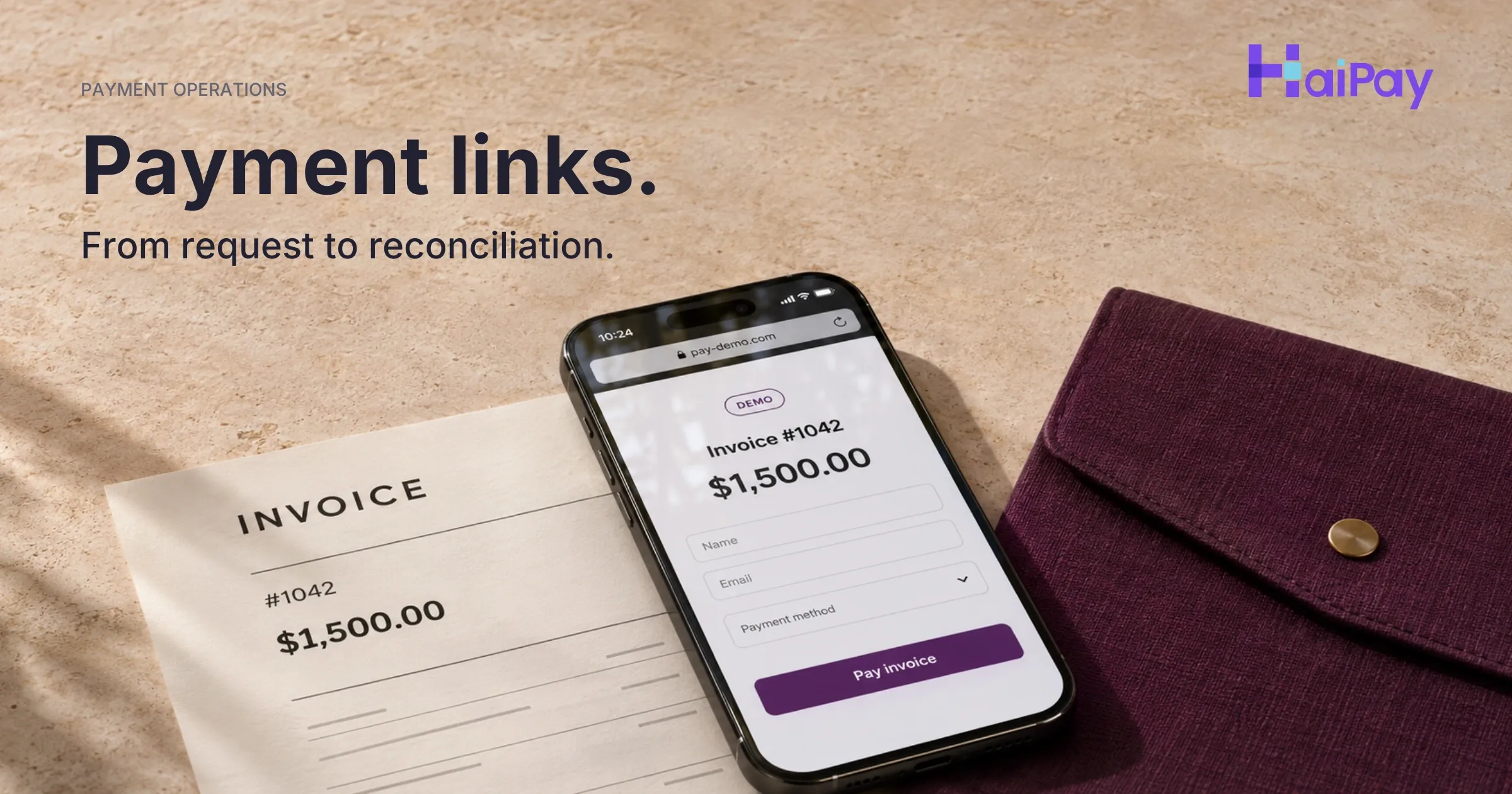
A payment link, or pay by link, is a merchant-generated checkout address for collecting payment remotely without a website storefront. Buyers open the link in an email, message, or scannable quick-response code and pay on a page the provider hosts. Depending on setup, the link expires immediately after one payment or stays active for repeated manual orders.
Pay by Link vs. Checkout, Subscriptions, and Invoices
A link opens a payment gateway, relaying card or bank data without storefront code. Invoicing is a billing workflow, not a standalone payment product.
Collection Mode | Trigger and Reuse Rule | Primary Use Case |
|---|---|---|
One-Time Payment Link | Expires once paid | Custom quotes, invoices |
Reusable Payment Link | Allows repeat clicks | Fixed-price items |
Hosted Payment Page | Storefront checkout | Multi-item carts |
Automated Subscription | Scheduled charges | Recurring plans |
Source: Payment Links Guide; Payment Gateway; Hosted Payment Page; Subscription Billing; Stripe Docs, "Accept payments online without writing code"; Global Payments, "Pay by Link - Overview", accessed 2026-11-17.
Pay by Link vs. Consumer Link.com
Merchants also call pay by link a payment request link or link payment. By contrast, Link.com is Stripe's consumer digital wallet serving more than 300 million consumers for card autofill. Buyers need no Link.com wallet.
Source: Link, "Link: A smarter way to pay" (more than 300 million consumers); GoCardless, "What are Link Payments? Your Complete Guide to Understanding and Using Them" (aliases), accessed 2026-11-17.
Single-Use vs. Reusable Link Controls
In HaiPay Payment Links, One-Time links expire once paid, while Reusable Recurring Payment Links accept repeat clicks. Scheduled auto-charges belong on subscription billing, and carts belong on hosted checkout.
Uncapped reusable links invite duplicate transfers and card testing (fraudulent probes). Adyen defaults links to 24 hours, sets a 70-day cap, expires links after five failed attempts, removes links after three months, and bars sole-checkout shop use. See our payment links guide for fees and reconciliation.
Source: Payment Links, Subscription Billing, Hosted Payment Page; Adyen Docs, "Create payment links" (24h/70d/5-attempt limits); Adyen Docs, "Pay by Link" (removal, sole-checkout rule), accessed 2026-11-17.
Security and PCI DSS Responsibility
Hosted links tokenize cards (replacing raw card numbers with payment tokens) and support 3-D Secure (3DS), a cardholder authentication protocol. Outsourcing lowers PCI DSS (Payment Card Industry Data Security Standard) scope without removing accountability. PCI DSS requires written agreements (Requirement 12.8.2) and annual monitoring (12.8.4), while acquirers or payment brands set validation, typically Self-Assessment Questionnaire A (SAQ A).
Source: Payment Links; 3-D Secure (3DS); PCI DSS Compliance; Stripe, "How to accept payment by link"; PCI Security Standards Council, "Does PCI DSS apply to merchants who outsource all payment processing operations and never store, process or transmit cardholder data?" (Req 12.8.2, 12.8.4, SAQ A), accessed 2026-11-17.
Disclosure: Informational content published by commercial payment provider HaiPay, verified 2026-11-17. Not investment, legal, tax, or compliance advice; provider agreements and acquirer rules govern.
FAQ
A seller creates a payment link in a provider dashboard or application programming interface (API) with the amount, currency, and order reference. The seller sends that web address or scannable quick-response code via email, invoice, or chat. When the buyer pays on the provider-hosted page, confirmation triggers before funds settle.
No. Pay by link is a merchant-generated checkout web address sent to collect payment for an order or fixed-price item. By contrast, Link.com is Stripe's consumer digital wallet that saves buyer cards and bank details for autofill checkout. Customers do not need a Link.com wallet account to pay a merchant payment link.
A one-time payment link becomes invalid once the customer completes payment, preventing accidental repeat charges on bespoke quotes. A reusable payment link stays active across multiple manual buyer checkouts for fixed-price items. Neither link mode auto-debits stored cards on a schedule; automated recurring cycles require dedicated subscription billing.
Legitimate links open an encrypted provider-hosted checkout using tokenization (replacing raw card numbers with tokens) and 3-D Secure where risk rules or European Strong Customer Authentication mandates apply. Buyers should verify the domain, and outsourcing never removes Payment Card Industry Data Security Standard accountability. Written agreements (Requirement 12.8.2), annual monitoring (12.8.4), and acquirer-confirmed validation—typically Self-Assessment Questionnaire A—still apply.

Sources
Related terms
Acquiring and settlement
Payment Gateway
A payment gateway is technology that passes payment information from a business's checkout to the systems that process the transaction.
Risk and compliance
Chargeback
A chargeback is a forced reversal of a card transaction initiated by the cardholder through their issuer, usually citing fraud, non-delivery, or billing disputes, and debited from the merchant through the acquirer.
Cross-border and FX
Cross-Border Payment
A cross-border payment is a transaction where the payer, merchant outlet, or payment route spans more than one country or jurisdiction, while currency conversion remains a separate event.
Usage Guide
 Read Guide
Acquiring Decisions
Payment Links (Pay by Link): Cross-Border Fees, 3-D Secure (3DS2) Risk & Reconciliation Guide

Need help mapping your payment stack?
Share no-code links for invoices, social sales, and one-off collections.
Contact Us