


3D Secure Payment Gateway: Merchant Setup and Testing
Reviewed by WeiJun Tang










Last updated: September 8th, 2026
Insights
Treat authentication and authorization as separate states.
- Authenticate: Receive a documented frictionless, challenge, failed, or unavailable result.
- Interpret: Apply the provider-approved action; never infer liability from a generic label.
- Authorize: Wait for the issuer's final approved or declined payment result.
- Confirm: Fulfil only after the server confirms the authoritative final state.
- Record: Link the order, 3DS reference, timestamps, authorization result, and fulfilment state.
A browser return is navigation—not final payment proof. Test abandonment, mobile return, delayed webhooks, retries, and duplicate-order protection before launch.
A 3D Secure payment gateway connects checkout to issuer-led cardholder authentication before payment authorization. The issuer may authenticate the shopper without interaction—a frictionless flow—or ask for a challenge such as a banking-app approval, biometric check or one-time passcode.
The distinction that matters most is this: 3D Secure authenticates the shopper; it does not approve the payment. An authenticated transaction can still be declined for funds, card status or another authorization reason. And although 3DS may shift liability for certain fraud disputes, it does not prevent every chargeback or replace evidence that the merchant delivered what was sold.
This guide turns those boundaries into an implementation and testing plan for merchants.
What a 3D Secure payment gateway actually does
EMV 3-D Secure, usually shortened to EMV 3DS or 3DS, is a protocol used to authenticate consumers in card-not-present payments. If you only need the short definition, see HaiPay's 3-D Secure glossary entry. In an implementation, the payment gateway or another 3DS service connects the merchant's checkout to the card issuer's authentication environment.
The protocol is called “three-domain” secure because it coordinates three sides of the ecosystem:
- The merchant/acquirer side, which starts authentication and supplies transaction, payment and device context.
- The interoperability side, which routes the authentication message to the appropriate card issuer environment.
- The issuer side, which evaluates the request and, when needed, asks the cardholder to complete a challenge.
EMVCo's protocol overview describes EMV 3DS as a way for merchants and issuers to exchange transaction, payment-method and device information so that the issuer can authenticate the consumer. The specification supports browser and app purchases, multiple challenge methods and non-payment messages such as account verification.
A payment gateway can package this complexity behind an API or hosted checkout. The merchant still decides when an order may be fulfilled, what customers see after a failed or abandoned challenge, how retries are linked, and what evidence is retained.
Authentication is not authorization
The cleanest 3DS implementation uses two separate state machines.
Stage | Question answered | Typical decision-maker | What the merchant must wait for |
|---|---|---|---|
Authentication | Is the person using the card sufficiently verified for this transaction? | Card issuer's authentication system | A formal authentication outcome from the provider |
Authorization | Can this card transaction proceed? | Card issuer through the card-payment network | The final approved or declined payment status |
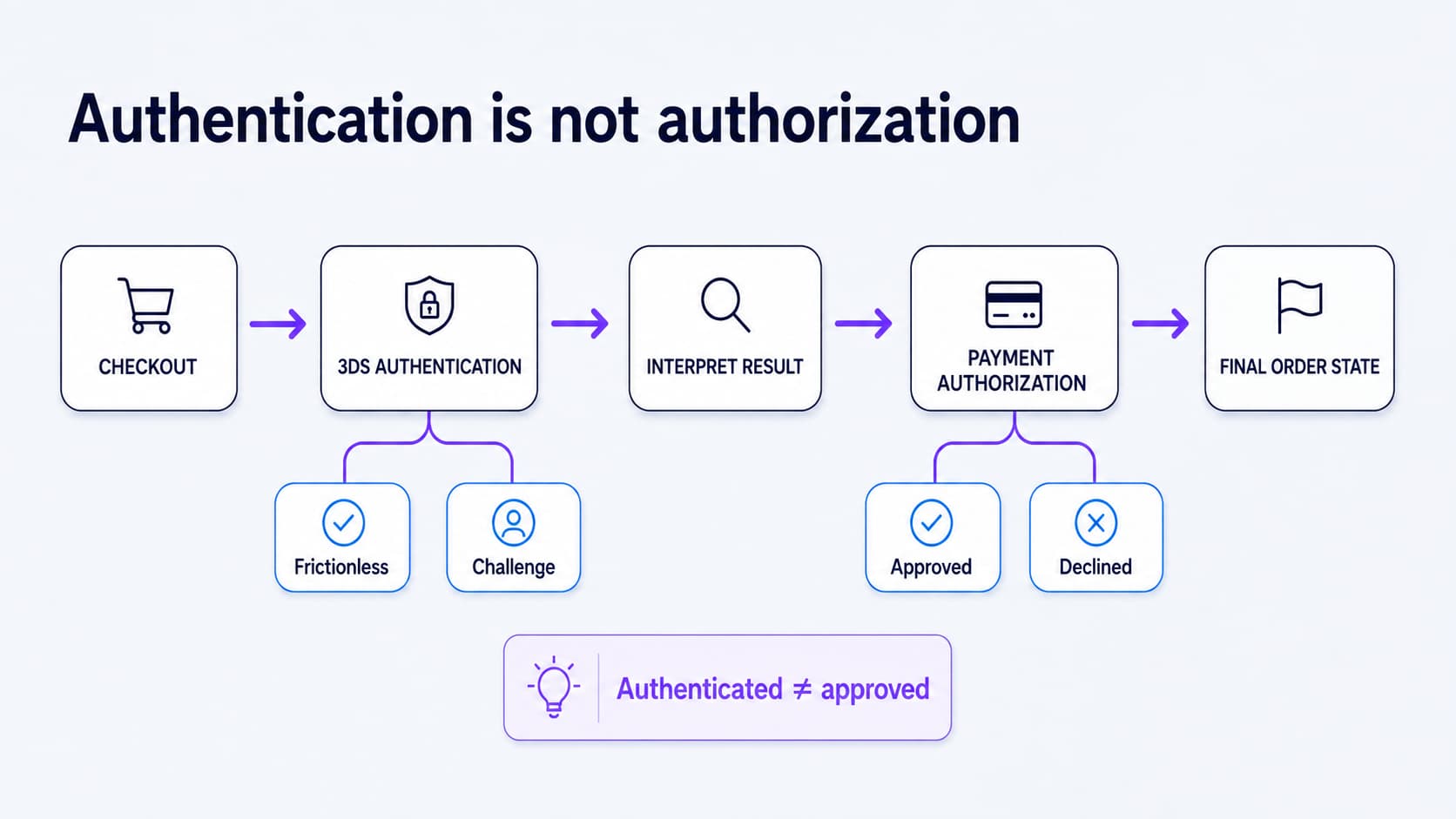
After authentication, the payment authorization can still fail. The issuer may decline because of insufficient funds, an expired or restricted card, velocity controls, or another reason unrelated to the shopper's identity. That is why a customer-facing message should not say “3DS failed” when authentication succeeded but authorization was declined. For the second-stage reasons and recovery choices, use the credit card decline codes guide.
The separation also protects fulfilment. A browser can return from a challenge before your server has a reliable final payment result. Treat that return as a navigation event, not proof that money was authorized. Release goods, access or account credit only after your server confirms the provider's authoritative final payment state.
This rule prevents one of the most expensive integration errors: marking an order paid because a modal closed or a success URL loaded while the underlying payment remained incomplete.
How frictionless and challenge flows work
EMVCo describes two primary EMV 3DS customer experiences.
Frictionless flow
The issuer assesses the authentication request using the available transaction, account, payment and device context. If it can authenticate the consumer without asking for another action, the shopper may only see a brief processing state—or no visible interruption beyond normal checkout.
“Frictionless” does not mean authentication was skipped. It means the issuer completed its assessment without a cardholder challenge.
Challenge flow
If the issuer needs more evidence, it can ask the cardholder to complete a challenge. Examples in EMVCo's 3DS whitepaper include a one-time passcode, knowledge-based questions, biometrics and other methods. The exact method and interface are controlled by the issuer and scheme program, not solely by the merchant.
For Visa Secure specifically, Visa's user-experience guidance covers modal and full-page challenge presentations and recommends layouts that adapt to the device. That is a Visa-program example, not a universal rule for every network or gateway. Your checkout must follow the integration method and permitted screen behavior supplied by your provider.
For either path, preserve one order and payment attempt across authentication, return and authorization. Wait for the formal result, and show a recoverable next step if the customer cannot continue.
How to interpret 3DS outcomes without guessing
Gateways expose different status names and fields. Do not copy an enum from one provider and treat it as a network-wide standard. Instead, map your provider's documented values into a small set of operational outcomes.
Normalized outcome | What it means operationally | Safe merchant action |
|---|---|---|
Authenticated | The provider reports completed authentication | Submit or continue authorization as documented; still wait for final payment approval |
Challenge required / pending | The issuer requests cardholder interaction or the interaction is still open | Keep the order pending; render or redirect to the supported challenge; do not fulfil |
Failed / rejected | The provider reports that authentication did not complete successfully | Do not call the order paid; show a retry or alternative-payment route according to provider policy |
Unavailable / unable | Authentication could not be completed because a participant or service was unavailable | Apply the provider/acquirer-approved policy; record the condition and do not assume liability shift |
Attempted | Authentication was attempted but the issuer/cardholder was not fully authenticated | Confirm the provider's network-, region- and transaction-specific liability interpretation before proceeding |
Unknown / no final state | The application cannot reconcile browser and server events | Poll or retrieve the payment server-side; hold fulfilment and escalate with trace evidence |
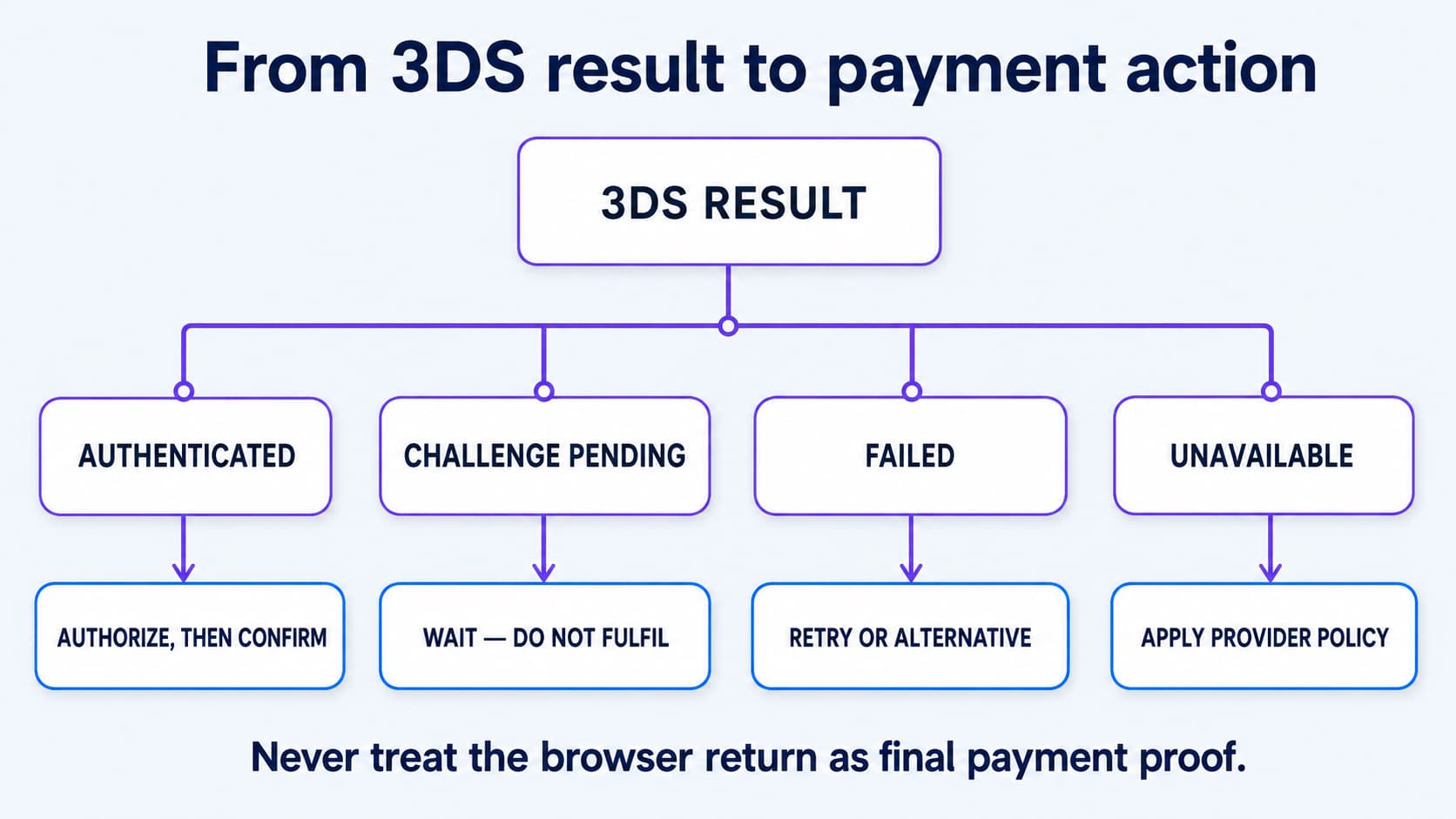
The table deliberately avoids universal electronic commerce indicator (ECI), cryptogram or authentication-status mappings. Those values matter, but their interpretation depends on the card network, protocol version, provider implementation and transaction context. Your integration specification—not a generic blog post—must be the source of truth for exact fields.
The useful engineering pattern is:
Authenticate → interpret the documented result → authorize → confirm final payment state → record and reconcile.
Each transition should be idempotent. If the customer refreshes, uses the back button or returns twice from a banking app, the same logical payment attempt must not create a second charge or a second fulfilled order.
What liability shift does—and does not—cover
Liability shift is often described too broadly. A careful merchant model starts with four limits.
- It is a card-network rule, not an automatic property of the EMVCo protocol. EMVCo defines interoperable authentication; card networks and participants define commercial and dispute treatment.
- It applies only when the relevant conditions are met. These can vary by network, region, merchant category, transaction type, authentication outcome and how the result enters authorization.
- It generally concerns applicable fraud disputes. Authentication does not prove that the merchant shipped an item, provided a service, disclosed recurring terms or issued a promised refund.
- A displayed “success” is not enough. The provider must recognize the authentication outcome, and the required authentication data must be carried through the payment flow correctly.
Use this pre-launch liability checklist:
- Which card networks and issuer countries are in scope?
- Which authentication outcomes does the provider classify as protected?
- Are there exclusions for the merchant category, transaction type or program?
- How are exemptions, attempted authentication and unavailable outcomes treated?
- Which fields or dashboard indicators prove the provider recognized the result?
- What evidence must be retained for a later dispute?
- Does the protection cover only fraud, or does the provider documentation describe anything else?
Do not market 3DS internally as “chargeback protection.” Describe it as an authentication control that may change liability for eligible fraud disputes under the applicable rules.
Visa's Dispute Management Guidelines for Visa Merchants say participating merchants can be protected from certain fraud-related disputes when transactions are processed correctly, while warning that Visa Secure liability-shift rules may vary by region. Confirm the current rule with your acquirer.
If a dispute occurs, the merchant still needs a process for notices, deadlines, evidence and representment. See the chargeback process guide and the separate overview of chargeback reason codes.
3DS, PSD2 and Strong Customer Authentication
Three terms are often collapsed into one:
- PSD2 and its regulatory technical standards create legal and regulatory obligations in scope.
- Strong Customer Authentication (SCA) is an authentication requirement based on two or more independent elements drawn from knowledge, possession and inherence.
- EMV 3DS is a protocol that can support SCA for online card payments.
The European regulation also includes requirements for authentication codes and, in relevant remote-payment cases, dynamic linking to the amount and payee. The rules include exemptions and distinctions between transaction contexts.
The practical conclusion is not “every European payment must show an OTP.” A transaction can be authenticated without a visible challenge. Whether SCA, an exemption or an out-of-scope treatment applies depends on the participants and transaction facts. Merchants should let their payment provider handle the supported regulatory flow and should obtain legal or compliance advice for their specific model. This article is not legal advice.
Data quality and checkout design affect the result
The issuer's risk assessment is only as useful as the context it receives. EMVCo's frictionless-flow guidance explains that browser/device data and accurate merchant-supplied information support the issuer's analysis; incomplete or placeholder information can contribute to more challenges or unsuccessful authentication.
3DS also does a different job from AVS and CVV. Those checks provide address or card-security-code signals during the payment flow; they do not perform issuer-led cardholder authentication. Keep the controls distinct in your risk rules. For the detailed response-code and mismatch workflow, use the guide to AVS response codes and mismatches.
This does not justify collecting arbitrary data. Send the fields required or recommended by your approved integration, explain data use in the appropriate privacy notice, and comply with applicable privacy and security obligations. More data is not automatically better; complete, accurate and properly governed data is better.
For checkout design, focus on continuity:
- Keep the customer on a recognizable order journey before and after the issuer-controlled step.
- Preserve the order identifier across redirects, app switching and webviews.
- Use a clear processing state while the application waits for the server result.
- Explain what the shopper can do after a timeout, failure or abandonment.
- Offer a documented retry or alternative payment method without duplicating the original order.
- Test keyboard, screen-size and mobile return behavior for the integration you use.
Avoid adding merchant branding inside issuer-controlled content unless the scheme and provider explicitly support it. The best experience is a reliable transition, not a challenge screen made to look like your own checkout.
3DS launch acceptance tests
A sandbox success with one test card is not a launch gate. Production behavior varies by issuer, device, browser, webview and transaction. Before pilot traffic, run at least the following tests.
Core flow tests
- Frictionless authentication: confirm that the server receives the outcome and still waits for authorization.
- Successful challenge: confirm that browser return, server notification and payment retrieval converge on one final order state.
- Failed challenge: confirm that the order is not marked paid and that the customer receives a useful recovery option.
- Abandoned challenge: close the modal or page and verify that the order stays unpaid or recoverable.
- Authentication unavailable: simulate or use the provider's test path and confirm the approved policy is applied.
- Authenticated but authorization declined: verify that the message describes a payment decline, not an authentication failure.
Browser and order-integrity tests
- Test mobile Safari, mobile Chrome, in-app webviews and the desktop browsers used by your customers.
- Switch to a banking app and return; then repeat with the original tab closed or backgrounded.
- Refresh, double-click, use the back button and submit the return route twice.
- Delay the server notification so that the browser return arrives first.
- Retry with the same card and another card; verify that each attempt is traceable to the same order without double fulfilment.
- Confirm that client-side parameters cannot change the amount, currency, order owner or “paid” state.
Operational tests
- Give support only an order ID, approximate time and customer email, then verify that the team can find the authentication and authorization records.
- Export or retrieve the evidence needed to explain whether the failure occurred before authentication, during challenge, after return or at authorization.
- Run a monitored pilot across priority issuer countries, devices and browsers before expanding traffic.
The package for this guide includes a downloadable 3DS rollout acceptance-test matrix and a rollout readiness checker. Treat completion of the checklist as the beginning of a pilot, not proof that every issuer path will work.
Build an authentication-to-authorization evidence ledger
When a customer says “3DS failed,” support needs more than a screenshot. Store enough linked evidence to locate the break without retaining prohibited card credentials.
Evidence group | Minimum useful record |
|---|---|
Merchant context | Order ID, customer/account reference, amount, currency, attempt number |
Provider context | Payment reference, 3DS/authentication reference, environment |
Authentication | Request and completion time, browser/app channel, frictionless/challenge path, normalized outcome |
Challenge | Presented, completed, failed, timed out or abandoned; return event time |
Authorization | Request time, approved/declined result, provider or issuer decline code where available |
Final state | Authoritative payment status, fulfilment status, refund/cancellation status |
Diagnostics | Issuer country or BIN country where permitted, device/browser class, provider trace or correlation ID |
Use access controls and retention rules appropriate to payment and personal data. The ledger is an operational index, not a reason to store sensitive authentication data or complete card details.
With this record, a team can answer four separate questions:
- Did authentication start?
- Did the issuer request and complete a challenge?
- Did authorization run, and what was its result?
- Did the order system interpret the final status correctly?
That is much more actionable than a single “incomplete” label.
Troubleshooting failed or incomplete 3DS payments
Start with the symptom, then locate the layer.
Customer or dashboard symptom | Likely layer to inspect | Evidence to collect | Next step |
|---|---|---|---|
No challenge appears after Buy | Browser integration, content blocking, provider response or issuer availability | Browser console/network log, payment reference, timestamp, device/browser | Reproduce on supported browsers; check whether an authentication request and challenge URL/result were returned |
Challenge opens blank or cannot resize | Browser/webview, iframe/modal policy or issuer UI | Screen recording, browser/webview version, request reference | Compare full-page vs supported modal behavior; escalate with provider trace |
Customer approved in banking app but checkout remains pending | Return/deep-link handling or missing server reconciliation | App/browser timestamps, return event, webhook/event log, retrieved payment state | Retrieve state server-side; fix resume and reconciliation logic |
“Authentication failed” | Cardholder challenge, issuer decision or provider mapping | Formal authentication outcome and provider reason—not only UI text | Offer a safe retry/another method; do not fulfil |
“Attempt incomplete” | Abandonment, timeout, navigation or unreconciled state | Challenge start/end, order and session history, server events | Distinguish true abandonment from a lost callback before changing risk policy |
Authentication succeeded but payment was declined | Authorization | Authentication result plus authorization decline code | Use the authorization recovery path and decline-code guidance |
Customer was charged or sees a hold but order is unpaid | Authorization/capture/order reconciliation | Final payment state, capture status, order events | Reconcile server-side and explain pending authorization accurately |
Multiple charges or orders | Retry/idempotency defect | Attempt IDs, idempotency keys, webhook deliveries, fulfilment events | Stop fulfilment, deduplicate safely and correct retry design |
Provider documentation often asks for a payment or checkout reference, merchant reference, approximate timestamp, environment and final status when escalating. Capture these before asking the customer to retry repeatedly.
Do not “solve” a failure cluster by immediately disabling 3DS or forcing challenges for every transaction. First segment the failures by issuer country, issuer, device/browser, authentication path and authorization result. A cluster at one browser return path needs an integration fix; a cluster after successful authentication may be an authorization or traffic-quality problem.
3DS for subscriptions and off-session payments
Recurring payments need an explicit design for the first customer interaction and later charges. The initial customer-initiated payment or credential setup may establish the relationship used for later merchant-initiated or off-session transactions. But the exact rules, data and recovery behavior vary by market, network, issuer and provider.
Do not assume “the customer authenticated once, so every renewal will succeed.” Later payments can still be declined, and some situations can require customer action. Test:
- Initial setup or payment with a frictionless result.
- Initial setup or payment with a challenge.
- A later off-session approval.
- A later decline that needs an ordinary retry.
- A later payment that requires the customer to return and authenticate.
- Plan changes, add-ons, amount changes and a newly issued card.
- Cancellation, refund and duplicate-invoice prevention.
Confirm how your provider represents the initial credential relationship, later transaction type and customer-recovery link. Do not hard-code a universal exemption rule from one gateway's API.
How to evaluate a 3D Secure payment gateway
A good provider conversation should go beyond “Do you support 3DS?” Ask:
- Which EMV 3DS versions, browser flows, mobile SDKs and card networks are supported for our markets?
- Is authentication embedded in the payment integration or implemented as a separate step?
- How do we request authentication, express a challenge preference or leave the decision to the provider?
- Which response fields represent authentication, challenge, liability and final payment status?
- How should each status map to authorization, retry, alternate payment and fulfilment?
- How are browser return, server notification, retrieval and idempotency expected to work together?
- Which test scenarios cover frictionless, challenge, failure, unavailability and authenticated authorization decline?
- How are recurring, merchant-initiated and customer-recovery flows represented?
- Where can operations see the authentication trace, and what references should support provide?
- Under which network, region, merchant-category and transaction conditions does the provider recognize liability shift?
Compare the answers with your own order-state model and acceptance-test matrix. The best 3DS gateway is not the one with the shortest feature claim; it is the one your team can implement, observe, recover and audit correctly.
If you are evaluating cross-border card acceptance, ask HaiPay to map the authentication, authorization, callback and dispute-evidence flow for your priority markets. Confirm current capabilities and commercial terms for your specific integration before making a rollout decision.
Scope and disclosure
This guide was researched against primary standards, scheme/regulatory material and clearly labelled provider documentation available on September 4, 2026. Provider fields, network programs and regulatory treatment can change. Verify current requirements with your payment provider, acquirer and qualified legal or compliance adviser.
HaiPay provides payment services and may have a commercial interest when readers evaluate payment providers. The operational checklists are educational and do not guarantee authorization, fraud prevention, regulatory compliance or liability shift. This content is general information, not legal, financial or compliance advice.
Source notes
- EMVCo, EMV 3-D Secure and the EMV 3DS whitepaper introduction; accessed 4 September 2026.
- Visa, EMV 3DS User Experience Guidelines; accessed 4 September 2026.
- Visa, Dispute Management Guidelines for Visa Merchants, June 2024.
- Commission Delegated Regulation (EU) 2018/389, especially Articles 4–5; accessed 4 September 2026.
- EMVCo, Improving Risk Analysis and Frictionless Flow — Technical Features; accessed 4 September 2026.
FAQ
A 3D Secure payment gateway connects an online checkout to issuer-led cardholder authentication before payment authorization. The issuer may authenticate the shopper without interaction or request a challenge. The gateway then returns the documented authentication result so the merchant can continue the payment flow safely.
No. EMV 3-D Secure is an authentication protocol. A payment gateway is a service layer that can integrate the protocol into checkout, expose the result, and pass the transaction into authorization. The exact 3DS fields and workflow vary by gateway or acquirer.
In a frictionless flow, the issuer authenticates the shopper using the available transaction, account, payment, and device context without asking for another action. In a challenge flow, the issuer asks the shopper to complete an additional step, such as a banking-app approval, biometric check, or one-time passcode.
No. Authentication and authorization are separate. A shopper can complete 3DS successfully and the issuer can still decline authorization because of funds, card status, velocity controls, or another payment reason. Merchants should wait for the authoritative final payment status before fulfilling an order.
No. 3DS may change liability for certain eligible fraud disputes when the applicable network, regional, merchant-category, transaction, and processing conditions are met. It does not prove fulfilment or eliminate disputes about delivery, quality, cancellation, duplicate billing, or refunds.
Do not assume every payment must show a 3DS challenge. EMV 3DS can support Strong Customer Authentication, while the applicable PSD2/SCA treatment depends on the transaction and participants, including possible exemptions or out-of-scope cases. Confirm the current flow with your payment provider and qualified adviser.
The break can occur before the challenge loads, during cardholder authentication, while returning from a banking app, during server reconciliation, or later at payment authorization. Diagnose it using the order ID, payment and authentication references, timestamps, browser or device, formal authentication outcome, authorization result, and final order state.
Test frictionless, successful challenge, failed challenge, abandonment, unavailability, mobile app return, browser back and refresh, duplicate callbacks, delayed webhooks, retries, and authenticated transactions that later decline. Fulfilment should remain blocked until the server confirms the final payment state.
The initial customer interaction can establish the payment-credential relationship used for later charges, but later transactions can still be declined or require customer action. The exact recurring, merchant-initiated, exemption, and recovery behavior varies by market, network, issuer, and provider, so it must be tested and confirmed for the integration.
Not universally. Attempted and unavailable outcomes are interpreted under the relevant card-network, regional, transaction, and provider rules. Merchants should use the provider's documented liability indicator and confirm the applicable protection with their acquirer rather than infer it from a generic status label.
