QR Code Payments: Static vs. Dynamic Modes, Global Rails & Security
Reviewed by Wesley Wang


Last updated: November 18th, 2026
How QR Code Payments Work Across Payment Links and Local Rails
A quick response (QR) code payment lets buyers scan a matrix barcode to open a payment link or confirm a bank transfer.
Cameras suit hosted card links; local bank rails require authenticated apps. Dynamic codes lock amount and reference for automated reconciliation. Push rails lack card chargebacks, so teams align rail choice, payout speed, and tamper checks.
Quick-response (QR) code payments speed retail and chat checkouts. Yet static signs require manual screenshot checks, while tampered decals steal credentials.
Masahiro Hara invented QR codes in 1994 at DENSO WAVE (later standardized under International Organization for Standardization, ISO, 18004). Teams pairing payment links with local rails separate web checkouts from bank transfers.
How QR Code Payments Work: MPM, CPM, and URL Payment Links
EMVCo (the EMV card-standards body) published EMV QR Code Specification for Payment Systems (QRCPS) v1.1 on 27 November 2020 for Merchant-Presented Mode (MPM) and Consumer-Presented Mode (CPM).
Sellers show codes in MPM; buyers show codes in CPM. EMVCo warns phone operating system (OS) cameras generally fail on EMVCo MPM payloads holding banking tags instead of a Uniform Resource Locator (URL).
- URL Link QR: Encodes a Hypertext Transfer Protocol Secure (HTTPS) URL via HaiPay Payment Links for browser cards, wallets, or local methods. See how to create a payment link for parameter locks.
- EMVCo MPM & Bank Push: EMVCo tag-length-value (TLV) tags power Quick Response Code Indonesian Standard (QRIS), Pix, PromptPay, PayNow, and VietQR; in the US, American National Standards Institute (ANSI) X9.150 covers account-to-account (A2A) bank QRs.
- EMVCo CPM Scan: Buyer apps show codes to point-of-sale (POS) optical scanners for fast transit and retail (Bank Indonesia QRIS CPM; Vietnam customer-presented standard
TCCS 04:2024).
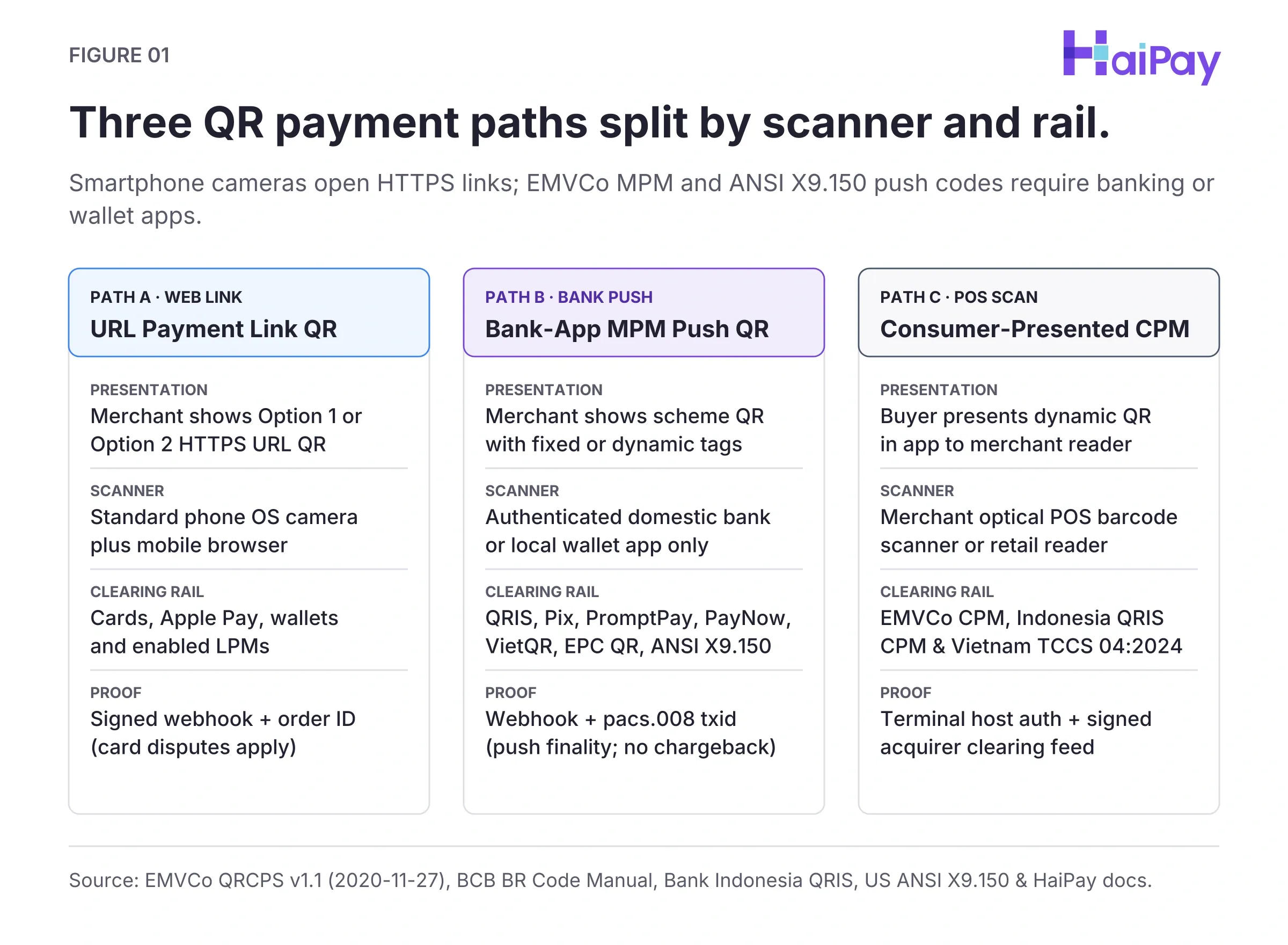
Figure 1: Three QR paths comparing scanner apps and payloads. Open full-size diagram.
Source: EMVCo "EMV® QR Codes" (v1.1, 2020-11-27); Bank Indonesia "QRIS" (CPM); US ANSI X9.150 & Payment Links (2026-11-17).
Static vs. Dynamic vs. Composite QR Codes and EMV TLV Structure
Short-link QRs only route clicks. Dynamic payment QRs bind currency, amount, and a transaction identifier (txid) to one order.
Under Banco Central do Brasil (BCB) BR Code Manual v2.0.0, EMVCo MPM uses TLV fields. Static codes allow buyer-entered or preset values, though printed signs invite tampering.
- Reuse (00–01):
Tag 00sets"01"; optionalTag 01=12sets single-use expiry. - Routing (26–51): Sub-tag
00sets the Globally Unique Identifier (GUI),br.gov.bcb.pix; subfield25holds a JavaScript Object Notation (JSON)locationURL. - Order (52–58): Encodes Merchant Category Code (
52), ISO 4217 currency (53), amount (54), and country (58). - Trace (62-05 & 63): Static QRs without custom identifiers store
***; dynamic Pix sends a 26–35 chartxidviapacs.008(ISO 20022 transfer message). Tag63usesCRC-16-CCITT(0x1021,0xFFFF) over payload plus6304to catch corruption, not authenticate payees. - Composite (Pix Automático): Adds a second URL on Brazil's Instant Payment System (SPI) for recurring consent.
Table 1: Static vs. Dynamic vs. Composite vs. URL Payment Link QR Modes
QR Mode | Payload | Amount & Reuse | Scanner | Reconciliation |
|---|---|---|---|---|
Static Push | Fixed key; no Tag 01 | Open or preset fixed; reusable | Bank app | Manual unless Tag 62-05 |
Dynamic Push | Tag 01=12 or JSON URL | Locked amount | Bank app | Webhook & pacs.008 txid |
Composite | Pay + recurrence URLs | Pix Automático | SPI app | Recurrence ID + txid |
URL Link QR | HTTPS (Option 1 or 2) | Option 1 expires | OS camera | order_id, invoice_id & Acquirer Reference Number (ARN) |
Source: BCB "BR Code v2.0.0" (2020-05-25) & "Pix Initiation v2.10.0"; Payment Links Page & Guide (accessed 2026-11-17).
Do not mistake reusable Option 2 links for automation. Option 2 awaits manual repeat payments; automated schedules use subscription billing.
Cross-Border QR Economics: Card Links vs. Local QR Rails
On HaiPay's US entity, US cards start from 2.5% + US$0.30, and non-US cards start from 4.0% + US$0.30 (+1.5% surcharge included). Foreign exchange (FX) starts from 0.5% (up to 2.5% by pair), subject to risk review and quote.
Across 40+ local payment method (LPM) markets (150+ methods, 160+ currencies), HaiPay LPM rates start from 1.5%, and Indonesia QRIS starts from 1.2%. Setup and annual fees are US$0 (no monthly minimum); refunds cost US$0.30, disputes US$20, and US dollar (USD) wires US$15 (recipient pays intermediary), subject to risk review and quote.
Settlement Windows and Quote Scope
Standard card settlement is typically T+5 calendar days, or typically T+7 for forex firms. LPMs settle as fast as T+1 strictly in eight markets: Indonesia, Vietnam, Thailand, the Philippines, India, Brazil, Mexico via SPEI (interbank rail), and Bangladesh. Quotes confirm final terms, excluding FX, fees, and taxes.
Modeling FX Spreads and Channel Fit
Model mix in HaiPay Pricing, or compare cross-border rails and alternative methods. Reddit users cite 4% card top-up fees, 4%–5% wallet app fees, and 5% retail wallet surcharges.
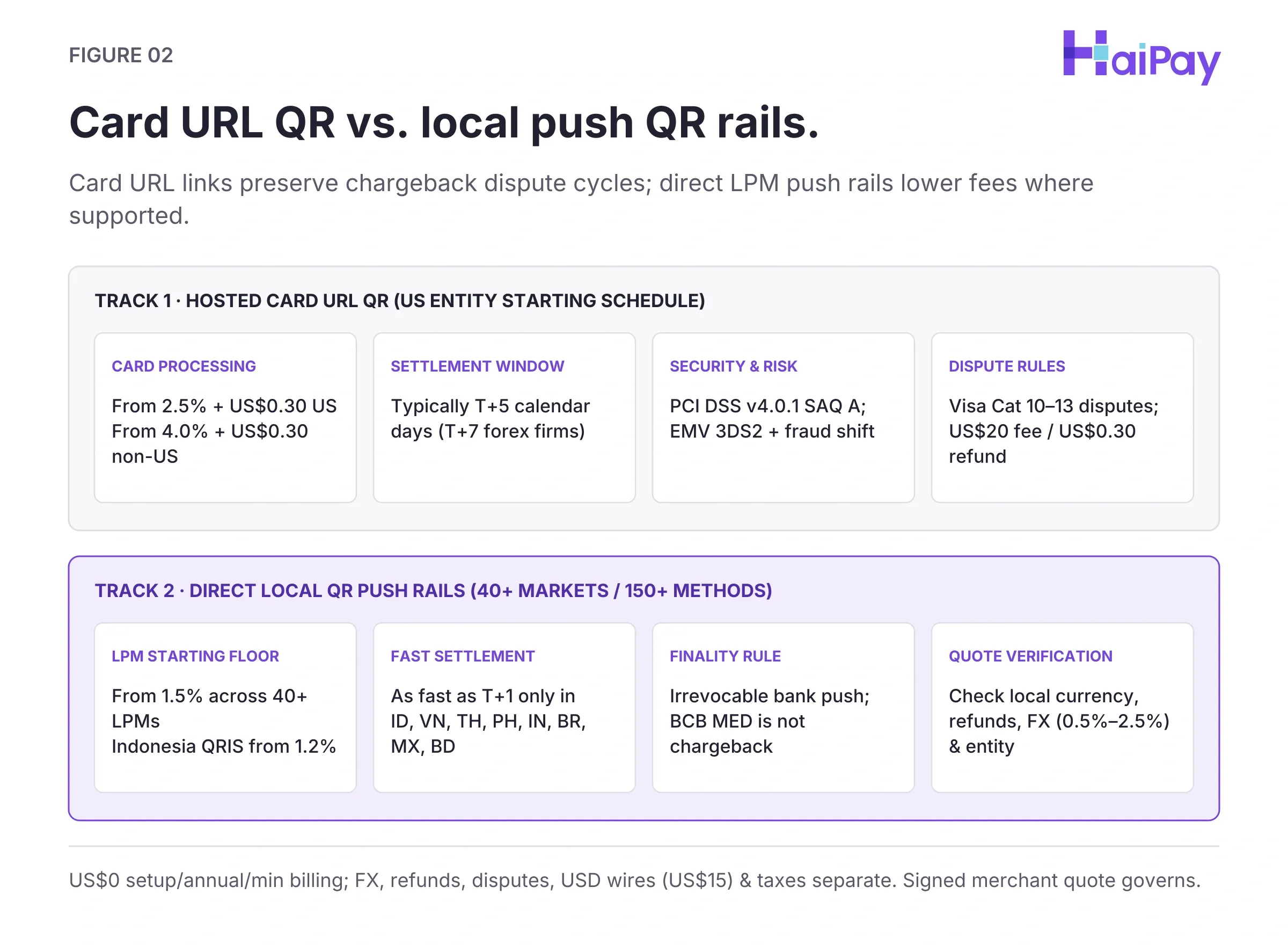
Figure 2: Card URL QR (typically T+5/T+7) vs. 40+ LPMs (as fast as T+1 in 8 markets; quote governs). Open full-size diagram.
Source: Pricing & Payment Links Guides; Reddit r/ThailandTourism (2026-11-12), r/Vietnam_Tourism (2026-11-13) & r/singaporefi (2026-09-11).
Global and Regional QR Payment Rails Compared
National QR schemes clear on bank switches, while closed-loop wallets run as separate commercial products.
- US (ANSI X9.150): Published 14 July 2026, ANSI X9.150 unifies bank QRs across FedNow, Real-Time Payments (RTP), and Automated Clearing House (ACH) credit transfers using public-key infrastructure (PKI) signatures as banks certify.
- Europe (EPC QR): European Payments Council (EPC) QR v2.10 encodes header tag
BCDfor Single Euro Payments Area (SEPA) Credit Transfer (SCT). Payloads carry Bank Identifier Code (BIC), payee, International Bank Account Number (IBAN), Euro (EUR), and reference. Pair 10s SEPA Instant (SCT Inst) with EU Reg 2024/886 Art 5c free Verification of Payee (VoP) in our SEPA guide. - Brazil (Pix): Settling 24/7 over SPI, Pix passed cards in 2023, hitting nearly R$3.4 trillion monthly in Q1 2026 with 200M monthly users and 8.6x card value.
- Indonesia (QRIS): Launched 17 August 2019, QRIS reached 50.50M users and 32.71M merchants in 2024 across MPM, CPM, QRIS Tanpa Tatap Muka (TTM, non-face-to-face), and TH/MY/SG/JP links.
- TH, VN & PH: PromptPay clears bank rails apart from TrueMoney. VietQR uses National Payment Corporation of Vietnam (
NAPAS247, Decision 1928, and consumer-presentedTCCS 04:2024under Decision 2525) apart from MoMo. QR Ph runs on InstaPay apart fromGCASH_QR. - SG, MY & IN: PayNow binds Unique Entity Numbers (UENs) 24/7/365 on Fast and Secure Transfers (FAST) inside Singapore Quick Response Code (SGQR) labels (our Singapore
PAYNOW_SGDroute lists Singapore Dollar,SGD, 1–3,000). Check DuitNow QR (Maintenance in application programming interface, API, docs) and Unified Payments Interface (UPI) scope on India UPI (Paytm/PhonePe).
Monetary Authority of Singapore (MAS) links tie PayNow to PromptPay, UPI (21 February 2023), QRIS, and DuitNow (17 November 2023). Like Bank for International Settlements (BIS) Project Nexus, these serve travelers; merchants use local acquiring across APAC and EU/Americas.
Table 2: Global and Cross-Border QR Payment Rails Compared
Rail / Region | Operator | QR Modes | Settlement & Dispute Rule | Check |
|---|---|---|---|---|
US (X9.150) | Accredited Standards Committee X9 | Dynamic MPM (PKI) | Push finality; not a chargeback | Bank cert |
Eurozone (EPC) | European Payments Council | BCD / SCT | SCT D+1 or 10s SCT Inst; VoP | Name & IBAN |
Brazil (Pix) | Banco Central do Brasil (SPI) | Static, Dynamic, Composite | 24/7 SPI; as fast as T+1 (risk review & quote); Special Return Mechanism (MED) is not a chargeback | Tag 62-05 txid |
Indonesia (QRIS) | Bank Indonesia | MPM, CPM, TTM (non-face-to-face) | From 1.2%; as fast as T+1 (risk review & quote) | Dynamic MPM |
Thailand (PromptPay) | Bank of Thailand & National ITMX | Thai QR & MyPromptQR | From 1.5%; as fast as T+1 (risk review & quote) | No TrueMoney |
Singapore (PayNow) | Association of Banks in Singapore & MAS | PayNow in SGQR | 24/7/365 FAST; quote governs | PAYNOW_SGD |
Vietnam (VietQR) | NAPAS & State Bank of Vietnam | Dec 1928 & TCCS 04:2024 (Dec 2525) | From 1.5%; as fast as T+1 (risk review & quote) | No MoMo |
PH & India | Bangko Sentral ng Pilipinas & National Payments Corporation of India | QR Ph & UPI URL / deep-link | From 1.5%; as fast as T+1 in PH/IN (risk review & quote) | Paytm/PhonePe |
Source: Pricing, X9.150, SEPA & Country Guides; Wikipedia; BCB, Bank Indonesia, Bank of Thailand, MAS, ABS & NAPAS (2026-11-17).
Engineering Matrix: Review 20 QR modes, EMV tags, settlement schedules, and fraud checks in the 20-Row QR Rails Matrix (CSV).
Quishing Defense, Push-Payment Finality, and Reconciliation
QR-code phishing (quishing) targets signs and invoices. Federal Bureau of Investigation Internet Crime Complaint Center (FBI IC3) alert PSA220118 flags tampered QRs; I-073125-PSA (July 2025) warns against unsolicited brushing parcels carrying malicious QRs.
QR codes hide URLs until scanned. One social-media account (@DutyCallll) describes a $1,200 Seattle meter-sticker loss, while reverse scams trick sellers into scanning outbound transfer QRs.
- Verify Domain & Descriptor: Match URL and doing-business-as (DBA) name.
- Enforce Single-Use Expiry: Use One-Time Links or
Tag 01=12dynamic codes. - Audit Stands Daily: Lock plaques in tamper-evident cases and inspect decals.
- Show Plain-Text IBANs: Print legal name and IBAN beside EPC QRs for free VoP.
- Apply SAQ A & EMV 3DS2: Card links use Payment Card Industry Data Security Standard (PCI DSS) v4.0.1 Self-Assessment Questionnaire A (SAQ A). Keep annual Attestation of Compliance (AoC) oversight (Requirements 12.8.2 and 12.8.4) with EMV 3-D Secure version 2 (3DS2).
Separate push finality from chargebacks. Brazil's Special Return Mechanism (MED), live since November 2021, freezes fraud funds. Yet BCB states, "the MED is not a chargeback mechanism (reversal of payment), as is the case with payment card arrangements." Typos and commercial disputes sit outside MED.
Card URL QRs keep Visa Category 10–13 dispute cycles (Categories 12–13 allow 30 calendar days for Dispute Response). For digital goods, Visa Table 11-6 requires description, download date, and two or more records such as Internet Protocol (IP) address or Device ID (chargeback guide). Fulfill only on webhooks carrying txid, invoice_id, or ARN.
Source: FBI IC3 PSA220118 (2022-01-18) & I-073125-PSA (2025-07-31); X @DutyCallll (2026-09-03); Reddit r/ScammersPH (2026-11-15); BCB "Pix Report"; Payment Links & Chargeback Guides (2026-11-17).
Choosing URL Payment Links vs. Direct Local QR APIs
- One-Time Link QR (Option 1): Use payment links post-Know Your Business (KYB) onboarding (US$0 setup/annual per quote).
- Recurring Link QR (Option 2): Keep Option 2 for manual reorders; use subscription billing for auto-billing.
- Direct Local QR API: Connect HaiPay Local Payment across 40+ LPM markets from 1.5% (QRIS from 1.2%). Settlement runs as fast as T+1 in eight markets versus typically T+5 on standard cards, subject to risk review and quote.
Ready to scope corridors? Request a quote via HaiPay Pricing or contact us.
Source: Payment Links, Subscription, Local Payment, Pricing & Contact Pages (2026-11-17).
Disclosure: HaiPay publishes this guide and has a commercial interest when merchants adopt its services. Specifications reflect official documentation accessed 2026-11-17, not live benchmarking. Content gives operational information only, not financial, investment, legal, or tax advice. Signed commercial agreements govern final pricing, corridors, and settlement.
Sources
- EMVCo: EMV QR Codes (2020-11-27).
- BCB: BR Code v2.0.0 (2020-05-25).
- BCB: Pix Initiation v2.10.0 (2026-11-17).
- BCB: Pix Management Report (2026-11-17).
- Bank Indonesia: QRIS (2026-11-17).
- Bank Indonesia: Cross-Border QRIS (2026-11-17).
- Bank of Thailand: PromptPay (2026-11-17).
- Bank of Thailand: Cross-Border (2026-11-17).
- MAS: SGQR (2026-11-17).
- MAS: Cross-Border Linkages (2026-11-17).
- ABS: PayNow (2026-11-17).
- NAPAS: VietQR (2026-11-17).
- FBI IC3: PSA220118 (2022-01-18).
- FBI IC3: I-073125-PSA (2025-07-31).
- Wikipedia: EPC QR (2024-06-17).
- Wikipedia: Pix (2026-11-17).
- Wikipedia: QRIS (2026-11-17).
- Wikipedia: QR code (2026-11-17).
- Wikipedia: PromptPay (2026-11-17).
- Wikipedia: QR Code Payment (2026-11-17).
- Reddit r/ThailandTourism (2026-11-12).
- Reddit r/Vietnam_Tourism (2026-11-13).
- Reddit r/singaporefi (2026-09-11).
- Reddit r/askSingapore (2026-04-28).
- Reddit r/ConselhosLegais (2026-04-18).
- Reddit r/DigitalbanksPh (2026-07-05).
- Reddit r/ScammersPH (2026-11-15).
- X @DutyCallll (2026-09-03).
- US X9.150 News (2026-07-15).
- Pricing (2026-11-17).
- Payment Links (2026-11-17).
- Subscription Billing (2026-11-17).
- Local Payment (150+ methods; 2026-11-17).
- APAC Coverage (2026-11-17).
- EU/Americas Coverage (EU/Americas; 2026-11-17).
- Contact (2026-11-17).
- Payment Links Guide (2026-11-17).
- Cross-Border Guide (2026-11-17).
- APM Guide (2026-11-17).
- SEPA Guide (2026-11-17).
- Chargeback Guide (2026-11-17).
- Thailand Guide (2026-11-17).
- Vietnam Guide (2026-11-17).
- Singapore Guide (2026-11-17).
- Malaysia Guide (2026-11-17).
- Philippines Guide (2026-11-17).
- India Guide (2026-11-17).
FAQ
Merchants use two primary setups after Know Your Business (KYB) onboarding. First, generate a One-Time or Recurring link inside HaiPay Payment Links with US$0 setup and annual fees, subject to risk review and your signed quote.
Second, integrate an application programming interface (API) through local payment acquiring to issue dynamic Quick-response (QR) codes on Quick Response Code Indonesian Standard (QRIS), Pix, PromptPay, or PayNow.
A static Quick-response (QR) code embeds fixed merchant account details in the printed image. Customers type payment amounts manually, and finance teams match bank statements by hand.
A dynamic QR code locks a single amount, currency, expiry window, and unique transaction identifier (txid) using Tag 01=12 or a server Uniform Resource Locator (URL). Signed webhooks then match funds to invoices automatically.
Hosted Uniform Resource Locator (URL) Quick-response (QR) codes open web checkouts in any mobile browser. EMVCo (the global EMV card-standards body) Merchant-Presented Mode (MPM) codes instead hold payment-specific banking tags.
EMVCo notes a generic phone operating system (OS) camera app is generally not usable with EMVCo MPM payloads. Consequently, an authenticated banking or wallet app is generally required to parse the code.
QR-code phishing (quishing) exploits tampered decals and hidden links rather than broken QR math. The Federal Bureau of Investigation Internet Crime Complaint Center (FBI IC3) warns against tampered counter Quick-response (QR) codes (PSA220118) and unsolicited package QRs (I-073125-PSA).
Inspect plaques daily, enforce single-use expiry, check hosted domains and doing-business-as (DBA) names, and show plain-text International Bank Account Numbers (IBANs) for European Verification of Payee (VoP). Use Payment Card Industry Data Security Standard (PCI DSS) Self-Assessment Questionnaire A (SAQ A) plus EMV 3-D Secure version 2 (3DS2) on card links.
No. Account-to-account (A2A) push Quick-response (QR) rails like Brazil Pix, Singapore PayNow, and the Philippines' interoperable QR Ph standard settle with push finality after app confirmation. The Central Bank of Brazil confirms its Special Return Mechanism (MED) is not a card chargeback mechanism.
Buyer typos and commercial disputes fall outside MED rules. Card-funded Uniform Resource Locator (URL) QR links keep Visa Category 10–13 dispute cycles, with US$20 per dispute on HaiPay's US-entity schedule, subject to risk review and quote.
No. Option 2 Recurring Payment Links stay reusable for manual repeat visits, whereas automated recurring billing uses subscription billing. Standard cards settle typically in T+5 calendar days (five days post-transaction, or typically T+7 for licensed forex firms), subject to business and risk review and your signed quote.
Local payment methods (LPMs) start from 1.5% across 40+ markets (Quick Response Code Indonesian Standard, QRIS, from 1.2%), per risk review and quote. LPMs settle as fast as T+1 (one day) only in eight markets: Indonesia, Vietnam, Thailand, the Philippines, India, Brazil, Mexico via SPEI (interbank rail), and Bangladesh, per quote.
