
Direct Answer
Payment processing routes a buyer's payment from checkout through authentication, authorization, batch clearing, and interbank settlement into a merchant's bank account. Card rails separate millisecond checkout approval from post-cutoff batch clearing and net settlement via Visa or Mastercard.
By contrast, real-time bank rails such as SEPA Instant, FedNow, Pix, and QRIS settle push transfers in seconds. Separating the roles of your payment gateway, processor, and acquiring bank prevents redundant middleware fees, multi-currency FX leakage, and ledger reconciliation gaps.
Architecture scope & cluster disclosure: This foundational guide examines end-to-end payment processing across card schemes, US and European bank rails, and 40+ local payment markets (reviewed November 8, 2026). For commercial card acceptance, visit Global Credit & Debit Card Acquiring and Local Payment Methods. For statement line-item audits, see our merchant account fees guide.
How End-to-End Payment Processing Works: The 4-Stage Transaction Lifecycle
Card and wallet payment processing runs on three clocks: millisecond checkout authorization, daily batch clearing, and interbank net settlement. When a buyer clicks pay, zero cash moves into your bank account during that two-second spinner. Instead, every transaction passes through four sequential technical and financial stages.
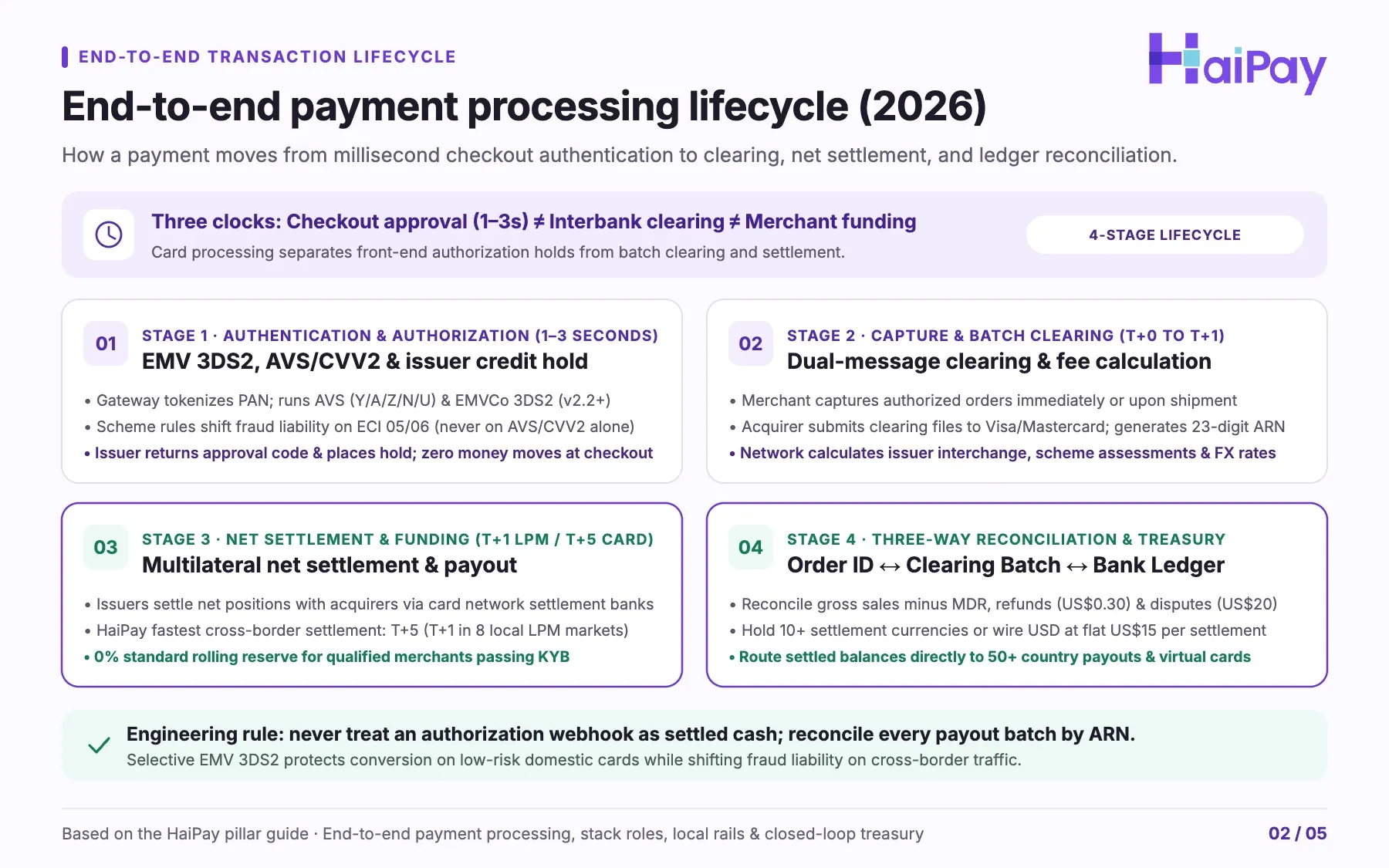
Stage 1: Checkout Authentication and Millisecond Authorization (1–3 Seconds)
The payment gateway captures the card number or wallet token, encrypts it under PCI DSS v4.0.1, and routes an ISO 8583 or ISO 20022 request to the issuer. Risk teams must distinguish data-match filters from cryptographic authentication:
- Address Verification Service (AVS) and CVV2. AVS checks the billing street and postal code (Y, A, Z, N, or U), while CVV2 checks the security code. As shown in our what is AVS guide, AVS and CVV2 cut fraud but never shift chargeback liability.
- EMV 3-D Secure 2 (EMV 3DS2 v2.2+). EMV 3DS2 shares over 100 device fields with the issuer for frictionless approval or PSD2 Strong Customer Authentication (SCA). Returning ECI 05 (authenticated) or ECI 06 (attempted) shifts fraud dispute liability (Visa Condition 10.4 or Mastercard 4837) to the issuer.
- Issuer Approval Code and Credit Hold. When funds and fraud checks pass, the issuer returns a 6-character code and places an open-to-buy hold. Our payment acceptance guide shows how selective 3DS2 protects conversion on low-risk cards.
Stage 2: Capture, Dual-Message Batch Clearing, and ARN Generation (T+0 to T+1)
Credit and signature debit rails use dual-message processing to separate authorization from batch clearing. Digital merchants auto-capture immediately, whereas physical retailers capture when warehouse staff ship the order.
At cutoff (T+0 or T+1), the processor submits captured batches to Visa Base II or Mastercard IPM. The network assigns a 23-digit Acquirer Reference Number (ARN) and calculates interchange, scheme assessments, and FX rates.
Stage 3: Multilateral Net Settlement and Merchant Payout (T+1 LPM / T+5 Card)
Card schemes calculate multilateral net positions across issuing and acquiring banks each business day. The acquirer deducts the Merchant Discount Rate (MDR), refund fees (US$0.30), and dispute fees (US$20) before payout.
Under HaiPay's published pricing schedule, cross-border card settlement arrives as fast as T+5 (and T+1 across 8 local payment markets). Qualified merchants passing pre-launch KYB receive a 0% standard rolling reserve; see our rolling reserve guide.
Stage 4: Three-Way Ledger Reconciliation by ARN
Never book an authorization webhook as settled cash. Finance teams automate payment gateway reconciliation across three records by 23-digit ARN: order IDs, clearing batches, and bank credits (net of any US$15 USD wire fee).
Source: Visa Payment Processing Basics, Visa Core Rules (Oct 2025), Mastercard Rules (Dec 2025), and EMVCo 3-D Secure Specification (Reviewed Nov 2026).
Payment Gateway vs. Payment Processor vs. Acquiring Bank: Who Does What?
Merchants and software engineers often treat payment gateway, payment processor, and acquiring bank as synonyms. In regulated payment architecture, each entity performs a separate technical or banking role.
Confusing these layers causes businesses to sign separate gateway and acquirer contracts that double-bill per-transaction fees.
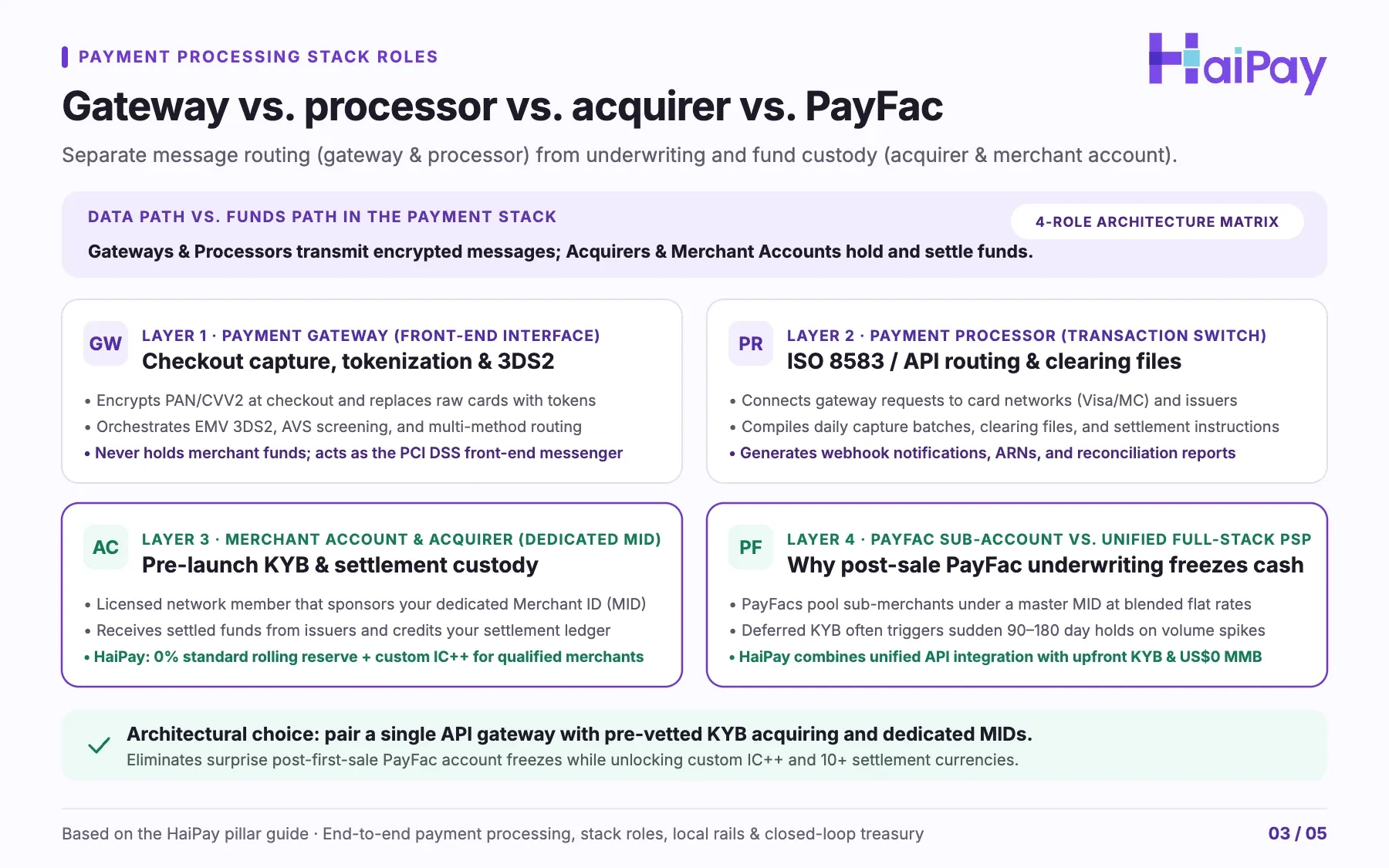
Stack Layer | Core Technical & Regulated Function | Primary Identifiers & Artifacts | Typical Fee Structure | Unbundled Stack Risk |
|---|---|---|---|---|
Payment Gateway | Front-end checkout UI, PCI DSS v4.0.1 tokenization, AVS/CVV2 filters, and EMV 3DS2 routing. | API keys, payment tokens, ECI 05/06 tags, and webhook events. | US$0.05–US$0.15 per API call plus monthly fee when unbundled. | Charges per-API-call fees even on declined checkout attempts. |
Payment Processor | Back-end switch formatting ISO 8583 and ISO 20022 authorization and clearing files. | Terminal ID (TID), clearing batch files, and 23-digit ARN. | US$0.05–US$0.13 per authorization and clearing switch item. | Cutoff mismatches between gateway capture and batch clearing. |
Acquiring Bank (Acquirer) | Licensed Visa/Mastercard principal member; underwrites KYB risk, holds funds, and settles payouts. | Merchant ID (MID), settlement ledger, and reserve policy (0% standard after KYB). | Acquirer IC++ margin or blended MDR; US$15 flat USD settlement wire. | Cross-border downgrades when lacking local or multi-currency MIDs. |
Card Network / Bank Rail | Sets scheme rules, interchange tables, dispute timelines (120 days), and net settlement. | Visa, Mastercard, Nacha ACH, FedNow, SEPA Instant (SCT Inst), Pix, QRIS. | Scheme assessments (~0.13%–0.15%) and cross-border fees (~0.80%–1.10%). | Non-negotiable card fees avoidable only by offering local A2A rails. |
Issuing Bank / Wallet | Issues buyer card or wallet; verifies balance, places auth hold, and absorbs ECI 05/06 fraud. | 6-digit BIN/IIN, 6-character auth approval code, and dispute reason code. | Wholesale interchange (0.20% EEA debit cap to 2.40%+ US corporate cards). | False declines (5%–15%) when foreign acquirers hit domestic issuers. |
Source: Compiled from Visa Core Rules, Mastercard Rules, Adyen Pricing, and HaiPay Pricing (Reviewed Nov 2026).
In a legacy unbundled setup, a merchant connects a standalone gateway to a third-party processor and a separate merchant acquiring bank. That structure forces finance teams to reconcile three statements and pay gateway API fees on every retry, as detailed in our payment gateway fees breakdown.
Full-stack platforms like HaiPay combine the hosted checkout, direct API integration, processor switch, and multi-currency settlement account under one contract. Comparing local acquiring vs. cross-border acquiring also shows how matching your acquiring entity to buyer regions lifts issuer approval rates.
Card Networks vs. Real-Time and Batch Bank Rails (ACH, FedNow, SEPA Instant, Pix & QRIS)
Credit and debit cards dominate online checkout because they offer universal buyer familiarity, revolving credit, and instant authorization holds. In the Federal Reserve Payments Study (FRPS), cards represented 76.8% of US noncash transactions by count (157.0 billion of 204.5 billion). By contrast, ACH transfers accounted for 91.5% of US noncash payment value (US$91.85 trillion of US$100.37 trillion).
Because card rails are pull payments, they carry percentage interchange and 120-day dispute exposure. Across the United States, Europe, Latin America, and Asia, account-to-account (A2A) push rails and QR switches deliver lower fees and immediate finality.
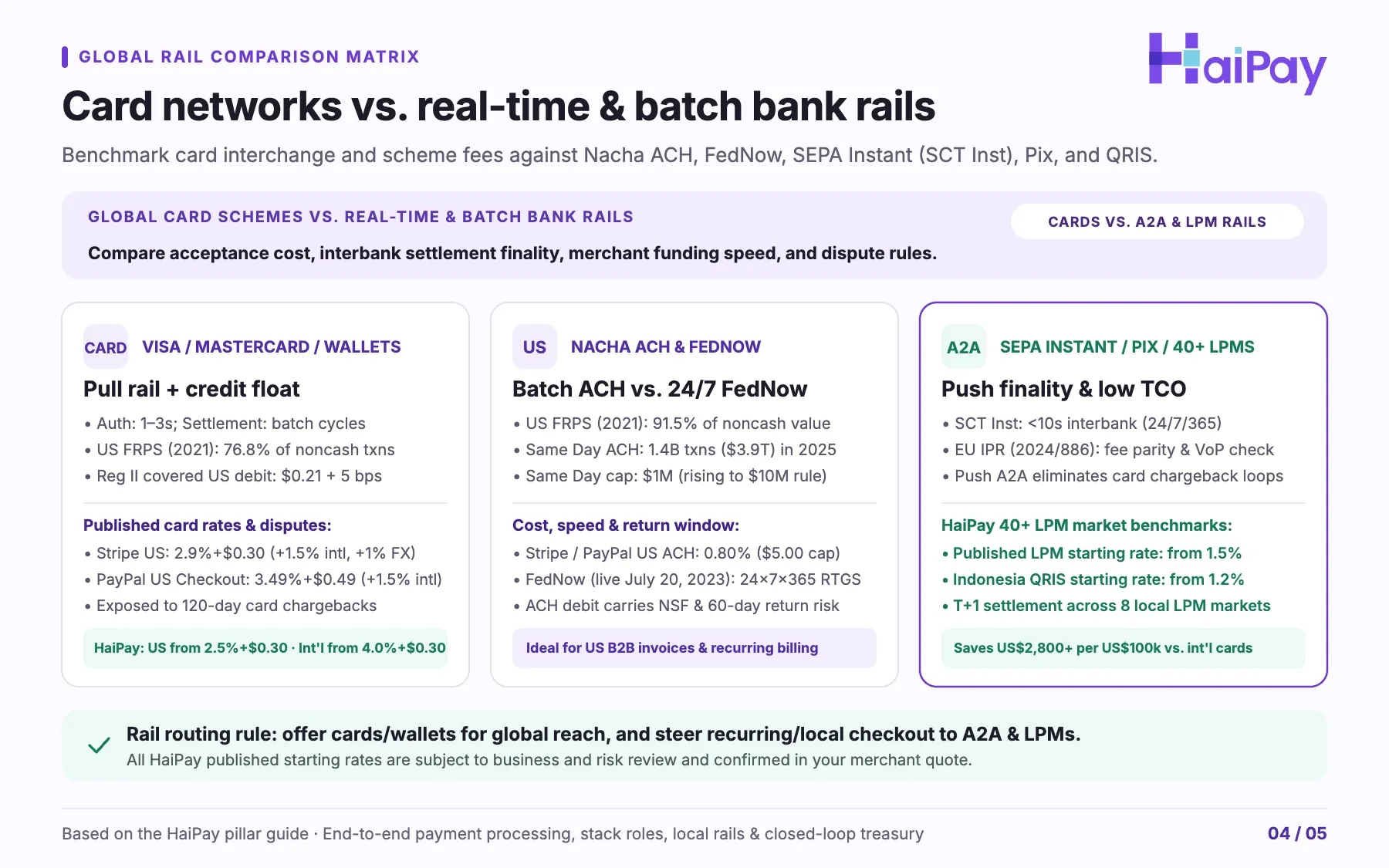
- United States (Nacha ACH & Federal Reserve FedNow). Nacha processed 35.2 billion ACH payments worth US$93.0 trillion in 2025, including 1.4 billion Same Day ACH payments worth US$3.9 trillion. The Same Day ACH cap is US$1 million per payment and rises to US$10 million on March 19, 2027. The Federal Reserve also launched the FedNow Service on July 20, 2023 for 24x7x365 real-time settlement; see our United States payment gateway guide.
- European Economic Area (SEPA Instant Credit Transfer & EU IPR). The European Payments Council (EPC) SEPA Instant Credit Transfer (SCT Inst) rail settles euro push transfers in under 10 seconds 24/7/365. Under EU Instant Payments Regulation (EU) 2024/886, eurozone PSPs must match standard SEPA transfer fees (from January 9, 2025) and verify payee names (from October 9, 2025). Explore our guides to SEPA payments, Germany payment gateways, and France payment gateways.
- High-Growth Local Push Rails (Brazil Pix & Indonesia QRIS). Through HaiPay's 40+ local payment methods and European and Americas local rails, merchants accept real-time push payments starting from 1.5% (and Indonesia QRIS from 1.2%). Supported corridors settle as fast as T+1 across 8 local markets.
Payment Rail / Corridor | Pull vs. Push Model | Interbank Clearing & Finality | Merchant Funding Speed | Statutory / Published Benchmark Rate | Dispute & Reversal Exposure |
|---|---|---|---|---|---|
Visa / Mastercard (US Domestic) | Pull (card PAN or wallet token) | 1–3s auth hold; next-day batch clearing (ARN) | T+2 standard (T+5 fastest cross-border) | Reg II covered debit: US$0.21 + 5 bps (+US$0.01 fraud adj.); HaiPay US cards: from 2.5% + US$0.30; Stripe US: 2.9% + US$0.30 | Up to 120-day cardholder chargebacks (US$20 dispute fee; US$15 on Stripe US). |
Visa / Mastercard (EEA Regulated) | Pull (with mandatory PSD2 SCA / 3DS2) | 1–3s auth hold; dual-message batch clearing | T+2 to T+5 by entity and corridor | EU IFR (EU) 2015/751 cap: 0.20% consumer debit / 0.30% credit; non-US cards: from 4.0% + US$0.30 | Fraud liability shifts to issuer on ECI 05/06; commercial cards exempt from IFR caps. |
Nacha ACH (Standard & Same Day) | Pull (ACH Debit) or Push (ACH Credit) | Batch windows (3 Same Day windows daily; US$1M cap) | T+1 to T+4 (Same Day for eligible credits) | Stripe / PayPal US ACH: 80 basis points (0.80%, capped at US$5.00) | ACH Debit carries R01 NSF (2 business days) and R10 consumer return risk (60 days). |
FedNow Service (US RTGS) | Push credit (with Request for Payment) | Real-time gross settlement (24x7x365, seconds) | Immediate interbank settlement finality | Flat per-item network fee set by Federal Reserve Banks | Irrevocable push credit upon settlement; zero card chargeback loops. |
SEPA Instant (SCT Inst) & EU A2A | Push credit (with mandatory VoP check) | Under 10 seconds 24/7/365 across SEPA | Immediate interbank credit (T+1 in 8 local LPM markets) | EU IPR (EU) 2024/886 fee parity with standard SCT; 40+ LPMs: from 1.5% | Irrevocable push transfer; eliminates 120-day friendly-fraud card disputes. |
Pix (Brazil) & QRIS (Indonesia) | Push QR / instant mobile bank transfer | Real-time (24/7 instant interbank clearing) | T+1 local LPM settlement in 8 supported markets | 40+ LPM markets from 1.5%; Indonesia QRIS from 1.2% | Authenticated in buyer banking app; zero card cross-border assessments. |
Source: Federal Reserve FRPS, Federal Reserve Regulation II, Nacha 2025 Volume Release, EUR-Lex IFR (EU) 2015/751, and EUR-Lex IPR (EU) 2024/886 (Reviewed Nov 2026).
Payment Processing Cost Architecture: Blended vs. Interchange++ (IC++) and Multi-Currency FX
Every card processing fee comprises three layers: wholesale issuer interchange, card scheme assessments, and acquirer processing markup. How your provider packages those layers—and how it handles currency conversion—sets your true effective Merchant Discount Rate (MDR).
- Blended (Flat-Rate) Pricing. Bundles interchange, scheme fees, and processor margin into one rate. Stripe US charges 2.9% + US$0.30 on domestic cards plus +1.5% on international cards and +1.0% for currency conversion. PayPal US charges 3.49% + US$0.49 on PayPal Checkout (2.99% + US$0.49 on standard cards) plus +1.50% international and a 3.00% to 4.00% FX spread.
- Tiered Pricing. Groups hundreds of interchange categories into opaque Qualified, Mid-Qualified, and Non-Qualified buckets. Rewards cards, corporate cards, and cross-border cards routinely downgrade into high-cost non-qualified tiers.
- Interchange++ (IC++) Pass-Through Pricing. Itemizes exact wholesale issuer interchange (+) and card scheme assessments (+) separately from a fixed acquirer margin, such as Adyen's US$0.13 processing fee plus IC++. IC++ passes statutory caps—0.20% EEA debit, 0.30% EEA credit, and US$0.21 + 5 bps covered US debit—directly to the merchant.
Merchants can compare published blended starting rates on our public pricing schedule against custom IC++ pass-through models in our merchant account fees guide. Published baselines start from 2.5% + US$0.30 for US domestic cards (after KYB review) and from 4.0% + US$0.30 for international cards. Local payment rails across 40+ markets start from 1.5% (Indonesia QRIS from 1.2%), with US$0 setup, monthly, annual, and minimum monthly fees.
Monthly Traffic Segment (US$100,000 Total Volume) | Order Count & Avg Ticket (US$100) | Legacy Blended PSP (Forced Domestic FX) | Published Multi-Currency + LPM Schedule | Monthly Cost Variance & Operational Impact |
|---|---|---|---|---|
US Domestic Cards (US$40,000) | 400 txns × US$100 | Stripe US 2.9% + US$0.30 = US$1,280.00 | US Card From 2.5% + US$0.30 = US$1,120.00 | -US$160.00 (40 bps lower starting card rate) |
International Cards in Foreign Currency (US$35,000) | 350 txns × US$100 | Stripe US 2.9% + 1.5% intl + 1.0% FX + US$0.30 = US$1,995.00 | Non-US Card From 4.0% + US$0.30 (0% FX when settled in matching currency; or from 0.5% FX) = US$1,505.00 | -US$490.00 (avoids forced 1%–4% checkout FX via 10+ settlement currencies) |
Local Payment Methods: SCT Inst, Pix, QRIS (US$25,000) | 250 txns × US$100 | Processed as cross-border cards (5.4% + US$0.30) = US$1,425.00 | 40+ LPMs From 1.5% (QRIS From 1.2%) = US$375.00 (at 1.5% benchmark) | -US$1,050.00 (T+1 local LPM settlement + zero card chargebacks) |
Fixed Monthly Gateway & Account Overhead | Account maintenance & minimums | Unbundled gateway (US$50–US$150/mo + API fees) = US$100.00 | Quadruple-Zero fixed overhead (US$0 setup / monthly / annual / minimum) = US$0.00 | -US$100.00 (US$0 fixed monthly platform fee) |
Total Monthly Processing Cost (US$100,000 GTV) | 1,000 total transactions | US$4,800.00 (4.80% effective MDR) | US$3,000.00 (3.00% effective MDR before IC++ / rebates) | Saves US$1,800.00 / month (US$21,600 / year) on US$100k volume |
Source: Modeled from published schedules at Stripe US Pricing, PayPal US Merchant Fees, Adyen Pricing, and HaiPay Pricing (Reviewed Nov 2026). All starting rates are subject to KYB review and confirmed in your merchant quote.
Model your exact card and local payment mix with our interactive credit card processing fee calculator. You can also review our multi-currency merchant account guide and cross-border payments guide to eliminate forced FX conversions.
Multi-Region Failover, Idempotency, and Webhook Reconciliation Architecture
Production payment engineering does not end when a card issuer returns an approval code. High-volume e-commerce brands, SaaS platforms, marketplaces, and game publishers must engineer fault-tolerant retry logic, webhook verification, and automated ledger reconciliation.
At the same time, settlement architecture must prevent Double FX leakage across cross-border corridors. Forcing EUR, GBP, BRL, or IDR sales into a home currency and converting funds again on outbound wires erodes 2% to 6% of revenue.
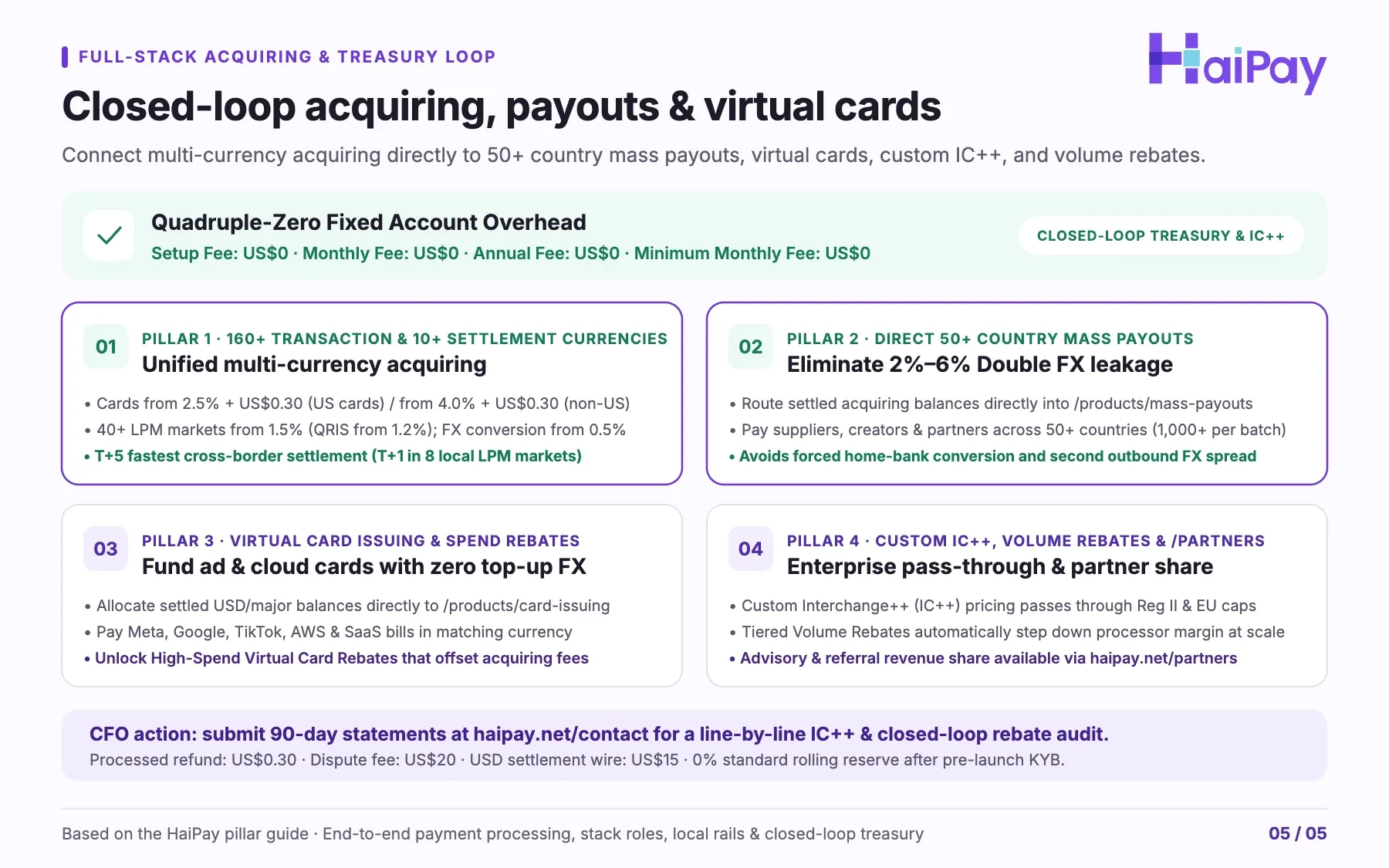
An enterprise payment architecture combines resilient API execution with native multi-currency settlement (160+ transaction currencies and 10+ settlement currencies, with US card FX from 0.5%) across three operational pillars:
- API Idempotency Keys and Multi-Region Switch Failover. Attach a unique UUID v4 idempotency key to every authorization, capture, and refund call so timeouts never trigger duplicate charges. Multi-region acquiring endpoints automatically route retries around degraded telecom paths without forcing buyers to re-enter payment credentials.
- Asynchronous Webhook Signature Verification for Delayed Bank Rails. While cards authorize synchronously in 1 to 3 seconds, bank rails such as Nacha ACH, SEPA Instant, Pix, and QRIS confirm clearing asynchronously. Verify HMAC-SHA256 webhook signatures and deduplicate event IDs before releasing digital goods or warehouse fulfillment.
- T+5 Card / T+1 LPM Batch Settlement Reconciliation and Mass Payouts Routing. Ingest daily settlement reports matched by 23-digit ARNs across T+5 cross-border card schedules and T+1 local payment corridors in 8 supported markets. Treasury systems can then route settled balances across 10+ native currencies directly into global mass payouts across 50+ countries (up to 1,000+ recipients per batch) without home-bank double FX conversion.
PCI DSS v4.0.1 Compliance, Dispute Ratios, and RFP Evaluation Checklist
Before signing a processor agreement or writing integration code, engineering and finance leaders should verify security scope, dispute thresholds, and contract fee caps. The PCI Security Standards Council published PCI DSS v4.0.1 on June 11, 2024, and all future-dated v4.0 requirements became mandatory on March 31, 2025.
- Keep Checkout Infrastructure in PCI SAQ A Scope. Never pass raw card numbers (PAN) or CVV2 through your application servers. Using hosted checkout or tokenized fields keeps your environment eligible for SAQ A (~20 controls) instead of SAQ D (300+ controls plus script monitoring under PCI DSS 6.4.3 and 11.6.1).
- Enforce Selective EMV 3DS2 and Monitor Dispute Ratios. Trigger EMV 3DS2 v2.2+ wherever required (such as EEA and UK SCA) or on elevated-risk cross-border orders. Securing ECI 05 or ECI 06 shifts fraud liability to issuers and keeps dispute ratios well below the 0.9% card scheme early-warning threshold.
- Audit Every Contract Clause Against our 18-Point RFP Checklist. Confirm in writing that your contract enforces US$0 setup, monthly, annual, and minimum monthly fees, plus a 0% standard rolling reserve after KYB approval. Verify that refund fees (US$0.30) and dispute fees (US$20) are capped and that clearing reports include 23-digit ARNs.
Download the Free Engineering & CFO Worksheet: Grab the Payment Processing Architecture & RFP Evaluation Checklist (CSV) to score candidate gateways, processors, and acquirers across 18 technical and treasury criteria. You can also request a 90-day statement audit with our acquiring architects.
Sources and Official Regulatory & Provider Schedules
All card network operating rules, statutory interchange caps, instant payment regulations, and provider fee schedules cited in this guide were verified against primary official documentation on November 8, 2026:
- Visa. Payment Processing Basics, Core Rules (Oct 18, 2025) & US Interchange Regulations. https://corporate.visa.com/en/solutions/commercial-solutions/small-business-hub/resources/payment-processing-basics.html, https://usa.visa.com/dam/VCOM/download/about-visa/visa-rules-public.pdf, and https://usa.visa.com/support/small-business/regulations-fees.html. Authorization, batch clearing, net settlement, 23-digit ARN, ECI 05/06 liability shift, and US interchange schedules (Reviewed 2026-11-08).
- Mastercard. Mastercard Rules (Dec 9, 2025) & U.S. Interchange Programs. https://www.mastercard.us/en-us/business/overview/support/rules.html and https://www.mastercard.us/en-us/business/overview/support/merchant-interchange-rates.html. Dual-message clearing, chargeback timelines, and interchange rate tables (Reviewed 2026-11-08).
- Federal Reserve Board. Federal Reserve Payments Study (FRPS), Regulation II & FedNow Service. https://www.federalreserve.gov/paymentsystems/fr-payments-study.htm, https://www.federalreserve.gov/paymentsystems/regii-average-interchange-fee.htm, and https://www.federalreserve.gov/newsevents/pressreleases/other20230720a.htm. US card vs. ACH share (76.8% count vs. 91.5% value), US$0.21 + 5 bps covered debit cap, and FedNow 24x7x365 launch (Reviewed 2026-11-08).
- Nacha. 2025 ACH Network Volume Release & Same Day ACH Dollar Limit Expansion. https://www.nacha.org/news/nacha-reports-352-billion-ach-payments-valued-93-trillion-2025 and https://www.nacha.org/news/same-day-ach-dollar-limit-increase-10-million-2027. 35.2B ACH payments (US$93T) and 1.4B Same Day ACH payments (US$3.9T) in 2025; US$1M limit rising to US$10M in 2027 (Reviewed 2026-11-08).
- EUR-Lex & European Payments Council (EPC). EU IFR (2015/751), EU IPR (2024/886) & SCT Inst. https://eur-lex.europa.eu/eli/reg/2015/751/oj, https://eur-lex.europa.eu/eli/reg/2024/886/oj, and https://www.europeanpaymentscouncil.eu/what-we-do/sepa-instant-credit-transfer. 0.20% EEA debit / 0.30% credit caps, SCT Inst under-10-second settlement, and 2025 EU instant payment fee parity and VoP mandates (Reviewed 2026-11-08).
- PCI Security Standards Council (PCI SSC) & EMVCo. PCI DSS v4.0.1 & EMV 3DS2 Core Specification. https://www.pcisecuritystandards.org/about_us/press_releases/pci-ssc-publishes-limited-revision-to-pci-dss-v4-0-1/ and https://www.emvco.com/emv-technologies/3-d-secure/. PCI DSS v4.0.1 publication (June 11, 2024), March 31, 2025 future-dated requirement enforcement, and EMV 3DS2 v2.2+ protocol (Reviewed 2026-11-08).
- Published Provider Fee Schedules. Stripe US, PayPal US, Adyen & HaiPay. https://stripe.com/pricing, https://www.paypal.com/us/webapps/mpp/merchant-fees, https://www.adyen.com/pricing, and https://www.haipay.net/pricing. Published card, LPM, ACH, FX, settlement, refund, dispute, and US$0 fixed account fee terms (Reviewed 2026-11-08).
FAQ
A payment gateway is the front-end encryption layer that captures payment credentials, runs AVS, CVV2, and EMV 3DS2 checks, and tokenizes card numbers. A payment processor is the technical switch that transmits authorization and clearing files between the merchant, card networks, and banks. An acquiring bank (acquirer) is the licensed institution that underwrites merchant risk, holds Visa and Mastercard membership, and settles payouts.
Card schemes use dual-message architecture that separates checkout approval from cash movement. At checkout, the authorization message verifies available funds and places a temporary hold on the buyer's card within 1 to 3 seconds. Cash moves only after batch clearing (T+0 or T+1) and interbank net settlement (T+1 to T+5).
No. Passing an AVS match (codes Y, A, or Z) and a CVV2 check filters out stolen cards, but fraud liability stays with the merchant. To shift fraud dispute liability (Visa Condition 10.4 or Mastercard 4837) to the issuer, transactions must pass EMV 3DS2 (v2.2+) and return ECI 05 or ECI 06.
Published card rates start from 2.5% + US$0.30 for US cards and from 4.0% + US$0.30 for non-US cards on HaiPay. Stripe US charges 2.9% + US$0.30 plus +1.5% on international cards and +1% for FX conversion. Local rails bypass card interchange: US ACH costs 80 basis points (capped at US$5.00), while 40+ local payment methods start from 1.5% (QRIS from 1.2%).
Blended pricing charges one flat rate across all cards, fitting portfolios under US$100,000 in monthly card volume. Above US$250,000 per month in regulated markets, EEA consumer debit is capped at 0.20%, EEA credit at 0.30%, and covered US debit at US$0.21 + 5 bps. Custom Interchange++ (IC++) pass-through pricing passes those wholesale rates directly to the merchant.
Double FX leakage happens when a processor converts foreign sales into your home currency and your bank charges a second FX spread on outbound wires. Collecting 160+ transaction currencies, holding 10+ native settlement currencies, and routing funds directly into 50+ country mass payouts via a multi-currency merchant account eliminates that second conversion.
An Acquirer Reference Number (ARN) is a unique 23-digit identifier generated when an acquiring processor clears a captured card payment or refund through Visa or Mastercard. Finance teams use the ARN for three-way ledger reconciliation and to trace customer refunds across bank statements.

Related HaiPay surfaces
Explore the payment stack
Guide
Merchant Account Fees Explained: MDR, Interchange & Hidden Costs
Audit every card, FX, settlement, refund, and chargeback line item on your merchant processing statement.
Guide
Multi-Currency Merchant Account: Accept 160+ & Settle in 10+ Currencies
Learn how like-for-like multi-currency settlement eliminates forced checkout FX conversion spreads.
Guide
SEPA Payments Guide: SCT, SEPA Instant (SCT Inst) & SDD Core/B2B
Compare European SEPA bank rails, EU Regulation 2024/886 fee parity, and card interchange savings.
Guide
Cross-Border Payments Guide: Multi-Currency Acquiring, Local Rails & FX
Architect cross-border collection, local acquiring, and closed-loop payouts without Double FX leakage.
Guide
Rolling Reserve in Payment Processing: Holdback Rules & 0% Qualification
Understand why acquirers hold 5%–15% reserves and how pre-launch KYB underwriting qualifies for 0% standard reserve.
Guide
US Payment Gateway Guide: Cards, Reg II Debit, ACH & FedNow
Navigate US card acquiring, Durbin Amendment debit caps, Same Day ACH, and real-time FedNow routing.
Guide
Germany Payment Gateway Guide: Girocard, SEPA, Klarna & Cards
Optimize German checkout conversion across SEPA Instant, open banking, BNPL, and EEA-regulated cards.
Guide
France Payment Gateway Guide: Cartes Bancaires (CB), SEPA & Local Wallets
Configure French payment acceptance with Cartes Bancaires co-badging, PSD2 SCA, and SEPA rails.
Pricing
HaiPay Transparent Pricing & Custom Enterprise IC++ Schedule
Review published starting rates for cards, 40+ local payment methods, FX, mass payouts, and virtual cards.
Product
Global Credit & Debit Card Acquiring
Accept Visa, Mastercard, American Express, and digital wallets across 160+ currencies with smart 3DS2.
Product
Global Mass Payouts Across 50+ Countries
Route settled acquiring balances directly into 1,000+ batch payouts without home-bank Double FX conversion.
Product
Instant Corporate Virtual Card Issuing
Fund USD and major-currency virtual cards from settled balances for ad and cloud spend with high-spend rebates.

Need help mapping your payment stack?
Talk to HaiPay about acquiring, orchestration, local methods, and payout workflows.
Contact us