Acquirer vs Issuer: Roles, Fees, Declines & Chargebacks
Reviewed by Wesley Wang


Last updated: November 20th, 2026
Key Card Role Takeaways
An issuer manages the cardholder's account and approves purchases, while an acquirer contracts with the merchant, settles card funds, and carries merchant risk.
- Real-time authority vs. payout: Issuers decide approvals within Visa ceilings of 5 seconds in Europe and 10 seconds in United States retail lanes. Acquirers collect batch settlements afterward.
- Jurisdictional interchange caps: United States covered debit averaged US$0.23 in 2024 versus US$0.51 on exempt debit. United Kingdom consumer cards cap at 0.2% debit and 0.3% credit.
- Category-based dispute paths: Visa fraud and authorization disputes skip any merchant response stage. Consumer and processing disputes grant 30 calendar days for an acquirer response.
Disclosure: Verified against primary scheme, regulatory, and product documents on 2026-11-20. HaiPay publishes this comparison and provides the merchant acquiring and prepaid business virtual card services described below. This guide is operational documentation, not financial, investment, legal, or tax advice.
Acquirer vs. Issuer in a Four-Party Card Network
Every Visa or Mastercard purchase runs on a four-party rail linking the cardholder, merchant, issuing bank, and merchant acquirer. Both institutions hold network licenses yet carry opposite risk.
United States (US) Regulation II (12 Code of Federal Regulations, CFR § 235.2) defines an issuer as the entity authorizing a card. It defines an acquirer as the entity contracting with merchants for settlement. Retained United Kingdom (UK) law (European Union, EU Regulation 2015/751, Article 2) applies the same contract divide.
- Issuing bank (buyer side): Holds cardholder privity under Visa October 2026 rules, manages balances, and carries cardholder credit default or card-fraud exposure.
- Acquiring bank (merchant side): Signs a Merchant Agreement under Visa Rule 1.5.2.1 within its Country of Domicile (Rule 1.5.1.1) and absorbs unpaid merchant chargebacks.
- Four-party vs. three-party rails: Closed-loop three-party networks unify both roles unless external Payment Service Providers (PSPs) hold licenses under UK Article 1 rules.
See setup workflows in our merchant acquiring and card issuing pillar guides.
Source: 12 CFR Part 235 (eCFR) (§ 235.2); Regulation (EU) 2015/751 (Articles 1–2); Visa, Visa Core Rules (Rules 1.5.1.1, 1.5.2.1, Oct 2026); Card Issuing & Merchant Acquiring, accessed 2026-11-20.
Unbundling Banks From Processors, Gateways, and PayFacs
Checkout stacks wrap licensed banks behind Application Programming Interface (API) layers. Confusing a gateway or processor with an issuer or acquirer misroutes debugging. Non-bank card launches pair BIN sponsorship with an issuer processor.
- Acceptance intermediaries: A payment gateway encrypts credentials, an acquirer processor routes clearing, and a Payment Facilitator (PayFac) sponsors sub-merchants under an acquirer (Visa ID# 0028921).
- Issuing intermediaries: Fintechs issue cards under a Bank Identification Number (BIN) sponsor while an issuer processor runs the ledger. Stripe Issuing models this via real-time web callbacks (webhooks).
Table 1. Core Role Boundaries Across Six Card-Rail Participants
Participant | Side Served | Scheme Member? | Primary Legal & Risk Duty | Revenue Layer |
|---|---|---|---|---|
Issuing Bank | Cardholder | Yes | Cardholder privity, ledger, auth decision, card-fraud risk | Interchange Reimbursement Fee (IRF), interest |
Issuer Processor | Issuer / Fintech | No | Real-time ledger, tokenization, webhook evaluation | Program or API fees |
Acquiring Bank | Merchant / PayFac | Yes | Underwriting, Rule 1.5.2.1 contract, chargeback exposure | Discount rate & markup |
Acquirer Processor | Acquirer / Seller | No | Message switching, clearing files, reporting | Gateway & switching fees |
PayFac | Sub-Merchants | Sponsored | Sub-merchant onboarding and payout splitting | Blended or tiered spread |
Card Network | Both Banks | Operator | Rule governance, switching, net settlement, arbitration | Scheme assessments |
Source: Visa, Visa Core Rules (Oct 2026 Glossary & Rule 1.5.2.1); Stripe Issuing; What Is Card Issuing?; What Is Merchant Acquiring?, accessed 2026-11-20.
Tracing One US$100 Card Purchase End to End
Checkout approval is not settled cash. Tracing one US$100 online purchase separates real-time messaging from batch clearing and payout.
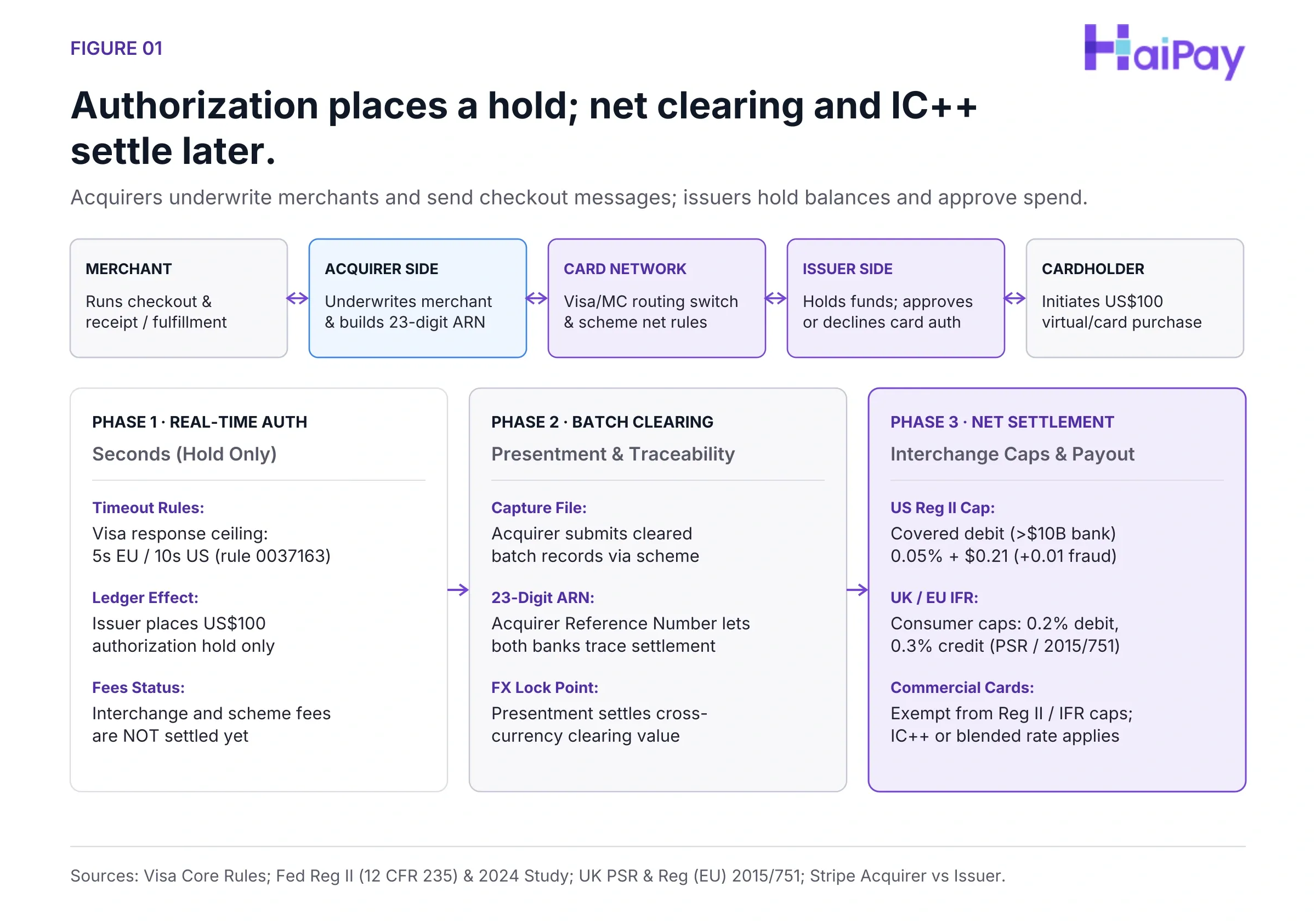
Figure 1: Four-party US$100 purchase flow across authorization, clearing, inter-bank settlement, and payout.
Source: Visa, Visa Core Rules (Rules 1.7.3.1, 1.7.4.1, Table 7-1, Oct 2026); Settlement (Card Payments), accessed 2026-11-20.
Step 1: Real-Time Authorization (Seconds)
The acquirer submits the US$100 payment authorization request via VisaNet under Rule 1.7.3.1. A hold lowers open-to-buy funds without moving cash.
Visa Rule 1.7.4.1 prohibits blanket wholesale declines by issuers. Under Visa Table 7-1, Point of Sale (POS) and Visa Direct responses allow 5 seconds in Europe. Responses allow 10 seconds in the US, Canada, Asia-Pacific, Central and Eastern Europe, Middle East, and Africa, and Latin America and Caribbean regions.
Step 2: Batch Clearing and the Acquirer Reference Number
Upon capture, the acquirer sends card payment clearing records (Visa ID# 0024444). Clearing assigns an Acquirer Reference Number (ARN) and sets interchange rates.
Step 3: Inter-Bank Settlement vs. Merchant Payout
In card settlement (Visa ID# 0025095), issuers wire net Settlement Amounts to acquirers. When one bank fills both roles, an internal "on-us" ledger entry settles it.
Merchant payout occurs separately after reserves and Foreign Exchange (FX) rules. Commercial quotes confirm each seller's payout schedule.
Source: Visa, Visa Core Rules (Rules 1.7.3.1, 1.7.4.1, Table 7-1, Glossary ID# 0024444/0025095, Oct 2026); What Is Settlement in Card Payments?, accessed 2026-11-20.
Interchange, Scheme Fees, and Acquiring Markup Economics
Merchant pricing combines issuer interchange (Rule 1.8.1.2), scheme fees, and acquirer markup. Under Interchange++ (IC++), acquirers itemize all three tiers, and Rule 1.8.2.1 limits inter-member fee adjustments to 90 calendar days (or 2 years for extenuating circumstances).
Statutory caps vary sharply by card scope. United States (US) Regulation II caps big-bank debit, while retained United Kingdom (UK) Interchange Fee Regulation (IFR) caps UK domestic consumer cards.
Table 2. Statutory Interchange Caps & 2024 United States Benchmarks
Jurisdiction & Rule | Covered Card Scope | Published Statutory Ceiling / 2024 Benchmark | Scope Boundary |
|---|---|---|---|
US Regulation II Covered Debit | Issuers >= US$10B assets | 21 cents + 0.05% + 1 cent; 2024 average US$0.23 (0.47% on US$48.95) | Covered US electronic debit only; excludes credit cards. |
US Regulation II Exempt Debit | Issuers < US$10B, prepaid, government | Uncapped; 2024 average US$0.51 (1.21% on US$42.27; 39.3% of txns) | Doubles average per-transaction fee vs. covered US debit. |
US Debit Combined Average (2024) | All US networks | US$0.34 per txn (0.73% of US$46.32 average purchase) | Federal Reserve 2024 data (updated Dec 2025); debit only. |
UK Consumer Debit & Prepaid | UK domestic consumer | 0.2% cap per transaction (EU Regulation 2015/751, Article 3) | Payment Systems Regulator (PSR) limits cap to UK consumer cards. |
UK Consumer Credit | UK domestic consumer | 0.3% cap per transaction (EU Regulation 2015/751, Article 4) | Excludes corporate cards, exempt 3-party, and cross-border. |
Source: 12 CFR Part 235 (eCFR); Federal Reserve, Regulation II Standards & 2024 Average Debit Fee; UK Regulation 2015/751 & PSR IFR Scope; Visa, Visa Core Rules (Rules 1.8.1.2 & 1.8.2.1, Oct 2026), accessed 2026-11-20.
Debugging Declines and Chargebacks Across Both Sides
Pinpointing Who Blocked a Declined Card
Engineering logs separate merchant-side risk rules from issuing-bank declines. Guessing wrong wastes conversion on unnecessary retries.
- Gateway & Acquirer stops: Adyen refusal docs separate
4: Acquirer Errorand14: Acquirer Fraudfrom bank declines. Stripe decline codes flag processorfraudulentstops before network routing. - Issuer declines: Network code
05(do_not_honor),insufficient_funds, andissuer_not_availableconfirm an issuer decision. Debug them via our decline code playbook.
Reverse Liability in Inquiries and Chargebacks
Disputes reverse liability back up the rail. Compare dispute flows in our chargeback vs. refund guide and chargeback process playbook.
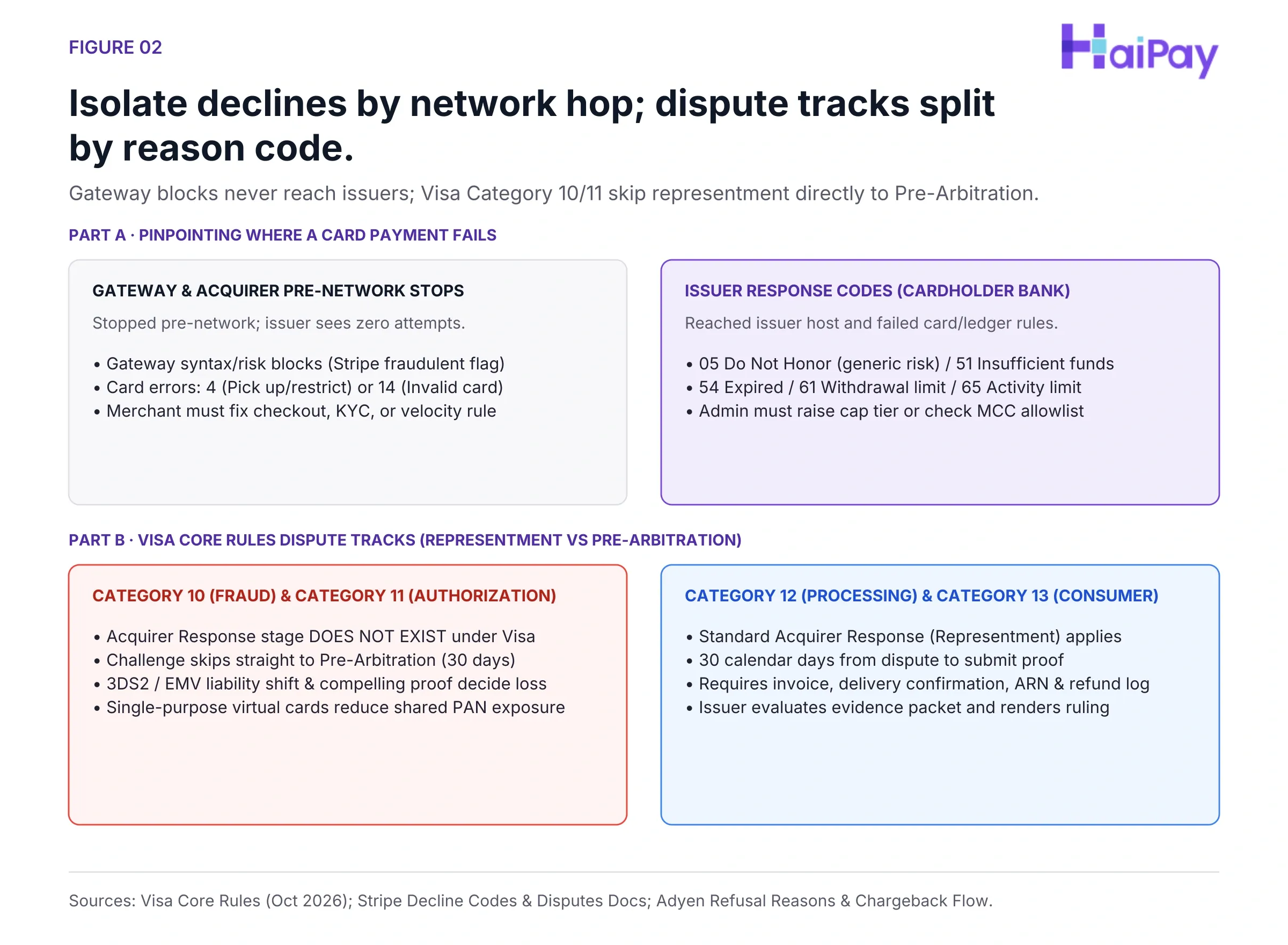
Figure 2: Decline fault boundaries and Visa dispute tracks comparing Category 10/11 against Category 12/13.
Source: Visa, Visa Core Rules (Tables 11-2 & 11-3, Oct 2026); Stripe Declines, Stripe Disputes, & Adyen Refusal Reasons, accessed 2026-11-20.
Before a formal chargeback, Stripe Disputes notes schemes may send a preliminary inquiry solvable without dispute fees. Formal timelines depend on Visa category, alongside 3D Secure 2 (3DS) and Europay, Mastercard, and Visa (EMV) chip liability shifts.
Table 3. Decline Telemetry & Visa Oct 2026 Dispute Stage Splits
Scenario / Stage | Who Acts First | Key Telemetry / Rule | Verified Deadline / Liability Impact |
|---|---|---|---|
Acquirer / Gateway Stop | PSP / Acquirer | Adyen | Check Merchant Category Code (MCC), risk rules, and gateway routing. |
Issuer Decline | Issuing Bank | Network | Issuer stop; cardholder contacts issuer or switches credential. |
Preliminary Inquiry | Issuer -> Acquirer | Stripe Disputes preliminary | Resolve early before formal dispute fee debit. |
Visa Category 10 & 11 | Issuer (No Response Stage) | Visa Table 11-2 (e.g., | Dispute Response stage omitted; Pre-Arbitration due in 30 calendar days. |
Visa Category 12 & 13 | Acquirer Response | Visa Table 11-3 ( | Dispute Response 30 calendar days; Pre-Arbitration 30 calendar days; Arbitration 10 calendar days. |
3DS & EMV Chip Shift | Issuing Bank Shift | Adyen 3DS shift & Visa EMV Table 11-9 | Authenticated 3DS or Full-Chip EMV shifts eligible fraud to issuer. |
Source: Visa, Visa Core Rules (Tables 11-2, 11-3, 11-9, Oct 2026); Stripe Declines; Stripe Disputes; Adyen Refusal Reasons & Adyen Chargebacks, accessed 2026-11-20.
Choosing Acquiring vs. Issuing Infrastructure
Teams separate checkout collection from company spend controls. The Credit Card Payment Gateway offers Blended and IC++ models with settlement in United States dollars (USD) and selected markets.
Published rates apply to US merchants contracting through HaiPay's US entity after business and risk review. US-issued cards start from 2.5% + US$0.30 per transaction, while non-US-issued cards start from 4.0% + US$0.30 per transaction. Published pricing sets Foreign Exchange (FX) for US card pricing from 0.5% depending on currency pair and local methods from 1.2%. Processed refunds cost US$0.30, disputes US$20, USD wires US$15 per wire, and quotes confirm timing.
For business spend, Card Issuing offers prepaid USD virtual cards and an API across US, Hong Kong, and Singapore Visa and Mastercard programs. Cards fund advertising and artificial intelligence (AI) tools, with quote-confirmed pricing and merchant billing limits. See our corporate card program guide for four-tier spend controls.
Source: Credit Card Payment Gateway for Global Businesses; Payment Gateway Pricing & Fees; Virtual Card Issuing Platform & Multi-Currency API; What Is Card Issuing?, accessed 2026-11-20.
Three Common Operational Mistakes to Avoid
- Treating Authorization as Settled Cash: Holds reflect credit availability only. Pending funding and pending refunds cannot be spent until settlement clears.
- Retrying Hard Declines Blindly: Re-running
Acquirer Fraud,lost_card, or repeated05 Do Not Honorhurts approval rates without fixing the blocking layer. - Assuming Universal Dispute Windows: Visa Category 10 and 11 disputes omit Dispute Response (Table 11-2). Waiting for a generic 30-day window forfeits representment.
Source: Visa, Visa Core Rules (Tables 11-2 & 11-3, Oct 2026); Stripe Declines; Adyen Refusal Reasons; Virtual Card Issuing Platform, accessed 2026-11-20.
Operational Lifecycle & Liability Matrix (22-Row Reference)
Our 22-row Acquirer vs. Issuer Lifecycle and Liability Matrix (CSV) maps each stage from onboarding through arbitration. Use the companion 22-row matrix dataset when auditing interchange fees or reconciling IC++ statements.
Sources
- Visa Inc. — Visa Core Rules and Visa Product and Service Rules (Oct 2026; accessed 2026-11-20).
- Electronic Code of Federal Regulations (eCFR) — 12 CFR Part 235 (Regulation II) (§ 235.2–235.5; accessed 2026-11-20).
- Federal Reserve Board — Regulation II - Interchange Fee Standards: Small Issuer Exemption (accessed 2026-11-20).
- Federal Reserve Board — Regulation II - Average Debit Card Interchange Fee by Payment Card Network (2024 data; accessed 2026-11-20).
- UK Legislation — Regulation (EU) 2015/751 on interchange fees for card-based payment transactions (accessed 2026-11-20).
- UK Payment Systems Regulator (PSR) — The IFR (accessed 2026-11-20).
- Stripe Documentation — Stripe decline codes (accessed 2026-11-20).
- Stripe Documentation — How disputes work (accessed 2026-11-20).
- Stripe Documentation — Issuing (accessed 2026-11-20).
- Adyen Docs — Refusal reasons (accessed 2026-11-20).
- Adyen Knowledge Hub — What is a chargeback and how to prevent them (accessed 2026-11-20).
- HaiPay — What Is Card Issuing? How Platforms & APIs Work (accessed 2026-11-20).
- HaiPay — What Is Merchant Acquiring? Roles, Fees, Reserves (accessed 2026-11-20).
- HaiPay — What Is Settlement in Card Payments? (accessed 2026-11-20).
- HaiPay — Credit Card Payment Gateway for Global Businesses (accessed 2026-11-20).
- HaiPay — Payment Gateway Pricing & Fees (accessed 2026-11-20).
- HaiPay — Virtual Card Issuing Platform & Multi-Currency API (accessed 2026-11-20).
FAQ
Yes, in an on-us transaction where the cardholder's issuing bank and the merchant's acquiring bank are the same institution, the bank settles obligations internally across its own ledgers. Closed-loop three-party schemes also unify both roles unless external Payment Service Providers (PSPs) hold licenses.
Any layer can stop an attempt, which is why raw gateway codes matter before retrying. Codes such as Adyen
4: Acquirer Erroror Stripefraudulentstop on the merchant or processor side, whereas network code05(do_not_honor) andissuer_not_availableoriginate from the issuing bank.An issuing bank holds the scheme license, Bank Identification Number (BIN) sponsorship, and legal contract with the cardholder under Visa rules. An issuer processor supplies the technical ledger, card controls, and real-time web callback (webhook) endpoints so platforms can evaluate authorizations within scheme response windows.
United States (US) Regulation II (12 Code of Federal Regulations, CFR Part 235) caps covered issuers with US$10 billion or more in assets at 21 cents plus 0.05% plus 1 cent if eligible. Smaller banks, government cards, and exempt reloadable prepaid cards sit outside the cap, averaging US$0.51 in 2024 versus US$0.23 for covered debit.
Timelines depend on the Visa dispute category under Edition October 2026 rules rather than one universal window. Processing errors (Category 12) and consumer claims (Category 13) give 30 calendar days for an Acquirer Dispute Response, whereas fraud (Category 10) and authorization (Category 11) jump straight to 30-day Pre-Arbitration.
An Acquirer Reference Number (ARN) is a clearing identifier created when an acquiring bank submits a captured purchase or refund record to the card network. Issuing banks and merchants use the ARN to trace delayed refunds, reconcile settlement batches, and audit chargebacks against original orders.
Through Credit Card Payment Gateway, acquiring rates apply to US merchants contracting via HaiPay's US entity after business and risk review. US-issued cards start from 2.5% + US$0.30 per transaction, and non-US-issued cards start from 4.0% + US$0.30 per transaction. Published pricing sets Foreign Exchange (FX) for US card pricing from 0.5% depending on currency pair, refunds at US$0.30, disputes at US$20, USD wires at US$15 per wire, and quote-confirmed timing. Quote-priced prepaid United States dollars (USD) virtual business cards fund advertising and artificial intelligence (AI) spend.
