


Direct Answer
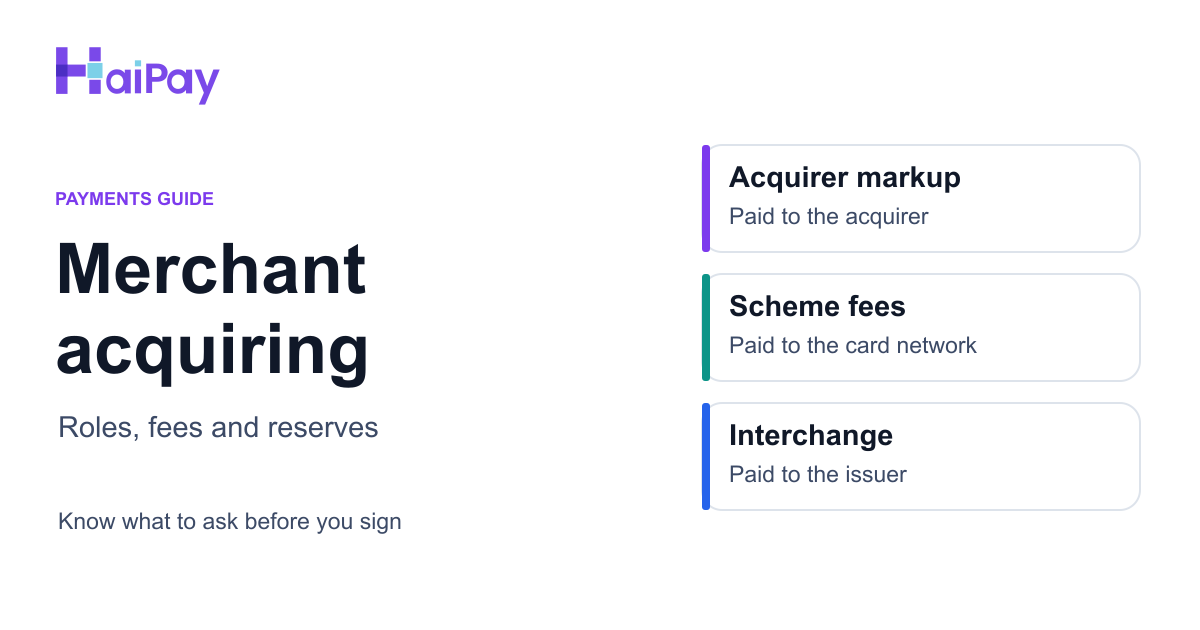
An interchange fee is a wholesale charge paid on each card transaction by the merchant’s card-acceptance provider to the bank that issued the customer’s card. Payment network operators typically set the default rates. The merchant instead pays a negotiated merchant discount or service fee. Rates differ by card product, channel, merchant category and market, and some regulators cap them. It is a cost input to that price, not a bill the merchant settles.
Source: Visa Core Rules (§1.8.1.2; AP, Canada, CEMEA, LAC, US Regions); RBA, Issues Paper (Oct 2024; rate setting); Federal Reserve, Regulation II (US debit), accessed 2026-09-04.
Who pays interchange, and who receives it
Visa describes an interchange reimbursement fee as a default transfer price between acquirers and issuers in the Visa system. Merchants, that rule says, pay a merchant discount or service fee negotiated with their acquirer, which each acquirer sets independently. The RBA describes the same flow and names the rate-setter: interchange is typically set by the operators of payment networks such as Visa or Mastercard. A merchant’s counterparty is its merchant acquirer, not the issuing bank.
Source: Visa, “Visa Core Rules and Visa Product and Service Rules” (§1.8.1.2 “What is Interchange? – AP, Canada, CEMEA, LAC, US Regions”, edition 18 April 2026; a Visa rule, and in those regions only); Reserve Bank of Australia, “Merchant Card Payment Costs and Surcharging: Issues Paper” (Phase 1, October 2024; Australian settings and terminology as described at that date), accessed 2026-09-04.
What puts a transaction in one category rather than another
Visa is explicit: a transaction must meet the qualifications defined in the Visa Rules and the applicable rate qualification guide, and the acquirer must request the correct fee when submitting it into interchange. Under that rule, category assignment follows the data submitted at card payment clearing, not the checkout display.
Source: Visa, “Visa Core Rules and Visa Product and Service Rules” (§1.8.1.3 “Interchange Reimbursement Fee (IRF) Requirements”, edition 18 April 2026; a Visa rule), accessed 2026-09-04.
The RBA attributes the growth in category counts to developments including:
- new infrastructure, such as tokenisation;
- new products, such as instalments programs;
- competitive responses, such as special rates for small and medium businesses;
- splitting categories into card present and card not present.
It adds that this complexity makes it hard for merchants on unblended plans to check costs and compare providers, an assessment about Australia.
Source: Reserve Bank of Australia, “Merchant Card Payment Costs and Surcharging: Issues Paper” (Phase 1, October 2024; Australian settings and terminology as described at that date), accessed 2026-09-04.
Regulated ceilings are market-specific and mid-change
Published ceiling or benchmark | What the source states | Scope to check before using it |
|---|---|---|
United States, Regulation II | No more than $0.21 plus 0.05 percent of transaction value, plus a $0.01 fraud-prevention adjustment if eligible. | Covered issuers only; certain reloadable general-use prepaid and government-program cards are exempt. |
United States, small-issuer exemption | The fee standard does not apply. | Exempt institutions reported assets under $10 billion at 31 December 2025. |
Australia, domestic consumer credit | To 30 Sep 2026: benchmark 0.5 per cent, individual cap 0.8 per cent. From 1 Oct 2026: cap 0.3 per cent, benchmark abolished. | Domestic-issued cards acquired in Australia; the second line is a March 2026 decision not yet in force. |
Australia, domestic commercial credit | From 1 Oct 2026 the cap stays at 0.8 per cent, benchmark abolished. | Same scope; commercial credit keeps the higher cap. |
Australia, domestic debit and prepaid | To 30 Sep 2026: benchmark 8 cents, cap 10 cents or 0.2 per cent. From 1 Oct 2026: benchmark unchanged, cap 8 cents or 0.16 per cent. | Domestic-issued cards acquired in Australia. |
Australia, foreign-issued cards | Uncapped to 31 Mar 2027; schedules show rates as high as 2.4 per cent. Capped at 1.0 per cent from 1 Apr 2027. | Foreign-issued cards acquired in Australia. |
EEA and the United Kingdom | Consumer credit interchange capped at 0.3 per cent; the October 2024 paper puts the debit cap at 0.2 per cent for the United Kingdom and Europe. | Domestic and intra-EEA consumer cards. That paper reports European inter-regional caps of 0.2 and 0.3 per cent in person, but 1.15 and 1.5 per cent online. |
Source: Federal Reserve Board, “Average Debit Card Interchange Fee by Payment Card Network” (US debit fee standard and 2024 reported network averages); Federal Reserve Board, “Interchange Fee Standards: Small Issuer Exemption” (US small-issuer asset threshold); Federal Reserve Board, “Regulation II (Debit Card Interchange Fees and Routing)” (US debit rule scope and exemptions); Reserve Bank of Australia, “Merchant Card Payment Costs and Surcharging: Issues Paper” (Phase 1, October 2024; Australian settings and terminology as described at that date); Reserve Bank of Australia, “3. Interchange Fees”, Conclusions Paper (March 2026; the Payments System Board’s final Australian interchange decisions); Reserve Bank of Australia, “8. Impact and Implementation”, Conclusions Paper (March 2026; Table 10 implementation dates), accessed 2026-09-04.
Read the scope column before pricing against these figures. The Australian rows are mid-change: the RBA’s Review of Merchant Card Payment Costs and Surcharging closed with a Conclusions Paper in March 2026, whose Table 10 sets 1 October 2026 for the domestic-card changes and 1 April 2027 for the foreign-card cap.
Source: Reserve Bank of Australia, “About Review of Retail Payments Regulation” (phases of the Review of Merchant Card Payment Costs and Surcharging and their publication dates); Reserve Bank of Australia, “3. Interchange Fees”, Conclusions Paper (March 2026; the Payments System Board’s final Australian interchange decisions); Reserve Bank of Australia, “8. Impact and Implementation”, Conclusions Paper (March 2026; Table 10 implementation dates), accessed 2026-09-04.
The same card brand can carry very different interchange
For 2024, the Federal Reserve Board reports that across all networks, exempt transactions averaged $0.51 each, or 1.21 per cent of average transaction value, while covered transactions averaged $0.23, or 0.47 per cent; all transactions averaged $0.34, or 0.73 per cent. The Board cautions that each figure is a network average and does not reflect what a particular issuer will earn.
Source: Federal Reserve Board, “Average Debit Card Interchange Fee by Payment Card Network” (US debit fee standard and 2024 reported network averages), accessed 2026-09-04.
Issuer mix moves the same lever. The RBA estimates that foreign-issued cards accounted for around 8 per cent of interchange fees paid by merchants in Australia while making up around 3 per cent of transactions. A shift in cross-border payment volume can therefore change blended card cost by itself, apart from any foreign exchange spread.
Source: Reserve Bank of Australia, “Merchant Card Payment Costs and Surcharging: Issues Paper” (Phase 1, October 2024; Australian settings and terminology as described at that date), accessed 2026-09-04.
What your acquirer has to tell you, and where that stops
In the Europe Region, Visa requires an acquirer to inform its merchant of the availability of interchange reimbursement fee rates, including for intra-EEA and domestic EEA transactions. Such agreements must also notify the merchant that merchant service charge pricing on a “MIF Plus Plus” basis is available for transactions completed with a consumer credit or consumer debit card, specify the charge, interchange fees and scheme fees for each Visa product category unless the merchant asks in writing for another format, and not blend merchant service charges across schemes unless the merchant requests it. Those are Visa Europe Region obligations, and the MIF Plus Plus notification does not reach commercial cards. Elsewhere, write the itemisation you want into the contract and check it against your merchant discount rate.
Source: Visa, “Visa Core Rules and Visa Product and Service Rules” (§5.2.1.8 “Communication of Interchange Reimbursement Fee (IRF) Rates – Europe Region”, edition 18 April 2026; a Visa Europe Region rule); Visa, “Visa Core Rules and Visa Product and Service Rules” (§5.2.1.6 “Additional Merchant Agreement Requirements”, Table 5-1, Europe Region row, edition 18 April 2026; a Visa Europe Region rule), accessed 2026-09-04.
Interchange corrections run between members
Visa reserves the right to rectify improper interchange allocations, but that process runs between issuers and acquirers. Adjustments are limited to transactions within 90 calendar days of the processing date of the oldest one submitted or identified; up to two years where Visa determines extenuating circumstances applied; and are made only when the total exceeds USD 2,500, with individual correcting transactions above USD 50. A merchant is not a party to it; billing queries go to the acquirer.
Source: Visa, “Visa Core Rules and Visa Product and Service Rules” (§1.8.2.1 “Interchange Reimbursement Fee (IRF) Adjustments”, edition 18 April 2026; a Visa rule), accessed 2026-09-04.
Continue with merchant discount rate for the merchant-facing price and settlement for how amounts reach the account.
FAQ
No. Visa describes the interchange reimbursement fee as a default transfer price between acquirers and issuers, and says merchants instead pay a merchant discount fee or merchant service fee negotiated with their acquirer. The RBA describes the same flow: the acquirer typically pays the issuer, and the cost reaches the merchant through its provider. The merchant’s invoice and its recourse both sit with the acquirer.
Source: Visa, “Visa Core Rules and Visa Product and Service Rules” (§1.8.1.2 “What is Interchange? – AP, Canada, CEMEA, LAC, US Regions”, edition 18 April 2026; a Visa rule, and in those regions only); Reserve Bank of Australia, “Merchant Card Payment Costs and Surcharging: Issues Paper” (Phase 1, October 2024; Australian settings and terminology as described at that date), accessed 2026-09-04.
Yes. Visa requires a transaction to meet the qualifications in the applicable rate qualification guide, and requires the acquirer to request the correct fee at submission. The RBA links growing category counts to tokenisation, instalments programs, small-business rates and card-present versus card-not-present splits. US data shows the spread: in 2024, exempt transactions averaged more per transaction than covered ones across all networks.
Source: Visa, “Visa Core Rules and Visa Product and Service Rules” (§1.8.1.3 “Interchange Reimbursement Fee (IRF) Requirements”, edition 18 April 2026; a Visa rule); Reserve Bank of Australia, “Merchant Card Payment Costs and Surcharging: Issues Paper” (Phase 1, October 2024; Australian settings and terminology as described at that date); Federal Reserve Board, “Average Debit Card Interchange Fee by Payment Card Network” (US debit fee standard and 2024 reported network averages), accessed 2026-09-04.
No, and it is not fixed over time either. Regulation II caps what covered issuers may receive in the United States. In Australia, the RBA’s March 2026 Conclusions Paper lowers the domestic consumer credit cap to 0.3 per cent from 1 October 2026 and caps foreign-issued card interchange at 1.0 per cent from 1 April 2027. Check the instrument in force in each market.
Source: Federal Reserve Board, “Average Debit Card Interchange Fee by Payment Card Network” (US debit fee standard and 2024 reported network averages); Reserve Bank of Australia, “3. Interchange Fees”, Conclusions Paper (March 2026; the Payments System Board’s final Australian interchange decisions); Reserve Bank of Australia, “8. Impact and Implementation”, Conclusions Paper (March 2026; Table 10 implementation dates), accessed 2026-09-04.
Start with visibility. In the Europe Region, Visa requires acquirers to notify merchants that MIF Plus Plus pricing is available for consumer credit and consumer debit card transactions, and to itemise the merchant service charge, interchange and scheme fees per Visa product category. Elsewhere, negotiate that itemisation into the agreement, then track issuer and channel mix.
Source: Visa, “Visa Core Rules and Visa Product and Service Rules” (§5.2.1.6 “Additional Merchant Agreement Requirements”, Table 5-1, Europe Region row, edition 18 April 2026; a Visa Europe Region rule); Visa, “Visa Core Rules and Visa Product and Service Rules” (§5.2.1.8 “Communication of Interchange Reimbursement Fee (IRF) Rates – Europe Region”, edition 18 April 2026; a Visa Europe Region rule), accessed 2026-09-04.

Sources
Related terms
Acquiring and settlement
Merchant Discount Rate (MDR)
The merchant discount rate is the blended price charged to a merchant for processing card payments, covering network fees, acquirer margin, and related service costs.
Acquiring and settlement
Merchant Acquirer
A merchant acquirer is a payment service provider that contracts with businesses to accept and process card payments on behalf of participating card networks.
Acquiring and settlement
Issuing Bank
An issuing bank provides payment cards to customers and manages the accounts used for those cards throughout authorization, clearing, and settlement.
Acquiring and settlement
Card Payment Clearing
Card payment clearing exchanges final transaction details so the institutions serving the merchant and cardholder can calculate what they owe.
Acquiring and settlement
Settlement (Card Payments)
Card payment settlement transfers funds between participating financial institutions to meet obligations from processed card transactions after clearing has been completed.
Cross-border and FX
Cross-Border Payment
A cross-border payment is a transaction where the payer, merchant, acquirer, or settlement currency spans different countries, triggering FX conversion, local method requirements, and compliance checks.
Usage Guide
 Read Guide
Acquiring Decisions
Payment Gateway Fees: Complete Cost Breakdown (2026)
 Read Guide
Payment Roles
Merchant Acquiring Explained: Acquirer vs Processor vs Acquiring Bank vs PayFac

Need help mapping your payment stack?
Accept major card networks with routing, 3DS, and settlement built for cross-border sales.
Contact Us