What Is BIN Sponsorship? Issuing vs. Acquiring, US & UK Rules, and When to Skip It
Reviewed by Wesley Wang


Last updated: November 20th, 2026
BIN Sponsorship Key Insights
BIN sponsorship lets a non-bank business issue or acquire cards through a licensed institution's Bank Identification Number (BIN) under strict bank oversight.
The sponsor bank or e-money institution retains scheme liability and regulatory compliance. Non-bank partners manage software, onboarding, or processing, while corporate finance teams can skip program sponsorship by adopting prepaid virtual cards.
Card networks do not grant Bank Identification Number (BIN) ranges to unregulated startups. Card-issuing companies either pursue direct charters or operate under a BIN sponsor. This guide pairs with our card issuing guide and compares BIN sponsorship against turnkey virtual corporate cards.
Regulatory Disclosure: Published by HaiPay (not a bank; does not provide Banking-as-a-Service [BaaS] or bank BIN sponsorship) as general information—not investment, legal, regulatory, compliance, or financial advice. Primary sources verified 2026-11-20; scheme bylaws, bank contracts, and law govern live programs.
How BIN Sponsorship Works Under Card Scheme Rules
A BIN—also called an Issuer Identification Number (IIN)—is a card number's opening prefix. Under the October 2026 Visa Core Rules glossary, the International Organization for Standardization (ISO) assigns BIN identifiers to Visa for Issuer licensing. A Visa BIN comprises a 6-digit prefix licensed before April 22, 2022, or an 8-digit prefix. Payment rails read those digits to identify card type, issuer, and settlement path.
Only licensed network members can license BIN ranges. Visa Core Rules Section 2.2.1.1 separates Principal-Type Members, Associate-Type Members, and Participant-Type Members. Principal Members stay liable for all BIN activity and cover Associate shortfalls.
Sponsors offer shared BINs or dedicated BINs. Edenred Payment Solutions notes shared BINs host multiple programs on preset rules for quicker launch, whereas dedicated BINs isolate routing and branding with longer setup. Visa Section 2.2.1.1 bars Associate BINs licensed on or after July 22, 2017 from having multiple sponsors.
Source: Visa Core Rules and Visa Product and Service Rules (Section 2.2.1.1 and Glossary, Edition 24 October 2026, accessed 2026-11-20) and Edenred Payment Solutions, "What is BIN sponsorship and why does it matter?" (May 19, 2025, accessed 2026-11-20).
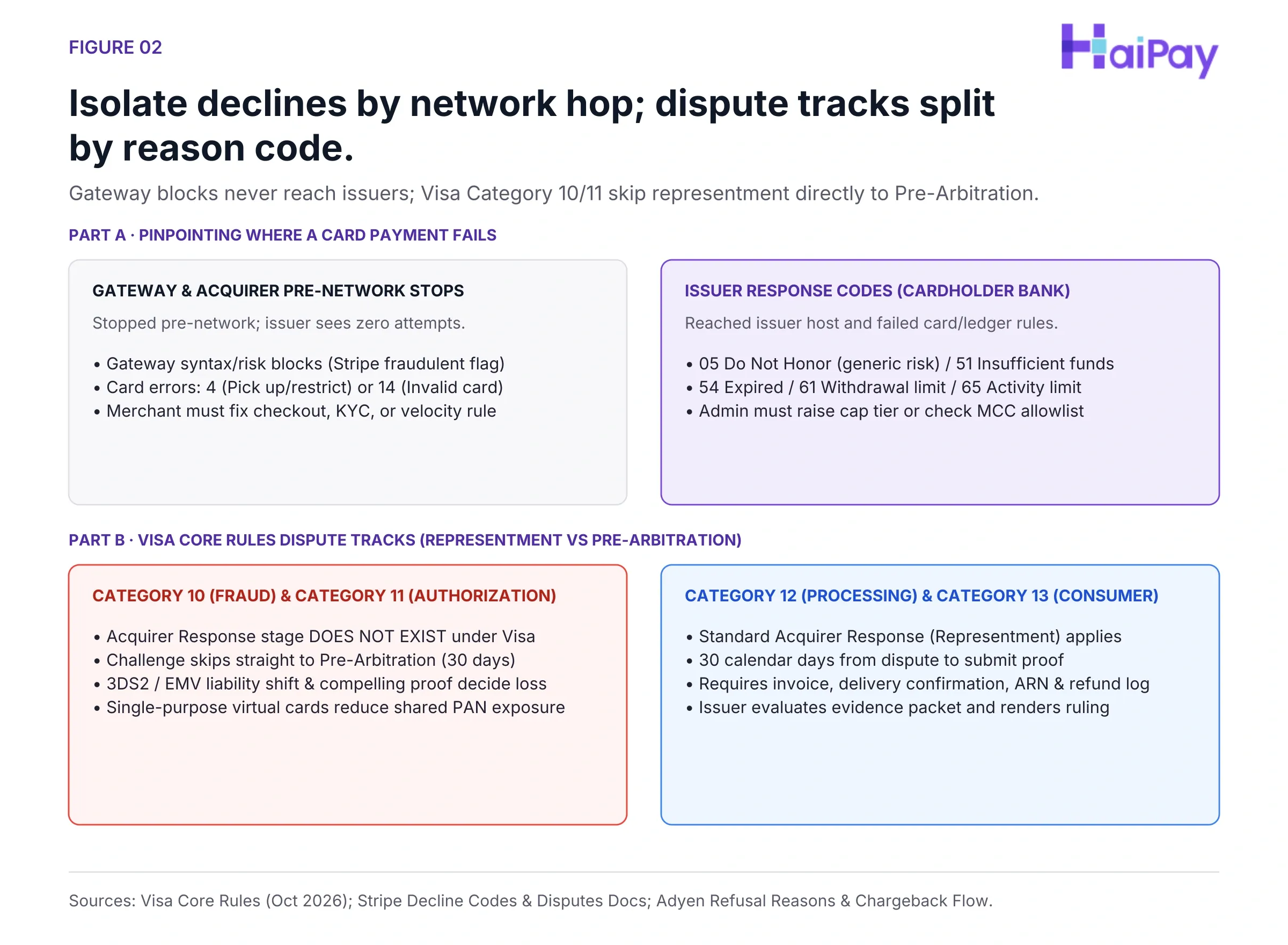
Figure 1: Card networks license BINs to regulated Principal Members, who oversee issuer processors and non-bank program managers.
Source: Visa Partner Types (2026, accessed 2026-11-20) and Visa Core Rules (Section 2.2.1.1, October 2026, accessed 2026-11-20).
Two Distinct Models: Issuing vs. Acquiring BIN Sponsorship
Teams often confuse card issuing with merchant acquiring when evaluating sponsors. Both rely on a licensed Principal Member for network access, yet sit on opposite sides of the payment rail. Review acquirer vs. issuer to confirm which side your product touches before contacting banks.
Issuing BIN Sponsorship vs. Acquiring BIN Sponsorship
Dimension | Issuing BIN Sponsorship | Acquiring BIN Sponsorship |
|---|---|---|
Primary Purpose | Issue physical or virtual debit, prepaid, or credit cards to users | Onboard merchants and process incoming card acceptance volume |
Licensed Sponsor | Issuing bank or authorised electronic money institution (EMI) | Merchant acquirer of record (or US special acquiring bank) |
Sponsored Party | Neobanks, expense platforms, travel agencies, lenders | Payment Service Providers (PSPs), Payment Facilitators (PayFacs), Independent Sales Organizations (ISOs) |
Core Sponsor Risk | Anti-Money Laundering (AML) and Know Your Customer (KYC) gaps, fund safeguarding, fraud | Merchant bankruptcy, excessive chargebacks, underwriting breaches |
Adjacent Deep Dive |
Source: Visa Partner Types (2026, accessed 2026-11-20), Tribe Payments "How BIN sponsorship works in acquiring" (accessed 2026-11-20), and Cross River Acquiring BIN (accessed 2026-11-20).
Tribe Payments summarizes acquiring sponsorship bluntly: delegation covers operations, while accountability stays with the sponsor. PayFacs and ISOs handle merchant sales and risk alerts, while the acquirer of record guarantees settlement. In the US, Flagship Advisory notes only licensed banks or special purpose charters such as Georgia's Merchant Acquiring Limited Purpose Bank (MALPB) can act as acquiring sponsors.
Source: Tribe Payments, "How BIN sponsorship works in acquiring" (accessed 2026-11-20) and Flagship Advisory Partners, "U.S. Acquiring BIN Sponsorship: To Sponsor or Not to Sponsor" (November 6, 2025, accessed 2026-11-20).
Four Core Roles: Who Owns Compliance vs. Daily Operations
A live BIN-sponsored issuing stack splits across four distinct functions. Even when a bundled platform integrates multiple layers behind one contract, card schemes still enforce clear ownership across each party.
Responsibility Allocation Across BIN-Sponsored Card Programs
Operational Function | BIN Sponsor (Bank / EMI) | Program Manager | Issuer Processor |
|---|---|---|---|
Scheme & BIN License | Owns BIN license and Visa/Mastercard Principal status | Uses assigned or dedicated sponsor BIN | Connects certified network interface |
Regulatory & AML Owner | Holds statutory compliance accountability and audit rights | Executes onboarding checks per bank policies | Flags fraud signals and velocity rules |
Cardholder Contracts | Named as legal Issuer on customer agreements | Co-brands user interface (UI) and distributes approved marketing | Generates Primary Account Numbers (PANs), personal identification numbers (PINs), and digital wallets |
System of Record & Auth | Holds underlying settlement and reserve accounts | Runs app ledger and customer support | Processes live auth messages and clearing files |
Agent Governance | Registers partner as Third Party Agent; runs annual audit | Provides records within 7 business days on request | Maintains Payment Card Industry Data Security Standard (PCI DSS) compliance and network uptime |
Source: Visa Partner Types (2026, accessed 2026-11-20) and Visa Core Rules (Sections 10.2.2.4, 10.2.2.6, 10.2.2.8, and 10.2.2.9, Edition 24 October 2026, accessed 2026-11-20).
Visa Core Rules Section 10.2.2 requires sponsors to run annual Third Party Agent reviews. Members must report ownership or contract exits within 5 business days and keep terminated agent files for 2 years. Cardholder marketing must display the sponsor bank's name and headquarters city, not just the fintech brand.
Operators note daily work centers on ledger alignment over interface polish. Authorizations, reversals, and chargebacks must reconcile identically across the issuer processor, program ledger, and bank settlement account to prevent frozen funds or audits.
Source: Visa Core Rules (Section 10.2.2, October 2026, accessed 2026-11-20) and live operator reports on X (tweets 2057075877159022714 and 2056632614476513702, accessed 2026-11-20).
US vs. UK & EEA Rules: Sponsor Banks, EMIs, and 2026 Updates
A BIN sponsorship license cannot simply cross borders. US programs rely on chartered depository banks, while the United Kingdom and European Economic Area (EEA) also permit authorised Electronic Money Institutions (EMIs) and Payment Institutions (PIs) to sponsor BINs. Review our Banking as a Service (BaaS) overview and financial institution solutions for multi-rail context.
- US Interagency Bank Oversight: Office of the Comptroller of the Currency (OCC) Bulletin 2023-17 (June 6, 2023) and Federal Reserve SR 23-4 (June 7, 2023) mandate lifecycle third-party risk management. The July 25, 2024 Joint Statement (Federal Deposit Insurance Corporation [FDIC] Financial Institution Letter, FIL-45-2024) confirms outsourcing never reduces bank compliance duties.
- US 2026 Proposed Guidance Status: On September 15, 2026, federal banking agencies issued proposed Third-Party Risk Management Guidance to tailor oversight by risk level. Under FDIC FIL-68-2026 (November 13, 2026), comments run until December 16, 2026, leaving the proposal unfinalized.
- US Debit Routing & Acquiring Charters: Thredd notes the US Durbin Amendment mandates at least two unaffiliated debit networks per card. In US acquiring, Flagship Advisory highlights Georgia MALPB charters for Fiserv (approved September 2024; first transaction processing in April 2025) and Stripe (approved July 2025).
- UK FCA 2026 Safeguarding Regime: The UK Financial Conduct Authority (FCA) Approach Document (May 2026, version 8) embeds Client Assets Sourcebook (CASS) 15 safeguarding rules and CASS 10A resolution packs. These rules supplement Regulation 23 of the Payment Services Regulations 2017 (PSRs 2017) and Regulation 20 of the Electronic Money Regulations 2011 (EMRs 2011).
US vs. UK and EEA BIN Sponsorship Frameworks (2026)
Regulatory Factor | United States (US) | United Kingdom (UK) & EEA |
|---|---|---|
Eligible BIN Sponsor | FDIC-insured national/state banks (plus MALPB for acquiring) | Authorised banks plus FCA or EEA-regulated EMIs and PIs |
Primary Supervision | OCC 2023-17, Fed SR 23-4, FDIC FIL-45-2024, Financial Crimes Enforcement Network (FinCEN), and Consumer Financial Protection Bureau (CFPB) | FCA Approach v8 (May 2026), Payment Systems Regulator (PSR), national EEA supervisors |
Safeguarding Custody | Bank holds underlying deposits and reserve balances directly | CASS 15 account in firm's own name (never an agent), with no-set-off letter |
Network Routing & Caps | Durbin Amendment requires 2+ unaffiliated networks on debit cards | UK PSR confirms UK-EU consumer cross-border payments lack Interchange Fee Regulation (IFR) caps |
Active 2026 Change | FDIC FIL-68-2026 proposed revision (comments due Dec 16, 2026) | FCA CASS 15 safeguarding audits, monthly returns, and CASS 10A packs |
Source: OCC Bulletin 2023-17 (June 6, 2023), Fed SR 23-4 (June 7, 2023), FDIC FIL-45-2024 & OCC NR-IA-2024-85 (July 25, 2024), FDIC FIL-68-2026 (Nov 13, 2026), FCA Approach Document v8 (May 2026), PSRs 2017 Reg 23, EMRs 2011 Reg 20, UK PSR (accessed 2026-11-20), Thredd US Guide (2024), and Flagship Advisory (Nov 6, 2025).
Prefunding, Reserves, Reconciliation, and Sponsor Exit Risk
Interchange pitches often ignore capital lockups and sponsor concentration. Under Visa Section 1.9.1.2, the network can require collateral, hold settlement funds, or limit sponsorship rights. Banks pass those protections directly onto program managers.
Capital demands shift by funding model. Thredd notes credit cards require substantially higher capital reserves than prepaid or debit cards. Under UK FCA Sections 10.45–10.49, agents or group firms cannot share safeguarding accounts. Customer balances stay in the authorised firm's designated account with priority over general creditors under PSRs 2017 Regulation 23(14).
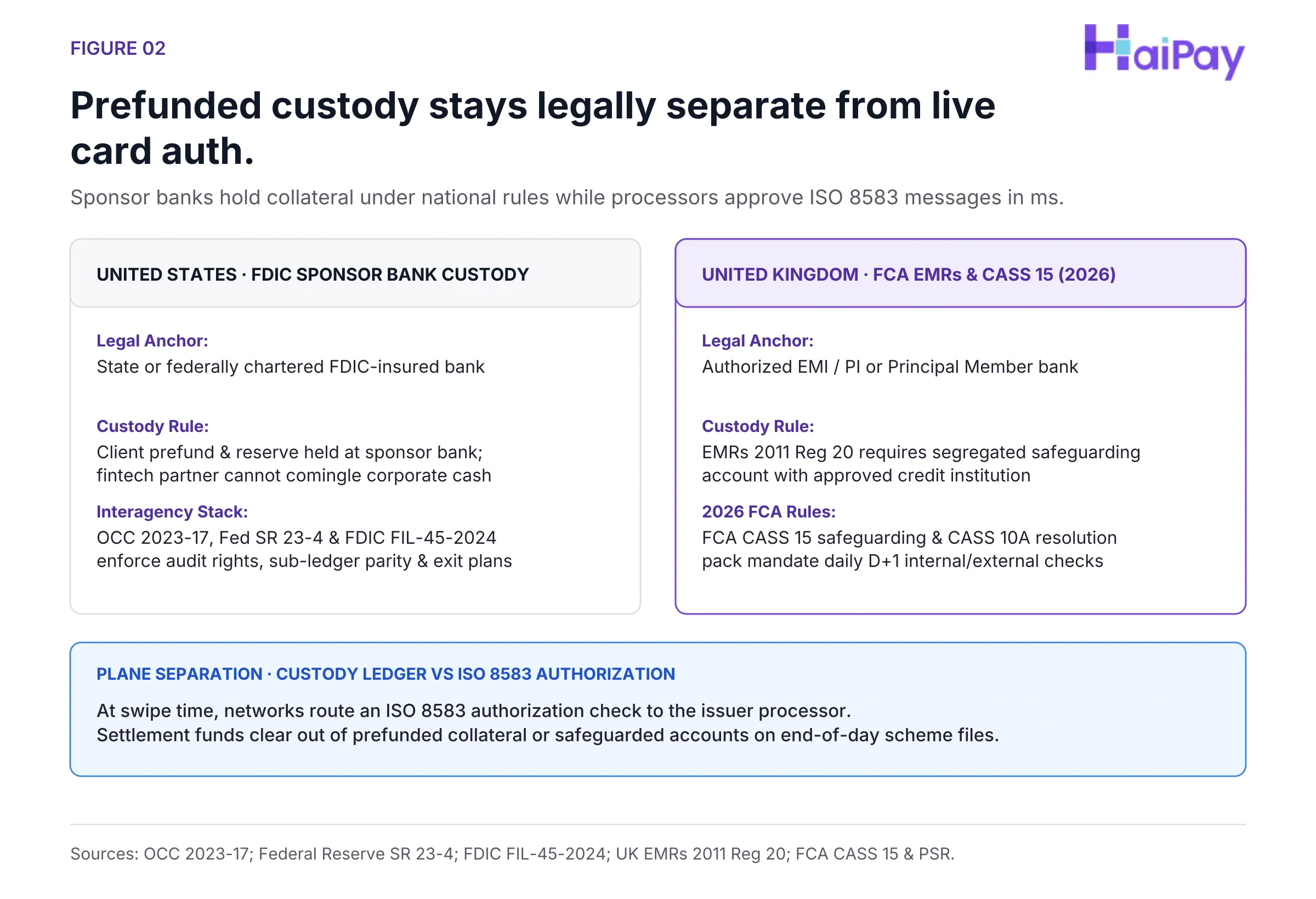
Figure 2: Real-time card authorization runs separately from prefunding collateral, UK CASS 15 safeguarding custody, and daily settlement reconciliation.
Source: FCA Approach Document v8 (Ch. 10, May 2026, accessed 2026-11-20) and Visa Core Rules (Sec. 1.9.1.2, Oct 24, 2026, accessed 2026-11-20).
Sponsor dependency poses the largest operational hazard. Nium warns sponsor exits or license changes disrupt live portfolios. Switching sponsors requires migrating tokens, re-underwriting KYC records, and updating routing—a multi-month move if vendor logs stay trapped.
Source: Nium BIN Sponsorship Glossary (accessed 2026-11-20) and live operator reports on X (tweets 1280129093602869248, 1913215941326016913, and 2122253358643732620, accessed 2026-11-20).
Sponsor Onboarding Readiness and 22-Row Diligence Matrix
Timelines depend on program risk, jurisdiction, and sponsor backlog. Thredd notes US sponsor discovery and due diligence commonly run 3 to 6 months or more—longer if policies lack depth. Instant launch promises skip underwriting reality.
- Corporate & Financial Packet: Incorporation records, ultimate beneficial owner (UBO) disclosures, financial statements, and capital adequacy proof.
- AML/KYC & Sanctions Policies: Identity verification flows, transaction monitoring rules, and escalation paths meeting bank and network audits.
- Technical & Continuity Evidence: PCI DSS scope, Business Continuity Plans (BCP), and processor integration tests.
- Portability & Exit Clauses: Ledger ownership, termination notice windows, and cooperation duties if migrating BINs to another sponsor.
Use the accompanying 22-row BIN Sponsorship Due Diligence and Role Matrix (CSV) alongside our Card Issuing API checklist (Application Programming Interface checklist) before signing sponsor exclusivity or paying deposits.
Source: Thredd, "Launching in America: A Guide to Issuing via BIN Sponsorship" (pages 17–18, 2024, accessed 2026-11-20), Visa Core Rules (Sections 10.2.2.6 and 10.3.1, Oct 24, 2026, accessed 2026-11-20), and Nium BIN Sponsorship Glossary (accessed 2026-11-20).
When to Skip BIN Sponsorship for Prepaid Corporate Virtual Cards
Many companies search for BIN sponsorship when they only need a corporate card program for internal spend. Paying advertising platforms, software, or suppliers does not require licensing a BIN, running customer Know Your Business (KYB) onboarding, or funding safeguarding accounts. Compare goals in HaiPay's business-spend card buyer guide before starting a bank search.
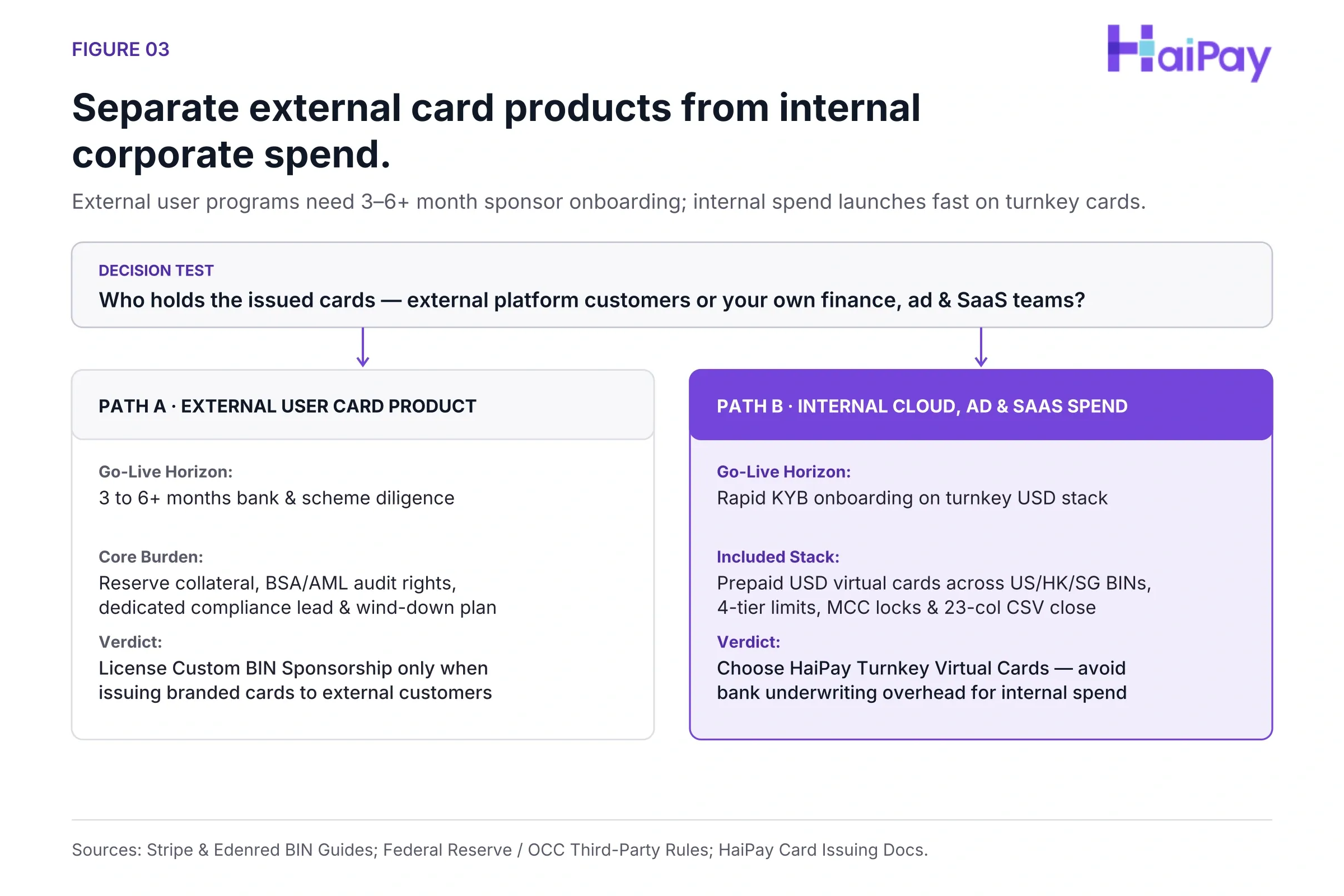
Figure 3: Choose BIN sponsorship only for external cardholder programs; choose turnkey prepaid virtual cards for internal business spend.
Source: Virtual Card Issuing Platform and What Is Card Issuing? (reviewed October 3, 2026, accessed 2026-11-20).
For corporate spending, HaiPay offers US-dollar (USD) prepaid virtual corporate cards across US, Hong Kong, and Singapore programs on Visa and Mastercard. Teams issue single-use or reusable cards with 3-D Secure, Address Verification Service (AVS), Apple Pay, Google Pay, spend limits, and merchant or category locks via dashboard or API.
Program rules still apply: companies outside mainland China are reviewed case by case, and pending funding cannot be spent. Hong Kong cards exclude OpenAI and Anthropic, and OpenAI excludes prepaid cards for API credits. Pricing on HaiPay Card Issuing is quote-based with no minimum spend. Contact HaiPay to confirm merchant and program fit.
Source: HaiPay Virtual Card Issuing Platform and What Is Banking as a Service (BaaS)? (updated October 24, 2026, accessed 2026-11-20).
Editorial Disclosure: HaiPay publishes this guide and offers the prepaid corporate virtual cards linked above. Educational only—not investment, legal, regulatory, compliance, or financial advice; verified 2026-11-20.
Sources
- Visa Inc., Visa Core Rules and Visa Product and Service Rules (PDF) — Scope: BIN 6/8-digit glossary, Principal/Associate Sections 2.2.1.1, risk collateral Section 1.9.1.2, and Third Party Agent & PCI DSS Sections 10.2.2 and 10.3.1 (Edition 24 October 2026, accessed 2026-11-20).
- Visa Partner Portal, What Partners Do I Need? (BIN Sponsors, Issuer Processors, Program Managers) — Scope: 4-role card program responsibility split and End-to-End Partner availability (2026, accessed 2026-11-20).
- Office of the Comptroller of the Currency (OCC), OCC Bulletin 2023-17: Third-Party Relationships Interagency Guidance — Scope: US national bank third-party risk lifecycle duties (June 6, 2023, accessed 2026-11-20).
- Board of Governors of the Federal Reserve System, SR 23-4: Interagency Guidance on Third-Party Relationships: Risk Management — Scope: Fed-supervised bank sponsor oversight expectations (June 7, 2023, accessed 2026-11-20).
- Federal Deposit Insurance Corporation (FDIC), FIL-45-2024: Joint Statement on Bank Arrangements with Third Parties — Scope: non-delegable bank BSA/AML and consumer compliance statement (July 25, 2024, accessed 2026-11-20).
- Office of the Comptroller of the Currency (OCC), News Release 2024-85: Agencies Issue Statement on Bank Arrangements with Third Parties — Scope: OCC release confirming non-diminished bank compliance obligations (July 25, 2024, accessed 2026-11-20).
- Federal Deposit Insurance Corporation (FDIC), FIL-68-2026: Extension of Comment Period for Proposed Third-Party Risk Management Guidance — Scope: proposed 2026 US third-party guidance comment window through Dec 16, 2026 (November 13, 2026, accessed 2026-11-20).
- UK Financial Conduct Authority (FCA), Payment Services and Electronic Money – Our Approach (Version 8, PDF) — Scope: UK EMI/PI licensing, CASS 15 safeguarding accounts, no-set-off letters, and CASS 10A packs (May 2026, accessed 2026-11-20).
- UK Legislation, The Payment Services Regulations 2017, Regulation 23 (Safeguarding) — Scope: statutory UK safeguarding segregation and creditor priority in insolvency (SI 2017/752, accessed 2026-11-20).
- UK Legislation, The Electronic Money Regulations 2011, Regulation 20 (Safeguarding) — Scope: statutory UK EMI e-money funds safeguarding requirements (SI 2011/99, accessed 2026-11-20).
- UK Payment Systems Regulator (PSR), Card Payments and the Interchange Fee Regulation — Scope: UK four-party roles and removal of UK–EU consumer cross-border IFR caps (accessed 2026-11-20).
- Thredd, Launching in America: A Guide to Issuing via BIN Sponsorship (PDF) — Scope: US Durbin debit routing, FinCEN/CFPB supervision, credit reserves, and 3–6+ month diligence horizon (2024, accessed 2026-11-20).
- Flagship Advisory Partners, U.S. Acquiring BIN Sponsorship: To Sponsor or Not to Sponsor — Scope: US acquiring bank scarcity and Georgia MALPB charter timelines for Fiserv (2024/2025) and Stripe (July 2025) (November 6, 2025, accessed 2026-11-20).
- Tribe Payments, How BIN sponsorship works in acquiring — Scope: acquiring operational delegation vs sponsor accountability (accessed 2026-11-20).
- Cross River, Acquiring BIN Sponsorship — Scope: US acquiring BIN sponsorship structure for payment processors and PayFacs (accessed 2026-11-20).
- Edenred Payment Solutions, What is BIN sponsorship and why does it matter? — Scope: shared BIN vs dedicated BIN launch trade-offs (May 19, 2025, accessed 2026-11-20).
- Nium, BIN Sponsorship: What It Is & How It Works — Scope: sponsor bank dependency and card-migration exit risk (accessed 2026-11-20).
- HaiPay First-Party Product & Controls, Virtual Card Issuing Platform & Multi-Currency API — Scope: USD prepaid corporate virtual cards (US/HK/SG), authorization controls, exclusions, and quote pricing (accessed 2026-11-20).
- HaiPay First-Party Issuing Scope, What Is Card Issuing? — Scope: issuer vs processor definitions, media/AI spend use cases, and non-advice statement (reviewed October 3, 2026, accessed 2026-11-20).
- HaiPay First-Party Non-Bank Disclosure, What Is Banking as a Service (BaaS)? — Scope: explicit confirmation that HaiPay is not a bank and does not provide BaaS or bank BIN sponsorship (updated October 24, 2026, accessed 2026-11-20).
FAQ
A BIN sponsor is a licensed bank or authorised electronic money institution that holds direct Visa or Mastercard membership and owns the Bank Identification Number range. It lends scheme connectivity to non-bank partners while retaining statutory compliance oversight, settlement liability, and cardholder fund custody.
Issuing BIN sponsorship enables fintechs or expense platforms to launch debit, prepaid, or credit cards for end users. Acquiring BIN sponsorship enables Payment Facilitators (PayFacs), Independent Sales Organizations (ISOs), or processors to onboard merchants and accept incoming card volume under an acquirer of record's network license.
No, the underlying regulatory architectures differ substantially. US BIN sponsorship centers on FDIC-insured depository banks overseen by the OCC, Federal Reserve, and FDIC. UK and EEA programs also permit FCA or EU-authorised Electronic Money Institutions bound by CASS 15 safeguarding custody.
Timelines vary by institution, card type, and applicant preparedness. Industry operators report US sponsor discovery and due diligence often take 3 to 6 months or longer when AML/KYC policies, audited financials, Business Continuity Plans, or technical processor testing require revision.
When a sponsor exits card issuing or changes risk appetite, affected programs face paused card creation, forced BIN migrations, or card reissuance. Maintaining portable customer ledger records, clean KYC documentation, and pre-vetted backup processor integrations reduces switching disruption.
Use turnkey prepaid corporate virtual cards when your company simply needs to pay advertising platforms, software subscriptions, or suppliers rather than operate external customer accounts. Businesses outside mainland China can review HaiPay virtual corporate cards across US, Hong Kong, and Singapore programs without signing sponsor-bank underwriting contracts.
