


Direct Answer
Evaluate a card issuing application programming interface (API) by checking each business action against the provider's documented capabilities and evidence. Assign an owner, require evidence of the resulting card outcome, and agree how uncertainty will be resolved before approving the integration.
This checklist helps engineering leads turn business requirements into acceptance tests. It separates five evidence layers: the request, the immediate response, the later card state, transaction records, and reconciliation. For this checklist, reconciliation means comparing the agreed financial records and investigating differences. Use the accompanying worksheet to record questions and missing evidence before implementation.
Terminology sources: MDN Web Docs, “API” (API terminology), accessed October 14, 2026. Stripe, “Accounting reconciliation: What it is and how it’s done” (general accounting explanation), accessed October 10, 2026.
Start with a business action
Describe the outcome your business needs before asking for an API feature list. For example, define one card for an approved advertising budget, associated with its internal spending purpose. This is a proposed requirement, not a supported API field or a promise that a provider can meet it.
For each action, record who approves it, who submits it, and who decides whether it succeeded. Define what must happen when the result is missing or contradictory. A technical response, a visible card, and a finance record answer different questions.
Limit the initial scope to your own company's spending workflows. If you need an introduction to issuers, card networks, and issuing platforms, read the card issuing guide. Return here to test the integration boundary for your chosen workflow.
Assign responsibilities before implementation
The following split is a starting proposal. Your contract and named contacts must settle the actual responsibilities; the worksheet does not assign legal or regulatory obligations.
Work to agree | Internal lead to name | Provider evidence or agreement to request |
|---|---|---|
Approve a spending purpose and permitted action | Business owner | Which product and application conditions apply? |
Submit and trace an approved action | Engineering | Supported operation, access requirements, response meanings, and a way to investigate the original attempt |
Verify the resulting card outcome | Engineering, with the business owner | A documented link between the operation and any resulting card, plus an agreed way to establish its current state |
Handle notifications and gaps | Engineering | Event meanings, delivery conditions, and the recovery procedure when notifications are missing or contradictory |
Review transaction and reconciliation evidence | Finance, supported by engineering | Record definitions, applicable exports, and a process for investigating differences |
Decide what happens after an uncertain result | Named engineering decision owner | A documented recovery procedure and a designated provider technical contact |
Engineering should review automatic retries in the client, job runner (software that runs scheduled or background tasks), and notification processing against the agreed contract. A planning decision to hold further submissions will need an operational implementation. Recording that decision in a worksheet does not stop software from sending requests.
Terminology source: RQ, “Workers” (a background-worker example), accessed October 14, 2026. This reference does not establish your provider’s runtime behavior.
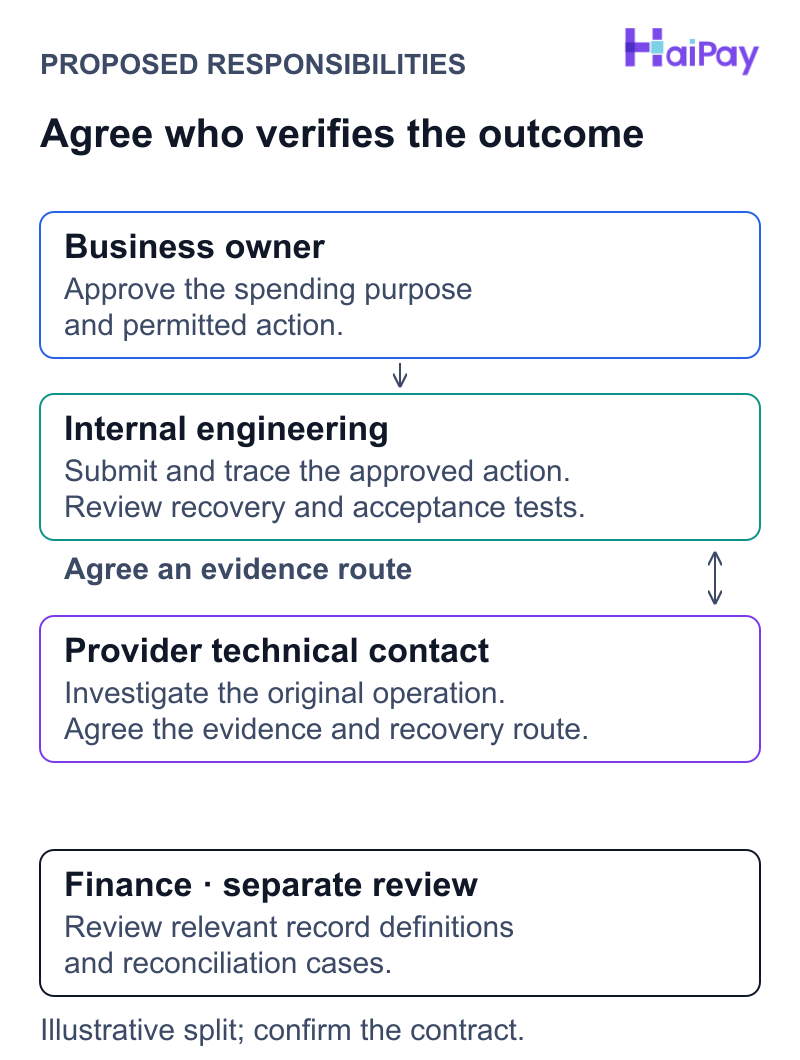
Proposed responsibility split; agree the actual roles and evidence routes in your contract.
Separate the API from the dashboard
HaiPay publishes this article. The capability summary below reflects first-party product confirmation dated October 10, 2026; it is not an independent integration test or an API contract.
Channel | Confirmed scope | What still needs implementation evidence |
|---|---|---|
API | Card creation, freezing and unfreezing, transaction queries, and webhook notifications | Operation-specific access, response meanings, resulting outcomes, and failure handling |
Dashboard | Per-card limits, freezing and unfreezing, card closure, failure alerts, transactions and comma-separated values (CSV) exports, and labels | Which actions belong in your operating process and which require manual handling |
Sandbox (a controlled test environment) | Access provisioned by the service | How access is arranged and which scenarios the available environment can represent |
Source: HaiPay, “Virtual Cards for Business: Ad Spend & AI Tools” (first-party product overview, not an API specification), accessed October 14, 2026. Capability scope was separately confirmed first-party on October 10, 2026.
Terminology sources: RFC Editor, RFC 4180 (CSV format); Stripe, “Sandboxes” (its own controlled test environment). Both accessed October 14, 2026. These references do not establish your provider’s test access or scenario coverage.
Verify notifications and controls
A webhook is a notification sent to an agreed receiving system. Confirmation that webhook notifications exist does not establish their delivery timing, ordering, completeness, or retry behavior. Ask for the applicable contract and test cases.
Terminology source: Stripe, “Receive Stripe events in your webhook endpoint” (its own notification model and delivery conditions), accessed October 10, 2026.
Likewise, a dashboard limit control does not prove that an API can set that limit when creating a card. A dashboard closure action does not establish an API closure operation. Verify each required action in its own channel.
Test five layers of evidence
Use the same business action across all five layers. Do not replace a missing layer with evidence from a different one. The proposed tests below must be adapted to the documented provider contract.
Layer | Evidence to agree | Success test to define | Failure or uncertainty test to define |
|---|---|---|---|
1. Request | Redacted submission history and a permitted reference for investigating the attempt | The approved action was submitted through the agreed route | Establish what can be verified when the caller cannot confirm delivery |
2. Immediate response | The actual response, or an explicit record that none was received | The response has the documented meaning expected for this action | Separate a rejection from a timeout or another unknown outcome |
3. Later card state | Evidence linking the original operation to any resulting card and its current state | The agreed outcome matches the intended internal purpose | Investigate missing, unexpected, or contradictory outcomes without assuming a state-query API exists |
4. Transaction records | Relevant records with definitions and references needed for the review | The records answer the transaction questions agreed for that workflow | Investigate missing or inconsistent records; their absence alone cannot settle whether card creation occurred |
5. Reconciliation | The finance evidence relevant to the action, with agreed meanings | Finance can explain the records required for its reconciliation process | Escalate unexplained differences rather than inferring balances or settlement from an API acknowledgement |
Finance must decide which financial records matter for each action. Do not assume that creating, freezing, or closing a card has a particular effect on fees, funding, pending transactions, or settled amounts. Those questions require the applicable terms and finance review.
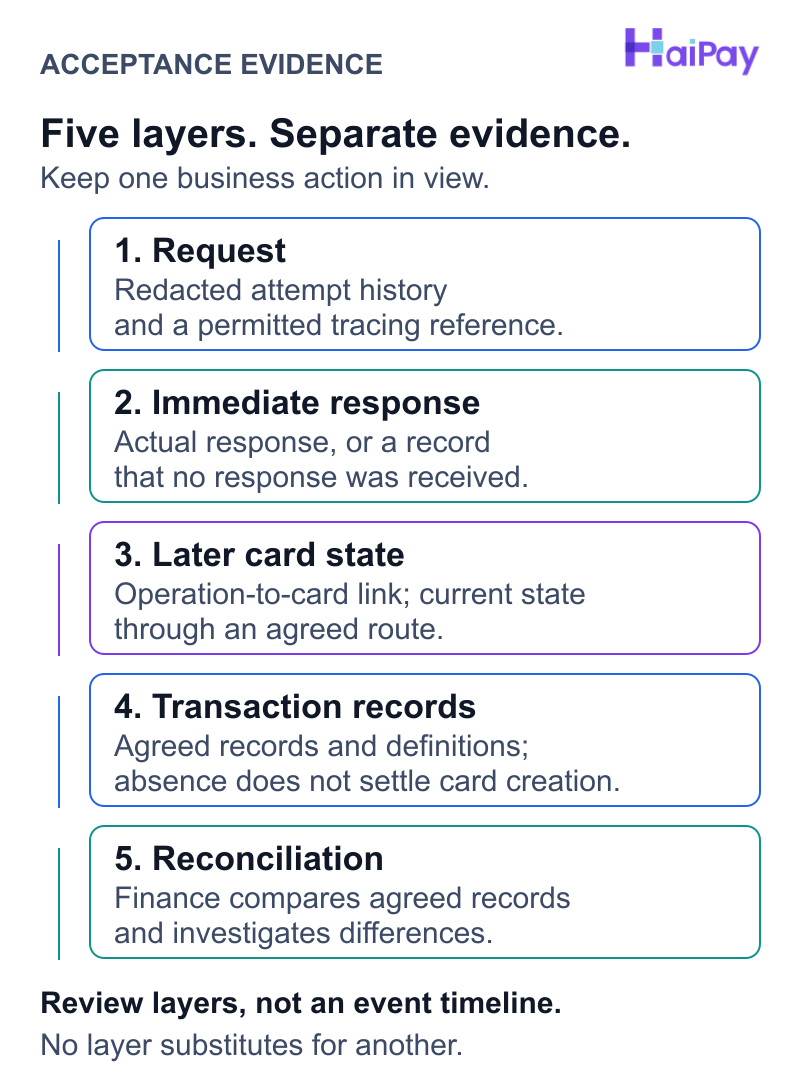
Five separate evidence layers, not an event timeline or a guaranteed provider lifecycle.
Fill the acceptance worksheet
Open the local planning tool, download the blank CSV, or inspect the synthetic timeout sample. These links refer to files in this delivery package; production download locations still need to be assigned.
The worksheet has 18 planning fields, not provider API parameters. Fill it in this order:
- Start with one row per business action. Name the internal owner and provider contact, then record the interface or event you need to verify.
- Attach redacted evidence references rather than credentials, personal details, or card numbers. Work through the five layers and define success and failure tests.
- Record unresolved questions and complete the decision fields. Name the first verifier, original-operation-to-resource evidence, hold trigger, and condition for a later action.
- Leave missing evidence visible. An unanswered question is not an acceptance pass.
The tool is a planning aid. Its sample and status labels do not authenticate provider evidence, approve a retry, or supply engineering or finance sign-off. Use its exports as review records, then agree and implement the controls in your actual systems.
Walk through a timeout with an unknown result
Synthetic example: no real provider request, card, event, transaction, or finance record is represented. Your application submits a request to create one card. The caller times out before receiving a usable response. The only established observation is the caller's timeout; delivery and execution remain unresolved.
1. Hold further submissions and name the verifier
For this proposed acceptance scenario, hold further creation attempts as soon as the result becomes unknown. The internal engineering lead checks the redacted attempt history first, then asks the designated provider technical contact to investigate the original operation. Include the attempt timeline and time zone, any permitted reference already available, and the intended business outcome.
2. Link the original operation to any resulting card
The investigation needs evidence connecting the original attempt to any resulting card, plus current-state evidence through an agreed route. A local identifier alone does not prove that repeating the request is safe. No transaction record, no visible notification, or a later connection recovery is not sufficient proof that creation failed.
Public documentation illustrates why the distinction matters. Advanced error guidance explains that restored connectivity cannot determine the original outcome. Its replay guidance has version-specific conditions. An idempotent API discussion describes contracts designed to avoid unintended repeated effects and service-dependent retention requirements. These are industry references, not implementation guarantees for your issuing provider.
Source: Stripe, “Advanced error handling” (its own API conditions), accessed October 14, 2026; AWS, “Making retries safe with idempotent APIs” (architecture examples), accessed October 14, 2026.
3. Record the decision and unresolved escalation
Before any further action, resolve the original outcome and apply a documented provider procedure reviewed by engineering. If the evidence remains missing or contradictory, keep the hold and escalate to the named provider contact. Finance separately reviews any financial evidence relevant to the action. This desk walkthrough ends unresolved; it does not establish provider retry, event, or financial semantics.
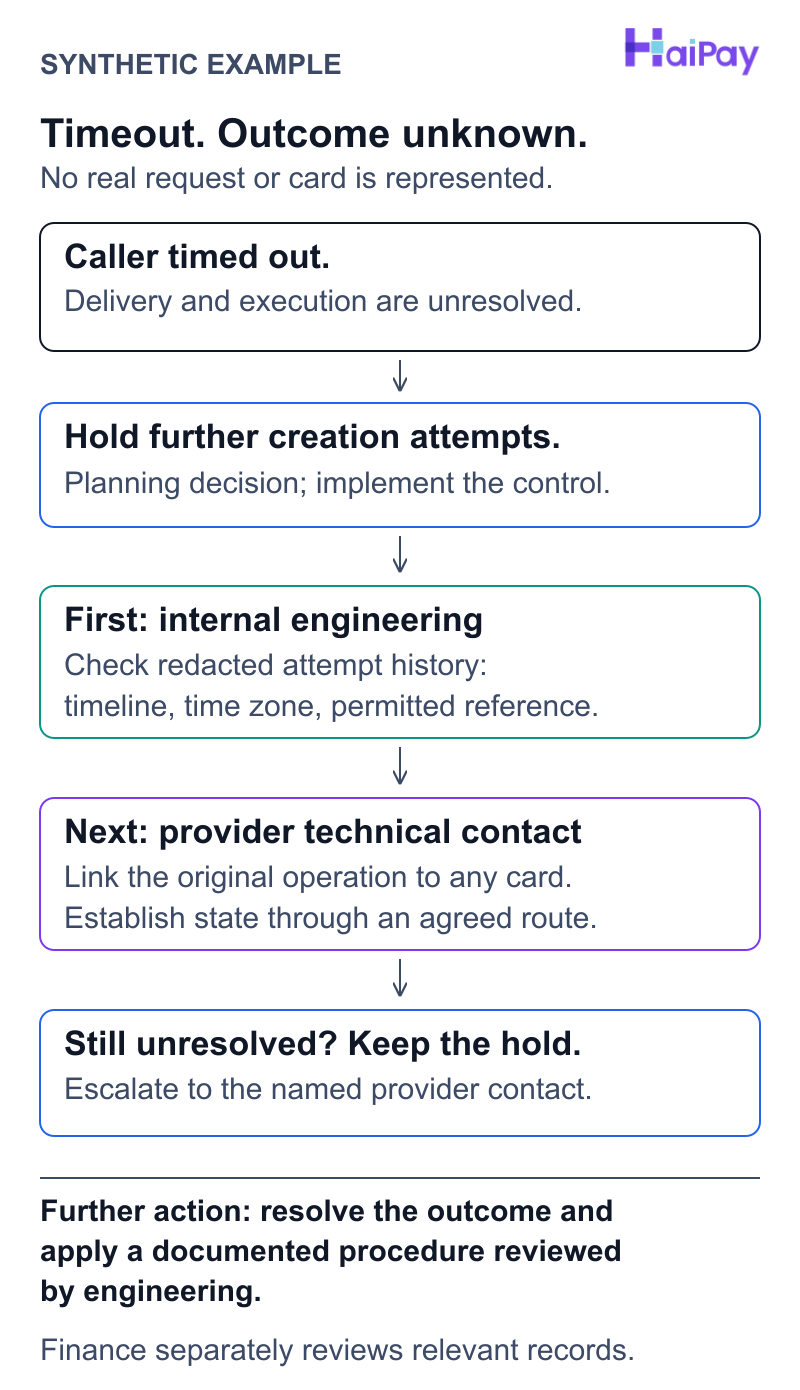
Synthetic planning scenario, not a live request or evidence of HaiPay retry, event, or financial behavior.
Synthetic decision field | Entry to review |
|---|---|
First verification owner | Internal engineering lead; designated provider technical contact next |
Evidence needed | Redacted attempt history, original-operation-to-card link, and agreed current-state evidence |
Stop condition | Unknown original outcome: hold further creation attempts in this planning scenario |
Further action | Resolve the original outcome and apply a documented procedure reviewed by engineering; otherwise retain the hold |
Turn the worksheet into a review handoff
Before approving implementation, ask engineering to review the actual access method, supported operations, tracing, configured retry behavior, notification handling, and recovery tests. Ask finance to review the applicable record definitions and reconciliation cases. The business owner should confirm the spending purpose and permitted scope.
Keep the completed worksheet, supporting evidence, unresolved questions, and named decisions together. Agree what blocks implementation and what must be tested before production use. The worksheet is useful only when those decisions become concrete acceptance criteria for the real integration.
For confirmed product scope and an integration discussion, visit the card issuing product page. Bring your business actions and evidence questions so the conversation can address the required boundaries. This article is technical evaluation guidance, not investment advice or a completed production approval.
Sources
- Stripe: Advanced error handling — public technical reference; accessed October 14, 2026.
- AWS Builders' Library: Making retries safe with idempotent APIs — public architecture reference; accessed October 14, 2026.
- HaiPay: Virtual Cards for Business: Ad Spend & AI Tools — public context and consultation route; accessed October 14, 2026. It is not the dated product confirmation or an API specification.
- MDN Web Docs: API — API terminology; accessed October 14, 2026.
- Stripe: Accounting reconciliation: What it is and how it’s done — general accounting explanation; not provider-specific financial semantics; accessed October 10, 2026.
- RQ: Workers — background-worker example; no provider runtime claim; accessed October 14, 2026.
- RFC Editor: Common Format and MIME Type for Comma-Separated Values (CSV) Files (RFC 4180) — CSV format reference; accessed October 14, 2026.
- Stripe: Sandboxes — its own controlled test environment; not your provider’s access or scenario coverage; accessed October 14, 2026.
- Stripe: Receive Stripe events in your webhook endpoint — its own notification model and conditions; not provider delivery guarantees; accessed October 10, 2026.
Product scope above uses dated first-party confirmation. The linked public references establish their own examples and limitations, not your issuing provider's interface contract.
FAQ
Start with your company's business actions, name the internal and provider owners, and agree evidence for the request, immediate response, later card state, transaction records, and reconciliation. Treat unresolved questions as requirements to settle before acceptance.
No. Verify the action in the required channel. HaiPay's confirmed dashboard limit and closure controls do not establish API create-time limit setting or an API closure operation.
First-party confirmation covers card creation, freezing and unfreezing, transaction queries, and webhook notifications. This is product scope, not an independently tested contract for response, retry, event, or financial behavior.
In the synthetic scenario, hold further creation attempts, have engineering check the attempt history, and ask the designated provider contact to establish the original outcome and linked card state through an agreed route. Consider a later action only under a documented procedure reviewed by engineering.
A reference can help investigate an attempt, but it does not by itself establish a provider's contract for repeated requests. Obtain the applicable documented procedure and evidence of the original outcome before deciding on further action.
No. It records planning questions, evidence references, acceptance criteria, and decisions. Real engineering review and finance review remain necessary for the actual integration and its applicable financial records.

Related HaiPay surfaces
Explore the payment stack
Guide
Card issuing roles
Read the introduction to issuers, card networks, and issuing platforms.
Product
HaiPay card issuing
Review product scope and discuss your business actions and evidence questions.
Glossary
Issuing bank
Check the issuing-bank role when assigning your integration questions.

Need help mapping your payment stack?
Talk to HaiPay about acquiring, orchestration, local methods, and payout workflows.
Contact us