Pix Has Published 67 Months of Uptime. None Below 99.9%.
Brazil's central bank publishes the uptime of its instant payment system every month, measured against a floor it set itself. There are 67 months of it now, from February 2021 to August 2026.
October 10th, 2026
Last updated: October 10
Key takeaways
- Brazil publishes a monthly availability index for SPI, the settlement core behind Pix, against a 99.9% regulatory floor.
- Across 67 months from February 2021 to August 2026 the index has never fallen below that floor.
- It reads exactly 100.0% in 27 of those months, including six of the eight months of 2026 so far.
- The lowest reading in the whole series is 99.90812%, in May 2021, which clears the floor by 0.008 points.
- The outage log lists two events in 2026, totalling 11m55s, in the only two months where the index is below 100.
- The minutes do not reconcile with the index, and the dataset does not state what the index is measured over.
Data highlight
67months
Consecutive monthly readings of the availability index for Brazil's SPI instant payment system, none of them below the 99.9 per cent regulatory minimum
February 2021 to August 2026, retrieved 10 October 2026
Compiled by HaiPay on 10 October 2026 from the Banco Central do Brasil's open data service for the Sistema de Pagamentos Instantâneos, the settlement system behind Pix, at olinda.bcb.gov.br. Two datasets were retrieved in full. PixDisponibilidadeSPI returns 67 monthly observations, from February 2021 to August 2026, each giving an availability index and the regulatory minimum applying in that month; the minimum is 99.9 in all 67 observations. PixInterrupcaoSPI returns a list of interruptions with start time, end time and duration, plus a total row; at the time of retrieval it contained two events, one beginning 28 July 2026 at 02:35:08 and lasting 1m0s, and one beginning 22 August 2026 at 23:44:33 and lasting 10m55s, with a stated total of 11m55s. The statements that the index has never fallen below the minimum, that it reads exactly 100.0 in 27 of the 67 months, and that the lowest reading in the series is 99.90812 in May 2021, are HaiPay's checks over the full retrieved series. The yearly figures are HaiPay's calculations from the same series: 2021, eleven months, mean 99.96443, lowest 99.90812, no month at 100.0; 2022, twelve months, mean 99.99717, lowest 99.97408, five months at 100.0; 2023, twelve months, mean 99.97917, lowest 99.91884, four months at 100.0; 2024, twelve months, mean 99.98272, lowest 99.95046, six months at 100.0; 2025, twelve months, mean 99.99407, lowest 99.98118, six months at 100.0; and 2026 to August, eight months, mean 99.99878, lowest 99.99100, six months at 100.0. The observation that the only two months of 2026 below 100.0 are July and August, the same two months as the logged interruptions, is HaiPay's. So is the reconciliation test: treating the index as a share of calendar minutes in the month gives roughly twenty seconds of downtime for July 2026 at 99.99925 and roughly four minutes for August 2026 at 99.991, against the logged 1m0s and 10m55s. The dataset does not state the basis on which the index is calculated, and HaiPay did not locate a published methodology defining it, so the difference is reported as unexplained rather than attributed to any cause; the minute conversions are used only for that test and are not presented as measurements of downtime. The description of SPI as the settlement core behind Pix, and the November 2020 launch date of Pix, are context rather than figures from these datasets. HaiPay notes three further limits. The index is the central bank's own unaudited measurement of its own system. Availability of the settlement core is not availability of Pix to an end user, since a participating institution can be unavailable while SPI is not, and the index covers only the former. The interruption list appears to be a current window rather than a complete history, because it contains two 2026 events and nothing earlier while the index shows readings below 100.0 in many earlier months; HaiPay did not find a statement of the period that list covers and does not treat it as a full outage history. The series begins in February 2021, three months after Pix launched, so the system's first months are not in the file. HaiPay did not contact the Banco Central do Brasil.
Brazil's central bank publishes the uptime of its instant payment system every month, measured against a floor it set itself. There are 67 months of it now, from February 2021 to August 2026.
The floor is 99.9%. The system has never been below it.
What is being measured
The Sistema de Pagamentos Instantâneos, SPI, is the settlement core behind Pix. It is the thing that has to be running for a Pix transfer to clear, at any hour, every day.
The central bank publishes a monthly availability index for it through an open data service, alongside the regulatory minimum that applies in the same month. The minimum is 99.9% in all 67 months.
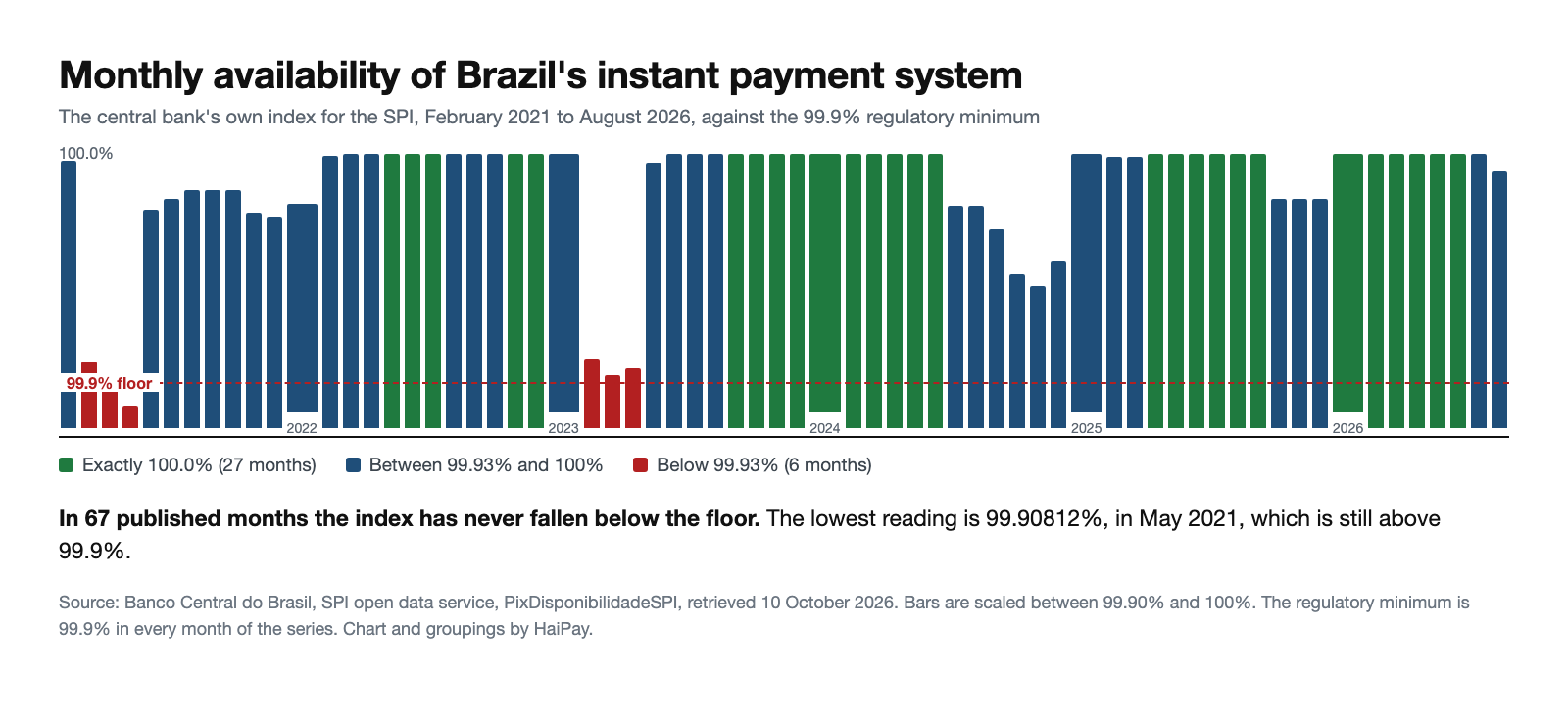
The index has been at exactly 100.0% in 27 of those months, including six of the eight months of 2026 so far. The lowest reading in the whole series is 99.90812%, in May 2021, six months after Pix launched. It cleared the floor by eight thousandths of a percentage point.
The shape of it
The first year is the worst year, which is what you would expect of a system that went live in November 2020. The 2021 mean is 99.96443%, pulled down by March, April and May.
Then it settles, with one interruption to the pattern. The 2022 mean is 99.99717%. In 2023 it falls back to 99.97917%, with February, March and April all below 99.93%. From 2024 it climbs again: 99.98272%, then 99.99407% in 2025, then 99.99878% so far in 2026.
Read as a curve, the system had a bad start, a clean second year, a worse third year, and has improved in each of the three years since.
The outage log, and a gap
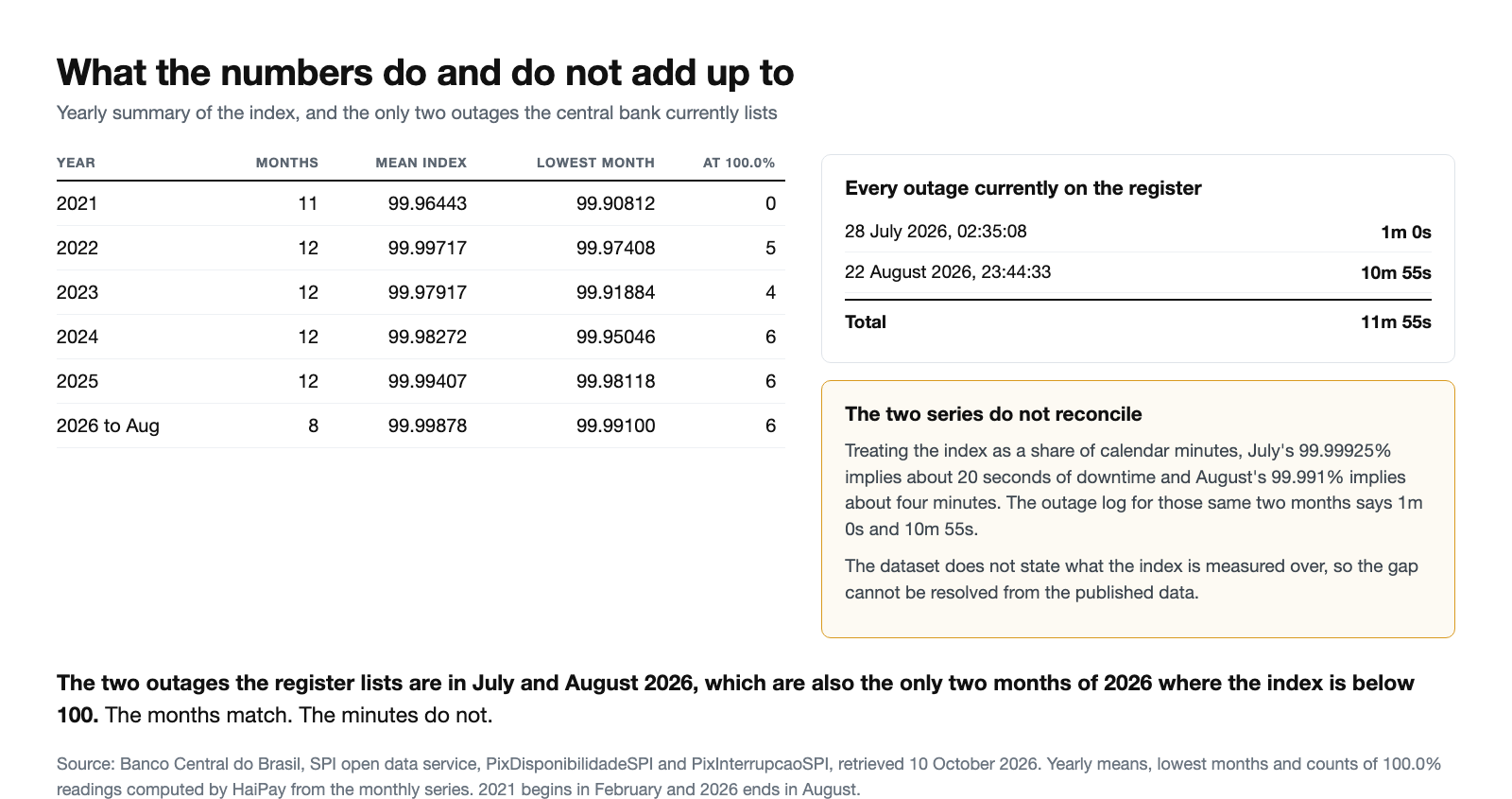
Alongside the index the bank publishes a list of interruptions with start and end times. Right now it has two entries: 28 July 2026 at 02:35:08, lasting one minute, and 22 August 2026 at 23:44:33, lasting ten minutes and fifty-five seconds. Total, eleven minutes fifty-five seconds.
Those are also the only two months of 2026 in which the index is below 100.0%. The months line up exactly.
The minutes do not. If the index were simply the share of calendar minutes the system was up, July's 99.99925% would imply about twenty seconds of downtime, not a minute, and August's 99.991% would imply about four minutes, not eleven. The published dataset does not say what denominator the index uses, so the difference cannot be closed from the data itself.
This is not a complaint about the numbers. It is the kind of thing you only find by pulling two series from the same publisher and checking whether they agree.
Why this is unusual
Very few payment systems publish this. Operators of card networks and domestic rails talk about reliability in press releases and annual reports; a monthly index, with a stated regulatory floor, in machine-readable form, going back to the system's first full quarter, is rare.
It is also an uncomfortable thing for an operator to publish, because it turns reliability into a number someone else can audit. The month the index dipped to 99.908% is in the file permanently, next to the floor it nearly touched.
For a payments business the practical value is comparison. A Brazilian acquirer or PSP arguing about its own SLA with a merchant can point at the rail's published figure and say what share of the chain is not theirs. Anyone evaluating instant rails across markets now has one country where the uptime question has a published answer rather than an assurance.
What this is not
The index is the central bank's own measurement of its own system, not an independent one, and it is unaudited.
HaiPay converted index values to minutes only to test whether the two published series agree. Those minute figures are illustrative and, as the article says, they do not match the outage log, so they should not be quoted as downtime.
Availability of the settlement core is not the same as availability of Pix to a consumer. A bank or payment institution can be down while SPI is up, and the index says nothing about that layer.
The interruption list appears to be a current window rather than a full history: it contains two events from 2026 and nothing earlier, while the index shows below-100% readings in many earlier months. HaiPay did not find a statement of what period that list covers.
The series has 67 monthly observations and begins in February 2021. Pix itself launched in November 2020, so the first three months are not in the file.
HaiPay did not contact the Banco Central do Brasil.
What to watch
Whether September 2026 publishes at 100.0% or carries the August interruption's successor. The file has been updated monthly without a gap.
Whether the floor moves. It has been 99.9% in every month published, and a regulator that has never seen a breach has room to raise it.
And whether any other instant rail starts publishing the same thing. The interesting question is not whether Pix is reliable. It is why almost nobody else lets you check.
How to cite
HaiPay News, "Pix Has Published 67 Months of Uptime. None Below 99.9%.", https://www.haipay.net/news/pix-spi-availability-67-months, October 10th, 2026
About the author
Crystal
Digital Public Relations
A digital PR specialist with a Master's in Journalism & Communication from UNSW. Started as an intern at ABC Australia, now leads public relations at Haipay, crafting press releases and media strategies that bring brand stories to life.
Reviewed by WeiJun TangEditorial policy