Priority's CEO Opened at $6. The Committee Got $8.05.
On 9 November 2025, Thomas Priore, chairman and chief executive of the payments company Priority Technology Holdings, wrote to his own board offering to buy the shares he and his group did not already own. His letter, filed with the US Securities and Exchange Commission the next day, proposed "a purchase price in the range of $6.00 to $6.15 per share in cash", which he valued at $510 million to $520 million for the whole equity.
September 23rd, 2026
Last updated: September 23
Key takeaways
- The opening offer from Priority's chief executive in November 2025 was $6.00 to $6.15 a share, filed with the SEC at the time.
- The agreement signed on 18 September is $8.05 a share, 31% above the top of that range, after 313 days of negotiation.
- Three separately disclosed premiums all imply the same unaffected share price of $4.88 on 7 November 2025.
- Closing requires change-of-control approval from every state that licensed the company, 46 states plus DC and two territories.
- The outside date is 18 December 2027, 456 days after signing, and withdrawals are allowed from states worth up to 10% of licence revenue.
- About 61.4% of shares roll over, so only about 31.8 million shares, roughly $256 million, are bought for cash.
Data highlight
31per cent
Increase from the top of the opening proposal range ($6.15) to the agreed price of $8.05 a share
9 November 2025 to 18 September 2026
Compiled by HaiPay on 23 September 2026 from filings by Priority Technology Holdings, Inc. (SEC CIK 0001653558). The opening proposal is the letter dated 9 November 2025 filed as an exhibit to a Schedule 13D/A on 10 November 2025, which proposed a purchase price range of $6.00 to $6.15 per share, described as a 23 to 26 per cent premium to the closing price on 7 November 2025, and a total equity value of approximately $510 million to $520 million. The agreed terms are from the Form 8-K, merger agreement and press release filed on 21 September 2026 for an agreement signed on 18 September 2026: $8.05 per share in cash, an enterprise value of about $1.6 billion, a 65 per cent premium to the 7 November 2025 close and a 38 per cent premium to the 18 September 2026 close. HaiPay derived the following: $8.05 is 30.9 per cent above $6.15 and 34.2 per cent above $6.00; the three disclosed premiums imply an unaffected close of $4.879, $4.878 and $4.881 respectively; the 38 per cent premium implies a close of $5.83 on 18 September 2026; 313 days separate the proposal letter and signing, and 456 days separate signing and the 18 December 2027 outside date. Share counts are the 82,440,372 shares outstanding at 31 July 2026 stated on the cover of the Form 10-Q for the quarter ended 30 June 2026, giving an equity value of about $663.6 million at $8.05; with supporting stockholders holding about 61.4 per cent and rolling their shares over, about 31.8 million shares, roughly $256 million, are to be paid in cash, excluding amounts for equity awards. The company termination fee of $15.75 million and parent termination fee of $35.25 million are 2.4 and 5.3 per cent of that equity value, a ratio of 2.24. Financing, credit facilities and cash figures are from the 8-K and the Form 10-Q: equity commitment of up to $160 million from funds advised by Searchlight Capital Partners, a $100 million revolving facility undrawn at 30 June 2026, cash and cash equivalents of $120.3 million at the same date, and a $1.02 billion term facility maturing in 2032. Licence counts are from the 2025 Form 10-K, which states money transmission licences through the subsidiary Finxera in 46 US states, the District of Columbia and two US territories. Money transmission services revenue of $41.989 million against total revenue of $262.256 million, 16.0 per cent, is from the segment revenue disaggregation in the Form 10-Q for the quarter ended 30 June 2026. Implied share prices are derived from the premiums the company disclosed and are not quoted market data. HaiPay did not assess the fairness of the price and did not contact the company, the buying group or their advisers. A signed merger agreement is not a completed transaction.
On 9 November 2025, Thomas Priore, chairman and chief executive of the payments company Priority Technology Holdings, wrote to his own board offering to buy the shares he and his group did not already own. His letter, filed with the US Securities and Exchange Commission the next day, proposed "a purchase price in the range of $6.00 to $6.15 per share in cash", which he valued at $510 million to $520 million for the whole equity.
On 18 September 2026, the company signed a deal at $8.05 a share. That is 31% above the top of the opening range, and 34% above the bottom.
What the filings say
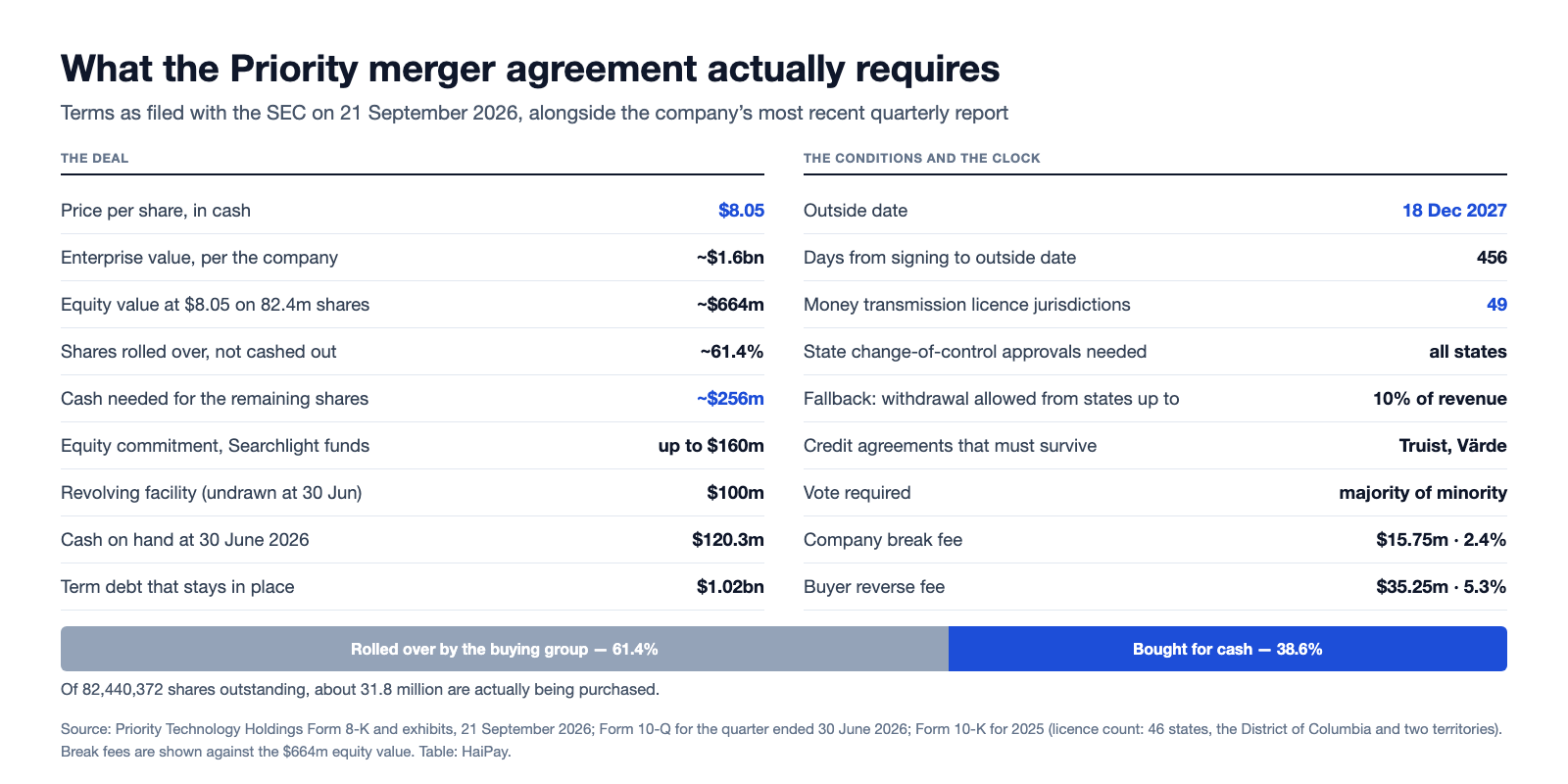
The merger agreement, filed on 21 September, takes Priority private through entities controlled by Priore. The company puts the enterprise value at about $1.6 billion. On the 82,440,372 shares outstanding at 31 July, $8.05 values the equity at roughly $664 million.
The press release leads with a 65% premium to the closing price on 7 November 2025, the last trading day before the proposal became public, and a 38% premium to the close on 18 September 2026.
Those three disclosures can be checked against each other. A 65% premium to the unaffected close implies $4.88. The opening letter said $6.00 was a 23% premium and $6.15 a 26% premium to the same day, which implies $4.88 and $4.88. The numbers agree.
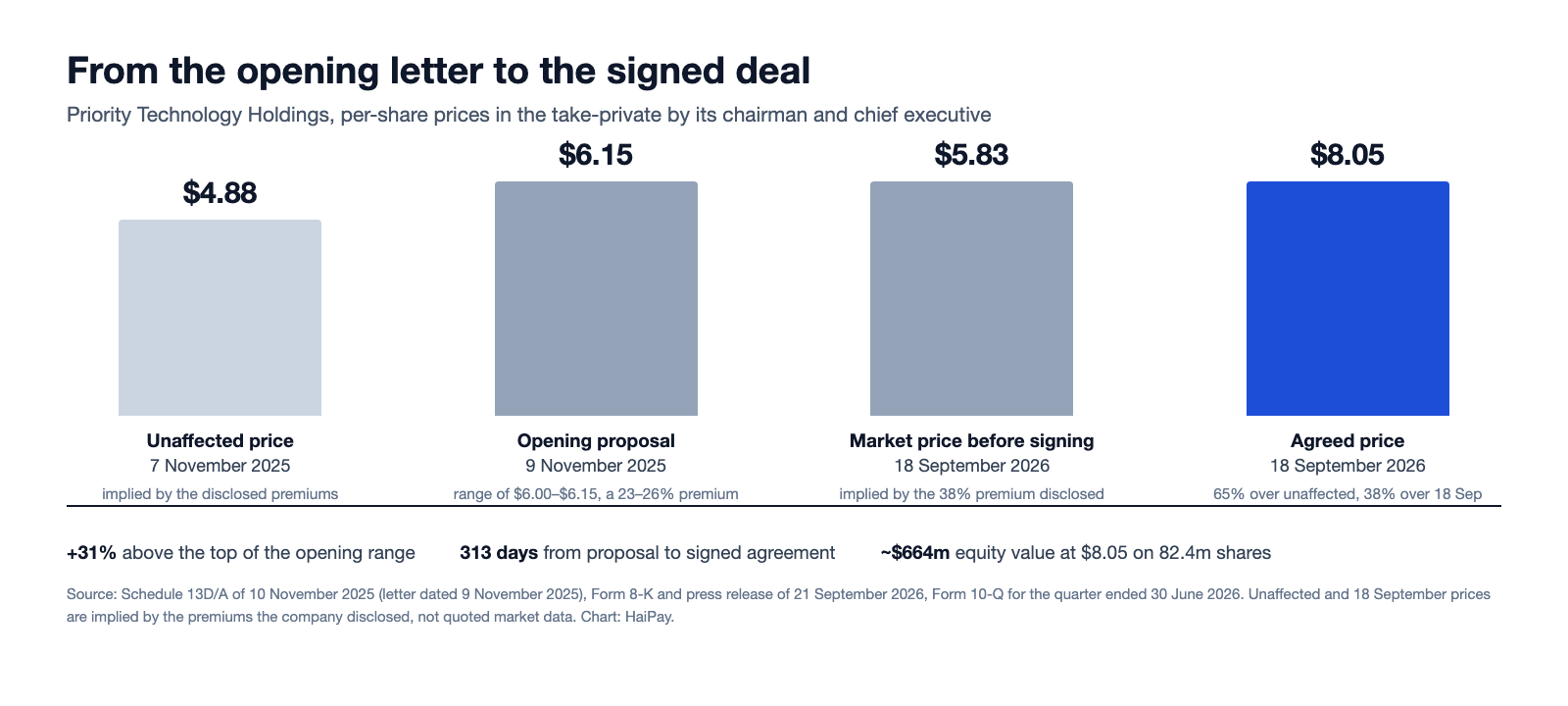
Negotiation took 313 days. A special committee of independent directors, advised by Barclays, recommended the final price unanimously. The board approved it with Priore and one other director recused.
The clock is set by state regulators, not by banks
The deal gives itself until 18 December 2027 to close. That is 456 days, about 15 months, from signing.
The reason is in the closing conditions. Priority holds money transmission licences, through its subsidiary Finxera, in 46 US states, the District of Columbia and two US territories. A change of control requires approval from each state regulator, and the agreement makes approval in all states a condition.
There is a release valve. After a specified deadline, the condition can instead be met by a combination of approvals, alternative arrangements and withdrawals from states, provided certain named states have approved and the states the company withdraws from did not together generate more than 10% of its consolidated fee revenue from operations that need those licences.
That is not a small business line. Money transmission services brought Priority $42.0 million of its $262.3 million in revenue in the second quarter of 2026.
The other closing condition worth noting is that the company's existing credit agreements with Truist Bank and Värde Partners must remain in force. The buyer is not refinancing $1.02 billion of term debt; it is keeping it.
What the buyers actually have to pay
The economics are unusual for a deal of this size because most of the stock is not being bought at all.
Supporting stockholders holding about 61.4% of the shares have agreed to roll their stock into the buyer rather than take cash. That leaves roughly 31.8 million shares, about $256 million at $8.05, to be paid out, plus cash for vested equity awards.
Against that, the filings list equity financing of up to $160 million from funds advised by Searchlight Capital Partners, a borrowing under the existing $100 million revolving facility, which was undrawn at 30 June, and the company's own cash, which was $120.3 million at the same date. There is no financing condition.
What protects the minority
Because the buyer is the chief executive, the agreement carries the features that usually come with a management buyout.
Approval requires both a majority of all outstanding shares and a majority of the votes cast by "disinterested stockholders" under Delaware law, a class that excludes Priore, the supporting stockholders, officers and directors who are not on the special committee.
The filing describes no go-shop period. The company may respond to unsolicited offers, and may terminate for a superior proposal after giving the buyer four business days to match. Breaking the deal for a better offer costs the company $15.75 million, or 2.4% of the equity value. If the buyer walks, it owes $35.25 million, or 5.3%, and the company can also sue to force the deal to close. The reverse fee is 2.24 times the company's.
What this is not
HaiPay did not evaluate whether $8.05 is a fair price. The special committee's reasoning, Barclays' analysis and the full negotiating history will appear in the proxy statement, which has not yet been filed.
A signed merger agreement is not a completed deal. This one needs a shareholder vote, approvals from dozens of state regulators and the survival of two credit agreements. HaiPay did not contact the company, the buyer or their advisers.
What to watch
The background-of-the-merger section of the proxy, which should show what happened between the $6.15 top offer and $8.05.
The disinterested-stockholder vote, the one place where minority holders can say no.
And the state approvals. If the buyer starts withdrawing from states to use the 10% carve-out, the licence footprint that Priority advertises will be the first thing to shrink.
How to cite
HaiPay News, "Priority's CEO Opened at $6. The Committee Got $8.05.", https://www.haipay.net/news/priority-technology-buyout-terms, September 23rd, 2026
About the author
Crystal
Digital Public Relations
A digital PR specialist with a Master's in Journalism & Communication from UNSW. Started as an intern at ABC Australia, now leads public relations at Haipay, crafting press releases and media strategies that bring brand stories to life.
Reviewed by WeiJun TangEditorial policy
6 sources
- Priority Technology Holdings, Inc.
Form 8-K, Priority Technology Holdings, 21 September 2026
- Priority Technology Holdings, Inc.
Agreement and Plan of Merger (Exhibit 2.1)
- Priority Technology Holdings, Inc.
Press release announcing the agreement (Exhibit 99.1)
- Priority Technology Holdings, Inc.
Letter from Thomas C. Priore dated 9 November 2025 (Schedule 13D/A exhibit)