The Stablecoin Law Starts in 116 Days. No Rule Is Final.
The American law that governs dollar stablecoins takes effect on 18 January 2027. That is 116 days from today. Not one of the rules that is supposed to make it work has been finalised.
September 24th, 2026
Last updated: September 24
Key takeaways
- The GENIUS Act takes effect on 18 January 2027, 116 days from now, on its own 18-month clock.
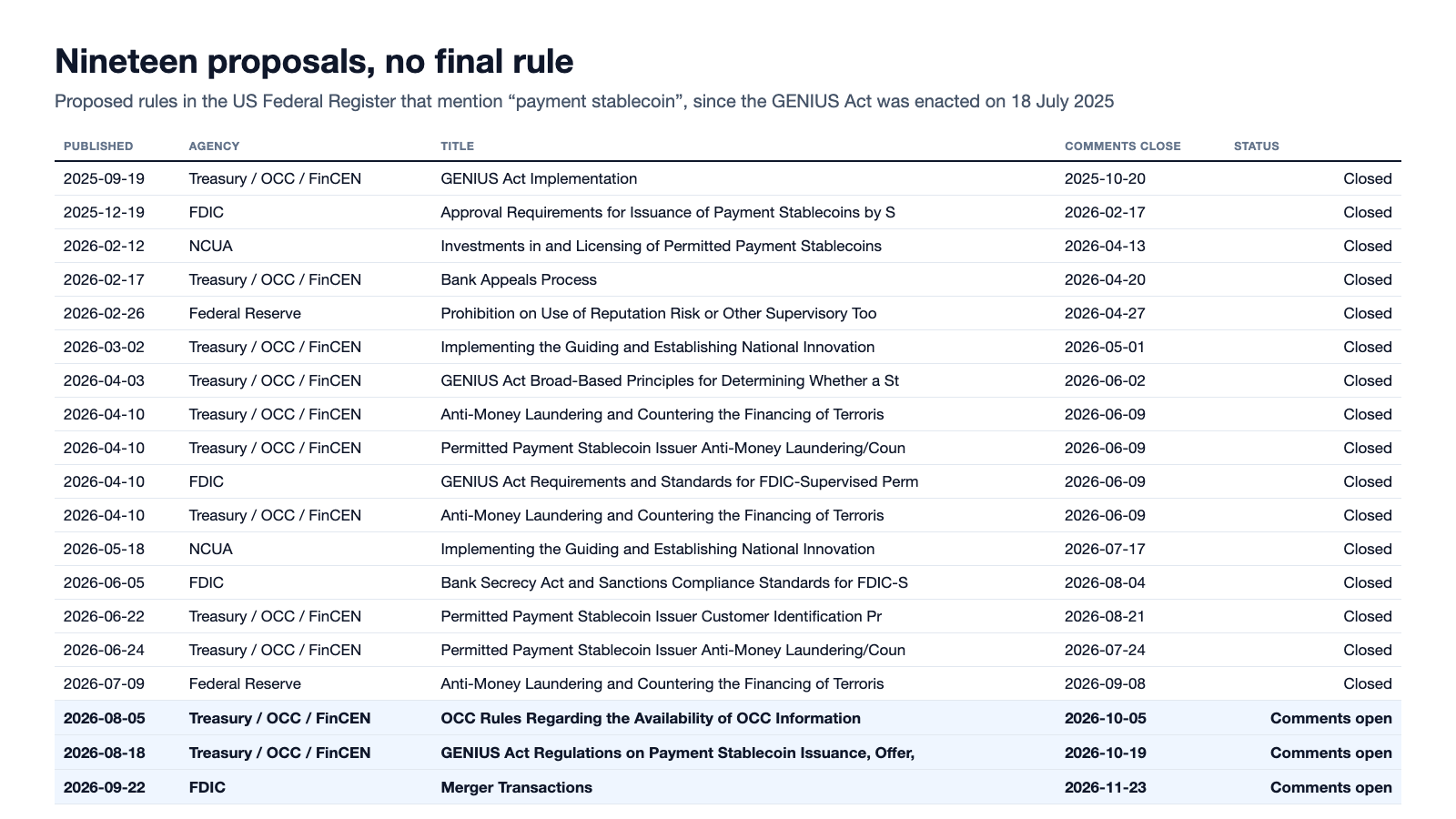
- US agencies have published 19 proposed rules using the term "payment stablecoin" since the Act passed.
- Sixteen of those comment periods have closed, and no final rule implementing the Act has been published.
- Federal Register documents mentioning stablecoin rose from 16 in 2023 to 47 so far in 2026.
- Treasury's core issuance rule closes for comment on 19 October, three months before the law applies.
- The Act sets no deadline for final rules, so their absence is not a missed legal deadline.
Data highlight
0final rules
Final rules implementing the GENIUS Act published in the Federal Register as of 24 September 2026
18 July 2025 to 24 September 2026
Counted by HaiPay on 24 September 2026 from the Federal Register API at federalregister.gov, the official journal of United States agency rulemaking. Searching the full text of documents for the word stablecoin returns 16 documents published in 2023, 20 in 2024, 27 in 2025 and 47 in 2026 to date. Searching for the statutory phrase "payment stablecoin" returns none in 2023 or 2024, three in 2025 and 30 in 2026 to date. Restricting to documents published on or after the enactment of the GENIUS Act on 18 July 2025 gives 19 proposed rules that use the phrase, published between 19 September 2025 and 22 September 2026, of which 16 had comment periods that closed before 24 September 2026; the three still open are the OCC information availability proposal closing 5 October 2026, the Treasury proposal titled GENIUS Act Regulations on Payment Stablecoin Issuance, Offer, and Sale closing 19 October 2026, and an FDIC merger transactions proposal closing 23 November 2026. The same search restricted to final rules returns two documents since enactment, a crypto-asset securities rule of 23 March 2026 and a tax rule on tipped occupations of 13 April 2026; a third 2026 final rule mentioning stablecoin is a supervisory practices rule of 1 September 2026. None implements the GENIUS Act. Federal Register documents may be tagged to more than one agency; on 2026 documents mentioning stablecoin, the Treasury Department appears on 18, the Securities and Exchange Commission on 11, the Federal Deposit Insurance Corporation on 10, the Office of the Comptroller of the Currency on nine, the Federal Reserve System on six, the Financial Crimes Enforcement Network on five and the National Credit Union Administration on three, with the OCC and FinCEN also counted inside Treasury. Statutory dates are taken from the OCC proposed rule published on 2 March 2026, which states that the GENIUS Act was enacted on 18 July 2025, that its effective date is the earlier of 18 months after enactment or 120 days after the primary federal payment stablecoin regulators issue final implementing regulations, and that the prohibition on digital asset service providers offering non-compliant payment stablecoins applies from 18 July 2028 under 12 U.S.C. 5902(b)(1). Eighteen months after 18 July 2025 is 18 January 2027, which is 116 days after 24 September 2026. A document that mentions stablecoin once is counted the same as one devoted to the subject, which is why the broad count is reported separately from the 19 proposals using the statutory term. HaiPay found no provision of the Act requiring agencies to finalise rules by a set date, so the absence of final rules is not evidence of a missed legal deadline. HaiPay did not contact any agency.
The American law that governs dollar stablecoins takes effect on 18 January 2027. That is 116 days from today. Not one of the rules that is supposed to make it work has been finalised.
HaiPay counted the Federal Register, the official journal in which US agencies publish rules. Since the GENIUS Act was enacted on 18 July 2025, agencies have published 19 proposed rules that use the statutory term "payment stablecoin". Sixteen of those comment periods have already closed. The number of final rules implementing the Act is zero.
Why the date arrives anyway
The Act sets its own start. It takes effect on the earlier of two dates: 18 months after enactment, or 120 days after the federal stablecoin regulators issue final implementing regulations.
The second route is now out of reach. A final rule published today would not take effect until late January anyway, and nothing has been finalised. So the law starts on the 18-month clock, on 18 January 2027, with the rulebook still in draft.
The Office of the Comptroller of the Currency spells the mechanism out in its own proposal of 2 March 2026, which cites the statute directly.
Who is writing what
The work is spread across most of the federal banking apparatus.
Counting every Federal Register document that mentions stablecoin in 2026, and noting that each document can be tagged to more than one agency, the Treasury Department appears on 18, the Securities and Exchange Commission on 11, the Federal Deposit Insurance Corporation on 10, the Office of the Comptroller of the Currency on nine, the Federal Reserve on six, the Financial Crimes Enforcement Network on five and the National Credit Union Administration on three. The OCC and FinCEN sit inside Treasury, so those tags overlap.
The proposals cover the parts a stablecoin business actually needs settled: who may be approved to issue, what reserves and capital look like, how anti-money-laundering programmes must work, what a customer identification programme must contain, and the test for whether a state regime is substantially similar to the federal one.
The core issuance rule, Treasury's "GENIUS Act Regulations on Payment Stablecoin Issuance, Offer, and Sale", was published on 18 August. Comments close on 19 October, three months before the statute bites.
The volume is real, the output is not
The rulemaking is not slow because nobody is working. Federal Register documents mentioning stablecoin rose from 16 in 2023 to 20 in 2024, 27 in 2025 and 47 so far in 2026. Use of the statutory phrase "payment stablecoin" went from three documents in 2025 to 30 this year.
Only three documents published in 2026 with the word stablecoin in them are final rules, and none of them implements the Act. One is a crypto-asset securities rule, one is a tax rule about tipped occupations, and one is a supervisory practices rule.
That gap between activity and finality is the whole story. Comment letters have been filed, hearings held and proposals stacked up, and an issuer looking for the finished requirements still has nothing to read but drafts.
What this means for a payments business
Anyone planning to issue a dollar stablecoin in the United States, or to distribute one, is now choosing between two uncomfortable options: build to the proposed text and accept that final rules may differ, or wait and lose four months of runway.
The Act's other dates keep running regardless. The prohibition on digital asset service providers offering stablecoins that are not issued by compliant issuers begins on 18 July 2028, and the approval process for issuers sits in proposals that are not yet law.
What this count is not
HaiPay counted documents, not pages or importance. A Federal Register document that mentions stablecoin once is counted the same as one devoted to it, which is why the article separates the broad count from the 19 proposals that use the statutory term.
A missing final rule is not evidence that any agency has missed a legal deadline. HaiPay found no statutory deadline in the Act requiring final rules by a given date; the 18-month clock sets when the law applies, not when regulators must finish.
Rules can also be finalised quickly once comment periods close, and several closed months ago. HaiPay did not contact any agency.
What to watch
Whether any agency publishes a final GENIUS rule before 18 January, and whether it uses the 120-day route or simply lands after the statute is already in force.
The Treasury issuance rule after 19 October, the one proposal whose final text decides most of what an issuer must do.
And whether agencies use interim final rules, which take effect without a further comment round, as the date closes in.
How to cite
HaiPay News, "The Stablecoin Law Starts in 116 Days. No Rule Is Final.", https://www.haipay.net/news/genius-act-no-final-rules-116-days, September 24th, 2026
About the author
Crystal
Digital Public Relations
A digital PR specialist with a Master's in Journalism & Communication from UNSW. Started as an intern at ABC Australia, now leads public relations at Haipay, crafting press releases and media strategies that bring brand stories to life.
Reviewed by WeiJun TangEditorial policy
4 sources
- Office of the Federal Register
Implementing the GENIUS Act for the Issuance of Stablecoins, OCC proposed rule, 2 March 2026
- Office of the Federal Register
Federal Register search: documents mentioning "payment stablecoin"
- Office of the Federal Register
Federal Register API documents endpoint
- Office of the Federal Register
GENIUS Act Regulations on Payment Stablecoin Issuance, Offer, and Sale, proposed rule, 18 August 2026