Firms Closed 238,396 Mule Accounts. Only 15% Were Shared.
British financial firms closed 238,396 accounts they suspected of being money mules last year, and 656,600 over three years. That is from a survey of 35 banks, building societies, challenger banks, payment institutions and e-money institutions published by the Financial Conduct Authority on 23 September.
September 24th, 2026
Last updated: September 24
Key takeaways
- UK firms closed 238,396 suspected money mule accounts in 2025, and 656,600 across 2023 to 2025.
- They filed 36,502 of those closures to the National Fraud Database, 15.3%; 201,894 were not filed.
- Payment and e-money institutions filed 320 cases in total, a rate near 1.2% of their own closures.
- Closures rose just 2.2% last year, but e-money institutions reported 164.6% more than in 2024.
- Criminals usually cashed out between the second and fifth mule account, most often by card payments.
- The filing threshold is higher than the closure threshold, so an unfiled closure is not evidence of wrongdoing.
Data highlight
15.3per cent
Share of 2025 suspected money mule account closures that UK firms filed to the National Fraud Database
2023 to 2025
Compiled by HaiPay on 24 September 2026 from the Financial Conduct Authority's multi-firm review, Money mules: mule activity and cashing out findings, and its annex of survey data, both published on 23 September 2026, and the accompanying FCA press release. The FCA surveyed 35 retail banks, building societies, challenger banks, payment institutions and e-money institutions. Reported offboarding for suspected money mule activity was 184,935 in 2023, 233,269 in 2024 and 238,396 in 2025, 656,600 across the three years, an increase of 28.9 per cent from 2023 to 2025 and 2.2 per cent from 2024 to 2025. In 2025 retail banks and building societies accounted for 56.1 per cent of closures and challenger banks 33 per cent, leaving about 10.9 per cent, roughly 26,000 accounts, for payment and e-money institutions as a residual calculated by HaiPay. Filings to the National Fraud Database maintained by Cifas in 2025 were 23,397 from retail banks and building societies, 12,785 from challenger banks, 215 from payment institutions and 105 from e-money institutions, a total of 36,502, which is 15.3 per cent of closures, the figure the FCA also reports, leaving 201,894 closures unfiled. HaiPay divided filings by closures for each firm type to get filing rates of 17.5, 16.3 and about 1.2 per cent. The FCA states that the threshold for filing to the database, reasonable grounds to believe fraud or financial crime was committed or attempted supported by clear evidence, is higher than the threshold for closing an account, and that the two counts are not expected to match, so an unfiled closure is not evidence of wrongdoing by a firm. Cifas introduced a dedicated money mule filing category in January 2025, so filings before and after are not directly comparable. Other figures quoted are from the same publications: closures of accounts held by customers aged 26 to 39 at 91,073, those aged 25 and under at 85,425 and those aged 40 to 49 at 37,274, up 44.7 per cent year on year; personal customers at 93.2 per cent of closures; e-money institutions' closures up 164.6 per cent and retail banks' down 10.9 per cent year on year; business account closures down 20.8 per cent; charities and other entities up 386.7 per cent on 2023 from a very small base; under-16 closures down 23.4 per cent to 1,343; 114,984 accounts closed within a year of opening, 55,353 of them within three months; 74.1 per cent of e-money institution closures and 56.9 per cent of payment institution closures within six months against 45.4 per cent of retail bank closures after more than two years; the share of closures with gender unrecorded rising from 24.1 to 30.1 per cent; and, from the FCA's working group of 22 firms that traced 140 cases across seven fraud types, that cashing out was concentrated between the second and fifth mule account with the heaviest concentration at the second, that card payments were the most common cash-out method, and that international and crypto cash-outs were lower in volume and higher in value. The figures are what surveyed firms reported about accounts they suspected, not a count of money mules or a finding about any customer. HaiPay did not contact the FCA, Cifas or any firm.
British financial firms closed 238,396 accounts they suspected of being money mules last year, and 656,600 over three years. That is from a survey of 35 banks, building societies, challenger banks, payment institutions and e-money institutions published by the Financial Conduct Authority on 23 September.
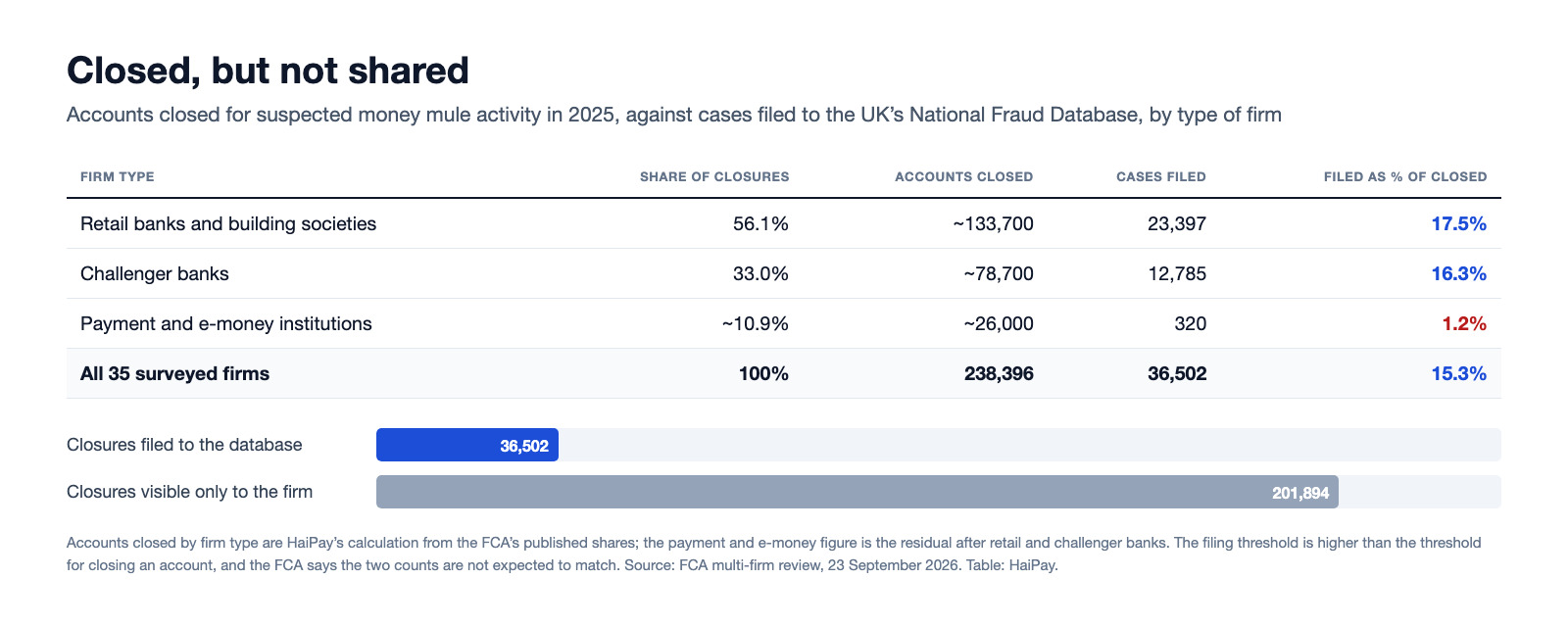
The same publication shows how few of those closures reach the database other firms can see. In 2025 the surveyed firms made 36,502 filings to the National Fraud Database: 15.3% of the accounts they closed. The other 201,894 closures stayed inside the firm that made them.
The gap is not evenly spread
The filing rate depends on the kind of firm.
Retail banks and building societies accounted for 56.1% of the closures and filed 23,397 cases, about 17.5% of their own closures. Challenger banks accounted for 33% and filed 12,785, about 16.3%.
Payment institutions and e-money institutions are the rest, roughly 10.9% of closures, or about 26,000 accounts. Between them they filed 320 cases: 215 from payment institutions and 105 from e-money institutions. That is a filing rate near 1.2%.
It is an improvement on a low base. In 2023 those firms filed nothing at all.
The FCA is careful about what the comparison means, and so is HaiPay. The bar for filing to the database, run by the fraud prevention service Cifas, is higher than the bar for closing an account: a firm must have reasonable grounds to believe fraud or financial crime was committed or attempted, backed by clear evidence. The regulator says the two numbers are not expected to match. A closure that is never filed is not proof that a firm did anything wrong.
It does mean that the shared record of British mule activity captures about one closure in six, and that the fastest-growing part of the payments industry contributes least to it.
The totals are flattening, the mix is not
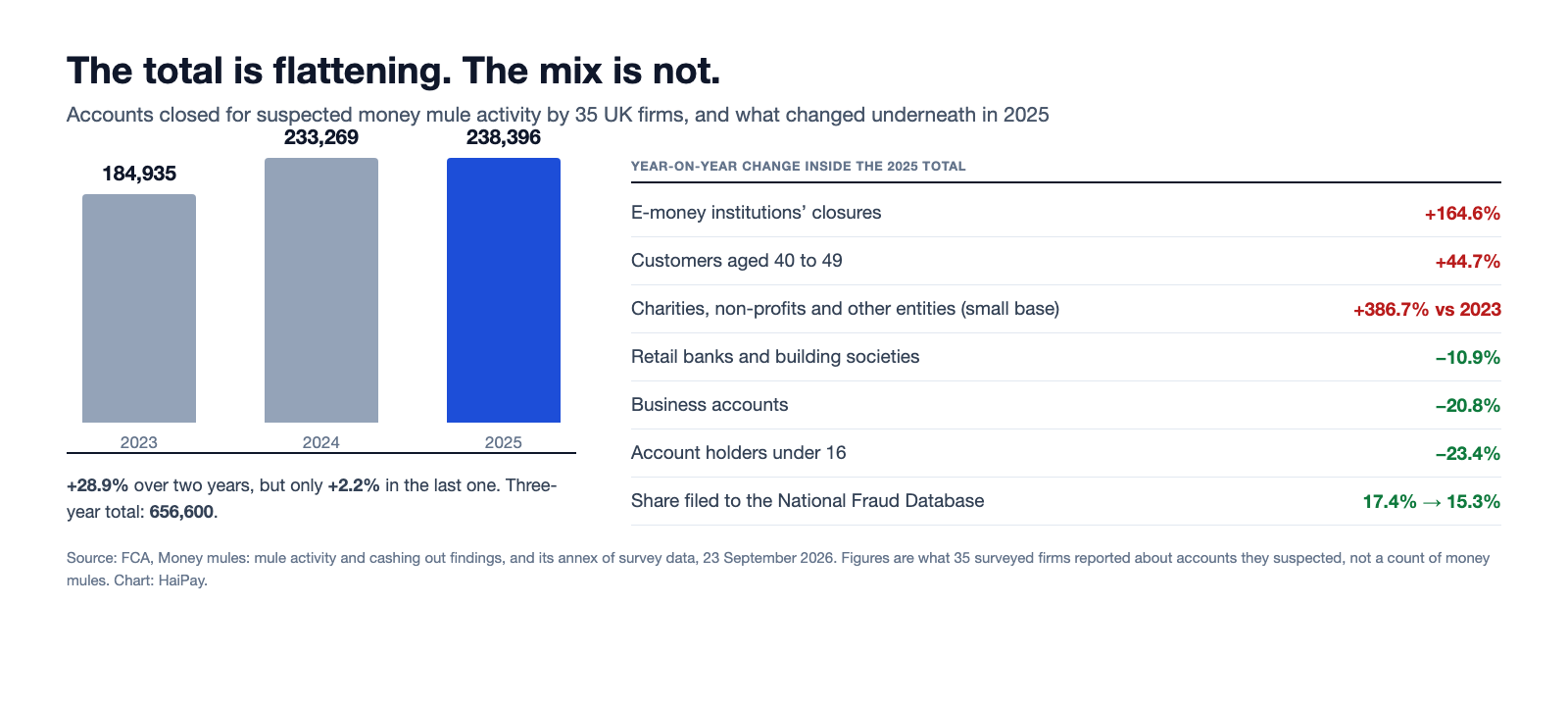
Closures rose 28.9% between 2023 and 2025, but almost all of that came in the first year. From 2024 to 2025 the total rose 2.2%, from 233,269 to 238,396.
Underneath, the picture moved. E-money institutions reported 164.6% more closures than in 2024. Retail banks and building societies reported 10.9% fewer. Challenger banks now account for a third of all closures, and for half of all business accounts closed.
The age profile moved too. Customers aged 26 to 39 remain the largest group, at 91,073 closures, with the under-25s close behind at 85,425. But the sharpest increase was among 40 to 49 year olds, up 44.7% in a year to 37,274. Closures of accounts held by under-16s fell 23.4%.
Personal accounts were 93.2% of closures. Charities, non-profits and other legal entities rose 386.7% from 2023, though the FCA notes the volumes stay very small.
Where the money actually leaves
The survey is only half the report. The FCA also ran a working group with 22 firms that traced 140 cases across seven types of fraud, following the largest payments from account to account until the trail ran out.
Two findings matter for anyone building payment controls.
First, cashing out is concentrated early. Funds usually left the mule system between the second and fifth account in the chain, with the heaviest concentration at the second. By then payments have been broken into smaller amounts that look ordinary.
Second, the exit is usually a card. Card payments were the most common cash-out method, used for many low-value transactions or larger payments to local businesses and retailers, which is hard to separate from normal consumer spending. International transfers, with recurring destinations in South Asia, West Africa and the Middle East, and crypto were lower in volume but higher in value.
The report also found accounts that had been used for mule activity more than once, and across different fraud types, before anyone closed them.
How quickly accounts are shut
Nearly half of the accounts closed in 2025, 114,984 of them, had been open less than a year, and 55,353 less than three months.
That varies by firm type in the way the business models predict. E-money institutions closed 74.1% of accounts within six months of opening and payment institutions 56.9%, while retail banks and building societies closed 45.4% of theirs after more than two years.
What this data is not
The figures are what 35 firms reported to their regulator about accounts they suspected, not a count of money mules, and not a court finding about any customer. The FCA says a rise in closures can reflect customer growth and better detection rather than more mules.
The database comparison also has a break in it: Cifas introduced a dedicated money mule filing category in January 2025, so filing numbers before and after are not directly comparable. The share of closures with no recorded gender rose from 24.1% to 30.1%, which limits what the gender split shows.
HaiPay derived the filing rates and the unfiled total from the FCA's own published figures. HaiPay did not contact any firm, the FCA or Cifas.
What to watch
Whether payment and e-money institutions' filings move from hundreds towards the thousands, now that they are closing accounts in the tens of thousands.
Whether the second-account concentration survives contact with better intelligence sharing under the Economic Crime and Corporate Transparency Act.
And whether the flattening total is a ceiling on detection or a ceiling on mules.
How to cite
HaiPay News, "Firms Closed 238,396 Mule Accounts. Only 15% Were Shared.", https://www.haipay.net/news/uk-money-mule-account-closures-2025, September 24th, 2026
About the author
Crystal
Digital Public Relations
A digital PR specialist with a Master's in Journalism & Communication from UNSW. Started as an intern at ABC Australia, now leads public relations at Haipay, crafting press releases and media strategies that bring brand stories to life.
Reviewed by WeiJun TangEditorial policy
4 sources
- Financial Conduct Authority
Money mules: mule activity and cashing out findings
- Financial Conduct Authority
Firms crack down on money mules but need to do more
- Financial Conduct Authority
Proceeds of fraud: detecting and preventing money mules
- Financial Conduct Authority
Firms' use of the National Fraud Database and money mule account detection tools