Circle Is Buying Payout Rails, Not Stablecoin Adoption.
Circle announced on 8 September that it has signed a definitive agreement to acquire Tazapay, a Singapore-headquartered cross-border payments company. The deal is expected to close in 2027, subject to regulatory approvals including one from the Monetary Authority of Singapore. The interesting number is not the volume. It is that roughly 60% of Tazapay's transaction volume already includes stablecoins.
September 9th, 2026
Last updated: September 9
Key takeaways
- Circle has agreed to acquire Singapore-based cross-border payments company Tazapay.
- About 60% of Tazapay's transaction volume already includes stablecoins.
- Tazapay brings over $25bn annualised volume and payout rails in more than 100 markets.
- Its licences page lists six jurisdictions, including a Singapore MPI licence with five permissions.
- The deal needs Monetary Authority of Singapore approval and is expected to close in 2027.
- Circle's release does not state a price, describe the consideration, or say it is undisclosed.
Data highlight
60per cent of volume already includes stablecoins
Share of Tazapay's transaction volume that already includes stablecoins at the time Circle agreed to acquire it
9 September 2026
Read by HaiPay on 9 September 2026 from Circle's press release of 8 September 2026 announcing a definitive agreement to acquire Tazapay, a Singapore-headquartered business-to-business cross-border payments infrastructure company serving payment service providers and financial institutions. The release states that Tazapay brings over 25 billion dollars of annualised payment volume, more than 60 banking and fintech partners, and local payout rails covering over 100 markets, and that approximately 60 per cent of Tazapay's transaction volume already includes stablecoins, which on the stated volume is roughly 15 billion dollars a year. It states that Tazapay has been a design partner for Circle Payments Network since 2025, that the deal is expected to close in 2027 subject to customary closing conditions and receipt of regulatory approvals including approval from the Monetary Authority of Singapore, and that Tazapay customers can expect no disruption to their service, APIs, pricing or support. The release does not state a purchase price, does not describe the consideration, and does not use the word undisclosed. For scale against Circle's own published figures, circle.com/transparency showed USDC in circulation of 74.3 billion dollars and USDC issuance of 333.5 billion dollars over the 365 days to 7 September 2026, so Tazapay's annualised volume is about 7.5 per cent of that issuance figure; annualised payment volume and stablecoin issuance are different measures and the comparison is offered for scale only. Tazapay's own licences page, read on the same date, lists six licensed jurisdictions: a Singapore major payment institution licence numbered PS20200638 under the Payment Services Act 2019 covering domestic money transfer, cross-border money transfer, merchant acquisition, account issuance and e-money issuance; a Canadian FINTRAC money services business registration numbered M21439799 and a Bank of Canada payment service provider registration under the Retail Payment Activities Act effective 5 December 2025; a United States FinCEN money services business registration numbered 31000321683608 with NMLS identifier 2787942 and state money transmitter licences in Arizona, Arkansas, Illinois, Iowa, Maryland, Michigan, Minnesota, Missouri, New Mexico and South Carolina with an exemption noted in Montana; an Australian AUSTRAC remittance service provider registration; and Hong Kong and India listed as licensed jurisdictions. From 9 September 2026 a close in 2027 is between 114 and 478 days away. HaiPay did not contact Circle, Tazapay or the Monetary Authority of Singapore and did not verify any licence entry against a regulator's own register.
“Stablecoin settlement is becoming core infrastructure in the global economy and combining USDC with Tazapay's world-class banking relationships, local payout rails, and institutional customer base will accelerate worldwide USDC adoption.”
Circle announced on 8 September that it has signed a definitive agreement to acquire Tazapay, a Singapore-headquartered cross-border payments company. The deal is expected to close in 2027, subject to regulatory approvals including one from the Monetary Authority of Singapore.
The interesting number is not the volume. It is that roughly 60% of Tazapay's transaction volume already includes stablecoins.
Circle is not buying adoption
The obvious reading of a stablecoin issuer buying a payments company is that the issuer is buying distribution: somewhere to push the token.
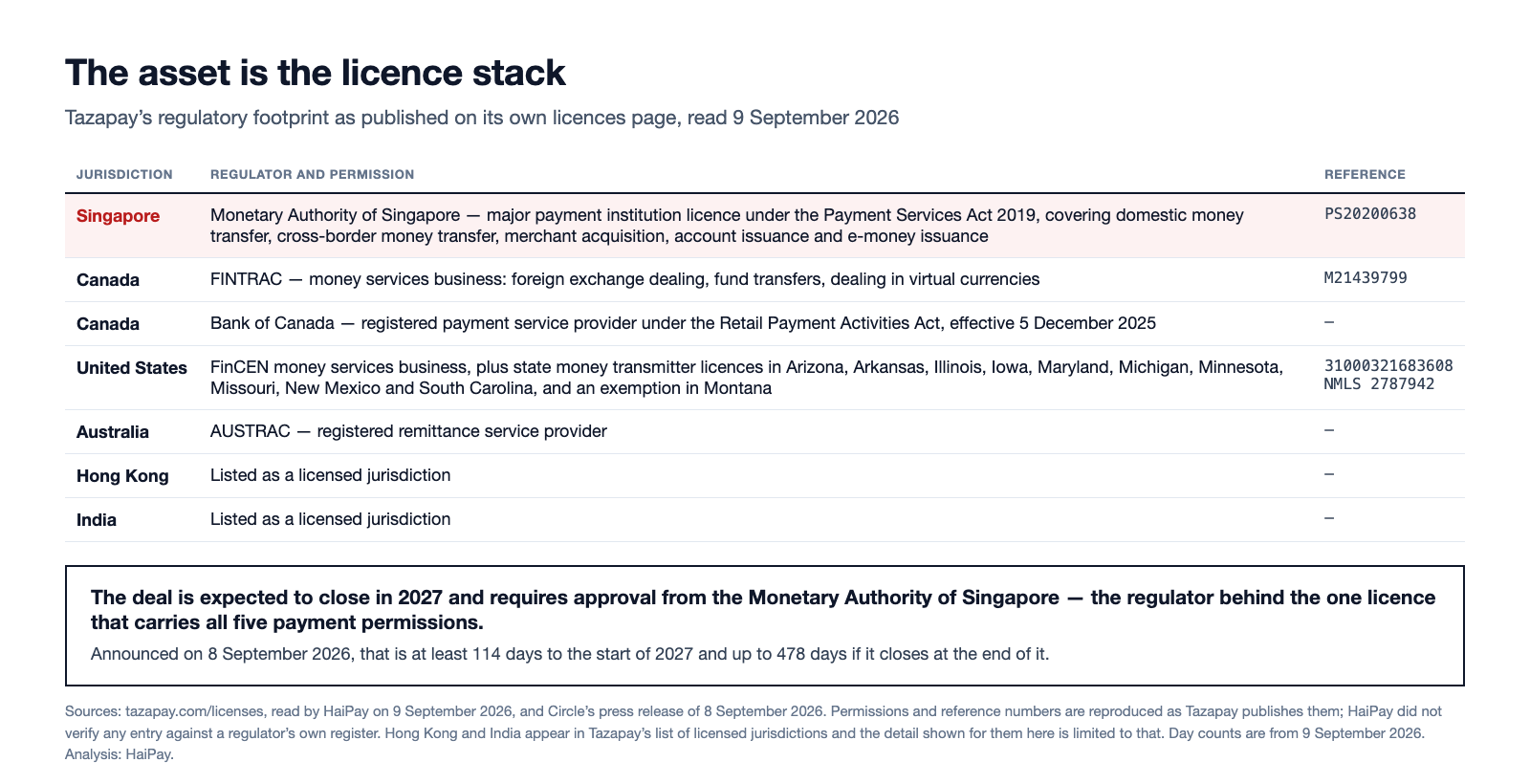
Circle's own release makes that reading hard to sustain. Tazapay has been "a design partner for Circle Payments Network since 2025," and around 60% of its volume already involves stablecoins. On $25 billion of annualised payment volume, that is roughly $15 billion a year already running through the thing Circle sells.
What Circle does not have is the other half of that sentence. Its release names what it is getting: "world-class banking relationships, local payout rails, and institutional customer base." Tazapay's own site puts numbers on the rails: local payment methods in over 100 countries, payouts in over 100 countries, cards in over 170, and business accounts in over 40.
A stablecoin solves the middle of a cross-border payment. It does not solve the end of one. Getting value into a supplier's bank account in Jakarta or São Paulo still requires a local connection, a local partner and, usually, a local permission. That is what is being bought.
The licence stack
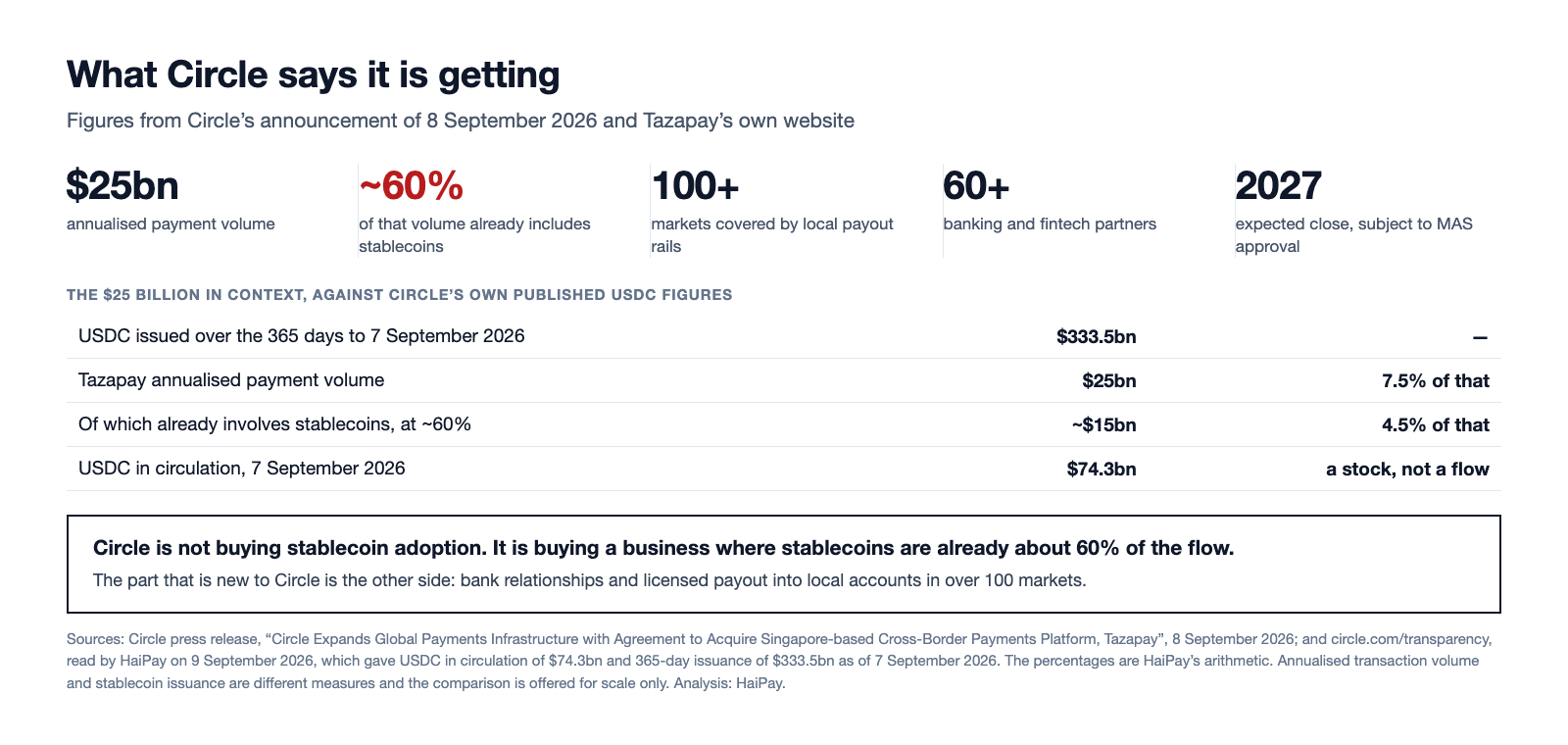
Tazapay publishes its regulatory footprint, and read as an asset list it explains the price of admission in this business, whatever the price of the deal turns out to be.
In Singapore, Tazapay Pte Ltd holds a major payment institution licence under the Payment Services Act 2019, number PS20200638, covering five separate permissions: domestic money transfer, cross-border money transfer, merchant acquisition, account issuance and e-money issuance.
In Canada there are two: a FINTRAC money services business registration covering foreign exchange dealing, fund transfers and dealing in virtual currencies, and a Bank of Canada payment service provider registration under the Retail Payment Activities Act, effective 5 December 2025.
In the United States, a FinCEN money services business registration plus state money transmitter licences in Arizona, Arkansas, Illinois, Iowa, Maryland, Michigan, Minnesota, Missouri, New Mexico and South Carolina, with an exemption noted in Montana. Australia is an AUSTRAC remittance service provider registration. Hong Kong and India appear on the list of licensed jurisdictions.
Six jurisdictions, a dozen or so separate permissions. None of it is technology. All of it takes years.
The gate is Singapore
The release says the deal needs approval from the Monetary Authority of Singapore, and that is not a formality in a transaction of this shape.
MAS is the regulator behind the one licence that carries all five payment permissions, and a change of control at a major payment institution is exactly the kind of thing a regulator looks at closely, particularly when the acquirer's principal product is a dollar stablecoin.
The timing reflects that. The agreement was signed on 8 September 2026 and is expected to close in 2027. That is a minimum of 114 days from now if it closes on the first day of the year, and up to 478 if it closes on the last.
For a payments business, a wait of that length is not neutral. Customers make renewal decisions inside it.
What the release says about customers
One line is aimed squarely at those customers: "Tazapay customers can expect no disruption to their service, APIs, pricing, or support."
It is a reasonable thing to say and there is no reason to doubt the intent. It is also, in the ordinary course, the kind of statement worth writing down and checking against the product later, because it is specific and falsifiable in four separate ways.
What HaiPay could not establish
The price. Circle's release does not state a purchase price, does not describe the consideration as cash or stock, and does not use the word undisclosed. It simply does not say.
Whether the volume figures are gross or net, or how Tazapay defines annualised volume. Payment volume is measured differently by different firms, and the release does not define it.
Whether the "60% includes stablecoins" figure means stablecoins on one leg of a payment or both. "Includes" is doing real work in that sentence and the release does not unpack it.
HaiPay did not contact Circle, Tazapay or the Monetary Authority of Singapore, and did not verify any licence entry against a regulator's own register.
What to watch
The MAS decision, which is the actual gating item and which will become public one way or another.
Whether Tazapay's licences page changes before close. Licence lists are maintained by lawyers, and additions or removals on it would say more about integration than a press release will.
And whether that four-part promise on service, APIs, pricing and support survives the first year after close. It is checkable, on a public product, by anyone who wants to look.
This piece reads a company announcement and a public licences page. It is not investment advice.
How to cite
HaiPay News, "Circle Is Buying Payout Rails, Not Stablecoin Adoption.", https://www.haipay.net/news/circle-tazapay-acquisition-payout-rails, September 9th, 2026
About the author
Crystal
Digital Public Relations
A digital PR specialist with a Master's in Journalism & Communication from UNSW. Started as an intern at ABC Australia, now leads public relations at Haipay, crafting press releases and media strategies that bring brand stories to life.
Reviewed by WeiJun TangEditorial policy