The CFPB Proposed 18 Rules by September. This Year: 2.
Between 1 January and 9 September 2025, the Consumer Financial Protection Bureau published 18 proposed rules in the Federal Register. In the same window this year it published two. Total output fell from 50 documents to 26. Over the same nine months, every peer financial regulator HaiPay checked either held steady or published more.
September 9th, 2026
Last updated: September 9
Key takeaways
- The CFPB published two proposed rules between 1 January and 9 September 2026, against 18 in 2025.
- Total documents fell from 50 to 26 over the same window, a drop of 48%.
- Notices fell only 10%, so the fall is concentrated in rulemaking rather than administration.
- Eleven of the 26 documents are routine Paperwork Reduction Act information collection notices.
- No 2026 document mentions "remittance" anywhere; there were four in 2024 and five in 2025.
- Six peer agencies were checked over the same window. Five published more; one fell 9%.
Data highlight
2proposed rules, down from 18
Proposed rules published in the Federal Register by the Consumer Financial Protection Bureau between 1 January and 9 September 2026, against the same window in 2025
9 September 2026
Counted by HaiPay on 9 September 2026 from the Federal Register API, filtering by publishing agency and document type across the identical window of 1 January to 9 September in each year. The Consumer Financial Protection Bureau published 2 proposed rules in that window in 2026 against 18 in 2025, a fall of 89 per cent; 6 final rules against 12; and 18 notices against 20. Total documents were 26 against 50, a fall of 48 per cent. The same window in earlier years gives 80 documents in 2022, 62 in 2023 and 51 in 2024. Of the 26 documents published in 2026, 11 are notices titled Agency Information Collection Activities: Comment Request, which is 42 per cent of the year's output, and three are withdrawals or rescissions of existing guidance. None of the 26 has payment, remittance, prepaid, Regulation E or electronic fund in its title. Searching the full text of Bureau documents across the same window, those mentioning remittance number four in 2024, five in 2025 and none in 2026; prepaid eight, seven and two; and Regulation E twenty-five, twenty-four and nine. Over the same window peer agencies moved as follows: the National Credit Union Administration from 23 to 62, the Federal Deposit Insurance Corporation from 56 to 75, the Federal Trade Commission from 47 to 57, the Securities and Exchange Commission from 1,668 to 1,751, the Comptroller of the Currency from 58 to 59, and the Federal Reserve System from 217 to 197. The Bureau is the only agency in that set whose output moved by more than a tenth in either direction. These counts measure publication in the Federal Register only and say nothing about supervision, enforcement, guidance issued elsewhere or work not yet published; a count also treats a short notice and a long rule identically. HaiPay did not contact the Bureau and expresses no view on why its published output fell.
Between 1 January and 9 September 2025, the Consumer Financial Protection Bureau published 18 proposed rules in the Federal Register. In the same window this year it published two.
Total output fell from 50 documents to 26. Over the same nine months, every peer financial regulator HaiPay checked either held steady or published more.
What the counts are
The Federal Register records every document an agency publishes, tagged by publishing agency and by type. Counting them is not a judgment about an agency's work. It measures one thing: how much of that work reached the public register.
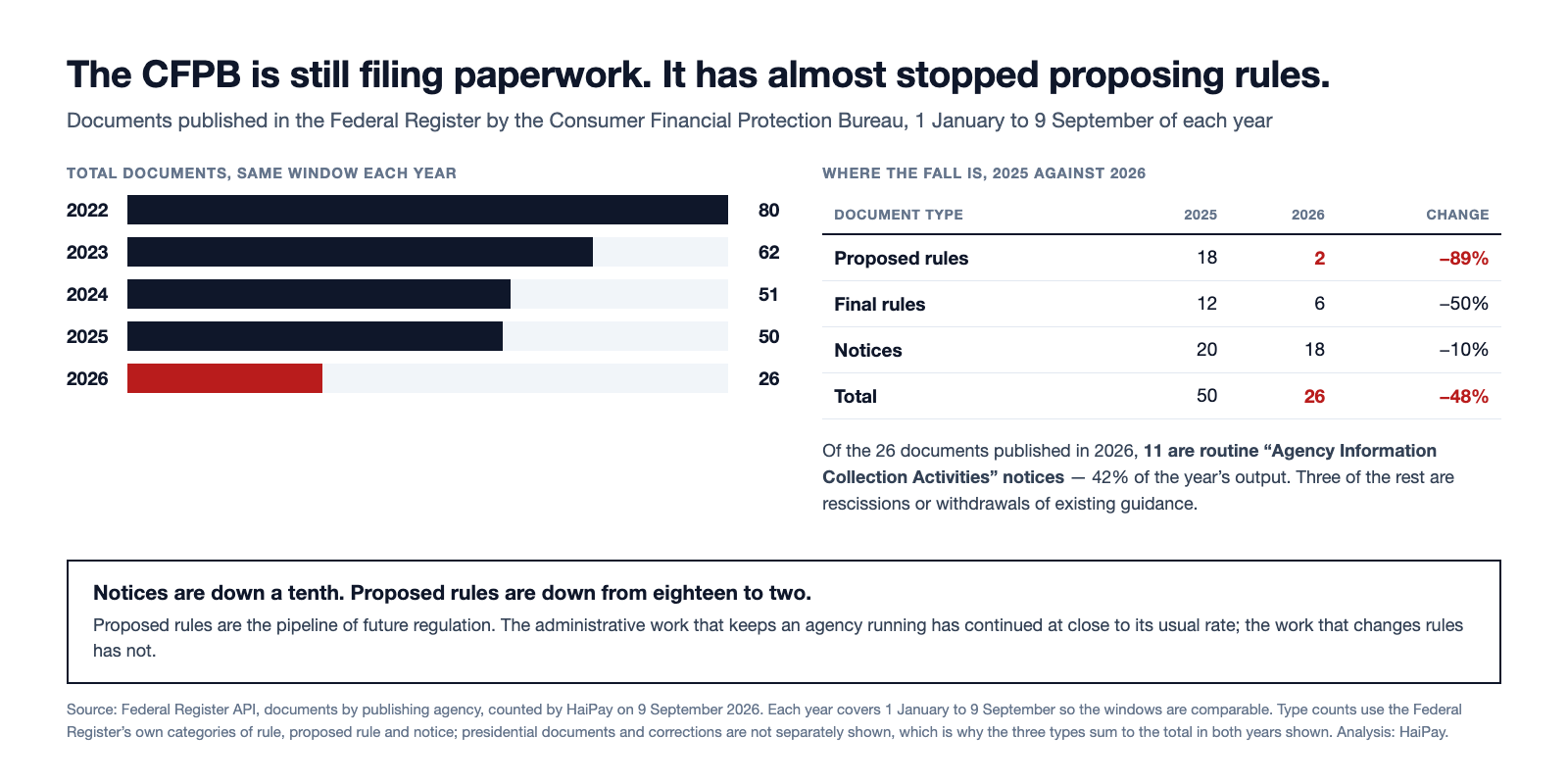
For the CFPB, over 1 January to 9 September in each year, the totals run 80 in 2022, 62 in 2023, 51 in 2024, 50 in 2025 and 26 in 2026. The decline from 2022 is gradual until this year, when it halves.
The composition matters more than the total. Notices fell from 20 to 18, a tenth. Final rules fell from 12 to 6. Proposed rules fell from 18 to 2, a drop of 89%.
Notices are the administrative exhaust of a functioning agency: information collection requests, privacy notices, meeting announcements. Proposed rules are the pipeline. On these numbers the exhaust is close to normal and the pipeline has nearly stopped.
What the 26 documents are
HaiPay read the list. Eleven of the 26, or 42%, are notices titled "Agency Information Collection Activities: Comment Request." These are Paperwork Reduction Act filings, required whenever an agency wants to keep collecting information it already collects.
Of the remainder, three are removals rather than additions: a withdrawal of a joint statement on the Equal Credit Opportunity Act and noncitizen borrowers in January, a rescission of Regulation B guidance on special purpose credit programs in June, and an interagency rescission of a related statement in August.
The two proposed rules are a Regulation B item in February and a request for information on mortgage credit in July.
Nothing about payments
This is where it matters for anyone in payments.
The CFPB writes Regulation E, which governs electronic fund transfers in the United States and, in its subpart B, remittance transfers. It wrote the prepaid accounts rule. It has the authority to supervise larger participants in digital payment markets.
Not one of the 26 documents published in 2026 has "payment", "remittance", "prepaid", "Regulation E" or "electronic fund" in its title.
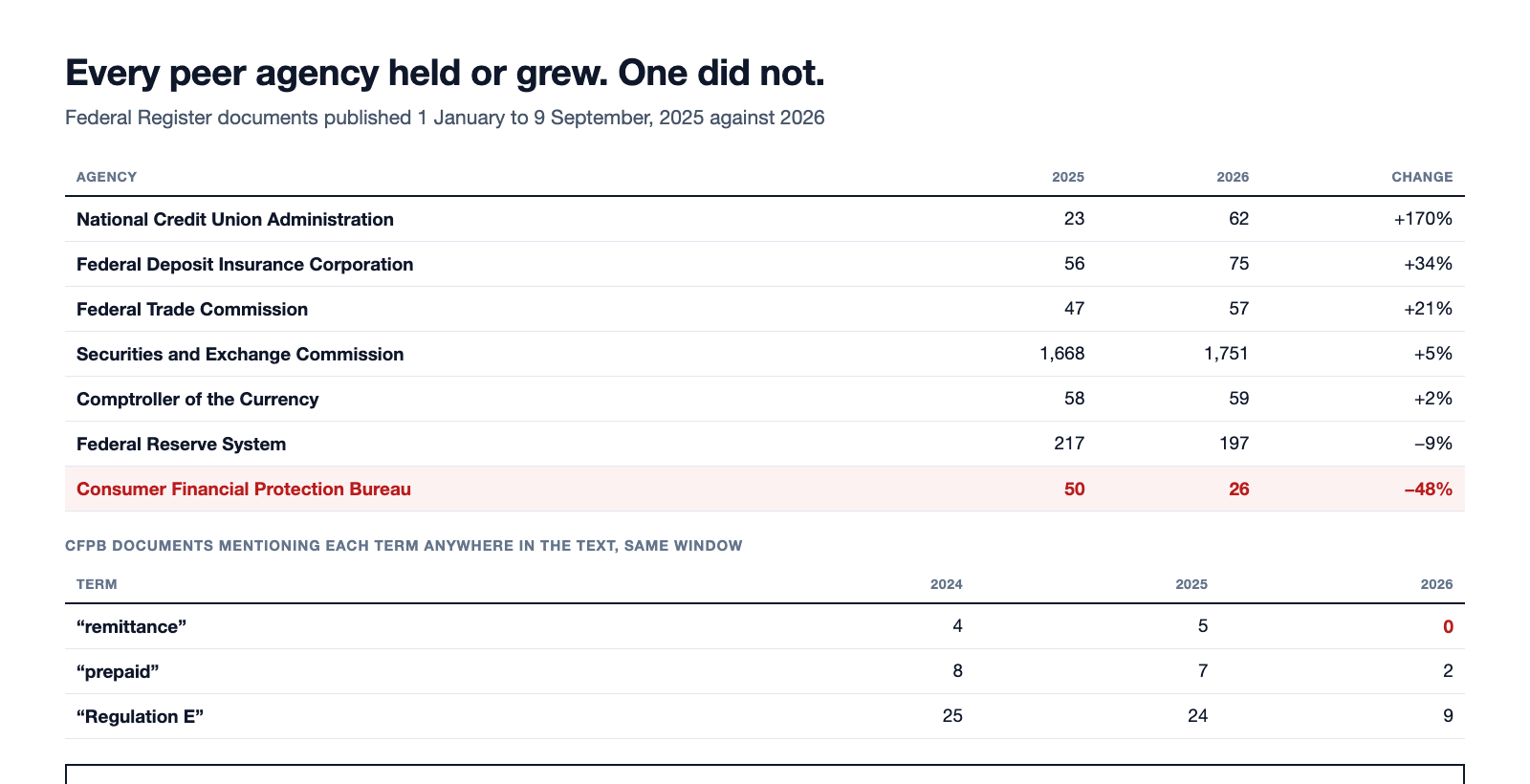
Searching the full text rather than the titles, the pattern holds. Documents mentioning "remittance" anywhere: four in 2024, five in 2025, none in 2026. Mentioning "prepaid": eight, then seven, then two. Mentioning "Regulation E": twenty-five, then twenty-four, then nine, and several of those nine are information collection notices that list the regulations a form relates to.
The word "remittance" does not appear in anything the CFPB has published this year.
Every peer went the other way
A halving could just mean the whole government published less. It did not.
Over the same 1 January to 9 September window, the National Credit Union Administration went from 23 documents to 62. The FDIC went from 56 to 75. The Federal Trade Commission went from 47 to 57. The SEC went from 1,668 to 1,751. The Comptroller of the Currency went from 58 to 59. The Federal Reserve System fell modestly, from 217 to 197.
The CFPB fell 48%. It is the only agency in that set whose output changed by more than a tenth in either direction, and the only one that fell by more than a tenth at all.
What HaiPay could not establish
Why. This piece counts documents; it does not explain them. Agency output can fall for many reasons, including deliberate policy, staffing, litigation, a decision to act through supervision and enforcement rather than rulemaking, or work in progress that has not yet been published. HaiPay did not contact the CFPB and takes no position on which applies.
What the agency is doing that does not reach the Federal Register. Supervisory examinations, enforcement, guidance issued outside the register and consumer complaint handling do not appear in this count at all, and a fall in published documents is not evidence about any of them.
Whether the two proposed rules are large or small. A count treats a two-page notice and a 200-page rule identically, which is the main weakness of counting anything this way.
What to watch
The Regulatory Agenda published on 14 August, which is one of the 26 and is the agency's own statement of what it intends to propose. It is the cheapest available check on whether the pipeline refills.
Whether a Regulation E item appears before year end. The remittance transfer rules have not been revisited in the register this year, and firms that price cross-border transfers under them are entitled to know whether that is a pause or a direction.
And whether the 2027 counts revert. One year at half rate is a data point. Two would be a policy.
This piece counts public records. It is not legal or compliance advice, and the counts describe publication in the Federal Register only.
How to cite
HaiPay News, "The CFPB Proposed 18 Rules by September. This Year: 2.", https://www.haipay.net/news/cfpb-federal-register-output-2026, September 9th, 2026
About the author
Crystal
Digital Public Relations
A digital PR specialist with a Master's in Journalism & Communication from UNSW. Started as an intern at ABC Australia, now leads public relations at Haipay, crafting press releases and media strategies that bring brand stories to life.
Reviewed by WeiJun TangEditorial policy
3 sources
- Office of the Federal Register
Federal Register API, documents published by the Consumer Financial Protection Bureau
- Office of the Federal Register
Consumer Financial Protection Bureau agency page, Federal Register
- Office of the Federal Register
Consumer Financial Protection Bureau documents published 1 January to 9 September 2026