Equities Want 24 Hours. Fedwire Gives 22, Five Days.
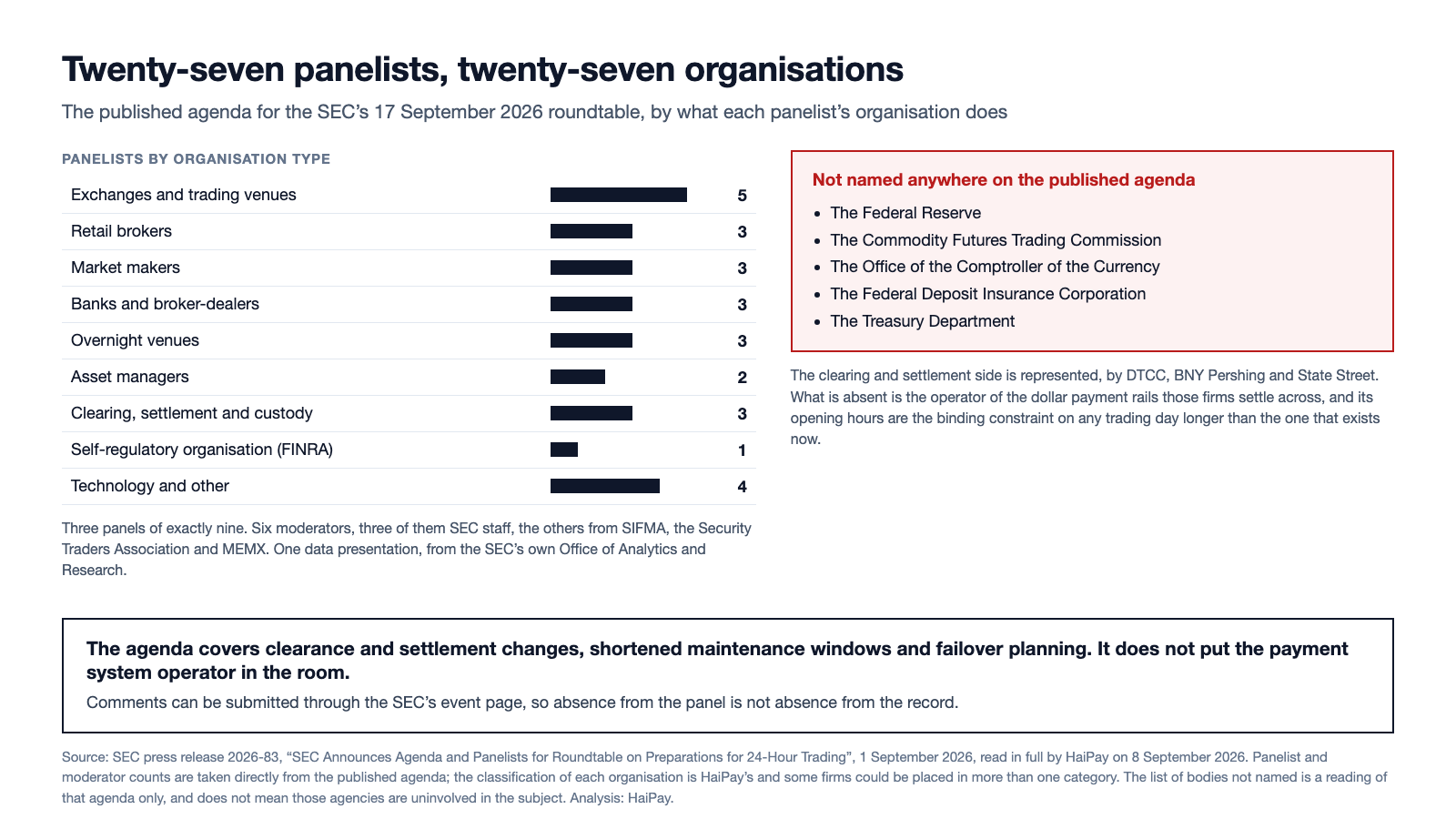
On 17 September the SEC will hold a roundtable at its Washington headquarters on preparations for 24-hour trading. It has published the agenda: three panels, twenty-seven panelists, twenty-seven different organisations, six moderators, and a data presentation from its own analysts. The Federal Reserve is not named anywhere on it.
September 8th, 2026
Last updated: September 8
Key takeaways
- The SEC holds a roundtable on preparations for 24-hour trading on 17 September 2026.
- The published agenda lists 27 panelists from 27 organisations and six moderators.
- The Federal Reserve is not named anywhere on it, nor is the CFTC, OCC, FDIC or Treasury.
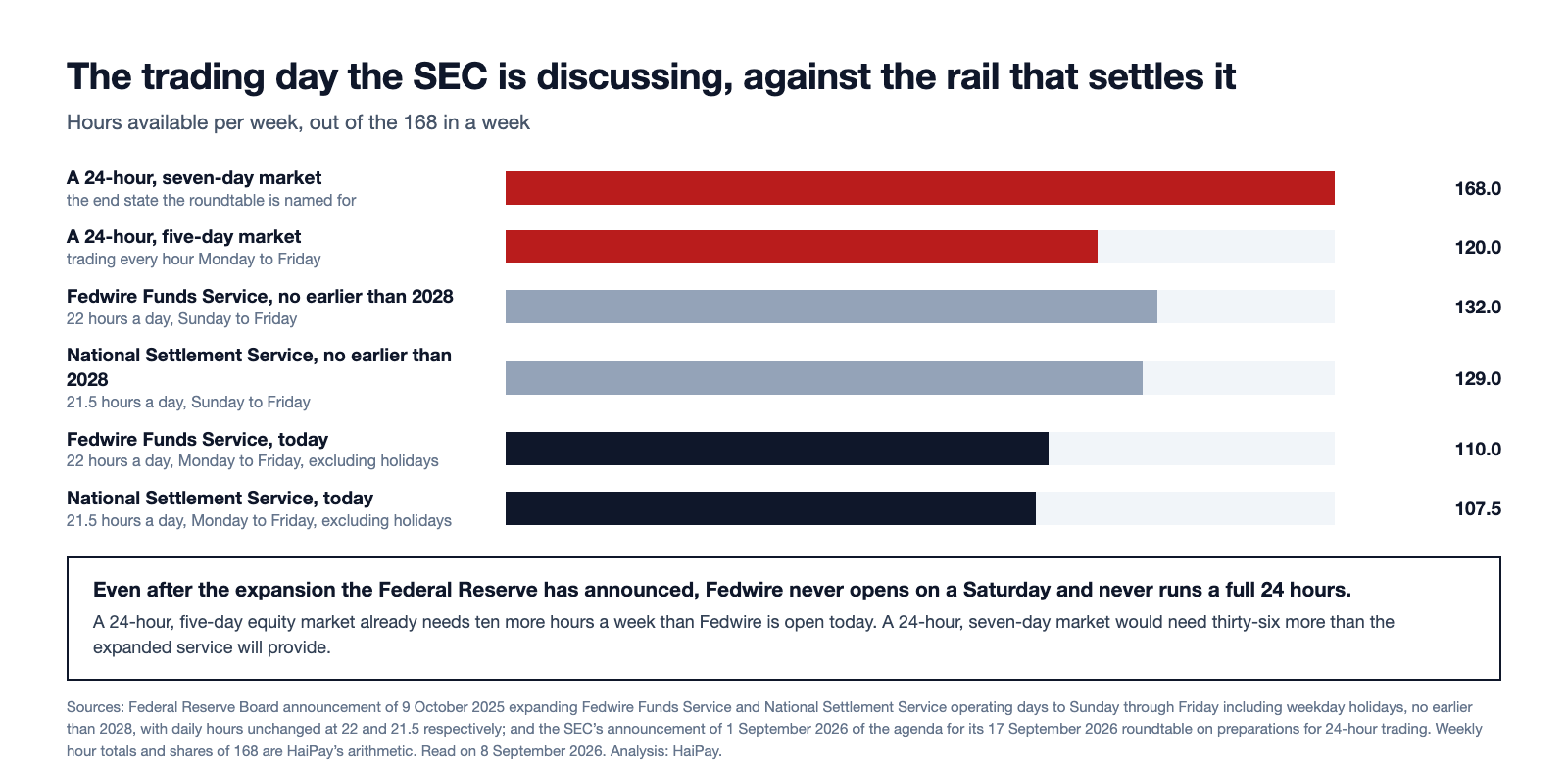
- Fedwire Funds Service is open 22 hours a day, Monday to Friday: 110 hours of the 168 in a week.
- The Fed will extend it to Sunday through Friday, but no earlier than 2028, still at 22 hours.
- A 24-hour weekday market needs 120 hours a week; a 24-hour seven-day market needs 168.
Data highlight
110of 168 hours a week
Hours a week the Fedwire Funds Service is open, against the 168 hours in a week and the 120 a 24-hour weekday equity market would require
8 September 2026
Calculated by HaiPay on 8 September 2026. The Federal Reserve Board's announcement of 9 October 2025 states that the Fedwire Funds Service is open 22 hours per day and the National Settlement Service 21.5 hours per day, that both currently operate Monday through Friday excluding holidays, and that both will expand to Sunday through Friday including weekday holidays no earlier than 2028, with daily operating hours unchanged. At 22 hours across five days the Fedwire Funds Service is therefore open 110 hours of the 168 in a week, or 65.5 per cent, and the National Settlement Service 107.5 hours, or 64.0 per cent. After the announced expansion to six days those totals become 132 hours and 129 hours, or 78.6 and 76.8 per cent, and neither service opens on a Saturday or runs a full 24 hours on any day. A market trading 24 hours a day Monday to Friday would require 120 hours a week, ten more than the Fedwire Funds Service is open today; a market trading 24 hours a day seven days a week would require 168, thirty-six more than the expanded service would provide. The same announcement states the Board will monitor demand for a potential further expansion to seven days per week. The weekly totals, percentages and gaps are HaiPay's arithmetic from the Federal Reserve's stated daily hours and operating days. Separately, the SEC's press release 2026-83 of 1 September 2026 sets out the agenda for its roundtable on preparations for 24-hour trading on 17 September 2026, listing three panels of nine panelists each, 27 panelists from 27 distinct organisations, six moderators of whom three are SEC staff, and one data presentation; the Federal Reserve, the Commodity Futures Trading Commission, the Office of the Comptroller of the Currency, the Federal Deposit Insurance Corporation and the Treasury Department are not named anywhere in that published agenda, which is a reading of that document alone and not evidence about those agencies' wider involvement. HaiPay did not contact the SEC, the Federal Reserve or any listed organisation.
On 17 September the SEC will hold a roundtable at its Washington headquarters on preparations for 24-hour trading. It has published the agenda: three panels, twenty-seven panelists, twenty-seven different organisations, six moderators, and a data presentation from its own analysts.
The Federal Reserve is not named anywhere on it.
That matters because a share trades in a second and settles in dollars, and the dollars move across a system that is open 22 hours a day, five days a week.
What is being convened
The roundtable runs from 10am to 4pm Eastern and is open to the public and webcast. The three panels are titled preparedness for a 24-hour market, resiliency in a 24-hour market, and expected impacts and consideration of next steps.
The subject matter is specific rather than speculative. Panel one covers exchange and broker-dealer readiness, overnight surveillance, closing price processes, clearance and settlement changes and investor protection. Panel two covers systems readiness, Regulation SCI, failover and capacity planning, market-data continuity, shortened maintenance windows and cybersecurity. Panel three covers liquidity, capital formation and what the SEC calls "Day 2" regulatory questions.
This is not a conversation about whether overnight trading will happen. Several of the firms on the roster already run it.
The rail underneath
The Federal Reserve operates the large-value services across which the dollar leg of US securities settlement moves. Their published hours are the constraint nobody on the agenda operates.
The Fedwire Funds Service is open 22 hours a day. The National Settlement Service, which is how clearing houses settle net obligations, is open 21.5 hours. Both run Monday to Friday, excluding holidays.
On 9 October 2025 the Federal Reserve Board announced it would expand both to Sunday through Friday, including weekday holidays. Two things about that announcement are easy to miss. The daily hours do not change: Fedwire stays at 22 hours, NSS at 21.5. And the implementation date is "no earlier than 2028."
Put in hours per week, out of the 168 there are: Fedwire is open 110 today and would be open 132 after the expansion. A market trading 24 hours a day Monday to Friday needs 120. A market trading 24 hours a day, seven days a week, needs 168.
So a 24-hour weekday market already asks for ten hours a week more than the money rail provides, and the expanded rail, whenever it arrives, still never opens on a Saturday and still closes for two hours every day.
The Board did leave the door open. The same announcement says it "will monitor demand for a potential further expansion of operating hours to seven days per week." That is a commitment to watch, not a date.
Who is in the room
The roster is broad on the trading side and thin on one specific thing.
By HaiPay's classification of the twenty-seven organisations, five are exchanges or trading venues, three are retail brokers, three are market makers, three are banks or broker-dealers, two are asset managers, and three sit in clearing, settlement and custody: DTCC, BNY Pershing and State Street. Three more are firms built around trading outside normal hours, including 24X and Blue Ocean. Four are technology or other firms. FINRA is the only self-regulatory organisation. Three of the six moderators are SEC staff; the others come from SIFMA, the Security Traders Association and MEMX.
So the settlement industry is present. What is not named on the published agenda is any federal banking regulator or payment system operator: not the Federal Reserve, not the CFTC, not the OCC, the FDIC or the Treasury.
That is a reading of one document, and it should be read as narrowly as it is written. It does not mean those agencies are uninvolved, uninterested or absent from the wider process. The SEC also takes written comments through the event page, so not being on a panel is not the same as not being on the record.
Why this is a payments question
Extended trading hours are usually discussed as a market structure problem: surveillance, closing prices, liquidity at 3am. Those are real. But the binding physical constraint on a longer trading day is when money can move with finality, and that is set by the operating calendar of a payment system, not by an exchange's willingness to quote.
A trade executed at 2am on a Saturday is a promise until the cash leg settles. Someone has to carry that exposure across the gap, and the length of the gap is decided by hours the SEC does not set. This is the same problem, in a different jurisdiction, as a scheme that runs instant payments around the clock while its settlement window does not.
It is also why the 2028 date is the most important number in this story. The trading side can move in months. The money side has published a plan measured in years, and it stops short of both 24 hours and seven days.
What HaiPay could not establish
Whether the Federal Reserve was invited, declined, or will participate in some form not listed on the published agenda. HaiPay did not contact the SEC, the Federal Reserve or any of the twenty-seven organisations.
Whether the agenda changes before 17 September. Agendas are revised, and this one was published on 1 September, seven days before this reading.
How the industry currently bridges the gap. Overnight venues already operate, so mechanisms exist; the published agenda does not describe them and this piece does not attempt to.
What to watch
Whether panel one's discussion of clearance and settlement changes reaches the operating calendar of the payment system, or stops at the clearing house.
Whether anyone on the day names a date. The Fed's is "no earlier than 2028," and no equivalent date exists publicly for the trading side.
And whether the comment file attracts submissions from banks rather than trading firms, because the institutions that would have to fund positions across a closed settlement window are the ones with the most to say and the least presence on the panel.
This piece reads two published documents, an SEC agenda and a Federal Reserve announcement. It is not investment advice.
How to cite
HaiPay News, "Equities Want 24 Hours. Fedwire Gives 22, Five Days.", https://www.haipay.net/news/sec-24-hour-trading-fedwire-hours, September 8th, 2026
About the author
Crystal
Digital Public Relations
A digital PR specialist with a Master's in Journalism & Communication from UNSW. Started as an intern at ABC Australia, now leads public relations at Haipay, crafting press releases and media strategies that bring brand stories to life.
Reviewed by WeiJun TangEditorial policy
4 sources
- U.S. Securities and Exchange Commission
SEC Announces Agenda and Panelists for Roundtable on Preparations for 24-Hour Trading, press release 2026-83
- U.S. Securities and Exchange Commission
SEC Announces Roundtable on Preparations for 24-Hour Trading, press release 2026-69
- Federal Reserve Financial Services
Wholesale Services Operating Hours and FedPayments Manager Hours of Availability
 Board of Governors of the Federal Reserve System
Federal Reserve Board announces expanded operating days of two large-value payments services, Fedwire Funds Service and the National Settlement Service, to include Sundays and weekday holidays