Everyone Says October 2027. The First Date Is 7 December.
Ask anyone in European post-trade when the EU moves to T+1 and you will get one date: 11 October 2027. It is on every conference slide and in every readiness survey. The regulation that makes it happen has three application dates, and the first one is 90 days away.
September 8th, 2026
Last updated: September 8
Key takeaways
- The EU's T+1 delegated regulation has three application dates, not the single one usually quoted.
- The first is 7 December 2026, covering allocations and confirmations: 90 days from this reading.
- The second is 1 July 2027 and the third is 11 October 2027, the migration date.
- Of the regulation's 13 amendment points, two apply in full from December 2026.
- It enters into force 20 days after Official Journal publication, so it must be published by 17 November.
- HaiPay searched EUR-Lex on 8 September 2026 and did not find it published there.
Data highlight
3application dates, the first 90 days away
Application dates in the Commission delegated regulation carrying the EU's T+1 settlement requirements, and days from this reading to the first of them
8 September 2026
Read by HaiPay on 8 September 2026 from Commission Delegated Regulation C(2026) 4640 final of 6 July 2026, amending the regulatory technical standards on settlement discipline in Commission Delegated Regulation (EU) 2018/1229, retrieved from the European Commission documents register. Its final article states that the regulation shall enter into force on the twentieth day following publication in the Official Journal of the European Union and shall start to apply from 7 December 2026, that Article 1 point (3)(a) as regards the amendment to Article 5(4) point (b), and points (8)(a)(i), (8)(b), (8)(c), (9), (11), (12) and (13) shall apply from 1 July 2027, and that points (3)(b), (4), (5), (6), (7) and (10) shall apply from 11 October 2027. Article 1 contains thirteen numbered amendment points; on HaiPay's reading two apply in full from 7 December 2026, four in full from 1 July 2027 and five in full from 11 October 2027, with points (3) and (8) split across dates. From 8 September 2026 that is 90 days to 7 December 2026, 296 days to 1 July 2027 and 398 days to 11 October 2027. Because entry into force is twenty days after publication, publication by 17 November 2026, which is 70 days from this reading, is required for the regulation to be in force on 7 December 2026. ESMA's statement ESMA74-2119945926-3773 of 20 July 2026 describes the same two headline deadlines, states that the amendments were endorsed by the European Commission and were then under scrutiny by the European Parliament and the Council, and states that ESMA and national competent authorities were in the last stages of their review of the Level 3 guidance on allocations and confirmations. HaiPay searched EUR-Lex on 8 September 2026 and did not find the amending regulation published there; the consolidated text of Regulation (EU) 2018/1229 was still dated 2 September 2024 and listed no 2026 amendment. Consolidated versions lag publication, so that is not evidence that the regulation is unpublished. ESMA's page on shortening the settlement cycle lists coordination meeting dates including 29 September 2026 and 1 December 2026. HaiPay did not contact the European Commission, ESMA, the European Parliament or the Council.
Ask anyone in European post-trade when the EU moves to T+1 and you will get one date: 11 October 2027. It is on every conference slide and in every readiness survey.
The regulation that makes it happen has three application dates, and the first one is 90 days away.
What the regulation says
On 6 July 2026 the European Commission adopted a delegated regulation, C(2026) 4640 final, amending the settlement discipline technical standards in Commission Delegated Regulation (EU) 2018/1229. It is the instrument that carries the operational requirements for T+1 in the EU.
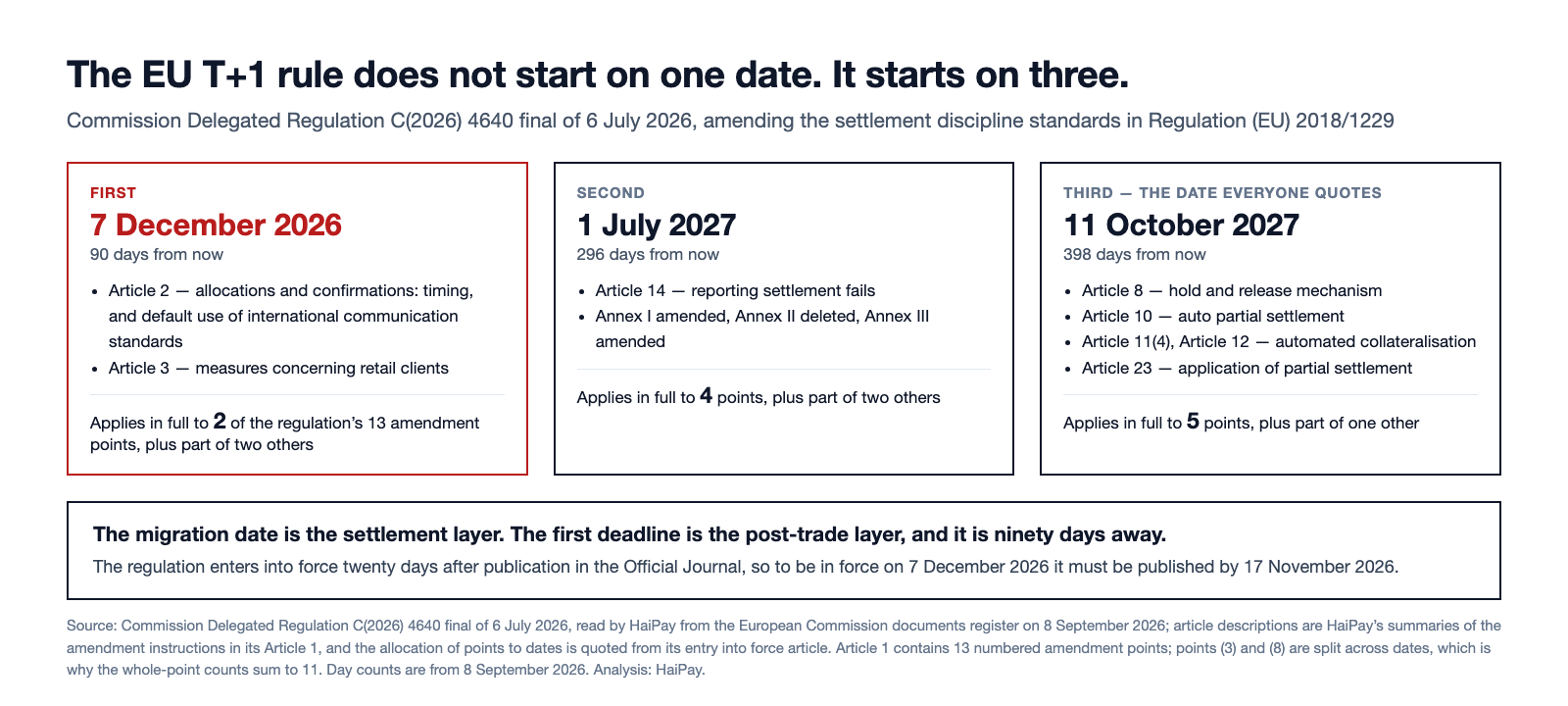
Its final article is short enough to quote. The regulation "shall start to apply from 7 December 2026." Then a list of specific provisions applies "from 1 July 2027," and another list "from 11 October 2027."
Article 1 makes thirteen numbered amendments. Two apply in full from December 2026, four in full from July 2027 and five in full from October 2027; two more are split, with different sub-points landing on different dates.
So the date the market quotes is the last of three, and it governs the smallest share of the text.
What lands in December
The December tranche is the part of T+1 that is not about settlement at all. It is about the step immediately after a trade is agreed.
Point (1) rewrites Article 2, which covers allocations and confirmations: how quickly a client and its broker must agree what was bought and for whom, and the requirement to do it through international communication standards by default rather than by email, spreadsheet or phone. Point (2) replaces Article 3, on measures concerning retail clients.
ESMA describes this as "the first post-trade step," and in its 20 July statement set out exactly the same two-stage structure: a first deadline on 7 December 2026 "to improve the first post-trade step, the exchange of allocations and confirmations, in terms of timing and through the default use of international communication standards," and a final deadline on 11 October 2027 "to optimise the settlement layer."
The October 2027 tranche is the settlement plumbing: hold and release, auto partial settlement, real-time functionality, automated collateralisation, and the application of partial settlement. Those are largely obligations on central securities depositories. The December tranche is an obligation on everyone who trades.
The publication problem
There is a wrinkle, and it is arithmetic rather than opinion.
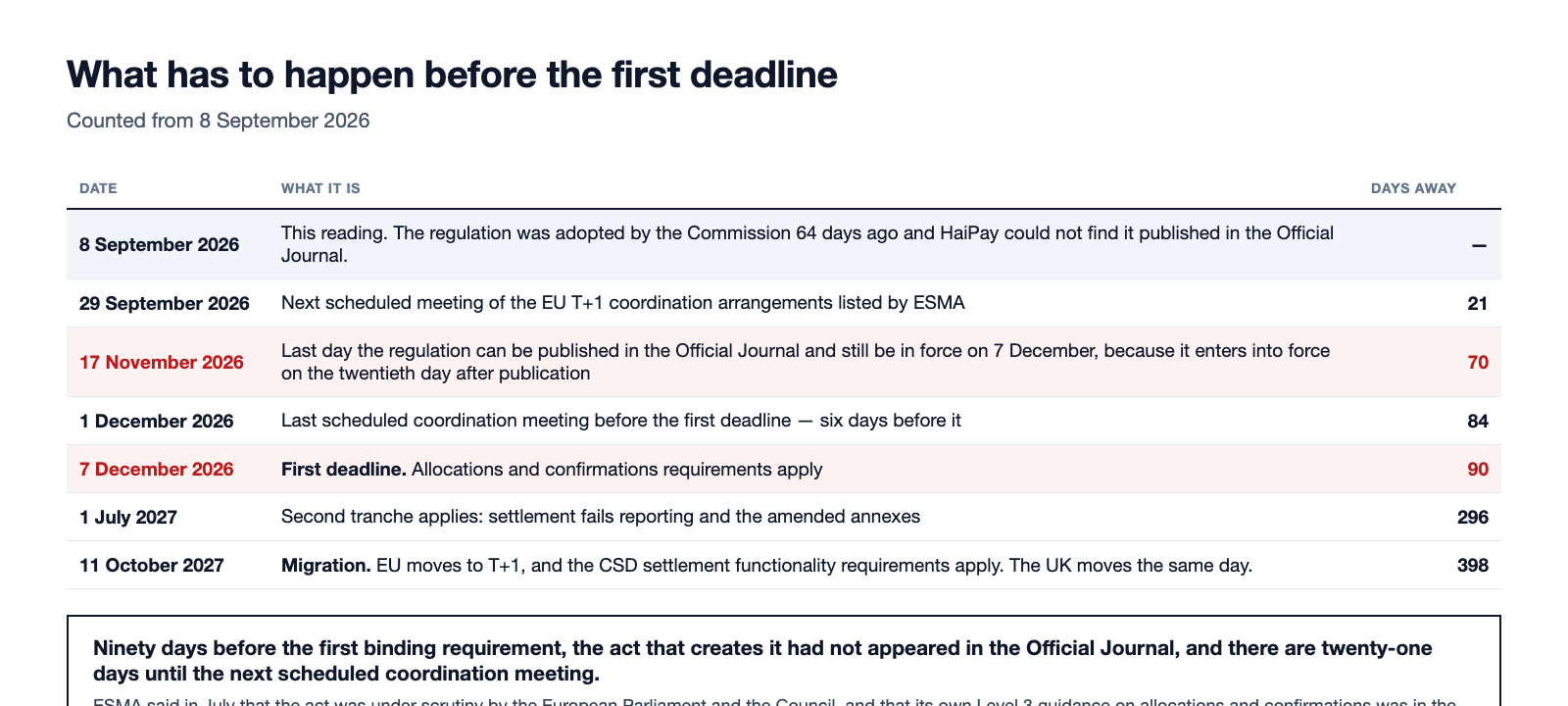
A Commission delegated regulation enters into force on the twentieth day following its publication in the Official Journal. This one says so. For it to be in force on 7 December 2026, it therefore has to be published by 17 November 2026, which is 70 days from now.
As of this reading, HaiPay could not find it published. ESMA's statement of 20 July said the amendments "have now been endorsed by the European Commission, and currently are under scrutiny by the European Parliament and the Council," which is the normal objection period for a delegated act. On EUR-Lex the consolidated text of Regulation (EU) 2018/1229 is still dated 2 September 2024 and lists no 2026 amendment.
That is not proof it is unpublished. Consolidated versions lag the Official Journal, sometimes by weeks, and a search that fails to find something is weaker evidence than a search that finds it. What can be said precisely is that HaiPay looked and did not find it, and that the window between now and the publication backstop is 70 days.
ESMA also said in July that it and national competent authorities were "in the last stages of their review of the Level 3 guidance on allocations and confirmations." Guidance in last stages in July, for a requirement applying in December, is a tight sequence even if everything lands.
Why December is the harder date
There is a case that the first deadline is the more demanding one, and it has nothing to do with how much text it covers.
The October 2027 requirements fall mainly on a small number of central securities depositories: sophisticated, heavily supervised institutions with dedicated programmes and a date they have been planning around for two years. The December 2026 requirements fall on every investment firm that allocates and confirms trades, including small ones, and they require changing a process that today is often manual precisely because it has always been allowed to be.
ESMA's own framing supports this. It noted "uneven implementation levels across the EU financial markets, sectors and firms" from the industry readiness surveys, and warned that insufficient preparedness could bring "significant operational and reputational risks."
There is also a coordination detail worth noting. The meeting dates ESMA lists for the EU T+1 coordination arrangements include 29 September 2026 and 1 December 2026. The last scheduled meeting before the first deadline falls six days before it.
What HaiPay could not establish
Whether the delegated regulation has been published in the Official Journal since this reading was taken, or the date the scrutiny period ends. HaiPay did not contact the Commission, ESMA or the Parliament.
How many firms are ready. ESMA references two industry readiness surveys and characterises the results, but the underlying figures are not in the statement HaiPay read.
Whether the UK's 11 October 2027 move carries an equivalent earlier deadline. The UK is legislating T+1 as mandatory from the same day under UK CSDR, but this piece did not audit the UK instrument for staged application dates.
What to watch
The Official Journal, between now and 17 November 2026. Publication after that date would put entry into force after the day the regulation says it starts to apply.
ESMA's Level 3 guidance on allocations and confirmations, which was in final review in July and gives firms the interpretation they will be examined against.
And the 1 December coordination meeting, which is the last scheduled moment for anyone to say publicly that the first deadline is or is not going to hold.
This piece reads published regulatory documents. It is not legal or compliance advice, and any firm affected should read the regulation and its own regulator's guidance.
How to cite
HaiPay News, "Everyone Says October 2027. The First Date Is 7 December.", https://www.haipay.net/news/eu-t1-settlement-three-application-dates, September 8th, 2026
About the author
Crystal
Digital Public Relations
A digital PR specialist with a Master's in Journalism & Communication from UNSW. Started as an intern at ABC Australia, now leads public relations at Haipay, crafting press releases and media strategies that bring brand stories to life.
Reviewed by WeiJun TangEditorial policy
4 sources
- European Commission
Commission Delegated Regulation amending the regulatory technical standards laid down in Commission Delegated Regulation (EU) 2018/1229 on settlement discipline, C(2026) 4640 final, 6 July 2026
- European Securities and Markets Authority
Statement on T+1 preparations: key deadlines and action points, ESMA74-2119945926-3773, 20 July 2026
- European Securities and Markets Authority
Shortening the settlement cycle to T+1 in the EU
- EUR-Lex
Commission Delegated Regulation (EU) 2018/1229 of 25 May 2018 supplementing Regulation (EU) No 909/2014 with regard to regulatory technical standards on settlement discipline