131 Days Out, No Issuer Publishes What the Law Asks
The GENIUS Act takes effect no later than 18 January 2027, which is 131 days from now. It tells payment stablecoin issuers exactly what to put on their websites every month. HaiPay read the transparency pages of three of the largest dollar stablecoin issuers on 9 September and compared them against that text. All three publish reserve compositions and independent accountants' reports. None publishes the two specific data points the statute names.
September 9th, 2026
Last updated: September 9
Key takeaways
- The GENIUS Act takes effect no later than 18 January 2027, which is 131 days away.
- It requires monthly publication of average tenor and custody location for each reserve category.
- Circle, Paxos and Tether all publish categories and percentages. None publishes either field.
- Circle and Paxos show July 2026 as their latest attested period; Tether shows 30 June.
- Tether publishes quarterly, not monthly, with assurance from BDO Italia.
- 25.08% of Tether's published reserves sits outside the categories the statute lists.
Data highlight
0of 3 issuers
Large dollar stablecoin issuers publishing the average tenor and geographic location of custody of each reserve category, as the GENIUS Act requires
9 September 2026
Checked by HaiPay on 9 September 2026 by loading and reading the public transparency pages of Circle, Paxos and Tether. The GENIUS Act, Public Law 119-27 of 18 July 2025, requires a permitted payment stablecoin issuer to publish the monthly composition of its reserves on its website, containing the total number of outstanding payment stablecoins and the amount and composition of the reserves, including the average tenor and geographic location of custody of each category of reserve instruments. On the pages read, all three issuers publish reserve categories and percentages and each publishes an independent accountant's report, and none publishes an average tenor or a geographic location of custody for any category. Circle showed a weekly reserve snapshot dated 7 September 2026 and a monthly assurance report from a Big Four firm whose most recent listed period was July 2026, 40 days after period end. Paxos showed a monthly KPMG attestation for PYUSD whose most recent listed period was July 2026, also 40 days after period end, alongside a self-reported composition published five business days after month end that Paxos states has not been independently reviewed. Tether's page states that reserves reports are published quarterly with assurance from BDO Italia under ISAE 3000R, and the most recent was as of 30 June 2026, 71 days before this reading. Tether's published mix for that date was 74.91 per cent cash, cash equivalents and other short-term deposits, 10.03 per cent precious metals, 7.17 per cent secured loans, 3.09 per cent bitcoin, 2.79 per cent other investments, 2 per cent public equities and zero corporate bonds, so 25.08 per cent sits in categories the Act does not list among permitted reserves; within the cash equivalents block Tether reports 4.97 per cent in term reverse repurchase agreements, equal to 3.72 per cent of total reserves, where the Act permits reverse repurchase agreements on an overnight basis. Tether is not a United States issuer and has not stated that it will seek a United States licence for USDT, and the Act is not yet in force, so these are measurements against the statutory text rather than findings of non-compliance. The Act takes effect on the earlier of 18 months after enactment, which is 18 January 2027 and 131 days after this reading, or 120 days after the primary Federal payment stablecoin regulators issue final implementing regulations. HaiPay checked each issuer's main transparency page and the report index shown on it, not every document in every archive, and did not contact Circle, Paxos, Tether or any regulator.
The GENIUS Act takes effect no later than 18 January 2027, which is 131 days from now. It tells payment stablecoin issuers exactly what to put on their websites every month.
HaiPay read the transparency pages of three of the largest dollar stablecoin issuers on 9 September and compared them against that text. All three publish reserve compositions and independent accountants' reports. None publishes the two specific data points the statute names.
What the Act asks for
The requirement is one sentence, and it is more prescriptive than it first looks. An issuer must "publish the monthly composition of the issuer's reserves on the website of the issuer," containing the total number of outstanding stablecoins and the amount and composition of the reserves, "including the average tenor and geographic location of custody of each category of reserve instruments."
Average tenor and custody location, per category. Not overall. Not on request.
Those two fields are the difference between knowing that an issuer holds Treasuries and knowing how long those Treasuries have to run and which jurisdiction is holding them. In a run, both matter more than the headline percentage does.
What is published today
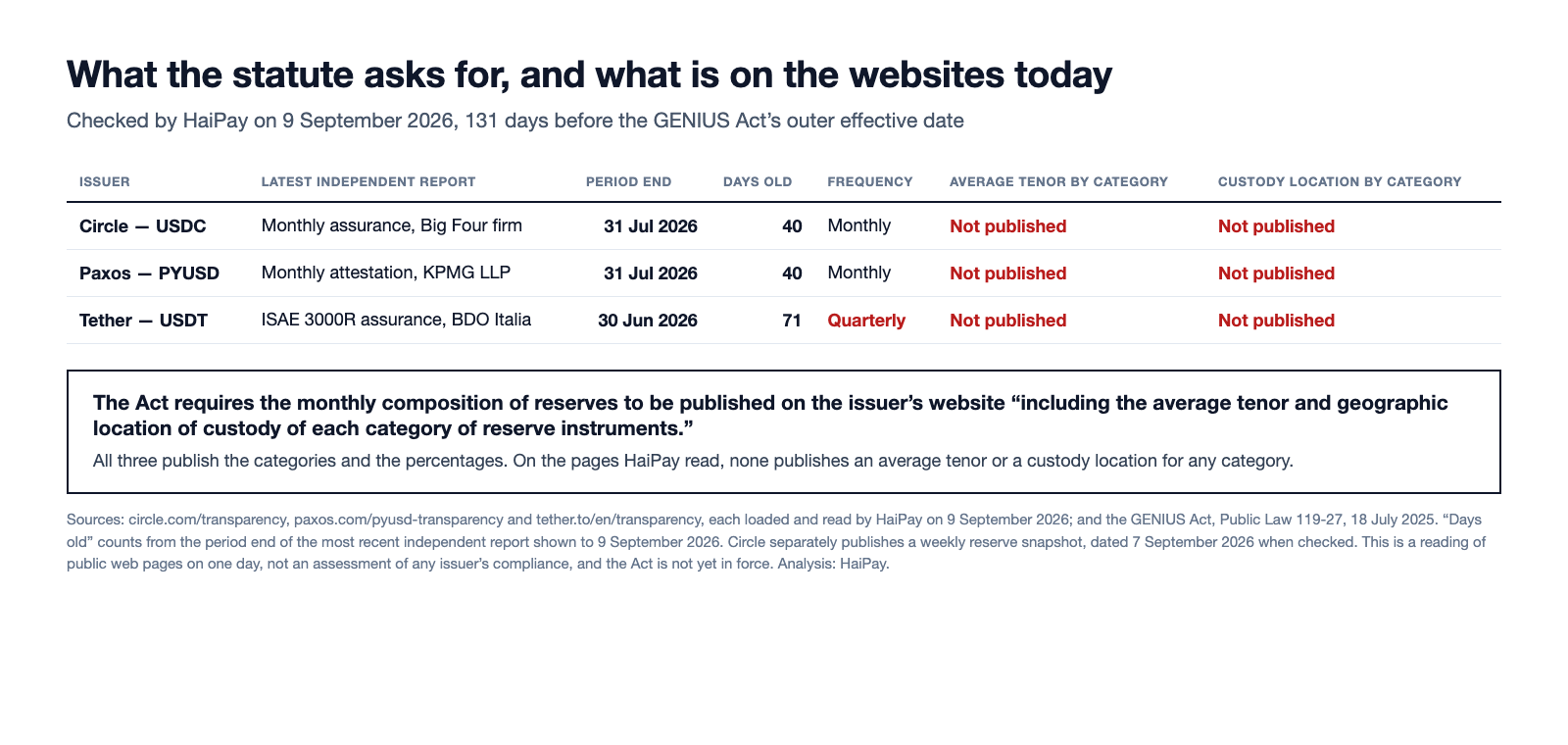
Circle publishes a weekly snapshot of USDC reserve holdings, dated 7 September when HaiPay checked, and a monthly assurance report from a Big Four firm. The most recent monthly report listed on its transparency page covers July 2026, a period that ended 40 days ago.
Paxos publishes two documents a month for PYUSD: a self-reported portfolio composition five business days after month end, which it states has not been independently reviewed, and a KPMG attestation. The most recent attestation listed is July 2026, also 40 days after period end.
Tether publishes on a different cadence entirely. Its transparency page states that reserves reports are published quarterly, with assurance from BDO Italia under ISAE 3000R. The most recent is as of 30 June 2026, 71 days before this reading.
All three publish categories and percentages. On the pages HaiPay read, none of the three publishes an average tenor for any reserve category, and none publishes where each category is held.
The gap is not transparency. It is granularity, and it is the granularity the statute specifies.
The other list
There is a second test in the Act, and it is harder than the disclosure one.
The statute enumerates what may be held as reserves: US coins and currency or balances at a Federal Reserve Bank; demand deposits at an insured depository institution; Treasury bills, notes or bonds with 93 days or less remaining; overnight repo backed by those Treasuries; overnight reverse repo collateralised by Treasuries; shares in a registered government money market fund invested solely in the above; other Federal Government-issued liquid assets a regulator approves; and tokenised forms of several of those.
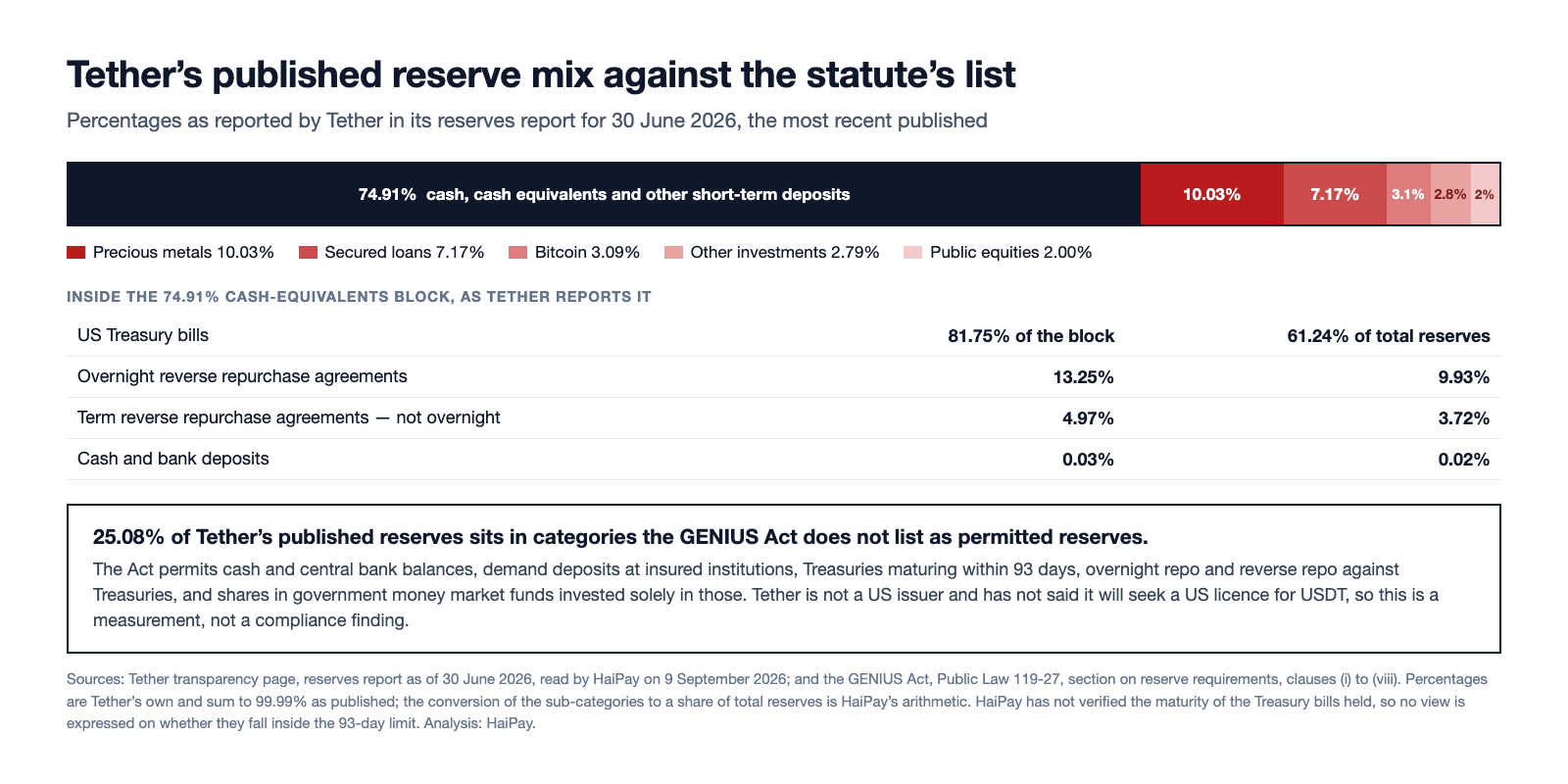
Measured against that list, Tether's published mix is the outlier. In its 30 June report it shows 74.91% in cash, cash equivalents and other short-term deposits, and the remainder in precious metals at 10.03%, secured loans at 7.17%, bitcoin at 3.09%, other investments at 2.79% and public equities at 2%. That is 25.08% in categories the statute does not list.
Inside the cash-equivalents block Tether reports a further detail worth noting: 4.97% of that block, or 3.72% of total reserves, is in term reverse repurchase agreements. The statute permits reverse repo on an overnight basis. Term is not overnight.
This is a measurement, not a compliance finding. Tether is not a US issuer, has not said it will seek a US licence for USDT, and the Act is not in force. The point is narrower and more useful: the published portfolio of the largest dollar stablecoin looks nothing like the portfolio the US statute describes, and anyone modelling what a US-regulated stablecoin market looks like should start from that.
Why the deadline is softer than it looks
The 18 January 2027 date is an outer limit, not a fixed one. The Act takes effect on the earlier of 18 months after enactment, which is that date, or 120 days after the primary federal regulators issue final implementing regulations.
Final regulations have not arrived. Proposed rules have: the OCC in March, the FDIC in April and a further set in August. Each of those is a proposal with a comment period, not a final rule, so the 120-day trigger has not started. On the current record, 18 January 2027 is the operative date, and it arrives whether or not the rules are finished.
What HaiPay could not establish
Whether any issuer publishes tenor and custody data somewhere other than the pages read. HaiPay checked each issuer's main transparency page and the report index on it, not every PDF in every archive.
What the maturity of any issuer's Treasury holdings actually is. None of the three publishes it, which is the point of this piece, so no view is expressed on whether those holdings sit inside the 93-day limit.
Whether the issuers intend to change their disclosures before the deadline. HaiPay did not contact Circle, Paxos, Tether or any regulator.
What to watch
Whether a monthly report appears with a tenor column. The first issuer to publish average tenor and custody location by category will have done something none of them does today, and it will be visible on a public page.
Whether Tether's next quarterly report, for 30 September, arrives on the same cadence or moves to monthly.
And whether final regulations land before late September 2026, because 120 days after that would fall before 18 January and would pull the whole timetable forward.
This piece reads public web pages and a public statute on one day. It is not legal, compliance or investment advice.
How to cite
HaiPay News, "131 Days Out, No Issuer Publishes What the Law Asks", https://www.haipay.net/news/genius-act-stablecoin-reserve-disclosure-audit, September 9th, 2026
About the author
Crystal
Digital Public Relations
A digital PR specialist with a Master's in Journalism & Communication from UNSW. Started as an intern at ABC Australia, now leads public relations at Haipay, crafting press releases and media strategies that bring brand stories to life.
Reviewed by WeiJun TangEditorial policy
4 sources
- United States Congress
GENIUS Act, Public Law 119-27, 18 July 2025
- Circle
Circle transparency and stability page, read 9 September 2026
- Paxos Trust Company
Paxos PayPal USD transparency reports, read 9 September 2026
- Tether
Tether transparency page, reserves report as of 30 June 2026, read 9 September 2026