FinCEN Says Nearly 25%. Its Own Numbers Give 29.7%.
FinCEN published a Financial Trend Analysis on 3 September counting $12.7 billion of suspected digital asset investment scam activity across 33,904 Bank Secrecy Act reports. It is the most detailed public accounting of pig butchering in the United States that exists. It also contains one division that does not come out, and the report's most quotable conclusion rests on it.
September 8th, 2026
Last updated: September 8
Key takeaways
- FinCEN counted $12.7 billion of suspected digital asset investment scam activity in 33,904 reports.
- It says elder financial exploitation was flagged in 10,082 of them, "nearly 25 percent."
- 10,082 divided by 33,904 is 29.74%, above the 24.4% elder share of the US population.
- The conclusion that older adults are not disproportionately targeted rests on that 25% figure.
- Stated growth of 18% month over month compounds to 74x; the endpoints show 1.7x.
- Average value per report fell 59% between October 2023 and December 2025.
Data highlight
29.74per cent, not the 25 per cent stated
Share of FinCEN's digital asset investment scam reports that flagged elder financial exploitation, calculated from the report's own two figures
8 September 2026
Calculated by HaiPay on 8 September 2026 from FinCEN's Financial Trend Analysis, Digital Asset Investment Scams: 2023-2025 Threat Pattern and Trend Information, published 3 September 2026. The report states that FinCEN analysed 33,904 Bank Secrecy Act reports filed between 8 September 2023 and 31 December 2025, involving approximately 12.7 billion dollars, and that figure of 33,904 appears four times. On page 11 the report states that financial institutions indicated involvement of elder financial exploitation in 10,082, or nearly 25 percent, of those reports, and compares that share to the 24.4 per cent of the national population that older adults represent in the 2020 Census, concluding that older adults did not represent a disproportionate amount of victims or losses. Dividing 10,082 by 33,904 gives 29.74 per cent, which exceeds the 24.4 per cent population share by 5.3 percentage points, about 22 per cent higher in relative terms. For 10,082 to equal 25 per cent the denominator would have to be 40,328, a figure that does not appear in the report. HaiPay cannot determine whether the count, the percentage or an unstated denominator accounts for the difference, and did not contact FinCEN. A report flagged for elder financial exploitation is not the same as a confirmed victim aged 60 or above and reports do not map one to one onto victims, so neither figure settles whether older adults are disproportionately targeted. Separately, the report states average month-over-month growth of 10.9 per cent in report volume and 18 per cent in value, while giving endpoints of 590 reports worth 485.7 million dollars in October 2023 and 2,482 reports worth 833.5 million dollars in December 2025; over those 26 months the actual multiples are 4.2 and 1.7, whereas compounding the stated averages would give 14.7 and 74, because the stated figures are means of monthly percentage changes rather than compound rates. Average value per report fell 59 per cent between those two months, from 823,220 dollars to 335,818 dollars. By filer type the report gives 18,568 reports and 5.5 billion dollars for money services businesses, 13,810 and 6.4 billion for depository institutions, 1,504 and 784.5 million for securities or futures firms and 22 and 8.4 million for other institutions. The data ends on 31 December 2025, 251 days before this reading.
FinCEN published a Financial Trend Analysis on 3 September counting $12.7 billion of suspected digital asset investment scam activity across 33,904 Bank Secrecy Act reports. It is the most detailed public accounting of pig butchering in the United States that exists.
It also contains one division that does not come out, and the report's most quotable conclusion rests on it.
What the report counts
FinCEN examined BSA reports referencing the key term from its own 2023 pig butchering alert, filed between 8 September 2023 and 31 December 2025. That is 845 days. Around 1,300 different financial institutions filed the 33,904 reports.
The report describes the mechanics in unusual detail: the wrong-number opening message, the fake persona, the inducement payments showing small early returns, the fabricated app showing gains, and the advance fee demanded at the end, which is often the moment the victim realises what has happened. Scammers used at least 22 different digital assets, Ethereum, Tether and USD Coin most often, and centralised exchanges were the most frequent way victims bought in.
The victim vignettes are worse than the aggregate. One person moved nearly $640,000 out of a retirement fund. Another withdrew $150,000 from a retirement account, opened a home equity line, took a personal loan and refinanced a mortgage. A third lost more than $1 million and, in a separate case, a victim who had brought a friend into the scheme took his own life after the money was gone.
The finding, and the number underneath it
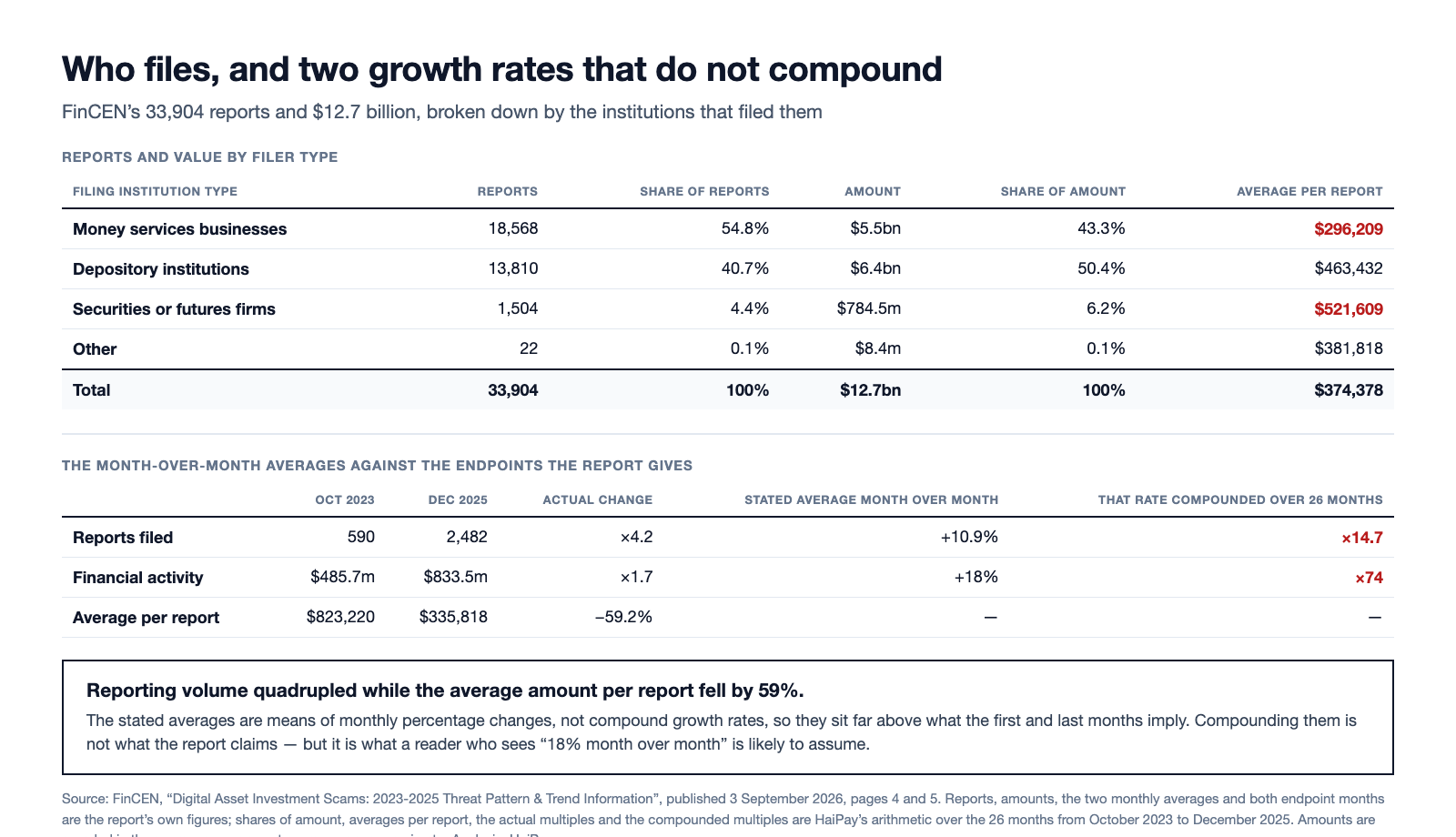
FinCEN's executive summary states that older adults make up approximately 24.4% of the population, and "approximately 25 percent of BSA reports involved both digital asset investment scams and elder financial exploitation, suggesting older Americans are not at a higher risk of victimization than other age demographics."
Later the report gives the count. Financial institutions indicated elder financial exploitation in "10,082, or nearly 25 percent" of the reports filed during the review period.
10,082 divided by 33,904 is 29.74%.
For 10,082 to be 25% of the reports, the total would have to be 40,328. That number does not appear anywhere in the document. The total appears four times, and it is 33,904 each time.
On the report's own figures, then, the elder share of reports is 5.3 percentage points above the elder share of the population, roughly 22% higher in relative terms, which is the opposite direction from the conclusion drawn on top of it.
HaiPay cannot say which figure is wrong: the count, the percentage, or a denominator FinCEN used but did not print. The comparison has a second weakness either way, because a report flagged for elder financial exploitation is not the same as a confirmed victim aged 60 or above, and reports do not map one-to-one onto victims. Whether elders are disproportionately targeted is not settled by either number. What can be said is that the arithmetic supporting the published conclusion does not reproduce.
Two averages that are not growth rates
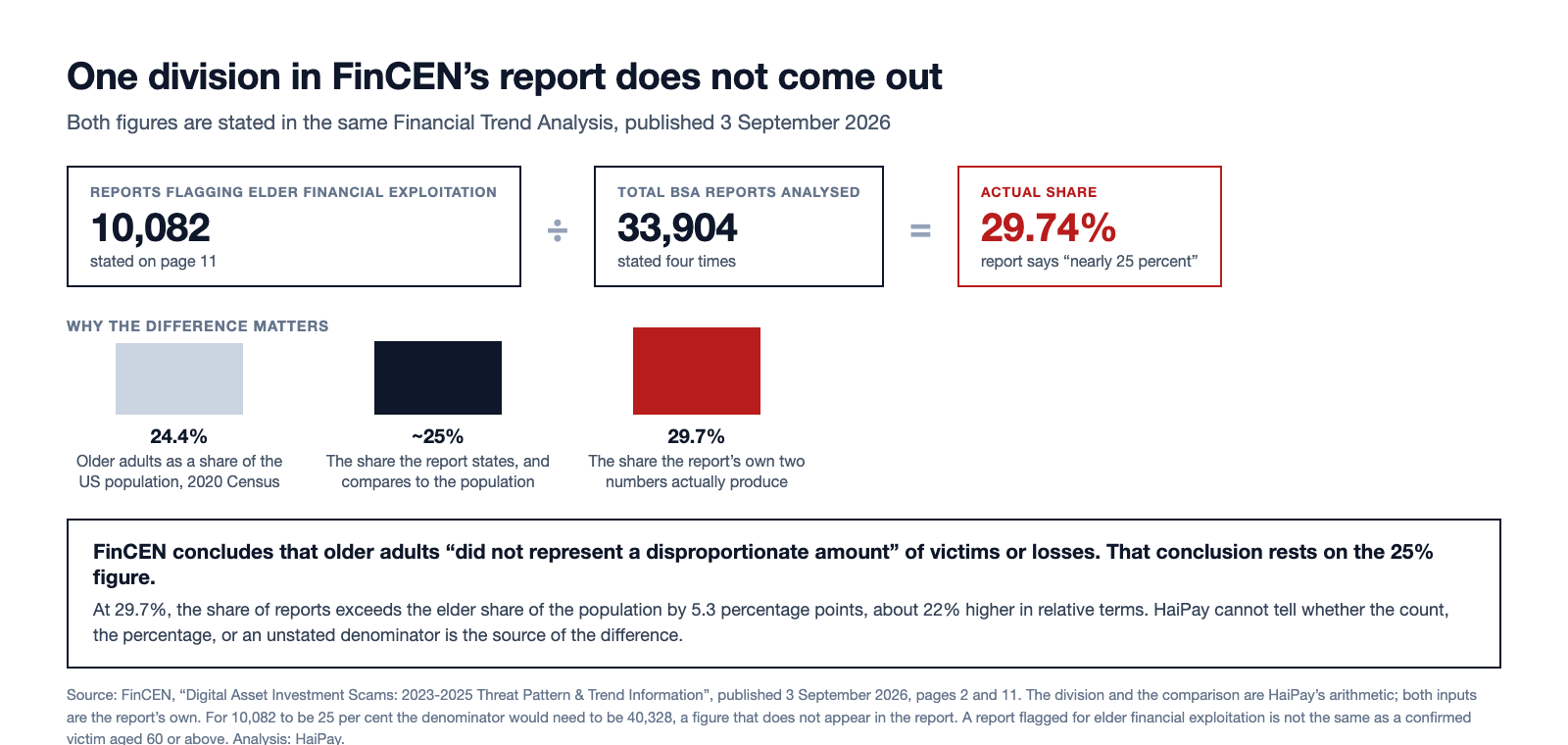
The report also states that over the review period the number of reports grew by an average of 10.9% month over month, and the dollar value by an average of 18%.
Those numbers will travel, and they should be handled carefully: they are means of monthly percentage changes, not compound growth rates.
The report gives the endpoints. October 2023, the first full month, produced 590 reports worth $485.7 million. December 2025, the last, produced 2,482 reports worth $833.5 million. Reports rose by a factor of 4.2 over 26 months. Value rose by a factor of 1.7.
Compounded across the same 26 months, 10.9% a month would give a factor of 14.7, and 18% a month a factor of 74. The gap is not an error. A series with large monthly swings will always show an arithmetic mean of its growth rates well above its compound rate, and FinCEN says plainly that growth was "not at a consistent rate." But a reader who takes "18% month over month" as the growth rate will be wrong by a factor of more than forty.
The endpoints carry a finding of their own that the report does not draw out. Average value per report fell from $823,220 in October 2023 to $335,818 in December 2025, a drop of 59%. Reporting got much more frequent and much smaller per filing.
Who files, and for how much
Money services businesses, mostly digital asset firms, filed 18,568 reports, 54.8% of the total, covering $5.5 billion. Depository institutions filed 13,810, or 40.7%, covering $6.4 billion. Securities and futures firms filed 1,504, and everything else 22.
So banks filed fewer reports than crypto firms but flagged more money: 50.4% of the value against 43.3%. Average per report runs $296,209 at money services businesses, $463,432 at depository institutions and $521,609 at securities and futures firms. The institution closest to the purchase sees the most cases; the one closest to the savings sees the largest.
For scale on recovery, FinCEN's Rapid Response Program has since 2015 facilitated the interdiction of $1.8 billion and the recovery of over $1 billion for 5,790 US victims. That covers all cyber-enabled fraud across eleven years, not this scam type over 27 months, so the two figures are not a recovery rate. They are still worth putting side by side.
What HaiPay could not establish
Which of FinCEN's two elder figures is correct. HaiPay did not contact FinCEN.
How much money victims actually lost. The $12.7 billion is financial activity described in suspicious activity reporting, which is suspicion rather than adjudicated loss, and FinCEN says so directly.
Whether the trend continued. The data stops on 31 December 2025, which is 251 days before this reading.
What to watch
Whether FinCEN corrects or clarifies the elder figure, because this report will be cited for years as evidence on who these scams target.
Whether the next Financial Trend Analysis publishes a monthly series rather than two endpoints and a pair of averages, which would let anyone compute the growth rate themselves.
And whether the falling average per report holds. If it does, it suggests detection is reaching smaller cases earlier, which is the only good news available in this document.
This piece reads a public report. It is not fraud advice. Anyone who believes they have been targeted should contact their financial institution and law enforcement; the 988 Suicide and Crisis Lifeline is available to anyone in distress.
How to cite
HaiPay News, "FinCEN Says Nearly 25%. Its Own Numbers Give 29.7%.", https://www.haipay.net/news/fincen-digital-asset-scams-elder-share, September 8th, 2026
About the author
Crystal
Digital Public Relations
A digital PR specialist with a Master's in Journalism & Communication from UNSW. Started as an intern at ABC Australia, now leads public relations at Haipay, crafting press releases and media strategies that bring brand stories to life.
Reviewed by WeiJun TangEditorial policy
3 sources
- Financial Crimes Enforcement Network
Financial Trend Analysis: Digital Asset Investment Scams: 2023-2025 Threat Pattern & Trend Information
- Financial Crimes Enforcement Network
FinCEN Alert on Money Laundering Activity Associated with Digital Asset Investment Scam Centers
- Financial Crimes Enforcement Network
FinCEN Identifies Nearly $13 Billion Linked to Suspected Digital Asset Scams Operated by Overseas Scam Centers