NewsPayouts
The Stablecoin Group Grew to 21. Two of the Ten Are Absent.
Twenty-one of the world's largest financial institutions said on 1 September that they will build a dollar stablecoin together. The interesting number is not 21. It is 2 — the number of banks that were named in the group's first announcement, eleven months ago, and are not named in this one.

Key takeaways 6
- Twenty-one financial institutions committed on 1 September to form a company in H2 2026 to issue a dollar stablecoin.
- Eight of the ten banks named in the October 2025 announcement are on the new list. Barclays and BNP Paribas are not.
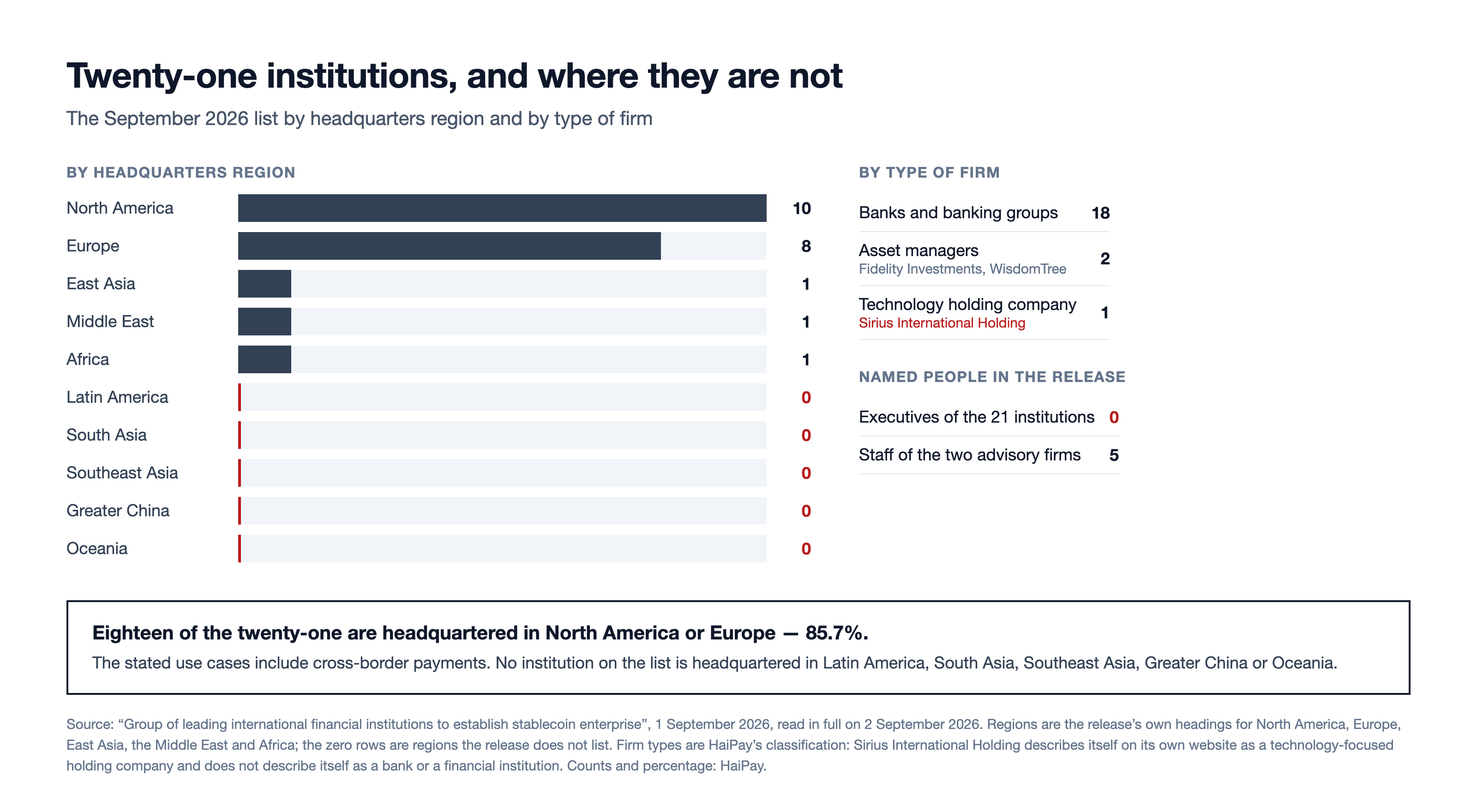
- Eighteen of the twenty-one are banks; two are asset managers and one is a technology holding company.
- Eighteen of the twenty-one are headquartered in North America or Europe, and none in Latin America or South Asia.
- Neither release quotes or names a single executive of any participating institution.
- The company is due in H2 2026 and the stablecoin in H1 2027, subject to unspecified closing conditions.
Twenty-one of the world's largest financial institutions said on 1 September that they will build a dollar stablecoin together. The interesting number is not 21. It is 2.
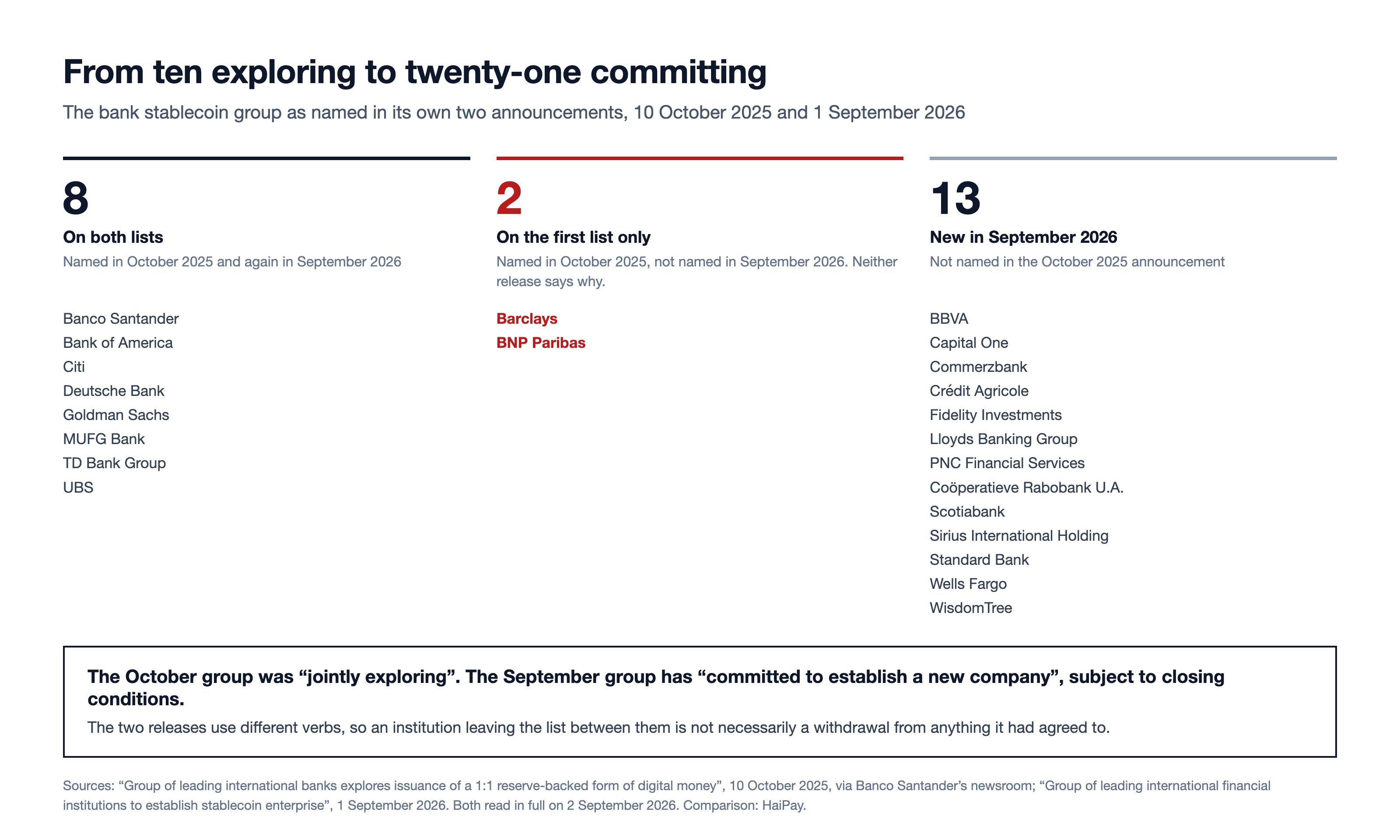
Eleven months earlier, on 10 October 2025, ten banks announced they were jointly exploring the same idea. Eight of those ten are on the new list. Barclays and BNP Paribas are not.
Ten exploring, twenty-one committing, and two gone
The two announcements are the group's own, and reading them against each other is the only way to see what changed.
The October 2025 release said ten named banks were "jointly exploring the issuance of a 1:1 reserve-backed form of digital money that provides a stable payment asset available on public blockchains, focused on G7 currencies". The September 2026 release says twenty-one named institutions "have committed to establish a new company in H2 2026, subject to closing conditions, to support the issuance of a stablecoin solution".
Eight institutions appear on both lists: Banco Santander, Bank of America, Citi, Deutsche Bank, Goldman Sachs, MUFG Bank, TD Bank Group and UBS. Thirteen are new. Two — Barclays and BNP Paribas — were named in October 2025 and are not named in September 2026.
Neither release explains the change, and the verbs matter. The first group was exploring; the second has committed. An institution that stops appearing between an exploration and a commitment has not necessarily withdrawn from anything it agreed to. But it is a fact about the public record that two of the ten founding names are gone, and neither release says why.
Eighteen banks, two asset managers, and one technology holding company
The September release calls all twenty-one "leading financial institutions". On its own list, eighteen are banks or banking groups. Fidelity Investments and WisdomTree are asset managers — financial institutions, but not banks, and neither issues deposits.
The twenty-first is Sirius International Holding, the sole Middle East member. Its own website describes it as a subsidiary of IHC "with a steadfast commitment to catalyzing the digital revolution", specialising in "harnessing the power of disruptive, cutting-edge technologies for human-centric progress". It does not describe itself as a bank, a financial institution, or as holding a banking or financial services licence.
That is not a criticism of the company. It is a caution about the shorthand: much of the coverage called it a group of 21 banks. Eighteen are.
Where the group is not
The release organises its members by region: North America ten, Europe eight, East Asia one, the Middle East one, Africa one. Eighteen of twenty-one — 85.7% — are headquartered in North America or Europe.
There is no institution on the list headquartered in Latin America, South Asia, Southeast Asia, Greater China or Oceania. The single African member, Standard Bank, and the single East Asian member, MUFG, carry two continents each.
That may be exactly right for a first cohort. A dollar stablecoin needs dollar-clearing institutions and regulated distribution before it needs reach, and the release names the GENIUS Act in the United States and MiCA in the European Union as the frameworks it intends to comply with — both of them North Atlantic. But the stated use cases include cross-border payments, and a payment has two ends. On this list, one of those ends is well represented and the other is not represented at all.
Nobody's name is on it
Both releases have something else in common, and it is unusual for an announcement of this size. Neither quotes a single executive from any participating institution. Neither names one.
The September release names five people. All five work for the two advisory firms: Brunswick Group, handling media, and Boston Consulting Group, handling business enquiries. The October 2025 release named three, all at Brunswick.
For an announcement carrying twenty-one names of this size, that is a deliberate choice. A joint venture announcement where no principal will put a name to a sentence is telling you something about how settled the arrangement is, or about how many legal departments had to approve the wording. Either reading is worth more than the quote would have been.
What is committed, and by when
The commitment in the release is to form a company, not to ship a product. The company is to be established in H2 2026 — within 121 days of the announcement — and it is "subject to closing conditions" that are not specified. Its name "will be announced in due course". The stablecoin is targeted to "go to market in the first half of 2027", between 121 and 302 days from the announcement.
The October 2025 release described a stable payment asset "available on public blockchains". In describing its own current plan, the September release does not say which chains, public or permissioned, the stablecoin would run on. The phrase "public blockchains" appears only in the sentence recapping what was announced in 2025.
There is also no reserve model, no issuing entity, no jurisdiction of incorporation, no capital figure and no governance structure in the release. What there is: a list of twenty-one names, two regulatory frameworks, two date ranges and a set of use cases.
What we could not verify, and what to watch
This piece reads two announcements against each other. It is not investment advice.
HaiPay did not contact Barclays or BNP Paribas and does not know why they are absent from the September list; nothing in either release addresses it, and the absence of a name is not evidence of a decision. The classification of the twenty-one by firm type is HaiPay's, applied to each institution's own description of itself.
Three dated things to watch. Whether the company is actually incorporated before 31 December 2026, which is the outer edge of "H2 2026". Whether the name, the reserve model and the chain are disclosed at the same time or separately — separate disclosures usually mean the hard one is not settled. And whether the roster moves again: it went from ten to twenty-one in eleven months, and two of the ten did not make the second list.
Data highlight
2 institutions
Banks named in the group's October 2025 announcement that are not named in its September 2026 announcement
10 October 2025 to 1 September 2026
Read the methodology and limitations
Methodology and limitations
Counted by HaiPay by comparing the two joint press releases issued by the group itself, both read in full on 2 September 2026. The release of 10 October 2025 names ten banks jointly exploring the issuance of a 1:1 reserve-backed form of digital money: Banco Santander, Bank of America, Barclays, BNP Paribas, Citi, Deutsche Bank, Goldman Sachs, MUFG Bank Ltd, TD Bank Group and UBS.
The release of 1 September 2026 names twenty-one institutions committed to establishing a new company: the ten North American entries Bank of America, Capital One, Citi, Fidelity Investments, Goldman Sachs, PNC Financial Services, Scotiabank, TD Bank Group, Wells Fargo and WisdomTree; the eight European entries Banco Santander, BBVA, Commerzbank, Credit Agricole, Deutsche Bank, Lloyds Banking Group, Cooperatieve Rabobank U.A. and UBS; MUFG Bank in East Asia; Sirius International Holding in the Middle East; and Standard Bank in Africa.
Eight names appear on both lists, thirteen appear only on the second, and two, Barclays and BNP Paribas, appear only on the first. The two releases describe different commitments, exploring in the first and committing in the second, so an absence from the second list is not evidence that any institution withdrew from an agreement; HaiPay did not contact either institution and neither release states a reason.
Term definition
- Stablecoin
- A digital token designed to hold a constant value against a reference asset, most often one unit of a national currency. In the reserve-backed model described here, each token is matched one for one by assets held by the issuer, and the token's value depends on those reserves and on the issuer's ability to redeem. A stablecoin is not a deposit; holders are creditors of the issuer, not depositors of a bank.
- Subject to closing conditions
- A qualifier meaning the parties have agreed in principle but that things must still happen before the arrangement takes legal effect, typically regulatory clearances, definitive documentation and internal approvals. The conditions are frequently not disclosed. Until they are met there is no company, no obligation to fund it, and no bar on a named participant ceasing to participate.
- Reserve-backed
- Describes a token whose issuer holds assets intended to match the tokens outstanding one for one. What matters is what those assets are, who holds them, how often they are attested, and who has a claim on them in an insolvency. An announcement that says a token will be reserve-backed, without naming the reserve assets or the issuing entity, has not yet answered any of those questions.
4 sources
- Wells Fargo
Group of leading international financial institutions to establish stablecoin enterprise
- PR Newswire
Group of leading international financial institutions to establish stablecoin enterprise
- Banco Santander
Group of leading international banks explores issuance of a 1:1 reserve-backed form of digital money
- Sirius International Holding
How to cite
HaiPay News, "The Stablecoin Group Grew to 21. Two of the Ten Are Absent.", https://www.haipay.net/news/bank-stablecoin-consortium-ten-to-twenty-one, 3 September 2026