NewsRegulation
103 Front Companies at Banque Misr UAE. Three Are Named.
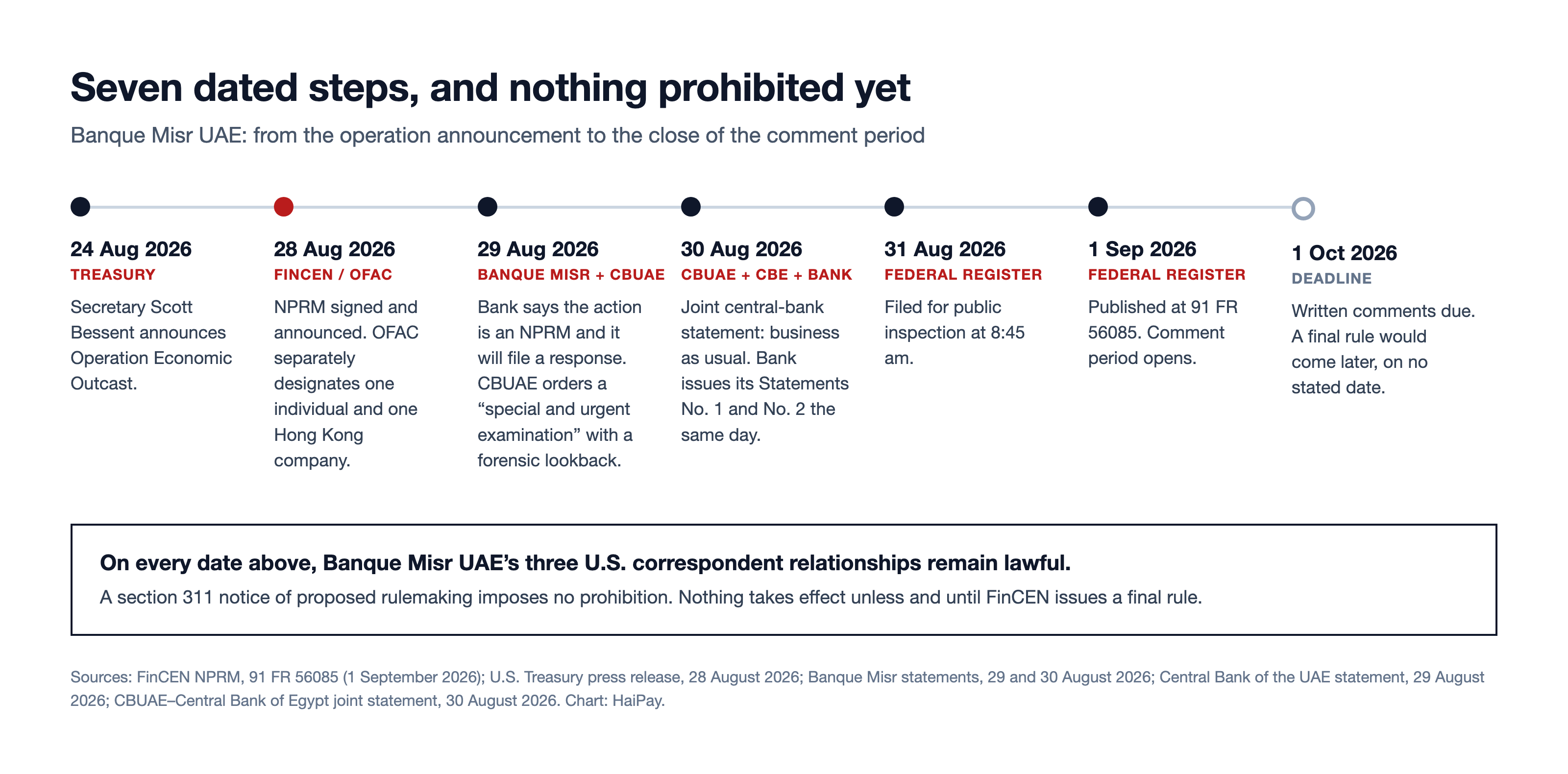
On 28 August the U.S. Treasury said it was moving to revoke Banque Misr UAE's access to American correspondent banking. Four days later the instrument that would do it reached the Federal Register, and it is a proposal. Nothing is prohibited yet — and in the meantime the bank and two central banks have already put their own statements on the record.

Key takeaways 6
- FinCEN proposed on 28 August 2026 to bar U.S. banks from holding correspondent accounts for the five UAE branches of Banque Misr.
- The notice is a proposal, not a prohibition. Comments close on 1 October 2026 and no final rule has been issued.
- FinCEN says 103 potential Iranian front companies moved about USD 1.8 billion through the bank from January 2024 to June 2026.
- Three of the 103 are named. Their transactions total more than USD 62 million, about 3.4 per cent of the USD 1.8 billion.
- The finding covers only the UAE branches. Banque Misr's Egyptian and other overseas operations are expressly excluded.
- Banque Misr called the action a proposal on 29 August; the UAE central bank ordered an urgent forensic lookback the same day.
On 28 August the U.S. Treasury said it was moving to revoke Banque Misr UAE's access to American correspondent banking. Four days later the instrument that would do it reached the Federal Register, and it is a proposal. Nothing is prohibited yet.
The gap between the announcement and the instrument is where the useful detail sits. It is also where the numbers are: a count of 103, a total of USD 1.8 billion, and three names.
What the proposal would actually require
FinCEN issued a notice of proposed rulemaking under section 311 of the USA PATRIOT Act, published on 1 September at 91 FR 56085. It finds the five UAE branches of Banque Misr — Egypt's state-owned commercial bank — to be a financial institution operating outside the United States of primary money laundering concern, and proposes the fifth of the five special measures the statute allows.
Three obligations would follow if it is finalised. Covered U.S. financial institutions could not open or maintain a correspondent account for Banque Misr UAE. They would have to take reasonable steps not to process a transaction involving it through a foreign bank's U.S. correspondent account. And they would have to apply special due diligence to their foreign correspondent accounts, including written notice to any correspondent they know or have reason to believe provides services to the bank.
None of it is in force. The notice sets no effective date, only a comment deadline of 1 October, and FinCEN asked for 30 days rather than a longer period on the ground that a longer one would prolong the national-security risk. A section 311 finding is also not an OFAC designation: no property is blocked, the bank is not added to the Specially Designated Nationals list, and business in other currencies with non-U.S. counterparties is untouched so long as no covered institution is involved. The same Treasury announcement did carry OFAC designations — of Bank Melli's Dubai branch manager and a Hong Kong trading company — but those are separate instruments against separate parties.
The bank reaches the dollar through three direct correspondent relationships with U.S. financial institutions. FinCEN says so in the notice, and gives that as the reason special measure five was chosen over the four lighter ones: an information-collection requirement does not help when the reported originator is itself a front company.
103 companies, and three names
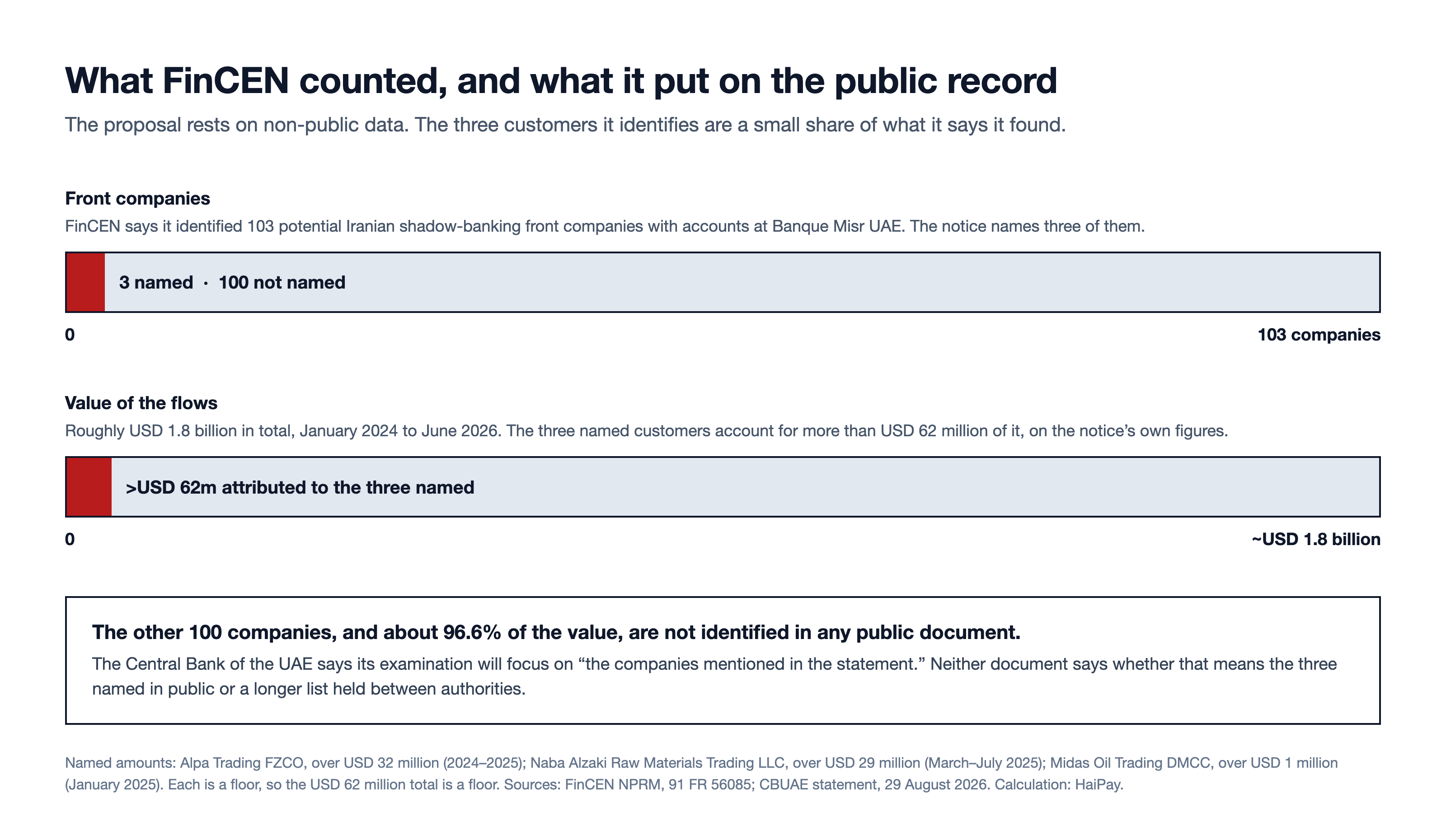
The evidentiary core is a count. FinCEN says it identified 103 potential Iranian shadow-banking front companies transacting approximately USD 1.8 billion using accounts with Banque Misr UAE between January 2024 and June 2026, including approximately USD 520 million over the most recent 12 months.
Three of the 103 are identified: Alpa Trading FZCO, over USD 32 million between 2024 and 2025; Naba Alzaki Raw Materials Trading LLC, over USD 29 million between March and July 2025; and Midas Oil Trading DMCC, over USD 1 million in January 2025. Each figure is stated as "over", so the named total is a floor of more than USD 62 million — roughly 3.4 per cent of the USD 1.8 billion. The other 100 companies are not identified in any public document, and FinCEN says its analysis rests on "public and non-public information" that it does not publish.
That is ordinary for section 311 and is not a defect. It does define what a comment period can achieve. The bank, its three correspondents and its customers can read the conclusion; they cannot read the data behind it, which makes the 30 days a window for arguing about the remedy rather than the finding.
Scale gives the count some context. FinCEN puts the branches at roughly USD 6 billion in assets, converting from their audited 2025 financial statements, and says the ratio of potential Iranian shadow banking to assets was concerningly high given the size of the institution. That comparison sets a 30-month flow against a point-in-time stock, so it does not mean a third of the balance sheet was Iranian money. It is a rough measure of how large the flagged activity is relative to the bank carrying it.
The scope line that keeps getting dropped
The proposed rule text applies to "all five branches of Banque Misr located in the United Arab Emirates" and to any other Banque Misr office, affiliate or subsidiary in the UAE. It then excludes, expressly, Egypt-based Banque Misr and its operations in every other country.
Banque Misr UAE is one of 63 banks on the Central Bank of the UAE's register as of July 2026, on the notice's own count. Those five branches are not abstract. The bank's own audited statements place two in Dubai, one in Deira and one in Business Bay, with one each in Abu Dhabi, Sharjah and Ras Al Khaimah, and a regional office in Bay Gate Tower, Business Bay. The UAE operation began in 1972 as Banque Du Caire and was acquired by Banque Misr in July 2007.
Banque Misr is wholly owned by the Egyptian government, which is why the action has been read in places as sanctions on an Egyptian state bank. On the face of the instrument, neither half of that reading holds yet. It is a proposal, and its scope stops at the UAE border.
Everyone on the record says the same thing
The bank got there early. On 29 August, Banque Misr issued a clarification stating that "what has been announced constitutes a Notice of Proposed Rulemaking (NPRM), which is subject to a formal period for receiving and reviewing comments before any final rule is issued". It said it would submit a response within the specified period, and that the action does not extend to its operations in Egypt or any other country.
One sentence in that statement is easy to skim past. The bank said it "will communicate with the U.S. Department of the Treasury to obtain further information". A bank named in a section 311 notice does not hold the file either; it is asking to see what the count is built on, in the same 30 days in which it is expected to respond.
The Central Bank of the UAE followed the same day with a harder message. It said it had decided to conduct "a special and urgent examination" of the branches, including "a forensic/in-depth lookback covering the period referred to in the statement issued by the U.S. authorities, with a focus on banking transactions of the companies mentioned in the statement". It added that it is "currently studying the available options regarding the status of the bank" if the measure is imposed, and reminded licensed banks generally not to expose the UAE financial system to reputational risk.
Then, on 30 August, the CBUAE and the Central Bank of Egypt issued a joint statement saying the UAE branches are "conducting all their business as usual". Banque Misr republished it as its own Statement No. 1 and added a Statement No. 2 the same evening, saying the branches "are operating normally".
Read together, four documents from three institutions in two days say the branches are trading, the books are being re-examined, and no one has decided what happens if Washington finalises the rule. The supervisor's lookback is also scoped to "the companies mentioned in the statement". The public U.S. documents mention three. Whether the CBUAE means those three or a longer list held between authorities is not stated in either document.
What we could not verify, and what to watch
This piece describes an instrument, not a compliance position. Whether any particular payment, account or counterparty is affected is a question for the rule text and legal advice, not for a news summary.
Three things are missing from the public record and could not be closed. The identities of the other 100 companies. The non-public data underlying the count. And which three U.S. banks hold the correspondent relationships.
One number could not be re-derived at source. FinCEN's footnote cites the branches' assets as "AED 23,397,322" without a units multiplier, and its own conversion at 0.27 only reaches "around USD 6 billion" if that figure is read in thousands. The published financial statements are presented in AED'000 throughout, which is consistent with that reading, but the balance-sheet page of the PDF carries no extractable text layer, so the total-assets line itself was not independently re-read.
Three dated things are worth watching. Whether the response Banque Misr says it will file appears on docket FINCEN-2026-0232 before 1 October, and whether it is posted publicly. Whether the three U.S. correspondents close the accounts before they are required to, which is how de-risking normally runs and would show up in the branches' next financial statements rather than in any announcement. And what the CBUAE decides. It has said it is studying its options. It has not said what they are.
Data highlight
103 front companies
Potential Iranian shadow-banking front companies FinCEN identified transacting through accounts at Banque Misr UAE
January 2024 to June 2026
Read the methodology and limitations
“Treasury promised to sever every economic lifeline Tehran has left and finally end the threat of the Iranian regime.”
Methodology and limitations
Count and value taken from the text of the notice of proposed rulemaking published at 91 FR 56085 on 1 September 2026 (FR Doc. 2026-17871, RIN 1506-AB76, docket FINCEN-2026-0232), signed 28 August 2026 and filed for public inspection on 31 August 2026 at 8:45 am.
FinCEN states that it identified 103 potential Iranian shadow banking front companies transacting approximately USD 1.8 billion using accounts with Banque Misr UAE from January 2024 to June 2026, including approximately USD 520 million over the most recent 12-month period, and that the analysis rests on public and non-public information which is not published.
Of the 103, the notice identifies three by name with individual amounts: Alpa Trading FZCO, over USD 32 million between 2024 and 2025; Naba Alzaki Raw Materials Trading LLC, over USD 29 million between March and July 2025; and Midas Oil Trading DMCC, over USD 1 million in January 2025.
HaiPay summed those three figures to more than USD 62 million and expressed it as approximately 3.4 per cent of the USD 1.8 billion; because each component is stated as "over", the sum is a floor and the percentage is a lower bound. HaiPay did not obtain the underlying transaction data, the identities of the other 100 companies, or the names of the three U.S. correspondent banks, none of which appear in any public document reviewed on 2 September 2026.
Term definition
- Correspondent account
- An account one bank holds for another so the second bank can make payments in a currency or market where it has no direct presence. For a bank outside the United States, a U.S. correspondent account is usually the only practical route to settle in dollars. Closing that route does not freeze the bank's assets or stop it trading in other currencies; it removes its access to one settlement system.
- Primary money laundering concern
- A formal finding under section 311 of the USA PATRIOT Act, codified at 31 U.S.C. 5318A, that reasonable grounds exist for concluding that a jurisdiction, a financial institution, a class of transactions or a type of account outside the United States poses money laundering risk. The finding is the legal predicate for imposing special measures; on its own it imposes no obligation on anyone.
- Special measure five
- The strongest of the five special measures available under section 311: a prohibition on, or conditions upon, opening or maintaining a correspondent or payable-through account in the United States that involves the institution found to be of primary money laundering concern. Measures one to four impose recordkeeping and reporting duties instead. Special measure five is not an OFAC designation and blocks no property.
10 sources
- Office of the Federal Register
- U.S. Government Publishing Office
Proposal of Special Measure Regarding Banque Misr UAE, full text PDF
- U.S. Department of the Treasury
Iran's Access to UAE Banks Targeted Under Operation Economic Outcast
- Financial Crimes Enforcement Network
- Office of Foreign Assets Control
Iran-related and Counter Terrorism Designations, 28 August 2026
- Central Bank of the UAE
Statement regarding Branches of Banque Misr operating in the UAE
- Central Bank of the UAE
Joint statement by The Central Bank of the UAE and the Central Bank of Egypt
- Banque Misr
Banque Misr Clarifies the Position of Its UAE Branch Regarding the U.S. Regulatory Action
- Banque Misr
Statement No. 2 regarding Banque Misr branches in the United Arab Emirates
- Banque Misr
Banque Misr – United Arab Emirates Branches, Financial statements for year ended 31 December 2025
How to cite
HaiPay News, "103 Front Companies at Banque Misr UAE. Three Are Named.", https://www.haipay.net/news/banque-misr-uae-103-companies-three-named, 2 September 2026