NewsRegulation
Seven Banks Merged Away. SEPA Still Lists Them as Live.
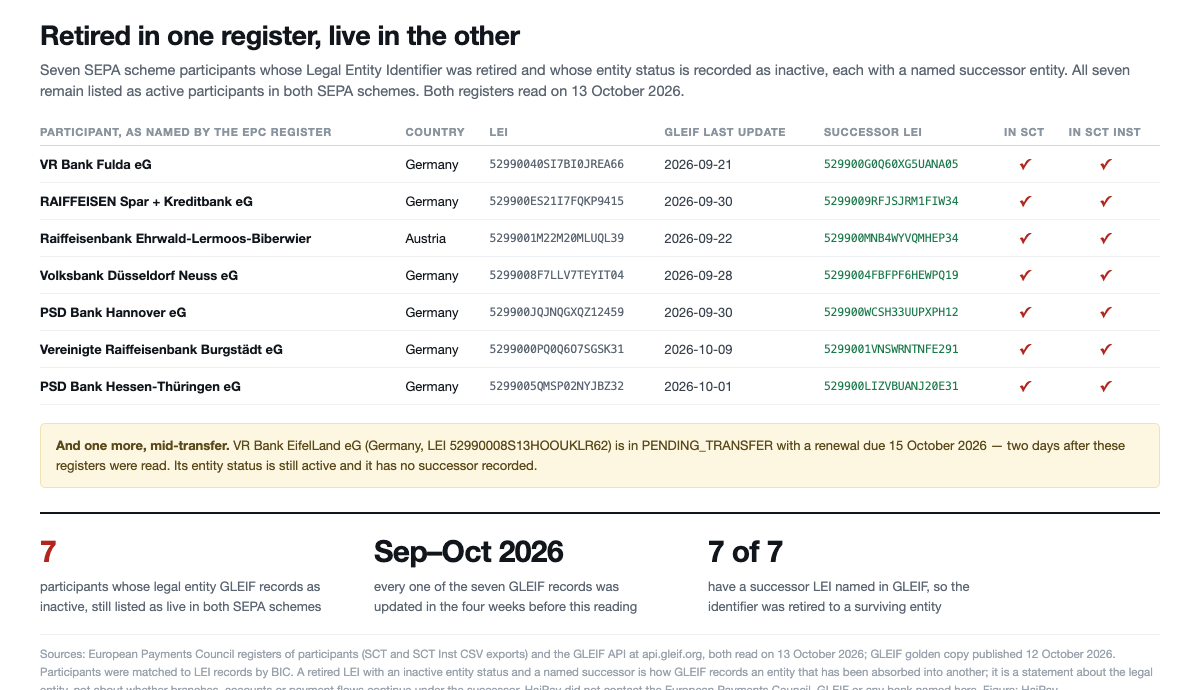
VR Bank Fulda eG, PSD Bank Hannover eG, Volksbank Düsseldorf Neuss eG and four others have had their Legal Entity Identifiers retired. In each case the global register that issues those identifiers now records the entity as inactive and names the entity that absorbed it, and in each case that record was last updated within the past four weeks.
Key takeaways 6
- Seven SEPA participants hold LEIs that GLEIF has retired, with the entity marked inactive and a successor named.
- All seven were updated in GLEIF between 21 September and 9 October 2026, and all seven remain live in both SEPA schemes.
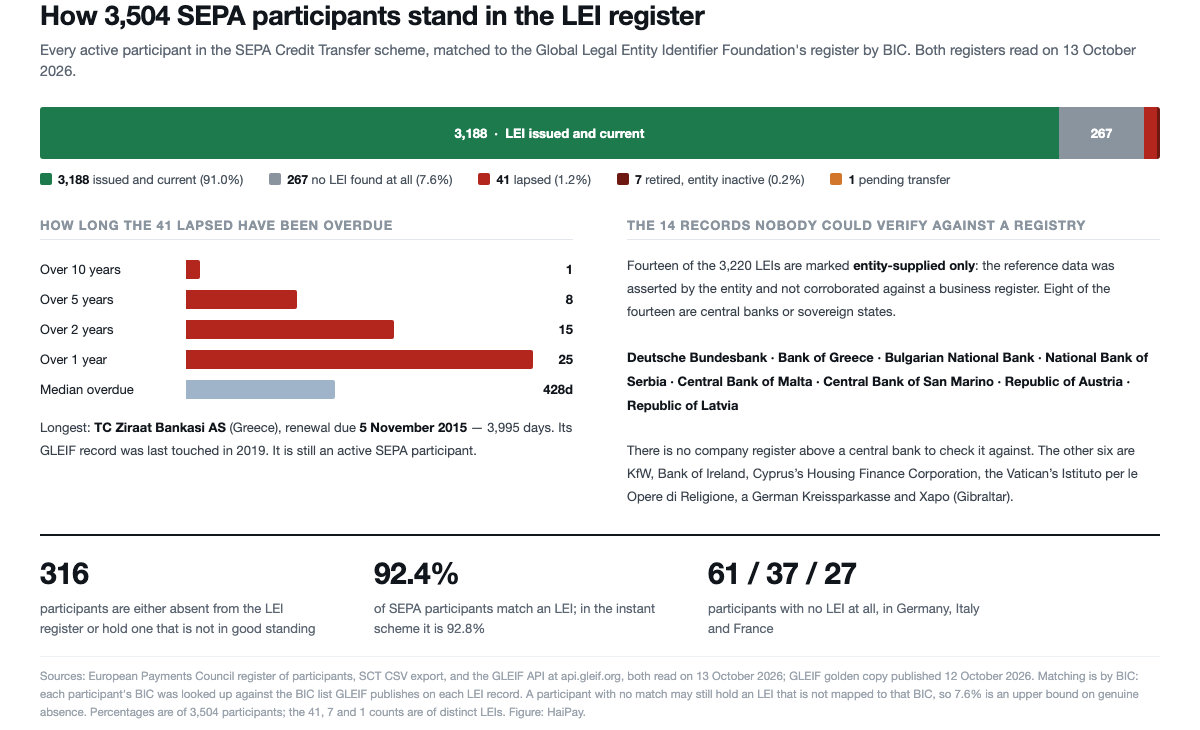
- Of 3,504 SEPA credit transfer participants, 3,237 resolve to an LEI (92.4%); 267 resolve to none at all.
- 41 of the 3,220 matched LEIs are lapsed; the median is 428 days overdue and the longest is 3,995 days.
- The longest lapse, TC Ziraat Bankasi AS in Greece, had a renewal due on 5 November 2015 and is still a SEPA participant.
- 14 LEIs are entity-supplied only; eight of those are central banks or sovereign states, which have no registry above them.
VR Bank Fulda eG, PSD Bank Hannover eG, Volksbank Düsseldorf Neuss eG and four others have had their Legal Entity Identifiers retired. In each case the global register that issues those identifiers now records the entity as inactive and names the entity that absorbed it, and in each case that record was last updated within the past four weeks.
All seven are still listed as live participants in SEPA Credit Transfer and SEPA Instant, under their own names and their own BICs.
Two registers, one join
The European Payments Council publishes the full membership of each SEPA scheme as a downloadable file, with a BIC for every participant. The Global Legal Entity Identifier Foundation publishes the world's LEI register, 3,459,313 records, and maps each one to the BICs it covers.
Join the two on BIC and you can ask a question neither body answers on its own: of the institutions Europe lists as able to move euros, how many are in good standing in the register that is supposed to say who they legally are?
Of 3,504 active credit transfer participants, 3,237 resolve to an LEI — 92.4%. Those resolve to 3,220 distinct identifiers, because one LEI can carry dozens of BICs. On the instant side the match rate is 92.8%.
Among the 3,220: 3,171 are issued and current, 41 are lapsed, 7 are retired, and one is mid-transfer between the organisations that maintain it.
The seven
A retired LEI with an inactive entity status and a named successor is how GLEIF records a legal entity that has been absorbed into another. All seven of these carry exactly one successor.
Six are German cooperative or PSD banks and one is Austrian. Their GLEIF records were updated between 21 September and 9 October 2026 — every one of them inside the four weeks before these registers were read.
And every one of the seven is listed as an active participant in both SEPA schemes, not just the credit transfer one.
There is an eighth worth noting. VR Bank EifelLand eG is in pending transfer, with its entity status still active, no successor recorded and a renewal falling due on 15 October 2026 — two days after this reading.
Eleven years overdue, still listed
Forty-one of the LEIs attached to SEPA participants are lapsed, meaning the holder has not revalidated its reference data by the renewal date. Twenty-seven of those also attach to instant scheme participants.
The median is 428 days past due. Twenty-five are more than a year overdue, fifteen more than two years, eight more than five.
The longest is TC Ziraat Bankasi AS, registered in Greece. Its renewal fell due on 5 November 2015. That is 3,995 days ago. The record was last touched in October 2019. The entity is active and so is its SEPA membership.
A lapse is not a failure. It means nobody has confirmed, to the body whose job is confirming it, that the name, address and legal form on file are still correct.
The fourteen nobody could check
GLEIF marks each record with how far its data was corroborated. Across the 3,220, 3,175 are fully corroborated against a business register, 31 partially, and 14 are entity-supplied only — the entity said so and nothing independent confirmed it.
Eight of those fourteen are central banks or sovereign states: the Bundesbank, the Bank of Greece, the Bulgarian National Bank, the National Bank of Serbia, the central banks of Malta and San Marino, the Republic of Austria and the Republic of Latvia.
This is not a lapse in diligence. There is no company register above a central bank to check it against. It is a reminder that the identifier system assumes a registry underneath every entity, and at the top of each country there is not one.
Why this matters
The LEI is not decoration. It travels in ISO 20022 payment messages, it is required in a widening set of European and American reporting regimes, and screening and onboarding systems use it to tell one legal entity from another.
So the question a payments operator should ask of this data is narrow. If a counterparty's BIC is still live in the scheme register but its LEI has been retired to a successor, which identifier does your system treat as authoritative, and what happens in the four weeks before the scheme register catches up?
On the dates the records carry, the gap these seven sit in is at most four weeks old. It may well close next month. The point is that it exists at all, and that it is visible to anyone willing to join two free files.
What this is not
A retired LEI is a statement about a legal entity, not about operations. Branches, accounts and payment flows normally continue under the successor. Nothing here says a payment failed, a customer was affected or any institution did anything wrong, and HaiPay is not alleging that.
A BIC that resolves to no LEI is not proof the institution has none. It may hold one that is simply not mapped to that BIC. HaiPay did not attempt name matching, so the 7.6% with no match is an upper bound on genuine absence, not a measurement of it.
Lapse periods are computed against 13 October 2026 from the renewal date each record carries. They are the age of the overdue renewal, not a measure of how wrong the underlying data is.
Both registers are amended continuously. These are the figures in the files read on 13 October 2026, against a GLEIF golden copy published the day before.
HaiPay did not contact the European Payments Council, GLEIF or any institution named here.
What to watch
Whether the seven drop out of the EPC register, and how long it takes. That lag is the only part of this that can be measured repeatedly, and it is measurable by anyone, monthly, for free.
Whether VR Bank EifelLand's renewal clears on 15 October. A pending transfer that does not complete becomes a lapse.
And whether the 267 unmatched participants shrink. As the LEI becomes mandatory in more payment and reporting flows, the share of Europe's scheme members that cannot be resolved to a legal identity is the number worth tracking — and today it is roughly one in thirteen.
Data highlight
7 participants
SEPA scheme participants whose Legal Entity Identifier is retired with the entity recorded inactive and a successor named, while they remain listed as active in both SEPA schemes
Both registers read 13 October 2026
Read the methodology and limitations
Methodology and limitations
Compiled by HaiPay on 13 October 2026 by joining two public registers. The first is the European Payments Council's register of participants, retrieved as CSV exports for the SEPA Credit Transfer and SEPA Instant Credit Transfer schemes; a participant counts as active when its Scheme Leaving Date is blank or later than 13 October 2026, which gives 3,504 and 2,817 participants respectively.
The second is the Global Legal Entity Identifier Foundation's register, queried through api.gleif.org, whose golden copy at the time of reading was published on 12 October 2026 and contained 3,459,313 LEI records. HaiPay took the 3,504 distinct BICs in the credit transfer register and looked each one up against the BIC list GLEIF publishes on every LEI record, in batches of sixty, resolving 3,237 of them, or 92.4 per cent, to 3,220 distinct LEIs; one LEI can carry many BICs, which is why the two counts differ.
267 BICs resolved to nothing. That 7.6 per cent is an upper bound on genuine absence rather than a measurement of it: an entity may hold an LEI that is simply not mapped to the BIC the EPC register lists, and HaiPay did not attempt name matching to close the gap. On the instant side, 2,614 of 2,817 participants resolved, or 92.8 per cent. Registration status across the 3,220 distinct LEIs is 3,171 ISSUED, 41 LAPSED, 7 RETIRED and 1 PENDING_TRANSFER; by BIC it is 3,188, 41, 7 and 1.
Entity status is ACTIVE on 3,213 and INACTIVE on 7, and those 7 are the same 7 whose registration is RETIRED. HaiPay then queried each of those eight records individually for full detail.
All seven retired records carry exactly one successor entity, which is how GLEIF records an entity absorbed into another, and all seven were last updated between 21 September and 9 October 2026: VR Bank Fulda eG (52990040SI7BI0JREA66, updated 21 September, successor 529900G0Q60XG5UANA05), Raiffeisenbank Ehrwald-Lermoos-Biberwier (5299001M22M20MLUQL39, 22 September, successor 529900MNB4WYVQMHEP34), Volksbank Düsseldorf Neuss eG (5299008F7LLV7TEYIT04, 28 September, successor 5299004FBFPF6HEWPQ19), RAIFFEISEN Spar + Kreditbank eG (529900ES21I7FQKP9415, 30 September, successor 5299009RFJSJRM1FIW34), PSD Bank Hannover eG (529900JQJNQGXQZ12459, 30 September, successor 529900WCSH33UUPXPH12), PSD Bank Hessen-Thüringen eG (5299005QMSP02NYJBZ32, 1 October, successor 529900LIZVBUANJ20E31) and Vereinigte Raiffeisenbank Burgstädt eG (5299000PQ0Q6O7SGSK31, 9 October, successor 5299001VNSWRNTNFE291).
Six are German and one Austrian; all seven appear in both the credit transfer and the instant register as active participants under their own names and BICs. The eighth, VR Bank EifelLand eG (52990008S13HOOUKLR62), is in PENDING_TRANSFER with its entity status still active, no successor recorded and a renewal due on 15 October 2026, two days after this reading.
Of the 41 lapsed LEIs, the renewal overdue period computed by HaiPay against 13 October 2026 has a median of 428 days and a maximum of 3,995 days; 25 are more than a year overdue, 15 more than two years, 8 more than five and 1 more than ten.
The longest is TC Ziraat Bankasi AS, registered in Greece, LEI 2138007EX5VCR4QPB730, whose renewal fell due on 5 November 2015 and whose record was last updated on 23 October 2019; its entity status is active and it remains an active SEPA participant. 27 of the 41 lapsed LEIs attach to participants in the instant scheme as well.
Corroboration level across the 3,220 LEIs is FULLY_CORROBORATED on 3,175, PARTIALLY_CORROBORATED on 31 and ENTITY_SUPPLIED_ONLY on 14, the last meaning the reference data was asserted by the entity and not checked against a business register; eight of those fourteen are central banks or sovereign states (Deutsche Bundesbank, Bank of Greece, the Bulgarian National Bank, the National Bank of Serbia, the Central Bank of Malta, the Central Bank of San Marino, the Republic of Austria and the Republic of Latvia) and the other six are KfW, the Bank of Ireland, Cyprus's Housing Finance Corporation, the Vatican's Istituto per le Opere di Religione, a German Kreissparkasse and Xapo (Gibraltar) Limited.
Participants with no LEI match concentrate in Germany (61), Italy (37), France (27), the United Kingdom (18) and Austria (15). Country-level match rates range from 96.3 per cent in Norway and 96.1 per cent in Austria down to 81.8 per cent in the United Kingdom and 82.5 per cent in Malta. Every count, share, median and overdue period here is HaiPay's arithmetic on the two registers; neither body publishes any of them. Two limits apply.
A retired LEI with an inactive entity status and a named successor is a statement about a legal entity, not about whether branches, accounts or payment flows continue under the successor, and this article makes no claim that any payment failed or that any customer was affected. And a BIC that resolves to no LEI is not proof that the institution has none. Both registers are amended continuously and these figures are a single snapshot. HaiPay did not contact the European Payments Council, GLEIF or any institution named here.
Term definition
- Legal Entity Identifier
- A 20-character code identifying a party to a financial transaction. It travels in ISO 20022 payment messages and must be revalidated annually; 3,220 of them cover Europe's SEPA scheme participants.
- Retired LEI
- The status GLEIF applies when a legal entity ceases to exist in its own right, normally through a merger. The record names a successor entity. Seven SEPA participants currently carry one.
- Lapsed LEI
- An identifier whose holder has not revalidated its reference data by the renewal date. The code still resolves; nobody has confirmed the details behind it. Forty-one attach to SEPA participants, one of them 3,995 days overdue.
5 sources
- Global Legal Entity Identifier Foundation
- Global Legal Entity Identifier Foundation
- Global Legal Entity Identifier Foundation
- European Payments Council
- European Payments Council
Register of participants, SEPA Instant Credit Transfer scheme
How to cite
HaiPay News, "Seven Banks Merged Away. SEPA Still Lists Them as Live.", https://www.haipay.net/news/sepa-participants-lei-status, 13 October 2026