NewsRegulation
Japan Licensed 85 Payment Firms. Its Stablecoin List Has 2.
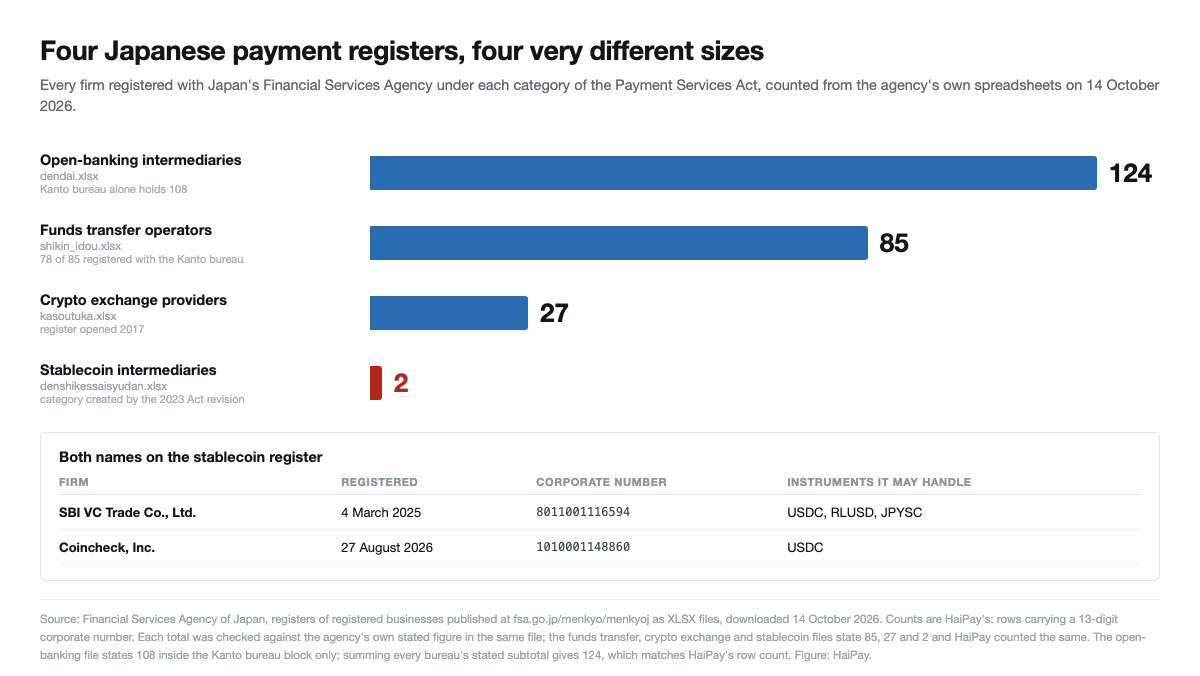
Japan has 124 firms registered to plug into bank accounts on a customer's behalf, 85 licensed to move money, and 27 licensed to run a crypto exchange.

Key takeaways 6
- Japan's register of stablecoin intermediaries has two names on it: SBI VC Trade and Coincheck.
- The same regulator lists 124 open-banking intermediaries, 85 funds transfer operators and 27 crypto exchanges.
- SBI VC Trade registered on 4 March 2025 for USDC, RLUSD and JPYSC; Coincheck on 27 August 2026 for USDC only.
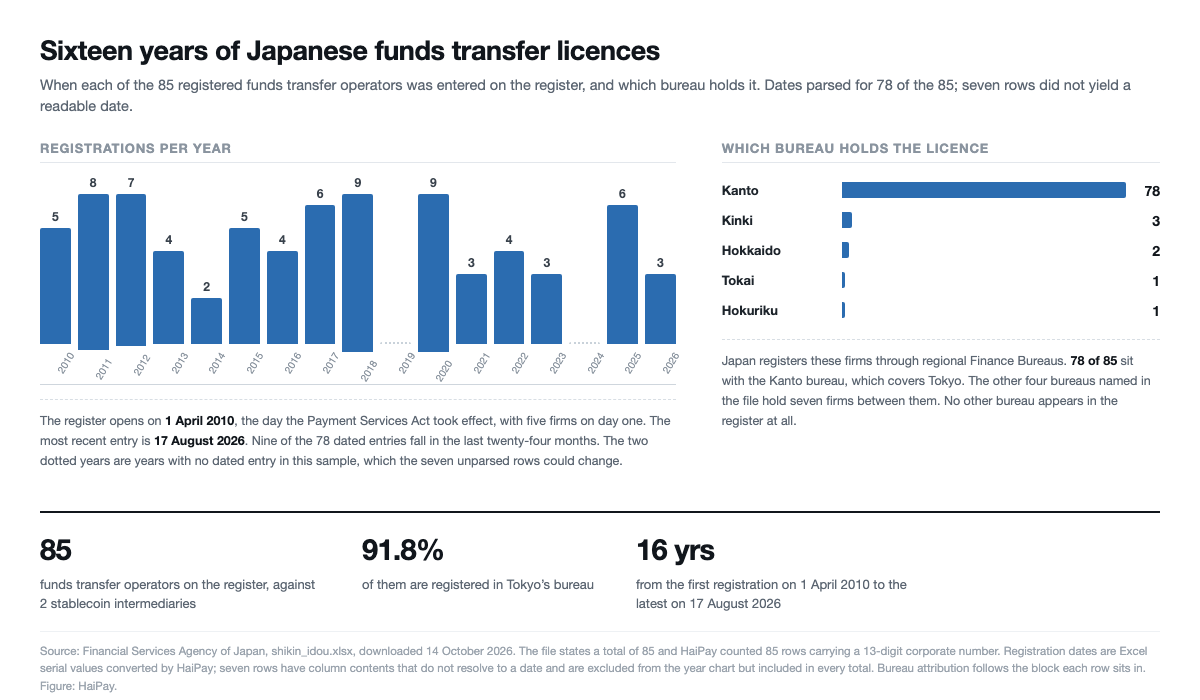
- 78 of the 85 funds transfer operators, or 91.8%, are registered with the Kanto bureau covering Tokyo.
- The funds transfer register opens on 1 April 2010 with five firms and runs to 17 August 2026.
- The FSA publishes every register as a spreadsheet as well as a PDF, so the whole list can be counted, not just read.
Japan has 124 firms registered to plug into bank accounts on a customer's behalf, 85 licensed to move money, and 27 licensed to run a crypto exchange.
It has two registered to handle stablecoins.
Four spreadsheets
The Financial Services Agency publishes each of its registers twice: once as a PDF and once as a spreadsheet. The spreadsheets hold the data as cells, which means the whole register can be counted rather than read.
Four of them cover payments. Funds transfer operators, the licence a remittance firm or a wallet needs. Electronic payment intermediaries, which is Japan's name for open banking. Crypto-asset exchange providers. And electronic payment instruments business operators — the category the 2023 revision of the Payment Services Act created for firms that intermediate stablecoins.
Counting the rows that carry a corporate number: 124, 85, 27 and 2.
The two
SBI VC Trade was registered on 4 March 2025. The file records it as able to handle USDC, RLUSD and JPYSC — a dollar stablecoin, a second dollar stablecoin and a yen one.
Coincheck was registered on 27 August 2026, seventeen months later. It is recorded for USDC alone.
That is the entire register. Japan wrote stablecoins into statute in 2023, built a bespoke licence for the firms that would distribute them, and three years on the list of holders fits in two lines.
It is worth being precise about what that does and does not mean. The register covers intermediaries — the firms that handle and distribute electronic payment instruments for others. Issuance sits under a separate regime. And a registration records permission, not activity: the instruments named are what each firm told the agency it may handle, not evidence that anyone is using them.
Everything is in Tokyo
Japan registers these firms through regional Finance Bureaus, and the register shows where each one sits.
Of the 85 funds transfer operators, 78 are with the Kanto bureau, which covers Tokyo. That is 91.8%. Kinki has three, Hokkaido two, Tokai one, Hokuriku one. No other bureau appears in the file at all.
The same pattern holds in the intermediaries register, where the Kanto bureau's subtotal of 108 is most of the national 124.
Sixteen years of licences
The funds transfer register opens on 1 April 2010, the day the Payment Services Act took effect, with five firms registered that day. The most recent entry is dated 17 August 2026.
Between those two dates the pace is uneven rather than rising. Eight firms in 2011, two in 2014, nine in 2018, nine again in 2020, three in 2021. Nine of the dated entries fall in the last twenty-four months.
Seven of the 85 rows do not yield a readable date, so the yearly figures cover 78 and the totals cover all 85. Two years, 2019 and 2024, show no dated entry in this sample; the seven unparsed rows could change that, and this article does not claim those years were empty.
Why this matters
Japan is the third-largest economy to have put stablecoins on a statutory footing, and it did so earlier than most. The usual way to assess how that is going is to read announcements. The register is the other way, and it is free, machine-readable and updated by the regulator itself.
For anyone deciding where to build, the four numbers together say something the announcements do not. The open-banking and funds transfer categories are mature and crowded; the stablecoin category is a licence that almost nobody has taken up yet. Whether that reads as an opening or as a warning depends on why the other 122 firms have not applied, and the register does not say.
It is also a reminder that the honest unit of measurement for a new regime is the register, not the law. Japan's stablecoin framework has existed for three years. Its register has two names on it.
What this is not
These are registers of registration, not of activity. A registered firm may be dormant, and the files record no volumes, no customers and no revenue.
The instrument names in the stablecoin register are what the registrants declared they may handle. They are not evidence that those instruments are circulating or that anyone has transacted in them.
HaiPay did not read the funds transfer register's service-tier columns. In the rows inspected they contain a mixture of circle marks and unrelated numeric values, and the file's merged headers do not resolve cleanly, so no breakdown by tier is reported here.
The registers are amended continuously. These are the figures in the files downloaded on 14 October 2026.
HaiPay did not contact the Financial Services Agency or any firm named here.
What to watch
Whether a third name appears. Seventeen months separated the first registration from the second. A third would be the first evidence of a trend rather than a pair.
Whether the yen stablecoin spreads. JPYSC sits on one firm's line today. If it appears on a second, the register will show it before any announcement does.
And whether anything leaves. These files carry no departure column, so a firm that gives up its registration simply stops appearing. Comparing two downloads a month apart is the only way to see it, and anyone can do that.
Data highlight
2 registrants
Firms on Japan's register of electronic payment instruments business operators, the registration created in 2023 for stablecoin intermediaries
Registers downloaded 14 October 2026
Read the methodology and limitations
Methodology and limitations
Compiled by HaiPay on 14 October 2026 from the Financial Services Agency of Japan, which publishes each of its registers of registered businesses at fsa.go.jp/menkyo/menkyoj as both a PDF and an XLSX file. HaiPay used the XLSX versions, which hold the data as cells; the PDF of the funds transfer register carries no extractable text layer.
Four registers were downloaded and parsed in full: funds transfer operators (shikin_idou.xlsx), electronic payment intermediary businesses (dendai.xlsx), crypto-asset exchange providers (kasoutuka.xlsx) and electronic payment instruments business operators (denshikessaisyudan.xlsx). Each file carries furigana ruby text inside the shared-string table, which HaiPay stripped before reading, and merged header cells that span two rows. A registrant was counted as a row carrying a 13-digit Japanese corporate number.
That gives 85 funds transfer operators, 124 electronic payment intermediaries, 27 crypto-asset exchange providers and 2 electronic payment instruments business operators. Three of those four counts match the agency's own stated total in the same file, which reads 85, 27 and 2 respectively. The fourth does not at first glance: the intermediaries file states 108, but that figure sits inside the Kanto bureau's block and is that bureau's subtotal, not the national one; summing every bureau's stated subtotal in that file gives 124, which equals HaiPay's row count.
The two registrants on the electronic payment instruments register are SBI VC Trade Co., Ltd. (corporate number 8011001116594, registered 4 March 2025, recorded as able to handle USDC, RLUSD and JPYSC) and Coincheck, Inc. (corporate number 1010001148860, registered 27 August 2026, recorded as able to handle USDC).
Registration dates are Excel serial values which HaiPay converted; for the funds transfer register 78 of the 85 rows yielded a readable date and seven did not, because of column misalignment in those rows, so the year distribution below covers 78 rows while every total covers all 85.
On that basis the dated registrations are 5 in 2010, 8 in 2011, 7 in 2012, 4 in 2013, 2 in 2014, 5 in 2015, 4 in 2016, 6 in 2017, 9 in 2018, none in 2019, 9 in 2020, 3 in 2021, 4 in 2022, 3 in 2023, none in 2024, 6 in 2025 and 3 so far in 2026; the two empty years are empty in this sample and the seven unparsed rows could change them.
The earliest date is 1 April 2010 and the latest 17 August 2026, and 9 of the 78 fall in the twenty-four months to 14 October 2026. By bureau the 85 funds transfer operators split 78 Kanto, 3 Kinki, 2 Hokkaido, 1 Tokai and 1 Hokuriku, which is 91.8 per cent with the Kanto bureau; no other bureau appears.
HaiPay did not attempt to read the funds transfer register's service-tier columns: in the rows inspected those columns contain a mixture of circle marks and unrelated numeric values, and the file's merged headers do not resolve cleanly, so no tier breakdown is reported here. Every count, share and date conversion is HaiPay's arithmetic on the agency's files; the agency publishes the totals quoted above and none of the derived figures. Three limits apply.
These are registers of registration, not of activity: a registered firm may be dormant and the files record no volumes, no customers and no revenue. The instrument names in the stablecoin register are what the registrants told the agency they may handle, not a statement that those instruments are in use. And the registers are amended continuously, so this is one reading taken on one day. HaiPay did not contact the Financial Services Agency or any firm named here.
Term definition
- Electronic payment instruments business operator
- Published by Japan's FSA as denshikessaisyudan.xlsx. The registration created by the 2023 revision of the Payment Services Act for firms that handle or distribute stablecoins for others. Issuance is regulated separately. Two firms hold it.
- Funds transfer operator
- Published by Japan's FSA as shikin_idou.xlsx. The registration a remittance company or wallet needs to move money in Japan without being a bank. The register opened on 1 April 2010 and holds 85 names.
- Finance Bureau
- The regional offices through which Japan registers these firms. The Kanto bureau, covering Tokyo, holds 78 of the 85 funds transfer registrations; four other bureaus hold the remaining seven.
5 sources
- Financial Services Agency
Register of electronic payment instruments business operators
- Financial Services Agency
- Financial Services Agency
- Financial Services Agency
- Financial Services Agency
How to cite
HaiPay News, "Japan Licensed 85 Payment Firms. Its Stablecoin List Has 2.", https://www.haipay.net/news/japan-fsa-payment-registers, 14 October 2026