208 Annual Reports Mentioned Stablecoins. Last Year: 61.
In 2024, thirty-five American annual reports used the word stablecoin. This year, 208 have.
October 10th, 2026
Last updated: October 10
Key takeaways
- A full-text search of SEC EDGAR returns 2,446 filings using the word stablecoin in 2026 so far, against 459 in 2024.
- Of the 1,955 filings in 2025, 1,381 came after the GENIUS Act was enacted on 18 July. That is 71% of the year.
- Annual reports using the word went 5, 23, 28, 35, 61, then 208. Most 10-Ks are filed between February and April.
- In 2024 the commonest form carrying the word was the S-1. In 2026 it is the mutual fund prospectus update.
- The heaviest filers this year include State Street, BlackRock, Goldman Sachs Trust, Dreyfus and Global X fund trusts.
- These are counts of filings, not of companies, and the search detects the word, not the company's position on it.
Data highlight
208filings
Form 10-K annual reports filed with the SEC in 2026 to 10 October that use the word stablecoin, against 61 in the whole of 2025
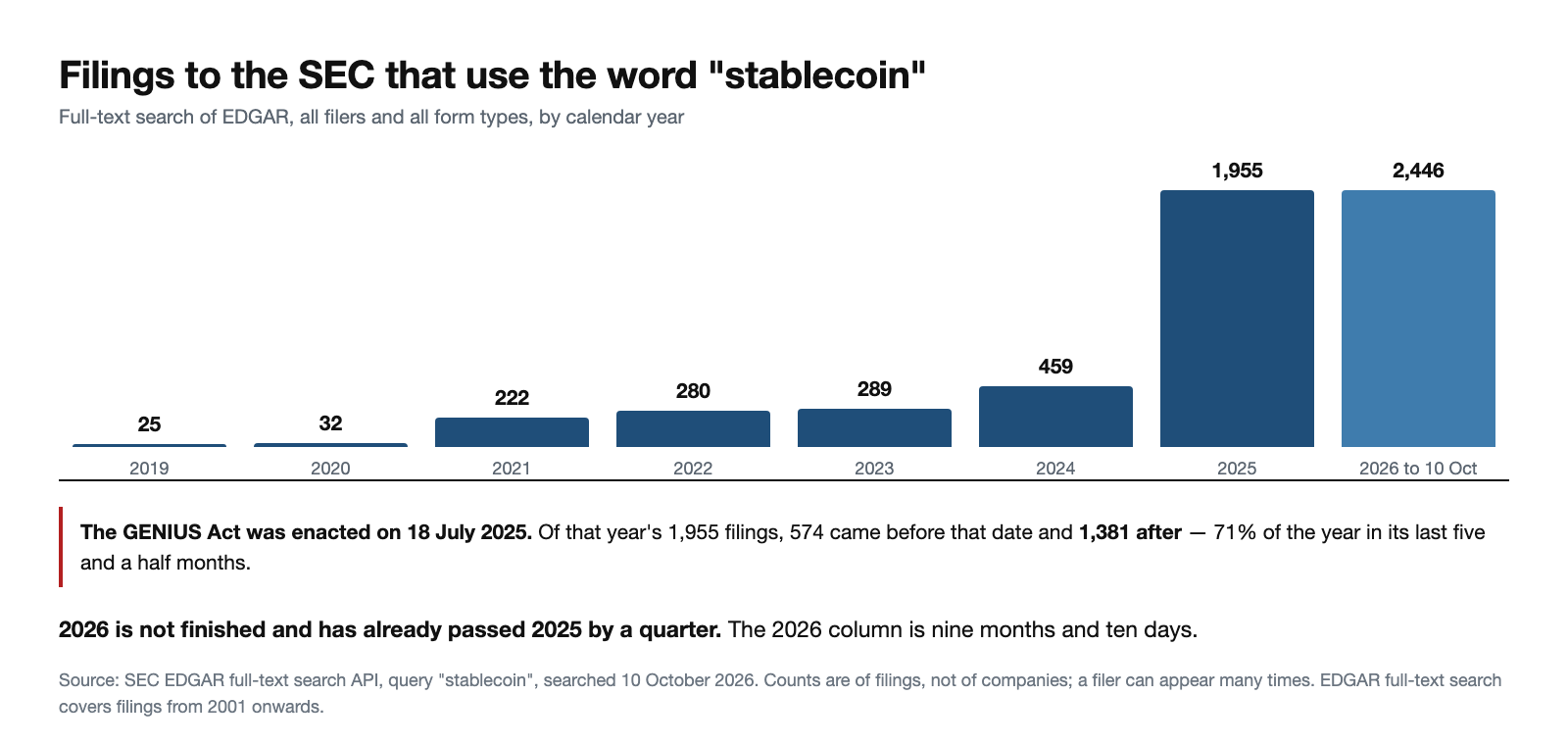
EDGAR filings by calendar year, 2019 to 10 October 2026
Compiled by HaiPay on 10 October 2026 from the US Securities and Exchange Commission's EDGAR full-text search service, queried through its public API at efts.sec.gov with a descriptive user agent. Every figure is a count of filings returned by that service for an exact-phrase query over a calendar-year date range, with no form-type restriction unless stated. For the query "stablecoin" the service returns 25 filings in 2019, 32 in 2020, 222 in 2021, 280 in 2022, 289 in 2023, 459 in 2024, 1,955 in 2025 and 2,446 for 1 January to 10 October 2026. Splitting 2025 at the enactment date of the GENIUS Act, 18 July 2025, gives 574 filings from 1 January to 17 July and 1,381 from 18 July to 31 December, which is 70.6 per cent of the year in the later period; the percentage is HaiPay's calculation. Restricting the same query to form 10-K gives 5 filings in 2021, 23 in 2022, 28 in 2023, 35 in 2024, 61 in 2025 and 208 in 2026 to 10 October; the ratio of 3.4 between 2025 and 2026 is HaiPay's calculation. For the exact statutory phrase "payment stablecoin" the service returns 52 filings in 2024, 132 in 2025 and 299 in 2026 to 10 October. The form-type figures come from the form_filter facet the service returns alongside each result set: for 2024 the largest were S-1 with 100, 424B3 with 43, 10-K with 35, 485APOS with 28, UPLOAD with 22, 10-Q with 21, CORRESP with 18 and 497K with 17; for 2026 to 10 October they were 485BPOS with 294, 8-K with 253, 10-K with 208, S-1 with 206, 6-K with 166, 10-Q with 146, 424B3 with 130 and 497K with 84. The named heavy filers in 2026, State Street Institutional Investment Trust, BlackRock Funds, Goldman Sachs Trust, Dreyfus, Global X Funds and Amplify ETF Trust, are taken from the entity_filter facet for that period. That facet is capped at thirty entities and reported 2,234 filings outside the thirty it names, so HaiPay cannot derive a count of distinct filers from it and does not report one. The descriptions of what each form type is are HaiPay's plain-language glosses of standard SEC form names. Several limits apply. The counts are of filings rather than of companies, so a fund family filing the same prospectus language across many share classes contributes many hits. The search detects the presence of a word, not a position, so a filing that mentions stablecoins only to disclaim exposure counts the same as one announcing an issuance. EDGAR full-text search covers filings from 2001 onwards, so there is no earlier series to compare against. The 2026 period is nine months and ten days and is compared against full calendar years, except for the 10-K series, where HaiPay notes that 10-K filings are concentrated between February and April and treats the 2026 figure as a substantially complete reporting season rather than a part-year; that characterisation is HaiPay's judgement, not a statement from the SEC. The source links given with this article are the EDGAR full-text search API endpoints HaiPay actually queried; www.sec.gov returns 403 to automated clients, so the human-facing search page and the SEC's own documentation pages could not be retrieved and are not cited. HaiPay did not read the filings behind any of these counts, offers no explanation for the level in any year beyond what the counts show, and did not contact the Securities and Exchange Commission or any filer.
In 2024, thirty-five American annual reports used the word stablecoin. This year, 208 have.
That is from a full-text search of every filing in the SEC's EDGAR system, run on 10 October. The same search across all form types returns 2,446 filings so far in 2026, against 1,955 in all of 2025 and 459 in 2024.
The shape of the curve
The series goes 25, 32, 222, 280, 289, 459, 1,955, and now 2,446 with two and a half months of the year left.
Two things stand out. The first is 2021, where the count jumps nearly sevenfold off a very small base, from 32 filings to 222. The search returns counts, not causes, and this article does not offer one.
The second is 2025. The GENIUS Act, the American law for dollar stablecoins, was enacted on 18 July that year. Of 2025's 1,955 filings, 574 came before that date and 1,381 after. Seventy-one per cent of the year's mentions landed in its last five and a half months.
It is not the same companies
A rising count could just mean crypto firms filing more. The form mix says otherwise.
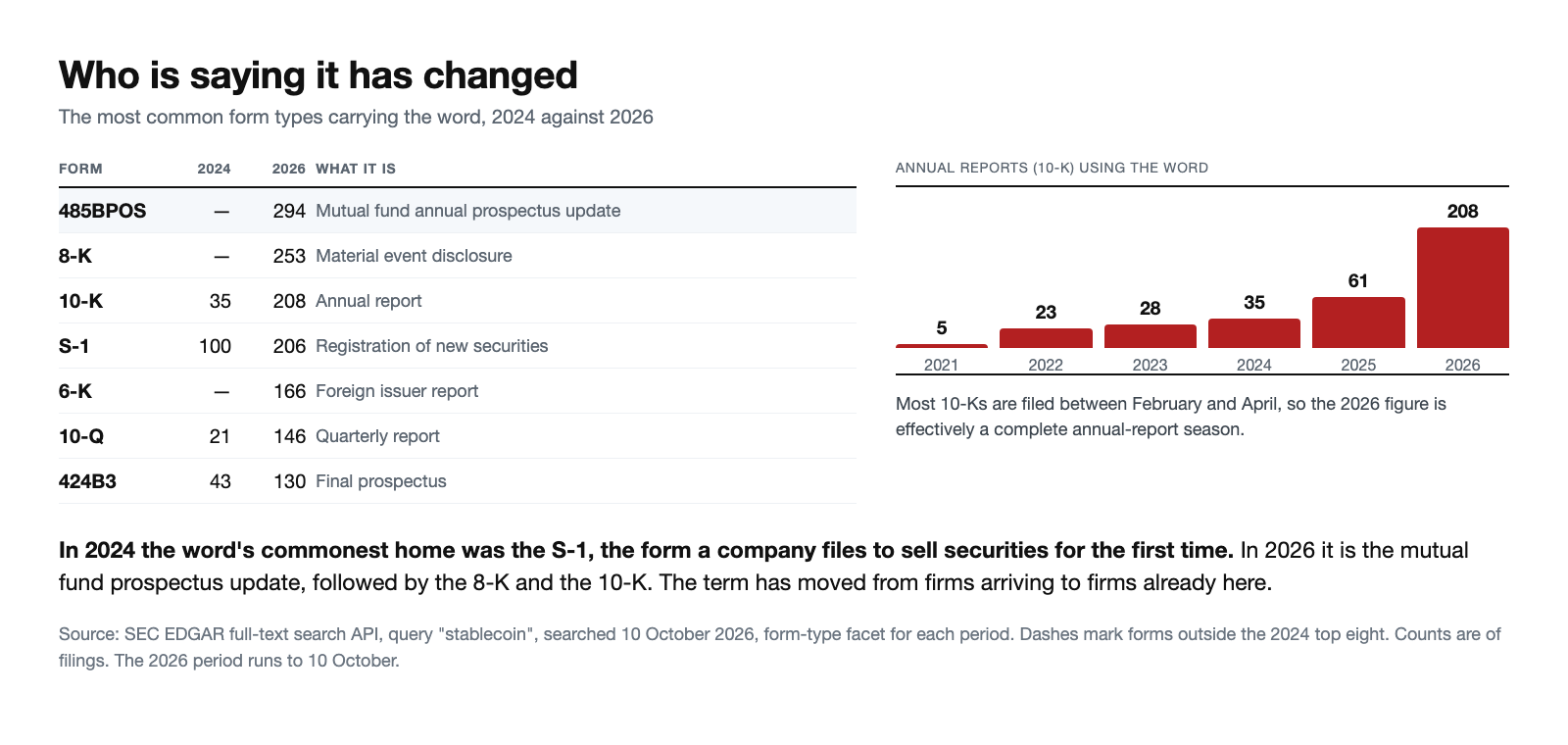
In 2024 the single most common form carrying the word was the S-1, the registration statement a company files to sell securities, with 100 filings. That is the paperwork of arrival: new issuers describing a new business.
In 2026 the most common form is the 485BPOS, with 294. That is the annual update to a mutual fund's prospectus. Behind it come the 8-K at 253, the 10-K at 208, the S-1 at 206, the foreign issuer's 6-K at 166 and the 10-Q at 146.
Among the heaviest individual filers this year are fund families: State Street Institutional Investment Trust, BlackRock Funds, Goldman Sachs Trust, Dreyfus, Global X, Amplify. These are not crypto companies describing a product. They are fund complexes adding a line to a risk section across dozens of share classes.
The annual report is the clearest signal
Form 10-K is the most conservative document a US public company produces, and the slowest to change. The series there is 5, 23, 28, 35, 61, 208 across 2021 to 2026.
Because 10-Ks are filed overwhelmingly between February and April, the 2026 figure is effectively a complete season rather than a part-year. On that basis the jump is 61 to 208, a multiple of 3.4 in one reporting cycle.
The statutory phrase moves the same way. Filings using the exact term "payment stablecoin", the one the GENIUS Act defines, number 52 in 2024, 132 in 2025 and 299 so far in 2026.
Why a payments team should care
Disclosure language is a leading indicator of procurement. A risk factor is written because a lawyer believes the company's own auditors, insurers or investors will ask about the thing. By the time a word is in 208 annual reports, the conversations behind it have already happened.
It also tells you who to sell to. The count is no longer concentrated in firms whose business is the coin. It is in fund complexes, in foreign issuers filing 6-Ks, and in the 8-Ks that announce deals. If you supply payment infrastructure, the relevant buyer is now a treasury or product team at an incumbent that has started writing the word down.
What this is not
This counts filings, not companies. A fund family that files the same prospectus language for forty share classes produces forty hits. The entity facet EDGAR returns is capped at thirty names, so HaiPay cannot report a distinct-filer count from it and does not.
It counts the presence of a word, not a position. A filing that mentions stablecoins to say the company has no exposure is counted the same as one announcing an issuance.
EDGAR full-text search covers filings from 2001 onward, so the series has no earlier history to compare against, and 2026 is a partial year against full years.
HaiPay did not read the 2,446 filings and offers no explanation for any year's level beyond what the counts themselves show.
HaiPay did not contact the SEC or any filer.
What to watch
Whether the 2027 annual-report season holds at the 2026 level or keeps climbing. The GENIUS Act applies from 18 January 2027, which lands inside the drafting window for most 10-Ks.
Whether the fund prospectuses stay the largest block. If they do, the word has finished its journey into boilerplate, which is usually where terms go to stop being news.
And whether "payment stablecoin", the statutory term, overtakes the generic one in the filings of operating companies. That would be the point at which American firms are describing a regulated instrument rather than a market.
How to cite
HaiPay News, "208 Annual Reports Mentioned Stablecoins. Last Year: 61.", https://www.haipay.net/news/stablecoin-in-sec-filings-61-to-208, October 10th, 2026
About the author
Crystal
Digital Public Relations
A digital PR specialist with a Master's in Journalism & Communication from UNSW. Started as an intern at ABC Australia, now leads public relations at Haipay, crafting press releases and media strategies that bring brand stories to life.
Reviewed by WeiJun TangEditorial policy
4 sources
- U.S. Securities and Exchange Commission
EDGAR full-text search API, query "stablecoin", 2026 year to date
- U.S. Securities and Exchange Commission
EDGAR full-text search API, query "payment stablecoin", 2026 year to date
- U.S. Securities and Exchange Commission
EDGAR full-text search API, query "stablecoin", all years
- United States Government Publishing Office
GENIUS Act, Public Law 119-27, as enacted