FinCEN Finishes a Case in 156 Days, or It Does Not Finish
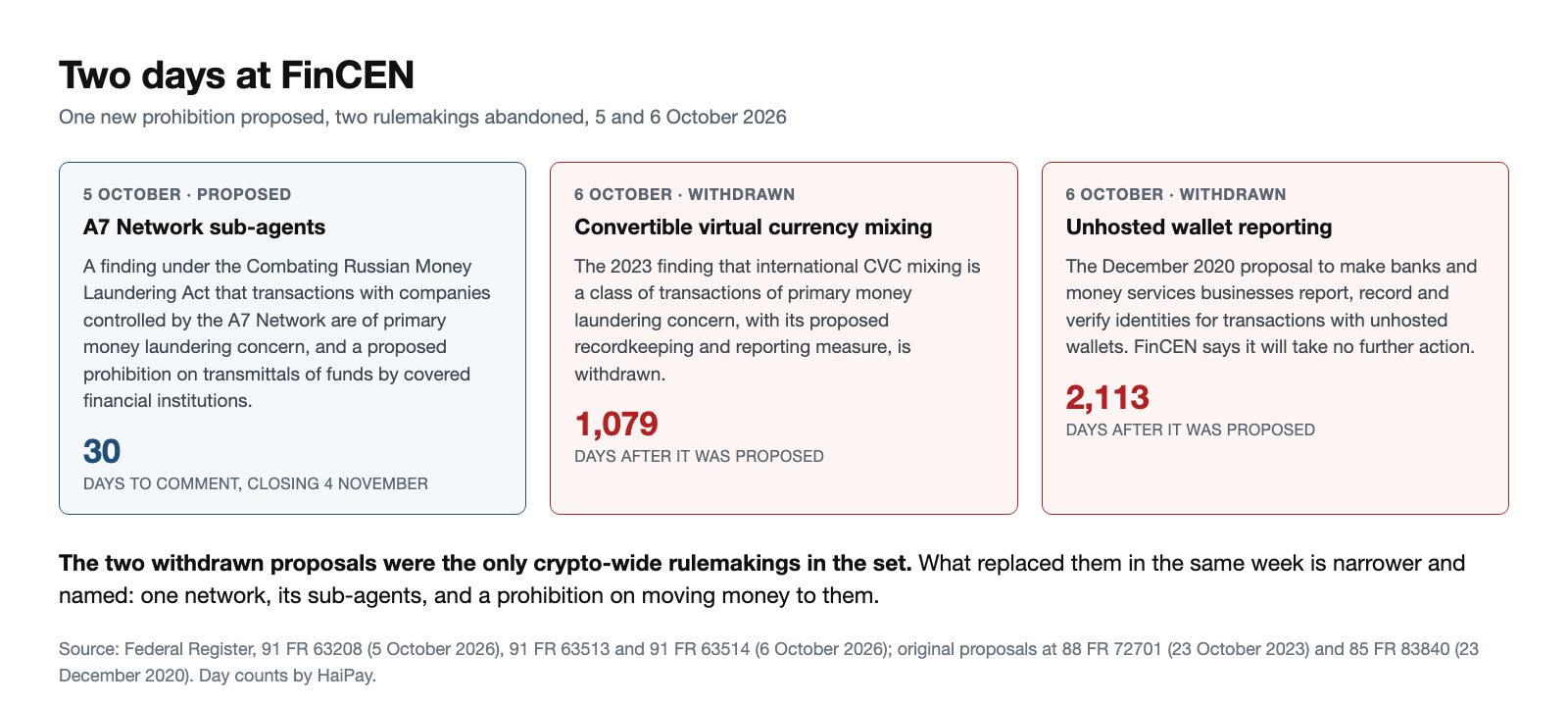
FinCEN did three things in two days. On 5 October it proposed banning American financial institutions from moving money to companies controlled by the A7 Network, a Russia-linked sanctions evasion service. On 6 October it abandoned two crypto rulemakings, one of which had been sitting open since December 2020.
October 9th, 2026
Last updated: October 9
Key takeaways
- HaiPay paired every FinCEN special-measure proposal since 2015 with the final rule or withdrawal that followed it.
- The four that became prohibitions took 124, 154, 159 and 164 days. The median is 156 and the whole range is six weeks.
- The three that were abandoned took 357, 1,079 and 2,415 days. Two of the four cases open today are already past 164.
- On 5 October FinCEN proposed barring transmittals of funds to companies controlled by the Russia-linked A7 Network.
- On 6 October it withdrew two crypto rulemakings, one open since 2023 and one since December 2020, with no replacement.
- Comment windows have halved: 60 days for proposals up to 2018, 30 days for every proposal since January 2024.
Data highlight
156days (median)
Median days from a FinCEN special-measure proposal to the final rule, across the four proposals since 2015 that were carried through to a prohibition
FinCEN rules and proposed rules published from 1 January 2015, counted 9 October 2026
Compiled by HaiPay on 9 October 2026 from the Federal Register. The dataset is every rule and proposed rule published by the Financial Crimes Enforcement Network since 1 January 2015, retrieved through the Federal Register API, which returns 104 documents; the special-measure documents were identified from their titles and from the ACTION line of each document. HaiPay then paired each notice of proposed rulemaking that names a target and proposes a special measure with the final rule or withdrawal covering the same target, and counted the days between publication dates. Four proposals were carried through to a final rule: North Korea, proposed 3 June 2016 at 81 FR 35665 and imposed 9 November 2016 at 81 FR 78715, 159 days; Bank of Dandong, proposed 7 July 2017 at 82 FR 31537 and imposed 8 November 2017 at 82 FR 51758, 124 days; Al-Huda Bank, proposed 31 January 2024 at 89 FR 6074 and imposed 3 July 2024 at 89 FR 55051, 154 days; and Huione Group, proposed 5 May 2025 at 90 FR 18934 and imposed 16 October 2025 at 90 FR 48295, 164 days. The median of those four is 156 days. Three were withdrawn: Banca Privada d'Andorra, proposed 13 March 2015 at 80 FR 13304 and withdrawn 4 March 2016 at 81 FR 11496, 357 days; convertible virtual currency mixing, proposed 23 October 2023 at 88 FR 72701 and withdrawn 6 October 2026 at 91 FR 63513, 1,079 days; and ABLV Bank, proposed 16 February 2018 at 83 FR 6986 and withdrawn 27 September 2024 at 89 FR 79184, 2,415 days. Four are open and counted to 9 October 2026: ten Mexican gambling establishments, proposed 17 November 2025 at 90 FR 51234, 326 days; MBaer Merchant Bank AG, proposed 2 March 2026 at 91 FR 10034, 221 days; Banque Misr UAE, proposed 1 September 2026 at 91 FR 56085, 38 days; and the A7 Network sub-agents, proposed 5 October 2026 at 91 FR 63208, 4 days. Comment windows were calculated as the days between publication and the comment closing date given by the Federal Register: 60 days for each of the four proposals from 2015 to 2018, 91 days for the convertible virtual currency mixing proposal, and 30 days for each of the six proposals published since January 2024. Special measures imposed by order without a prior notice of proposed rulemaking are excluded from the table, which removes the Bitzlato order of 23 January 2023 at 88 FR 3919, the PM2BTC order of 11 October 2024 at 89 FR 82499 and the orders of 30 June 2025 covering CIBanco, Intercam Banco and Vector Casa de Bolsa, together with their later extensions and amendments. Two further judgement calls are stated in the article: the FBME Bank sequence of 2015 and 2016 ran through a reopened comment period and two final rules and is not treated as a single proposal-to-rule pair, and the 2016 withdrawals covering Liberty Reserve and JSC CredexBank relate to findings issued before the start of the window. The details of the 5 October 2026 proposal are from its own text: it is issued under section 9714(a) of the Combating Russian Money Laundering Act rather than section 311 of the USA PATRIOT Act, it finds that transactions involving any company operating outside the United States that is controlled by the A7 Network are a class of transactions of primary money laundering concern in connection with Russian illicit finance, it proposes to prohibit certain transmittals of funds involving that class by any covered financial institution, and it records that the Office of Foreign Assets Control sanctioned the A7 Network on 1 October 2026 under Executive Order 13581 as amended. The statement that the A7A5 rouble-backed stablecoin passed $100 billion in transactions appears in that proposal as a citation to the blockchain analytics firm Elliptic and is not a FinCEN measurement; HaiPay has not verified it and does not report it as a measured figure. The account of ABLV is from the withdrawal document, which records that the European Central Bank determined on 23 February 2018, one week after the notice, that ABLV was failing or likely to fail, citing an abrupt wave of deposit withdrawals and loss of access to US dollar funding following the notice, that the ECB withdrew the bank's licence on 11 July 2018, and that FinCEN determined ABLV is no longer a financial institution of primary money laundering concern. The two withdrawals of 6 October 2026 are at 91 FR 63513, covering the convertible virtual currency mixing finding and proposal, and 91 FR 63514, covering the proposal on transactions involving convertible virtual currency or digital assets held in unhosted wallets, which was published on 23 December 2020 at 85 FR 83840, 2,113 days earlier, and on which FinCEN states it will take no further action. Source links are the canonical html_url values returned by the Federal Register API; federalregister.gov applies bot protection to automated clients, so HaiPay read every document through the API and the full-text endpoints. HaiPay did not contact FinCEN, the Office of Foreign Assets Control, or any named institution.
FinCEN did three things in two days. On 5 October it proposed banning American financial institutions from moving money to companies controlled by the A7 Network, a Russia-linked sanctions evasion service. On 6 October it abandoned two crypto rulemakings, one of which had been sitting open since December 2020.
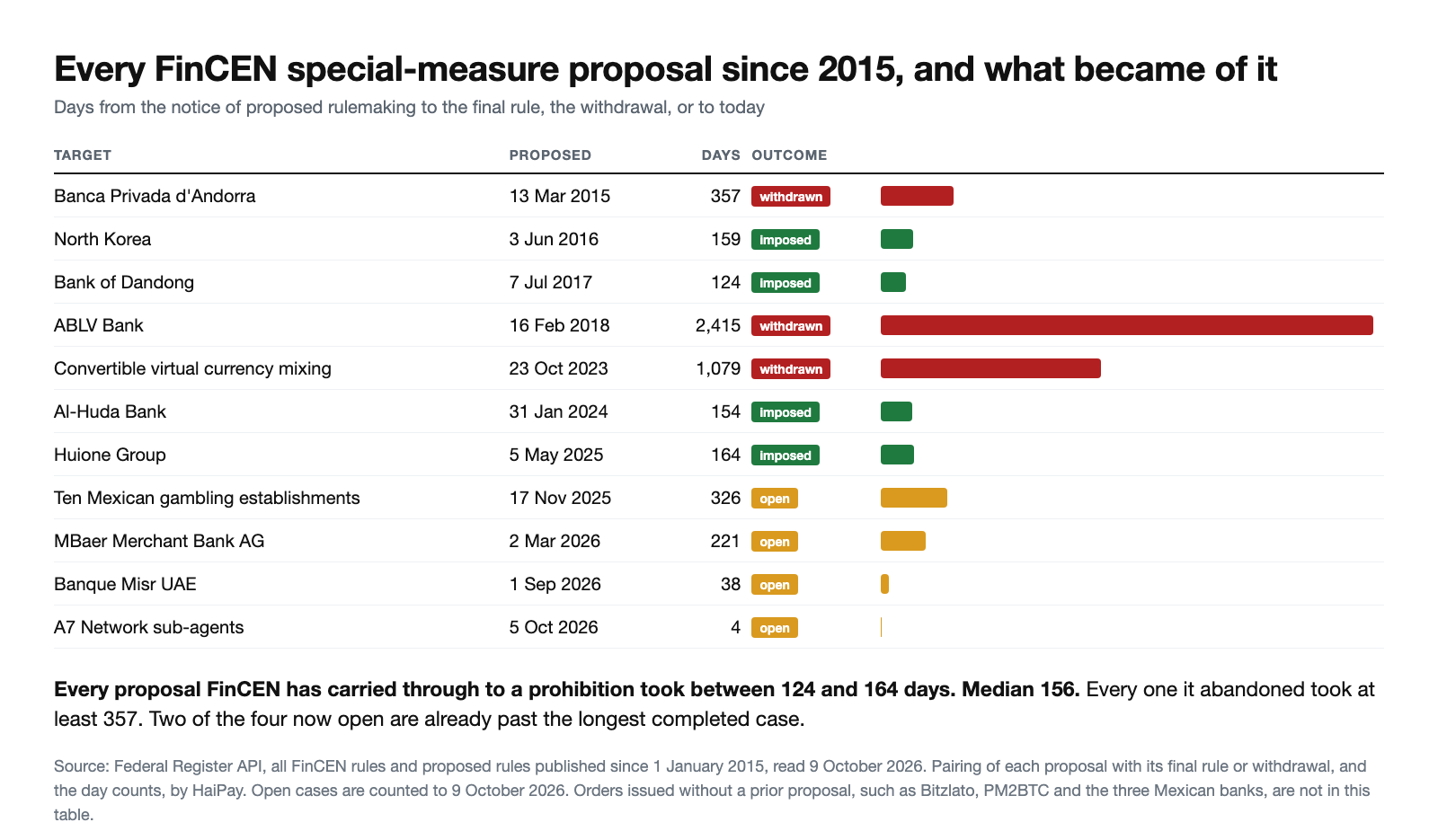
Set against the record, the pattern is sharper than any of the three announcements. HaiPay paired every FinCEN special-measure proposal since 2015 with whatever happened to it. The ones that became prohibitions took between 124 and 164 days. The ones that were abandoned took at least 357.
The record
Eleven proposals, each naming a bank, a jurisdiction, a group of businesses or a class of transactions.
Four were carried through. North Korea took 159 days from proposal to final rule, Bank of Dandong 124, Al-Huda Bank 154, Huione Group 164. The median is 156 days, and the whole range fits inside six weeks.
Three were withdrawn. Banca Privada d'Andorra after 357 days, convertible virtual currency mixing after 1,079, and ABLV Bank after 2,415 days, which is six years and seven months.
Four are open today. The proposal on ten Mexican gambling establishments has been pending for 326 days, MBaer Merchant Bank for 221, Banque Misr UAE for 38, and the A7 Network sub-agents for four.
Two of those four are already older than every case FinCEN has ever finished.
What that means if you are the one named
A special-measure proposal is not an order. Nothing is prohibited while it is pending, and a bank reading the Federal Register learns only that a named counterparty has been found to be a primary money laundering concern.
In practice the finding does the work. The clearest case is ABLV. FinCEN published its finding on 16 February 2018; one week later the European Central Bank declared the bank failing or likely to fail, citing the run on deposits and the loss of dollar funding that followed the notice, and its licence was withdrawn that July. The proposed prohibition was never imposed. It was withdrawn six and a half years later, on the ground that ABLV was no longer of primary money laundering concern. Correspondent banks act on the finding, not on the final rule, which is why the gap between the two matters.
This is also the part of the pipeline nobody is required to report on. There is no statutory clock between a FinCEN finding and a final rule, and the agency publishes no queue.
The week itself
The new proposal is not made under section 311 of the USA PATRIOT Act, the authority behind most of the list. It uses section 9714(a) of the Combating Russian Money Laundering Act, the Russia-specific power added in 2021.
The target is defined by control rather than by name: any company operating outside the United States that is controlled by the A7 Network. OFAC sanctioned the network itself on 1 October under the transnational criminal organisation authority. The proposed measure would prohibit covered financial institutions from transmitting funds to or from the sub-agents.
The comment period is 30 days, closing 4 November. That is now the house length. The four proposals from 2015 to 2018 each ran 60 days, and the convertible virtual currency mixing proposal ran 91. Every proposal since January 2024, six of them, has run 30.
Going the other way, the two withdrawals were the only crypto-wide items in the pipeline. The 2023 finding on convertible virtual currency mixing is gone, and so is the December 2020 proposal that would have made banks and money services businesses report, record and verify identities for transactions involving unhosted wallets. On that one FinCEN says it will take no further action.
The shape of the shift
Read together, the week moves the tool from categories to names. A rule about mixing services or unhosted wallets applies to a technique. A prohibition on the sub-agents of one network applies to a counterparty list, and it reaches whoever is on it.
For a payments business the practical difference is where the compliance burden lands. A category rule is a build: new reporting, new record retention, new identity checks across a product. A named-target prohibition is a screening problem: the same sanctions and watchlist plumbing, pointed at one more entity, with the hard part being the sub-agents that are not individually named.
What this is not
HaiPay counted proposals that name a target and propose a measure. Orders issued without a prior proposal are excluded, which removes Bitzlato, PM2BTC and the three Mexican institutions sanctioned in June 2025, where FinCEN went straight to an order. Including them would shorten nothing, because they had no proposal stage to measure.
The pairing of each proposal with its outcome is HaiPay's, made by matching targets across FinCEN's own Federal Register documents. Two of the eleven are judgement calls: the FBME sequence of 2015 and 2016 ran through a reopened comment period and two final rules, and is not counted as a single proposal-to-rule pair, and the 2016 withdrawals covering Liberty Reserve and JSC CredexBank concern findings issued before 2015, so their proposals fall outside the window.
Days to outcome are not a measure of difficulty, and a withdrawal is not a mistake. The ABLV withdrawal records that the bank had lost its licence and entered supervised liquidation.
The claim that the A7A5 rouble-backed stablecoin passed $100 billion in transactions appears in the proposal as a citation to a blockchain analytics firm, not as a FinCEN measurement, and HaiPay has not verified it.
HaiPay did not contact FinCEN, OFAC or any named institution.
What to watch
Whether the Mexican gambling proposal, at 326 days, gets a final rule or a withdrawal. It is the oldest live case and the one that will tell you which group the current pipeline belongs to.
Whether the A7 prohibition lands inside the 124 to 164 day band. If it does, it would be finalised in late February or early March.
And whether anything replaces the two crypto rules. The withdrawals leave the technique-level gap open, and FinCEN said nothing about filling it.
How to cite
HaiPay News, "FinCEN Finishes a Case in 156 Days, or It Does Not Finish", https://www.haipay.net/news/fincen-special-measures-156-days-or-never, October 9th, 2026
About the author
Crystal
Digital Public Relations
A digital PR specialist with a Master's in Journalism & Communication from UNSW. Started as an intern at ABC Australia, now leads public relations at Haipay, crafting press releases and media strategies that bring brand stories to life.
Reviewed by WeiJun TangEditorial policy
5 sources
- Financial Crimes Enforcement Network
Proposal of Special Measure Prohibiting the Transmittal of Funds Regarding Transactions Involving the A7 Network's Sub-Agents, 91 FR 63208
- Financial Crimes Enforcement Network
Proposal of Special Measure Against ABLV Bank, AS; Withdrawal, 89 FR 79184
- Financial Crimes Enforcement Network
Requirements for Certain Transactions Involving Convertible Virtual Currency or Digital Assets; Withdrawal, 91 FR 63514
- Financial Crimes Enforcement Network
Proposal of Special Measure Regarding Convertible Virtual Currency Mixing; Withdrawal, 91 FR 63513